Preeminent means standing above all others in a particular field, so it names the single most respected person or institution in a group. To use preeminent in a sentence, name the field with in or among, as in “She became the preeminent scholar of ancient glass.” The adjective is formal and usually follows the.
Preeminent at a glance
- Preeminent is an adjective meaning highest in rank, reputation or achievement within a stated group.
- It commonly appears as the foremost authority on a subject, though foremost stresses position rather than fame.
- Frequent collocations are preeminent scholar, preeminent institution and preeminent position.
- The noun is preeminence and the adverb is preeminently.
- Both preeminent and pre-eminent appear; the unhyphenated form is standard in American usage.
- The commonest error is using preeminent when dominant, or merely respected, is the better word.
What does preeminent mean?
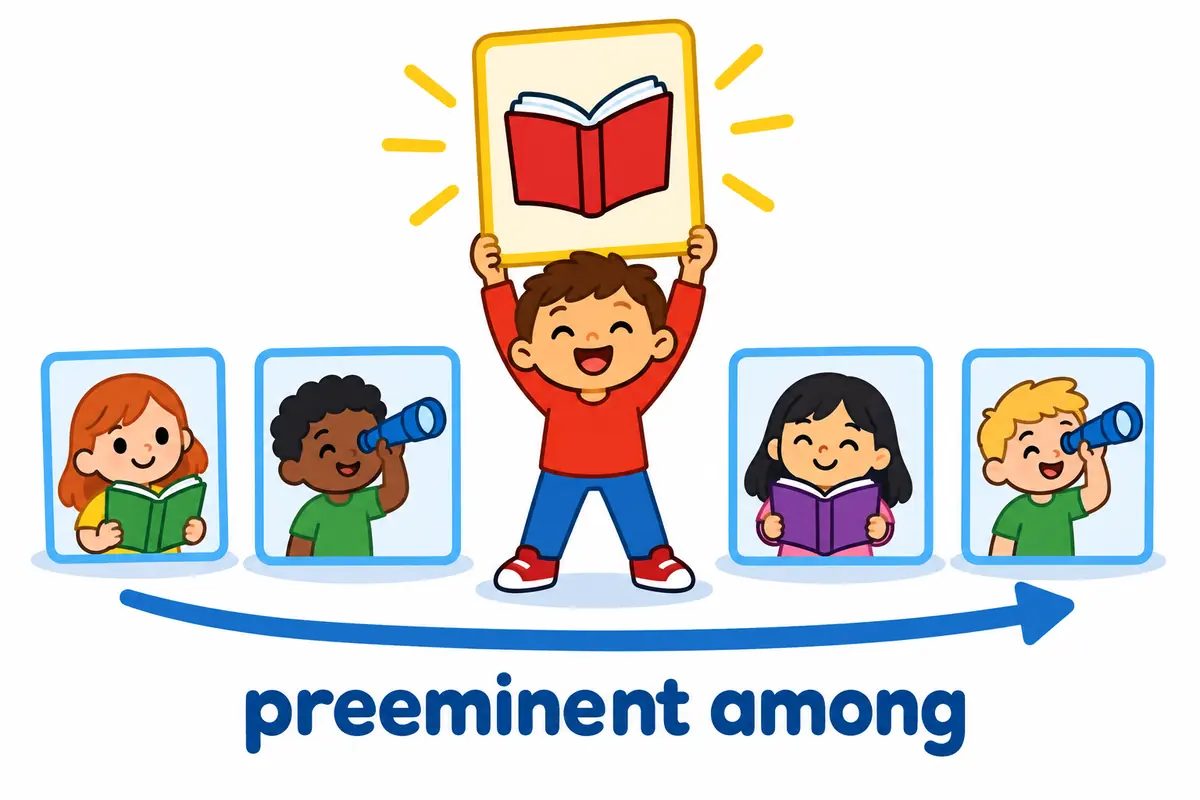
Preeminent is an adjective meaning highest in rank, reputation or achievement among a stated group. It is a ranking word, so it needs a group to rank within: a scholar is preeminent among historians, not preeminent in general. A ranking word is only as precise as the group it names, so vague praise such as a preeminent event says very little. The Cambridge entry for preeminent records the sense of being more important or famous than others.
| Sense | Plain meaning | Example sentence |
|---|---|---|
| Highest in rank | More important than every other in a group | The preeminent port on the coast. |
| Leading in a field | The most respected specialist in a subject | A preeminent authority on glaciers. |
| Outstanding | Clearly better than rivals at something | Her preeminent skill at negotiation. |
One limitation is worth stating plainly. Preeminent does not mean the largest or the richest, and it does not mean flawless. A preeminent critic can still be wrong, and a preeminent firm can still lose a contract; the word ranks reputation, not results, and where a plain word such as leading will do, preeminent can sound inflated. The word also implies that the ranking is widely accepted, so a contested claim to preeminence usually needs evidence rather than assertion.
How do you use preeminent in a sentence?
Use preeminent before a noun, often with the, or after a linking verb when the field is stated separately. The word pairs with in for a field and among for a group of people or things, and it rarely needs more or most, because it already means above all. The postpositive pattern, as in a scientist preeminent in her field, is common in academic prose but rare in speech, where the adjective almost always comes before the noun.
| Pattern | Example | What it signals |
|---|---|---|
| the + preeminent + noun | the preeminent voice on the topic | Signals a unique top position, usually with the. |
| preeminent in + field | preeminent in marine biology | Names the field the ranking applies to. |
| preeminent among + group | preeminent among modern poets | Compares within a stated set of rivals. |
| become + preeminent | The firm became preeminent within a decade. | Links the quality to a subject over time. |
| noun + preeminent in + field | a scholar preeminent in her field | Postpositive, common in formal prose. |
Preeminent in a sentence: examples across contexts
Preeminent changes subject more than it changes shape. The ten sentences below move from a scholarly review to a family kitchen, and each one names the group being ranked.
| Context | Example sentence | Why this works |
|---|---|---|
| Academic writing | She is now the preeminent historian of medieval trade. | Ranks a scholar within a named field. |
| News report | The city remains the preeminent financial centre in the region. | States a top position relative to rivals. |
| Company memo | Our goal is to become the preeminent supplier of laboratory glass. | Sets an ambition against competitors. |
| Sports writing | The club was preeminent in the league for a decade. | Places a team above all others over time. |
| Cultural criticism | His early films made him preeminent among documentary makers. | Uses among to name the group. |
| Legal or policy writing | The court treated a fair hearing as preeminent among procedural rules. | Uses the word for a highest-ranking principle. |
| Science writing | The laboratory became preeminent in its field after the discovery. | Links the ranking to a defined subject. |
| Book review | The biography confirms her preeminent place in the genre. | Preeminent before place is a fixed collocation. |
| Historical writing | Venice was preeminent in Mediterranean trade for two centuries. | Historical ranking over a stated period. |
| University prospectus | The department is preeminent in the study of climate records. | Announces a ranking to prospective students. |
| Award citation | She received the prize for preeminent service to the field. | Uses the adjective in a formal tribute. |
| Diplomatic writing | The treaty confirmed the port’s preeminent standing in the region. | Places preeminent before standing in formal prose. |
| Conversation | Everyone agreed she was the preeminent cook in the family. | Used lightly but still ranks one person above the rest. |
One detail separates strong from weak use: a strong sentence names the field or the group, while a weak one leaves the comparison hanging. Saying a venue is preeminent tells a reader nothing until the sentence says preeminent among what. A renowned studio is widely known, but only a preeminent one is ranked above all its rivals.
Preeminent vs paramount
Preeminent and paramount both describe something at the top, so writers reach for whichever sounds grander. Preeminent ranks people, institutions and works against rivals; paramount ranks duties, concerns and principles by importance, with no rivals in view.
| Attribute | preeminent | paramount |
|---|---|---|
| Core meaning | Highest in reputation or rank among others | Supreme in importance, often of a duty |
| What it ranks | People, institutions and works | Abstract priorities and obligations |
| Built-in comparison | Yes, against rivals | No, absolute in importance |
| Typical noun | preeminent scholar, preeminent institution | paramount importance, paramount concern |
| Register | Formal and evaluative | Formal, common in policy and law |
Verdict: choose preeminent to rank a person or body above named rivals, and choose paramount to say that a duty or concern matters more than everything else. A supreme authority holds the highest power, while a preeminent one holds the highest reputation. The two also differ in effect: preeminent flatters a person or body, while paramount raises the stakes of a decision.
Word forms and grammar of preeminent
The adjective has a hyphenated variant and a noun that drops the ending. The table also lists a weaker cousin that learners substitute by mistake.
| Form | Part of speech | Example |
|---|---|---|
| preeminent | adjective | a preeminent surgeon |
| pre-eminent | adjective, hyphenated variant | a pre-eminent historian |
| preeminently | adverb | preeminently qualified |
| preeminence | noun | the preeminence of the city |
| prominent | adjective, weaker | a prominent architect, not necessarily the top |
The noun preeminence is worth learning because it lets a sentence rank a whole field, as in the preeminence of the school in mathematics, without naming a single rival. Spelling causes trouble too: the adjective takes a hyphen only in the British variant, and the noun never takes one.
Common mistakes with preeminent
- Incorrect:
He is the preeminent doctor of all time.Correct: He is a preeminent doctor of his generation. Rule: Preeminent ranks within a stated group, and all time is too broad to rank. - Incorrect:
The preeminent is clear.Correct: Her preeminence is clear. Rule: Preeminent is an adjective; the abstract noun is preeminence. - Incorrect:
She is preeminent for her research.Correct: She is preeminent in her research field. Rule: Use in for a field and among for a group, never for. - Incorrect:
The plan is preeminent to us.Correct: The plan is paramount to us. Rule: Paramount means most important; preeminent ranks people and things. - Incorrect:
He is more preeminent than anyone.Correct: He is the preeminent figure in the field. Rule: The word already means above all, so more and most are redundant. - Incorrect:
She is the preeminent manager of the building.Correct: She is the building manager. Rule: Preeminent ranks reputation among rivals; it is not a substitute for senior or head of.
Practice using preeminent
Try all six items, then check the reasoning as well as the answer.
- Fill the gap: For fifty years the studio was ____ in animation.
- Choose the better word: Safety is (preeminent / paramount) during the trial.
- Correct the error: She is the preeminent of the three violinists.
- Build a sentence: use preeminent among about a scientist respected by other scientists.
- Spot the register: which belongs in a review — the preeminent scholar of her generation, or the really famous professor?
- Rewrite with the noun: The city is preeminent in rail engineering. Use preeminence instead.
- Fix the comparison: The cafe is preeminent, so we always eat there.
Answers
- preeminent — it ranks the studio against rivals in a named field.
- paramount — safety is a concern judged by importance, not by rivals.
- She is preeminent among the three violinists — the adjective needs among, not of.
- Model answer: The chemist became preeminent among her peers after the discovery.
- The preeminent scholar of her generation — a review keeps the formal ranking word.
- The city holds preeminence in rail engineering — the noun carries the ranking.
- The cafe is preeminent among the town’s diners — the sentence needs the group it ranks within.
The bottom line
Use preeminent in a sentence when one person, institution or work stands above all rivals within a stated field, and always name the group with in or among. The two nuances that decide most sentences are these: the word ranks reputation rather than size or wealth, and it already means above all, so more and most are redundant. Where a plain word such as leading will do, preeminent can sound inflated.
Frequently asked questions about preeminent
Is preeminent one word or hyphenated?
Both forms are correct. Preeminent is standard in American English, while British writing often uses the hyphenated pre-eminent. Choose one and stay consistent within a document. The meaning does not change, and the noun is always spelled preeminence, without a hyphen, whichever adjective form you use.
What is the difference between preeminent and eminent?
Eminent means respected and distinguished, which many experts can be. Preeminent means the single most respected figure in a stated group, so only one person or body holds the rank at a time. A preeminent chemist is also eminent, but an eminent one need not be the top.
What noun comes from preeminent?
The noun is preeminence, meaning the state of being highest in rank or reputation. It often appears in phrases such as the preeminence of the city in finance. The adverb is preeminently, as in preeminently qualified. Neither form takes a hyphen in the noun spelling.
Does preeminent need the word the?
It usually does when a single top figure is meant, as in the preeminent authority on the subject. Without the, the phrase can sound like a general description rather than a ranking. The article signals that only one holder of the position exists, which is what the word implies.