
Flaccid means soft and not firm, or lacking force and energy. To use flaccid in a sentence, decide whether you are describing a body or an effort: “The plant collapsed into a flaccid stem.” The word carries a critical tone, so it rarely praises.
Flaccid at a glance
- Flaccid is an adjective; its forms include flaccider or more flaccid, and the noun flaccidity.
- One sense is physical: soft, limp and without firmness, as of tissue or a stem.
- The second sense is figurative: lacking force or effectiveness, as of an argument or an economy.
- The register runs from neutral in medical writing to sharply critical in reviews and editorials.
- The commonest error is confusing flaccid with placid, which means calm and peaceful.
What does flaccid mean?
Flaccid is an adjective meaning soft and without firmness, or weak and lacking force. The Cambridge entry for flaccid records both the physical sense of hanging loose and the figurative sense of being without energy or effectiveness. A watered seedling goes flaccid in the stem, and a proposal with no evidence reads as flaccid in its argument. Both keep the core idea of something that has lost the tension holding it together.
| Sense | Plain meaning | Example sentence |
|---|---|---|
| Physical softness | Soft, limp, without firmness | The flaccid leaves lay flat against the soil. |
| Lack of force | Weak or ineffective | It was a flaccid reply that answered nothing. |
| Clinical description | Neutral term for low muscle tone | The notes describe reduced tone in the flaccid limb. |
One limitation is worth stating plainly. Flaccid is not a synonym for calm, gentle or relaxed. A calm surface is still firm, and a gentle voice is still strong; flaccid always signals a loss of firmness or force. In medical writing the word is neutral and descriptive, but everywhere else it is an evaluation, so writers should use it only when they mean to criticise.
How do you use flaccid in a sentence?
Flaccid is an adjective, so it fills an adjective slot rather than carrying an object. The frames below show where it sits and which nouns it naturally describes.
| Pattern | Example | What it signals |
|---|---|---|
| flaccid + body noun | The flaccid stem bent to the floor. | Physical softness in a plant or tissue. |
| flaccid + abstract noun | The flaccid argument persuaded no one. | Figurative weakness in an effort or idea. |
| linking verb + flaccid | The fabric became flaccid in the rain. | The adjective follows became, grew or felt. |
| more or most flaccid | Of the three drafts, this is the most flaccid. | Comparison, since the adjective is gradable. |
| noun + that is flaccid | A team that is flaccid in defence loses hope. | A relative clause softens the judgment. |
The place a learner slips is the noun slot. Flaccid is never a noun, so the flaccid of the defence is wrong; use the noun flaccidity or rewrite as a flaccid defence. For a milder physical image, a drooping branch avoids the critical edge that flaccid carries.
Two collocations mark a native ear. Flaccid tissue and flaccid muscle belong to clinical and technical writing, while a flaccid argument, a flaccid response and a flaccid economy belong to commentary. Mixing the two registers, as in a flaccid elbow inside a garden review, sounds like a category error even though the grammar is correct.
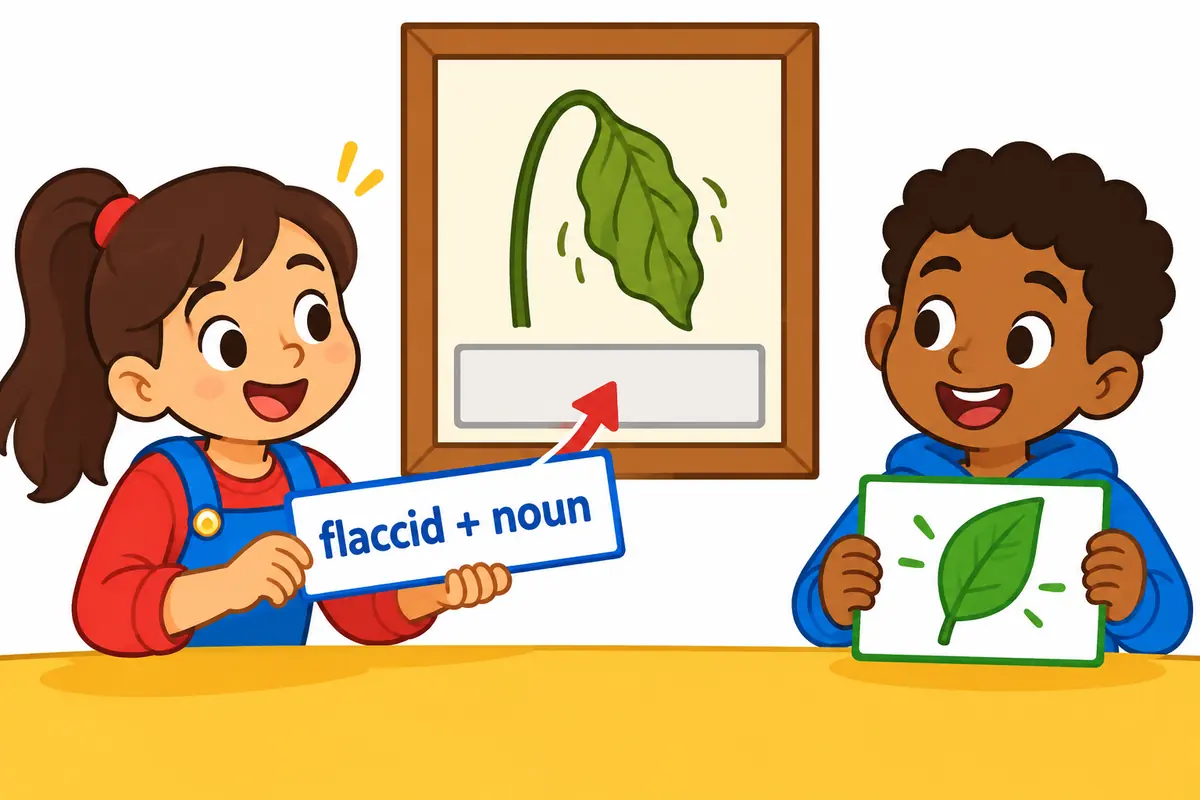
Flaccid in a sentence: examples across contexts
Flaccid moves between the garden and the boardroom, and the context decides whether it reads as a clinical note or a harsh verdict. Each sentence below names what has lost its firmness.
| Context | Example sentence | Why this works |
|---|---|---|
| Gardening | The transplanted seedlings turned flaccid by noon. | A physical, neutral use of the softness sense. |
| Clinical writing | The assessment recorded flaccid muscles on one side. | A technical register where the word stays descriptive. |
| Workplace review | The launch plan was flaccid, with no owner for any task. | The abstract sense turns the word into a judgement. |
| News report | Critics called the response flaccid and far too slow. | A quoted evaluation matches the reporting voice. |
| Editorial writing | A flaccid economy cannot create the jobs it promises. | Pairs the word with an abstract system. |
| Literary criticism | The middle chapters grow flaccid and lose their tension. | Applies the idea of lost force to prose. |
| Sports writing | A flaccid second half let the lead slip away. | Describes performance as a loss of energy. |
| Conversation | My grip felt flaccid after the long climb. | One of the few everyday uses, tied to the body. |
| Product review | The umbrella turned flaccid the moment the wind picked up. | Applies the softness sense to an object in everyday prose. |
The figurative rows are the ones a careful writer checks twice, because flaccid there is an opinion and needs evidence in the same sentence to earn its force.
Flaccid vs limp, slack and lax
Four adjectives describe a loss of firmness or tightness, and each points at a different cause. Flaccid names softness without tension; a limp handshake names the same softness in everyday speech; slack rope names a lack of tightness, and by extension carelessness; and lax rules names a lack of strictness.
| Attribute | flaccid | limp | slack | lax |
|---|---|---|---|---|
| Core sense | Soft, without firmness | Hanging loosely | Not tight or not busy | Not strict or severe |
| Typical noun | Tissue, argument, economy | Hand, leaf, body | Rope, line, period | Rules, standards, attention |
| Register | Formal, often critical | Everyday | Neutral | Formal |
| Can be positive? | No | Rarely | Sometimes, as in a slack day | No |
| Typical object | A thing or an effort | A body part | A rope or a schedule | A rule or a guard |
Verdict: choose flaccid for a formal judgment of softness or weakness, limp for the plain physical picture, slack for anything untight, and lax for standards that are not enforced. A lookalike to keep apart is a placid expression, which means calm and shares nothing with weakness.
Word forms and grammar of flaccid
Flaccid is a gradable adjective, so it takes more and most or the endings er and est. Its nouns are rarer, and one of them belongs more to technical writing than to everyday prose.
| Form | Part of speech | Example |
|---|---|---|
| flaccid | adjective | The flaccid rope offered no resistance. |
| more flaccid | comparative adjective | The second draft was more flaccid than the first. |
| most flaccid | superlative adjective | It was the most flaccid excuse of the year. |
| flaccidity | noun | Flaccidity in the soil explained the wilted rows. |
| flaccidness | noun, rare | Flaccidness is best kept out of formal writing. |
| flaccidly | adverb, rare | He answered flaccidly and lost the room. |
The related adjective an enervated team also describes a loss of energy, but it comes from a verb and stresses tiredness, while flaccid stresses the absence of firmness itself.
Common mistakes with flaccid
- Incorrect:
She kept a flaccid smile during the argument.Correct: She kept a placid smile during the argument. Rule: A calm expression is placid; flaccid means weak or soft, so it is an insult here. - Incorrect:
The flaccid of the defence cost them the game.Correct: The flaccidity of the defence cost them the game. Rule: Flaccid is an adjective, so a noun slot needs flaccidity. - Incorrect:
The proposal was flaccidly written.Correct: The proposal was flaccid or badly written. Rule: The adverb flaccidly is rare and sounds awkward; keep the adjective. - Incorrect:
His handshake was flaccid and friendly.Correct: His handshake was limp and friendly. Rule: Limp is the everyday physical word; flaccid would sound like criticism. - Incorrect:
The rules were flaccid.Correct: The rules were lax. Rule: Standards that are not enforced are lax; flaccid describes softness or weakness.
Practice using flaccid
Work through the six items, watching the tone as well as the meaning.
- Fill the gap: Without water for a week, the stems became ______.
- Choose the better word: The referee let every foul pass, so the match was (flaccid / lax / limp) in its discipline.
- Correct the error: The flaccid of the argument was obvious.
- Build a sentence: use a flaccid argument about a weak excuse.
- Spot the register: which belongs in a clinical note: the muscles were flaccid on one side, or the muscles were a total flop?
- Rewrite to soften the tone: The speech was flaccid. Use the speech lacked force.
- Explain the tone: why can the same word sound neutral in a medical note and harsh in a review?
Answers
- flaccid, because the physical sense describes stems that have lost firmness.
- lax, because the problem is discipline that was not enforced, which is the lax sense.
- The flaccidity of the argument was obvious, because a noun slot needs the noun form.
- Model answer: He offered a flaccid argument that answered none of the questions.
- The muscles were flaccid on one side, because a clinical note is neutral and precise.
- The speech lacked force, because the plain phrase states the weakness without the critical label.
- Because clinical writing uses flaccid as a plain description of tone, while other registers read it as a judgment, so context, not the word, sets the tone.
The bottom line
Use flaccid in a sentence when something has lost its firmness or its force, whether a stem, a muscle, an argument or an economy. The two nuances that decide most sentences are these: the word is an adjective, so a noun slot needs flaccidity, and it is critical outside clinical writing, so it should not replace calm words such as placid. When you only mean soft and everyday, limp is the gentler choice.

Frequently asked questions about flaccid
Is flaccid a medical word?
Flaccid appears in medical writing as a neutral description of tissue or muscle tone that has lost firmness. Outside that setting the same word becomes a judgement, describing an argument, an economy or a performance as weak. The meaning does not change, but the tone depends entirely on the context and the reader.
What is the noun form of flaccid?
The usual noun is flaccidity, as in the flaccidity of the wilted rows. A second form, flaccidness, exists but is rare and best avoided in formal writing. Because flaccid is an adjective, a sentence that needs a noun must switch to flaccidity rather than use flaccid on its own.
What is the difference between flaccid and placid?
Flaccid means soft, weak or without firmness, and it is usually critical. Placid means calm and peaceful, and it is usually neutral or warm. The two words look similar but share no meaning, so a placid lake is smooth and still, while a flaccid one would be a strange and unflattering description.
Can flaccid describe a person?
It can describe a part of a person, such as a hand or a muscle, and it can describe a person’s effort or performance indirectly. Applied to a whole person as a label, the word is harsh and sweeping, so careful writers attach it to the work rather than to the individual and name the evidence.