Go forward is a phrase meaning to move ahead or to proceed with something. To use go forward in a sentence, add with before a plan or to before the next stage: “The board agreed to go forward with the merger.” The phrase is intransitive, so it never takes a direct object.
Go forward at a glance
- Go forward is an intransitive verb phrase; its forms are goes forward, went forward and going forward.
- It means move ahead, proceed with a plan, or advance to the next stage.
- It links to a plan with with, to a stage with to, and to a role with for.
- The time phrase going forward means from now on and is common in business writing.
- The commonest errors are dropping the preposition and writing goforward as one word.
What does go forward mean?
Go forward is a phrase meaning to move ahead, to proceed with something, or to pass to the next stage. The Cambridge entry for go forward records the senses of advancing and of proceeding, and the two are easy to tell apart from context. When the subject is a line, a crowd or a vehicle the meaning is physical; when the subject is a plan, a motion or a team the meaning is figurative and administrative. Where you simply mean to keep doing something, continue is the plainer word, and proceed is the formal one.
| Sense | Plain meaning | Example sentence |
|---|---|---|
| Move ahead physically | Move in a forward direction | The queue went forward one slow step at a time. |
| Proceed with a plan | Continue with an agreed action | The council voted to go forward with the roadworks. |
| Advance to the next stage | Pass to the next round or level | The young team went forward to the final. |
| Be submitted for decision | Be put to a body unchanged | The motion went forward to the committee. |
| From now on | Starting at this point in time | Going forward, we will meet on the first Monday. |
The phrase is fixed in the sense that the verb changes but the particle forward never does: you write went forward, not went forwards in most ordinary prose, and the two words cannot be separated.
How do you use go forward in a sentence?
Go forward never takes a direct object, so a preposition carries the plan, the stage or the role that follows. The table shows the patterns that cover ordinary use.
| Pattern | Example | What it signals |
|---|---|---|
| go forward + with + noun | We will go forward with the plan. | proceed with a named plan |
| go forward + to + stage | They went forward to the next round. | advance to the next stage |
| go forward + for + role | She went forward for the post. | put oneself up for selection |
| going forward + comma + clause | Going forward, we will review costs. | a time phrase meaning from now on |
| go + forward + adverb | Go forward slowly and then stop. | a literal direction in instruction |
| no object between go and forward | Go forward the plan is wrong. | the phrase is inseparable and intransitive |
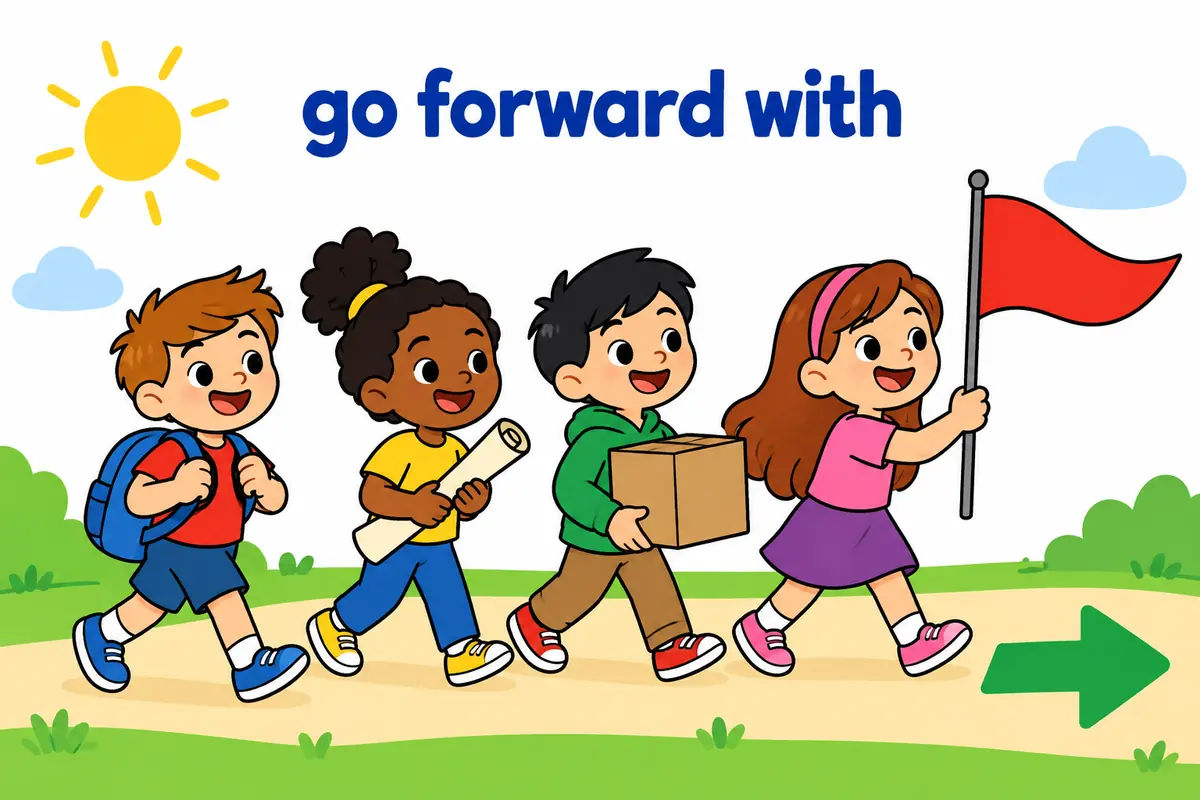
Go forward in a sentence: examples across contexts
| Context | Example sentence | Why this works |
|---|---|---|
| Classroom | The teacher told the front row to go forward and collect a worksheet. | a literal direction in a school instruction |
| Workplace email | We have approval to go forward with the new schedule. | with introduces the plan being proceeded with |
| Board minutes | The committee agreed to go forward with the revised budget. | formal register and an agreed action |
| News report | England went forward to the semi-final after a late goal. | to marks the next stage in a competition |
| Sports commentary | The winger advanced and the ball went forward down the line. | a physical sense beside the link word advance |
| Conversation | Go forward a little so I can see the sign. | the bare imperative shows the literal sense |
| Recruitment email | Please go forward for an interview at ten o’clock. | for names the role or selection step |
| Legal writing | The application went forward to the tribunal unchanged. | to shows a matter submitted for decision |
| Project update | Going forward, the team will publish notes every Friday. | the time phrase sets a new routine |
| Travel writing | The hikers went onward and forward along the ridge. | the phrase sits naturally with older journey words |
| Academic writing | The model went forward to the next round of testing. | to presents a stage in a process |
| Team stand-up | We agreed to carry on and go forward with the smaller release. | the phrase pairs with carry on in spoken planning |
Go forward vs come forward
The two phrases share the particle but not the meaning. Come forward means to volunteer information or to present oneself, while go forward means to proceed or advance; advance overlaps with the second sense, and carry on stresses continuing rather than moving to a new stage.
| Attribute | Go forward | Come forward |
|---|---|---|
| Core meaning | Proceed, advance or move ahead | Volunteer or present oneself |
| Typical subject | A plan, a team, a motion, a line | A witness, a volunteer, a source |
| Common pattern | go forward with / to | come forward with / to |
| Implied motion | Towards a goal or next stage | Out of the crowd to help |
| Register | Neutral and administrative | Neutral, often in appeals |
| Quick test | Is something being continued or advanced? | Is someone offering themselves? |
Use go forward when something proceeds or advances, and come forward when a person volunteers.
Word forms and grammar of go forward
| Form | Part of speech | Example |
|---|---|---|
| go forward | verb phrase, base | We will go forward with the plan. |
| goes forward | verb phrase, third person | The motion goes forward tonight. |
| went forward | verb phrase, past | The team went forward to the final. |
| going forward | verb phrase, participle | Going forward, we will meet monthly. |
| gone forward | verb phrase, past participle | The plan has gone forward unchanged. |
| go forwards | variant, chiefly British | The line moved forwards slowly. |
| goforward | non-standard one-word form | Always write go forward as two words. |
Common mistakes with go forward
- Incorrect: We will go forward the plan. Correct: We will go forward with the plan. Rule: the phrase is intransitive, so with introduces the plan.
- Incorrect: Going forward, we will going to meet monthly. Correct: Going forward, we will meet monthly. Rule: the time phrase needs one future form, not two.
- Incorrect: The team went forward for the final. Correct: The team went forward to the final. Rule: to marks a stage; for marks a role or attempt.
- Incorrect: The board decided to go forward to the merger. Correct: The board decided to go forward with the merger. Rule: a plan takes with, not to.
- Incorrect: We goforward next week. Correct: We go forward next week. Rule: as a verb phrase the expression is always two words.
- Incorrect: Going forward, this happened last year. Correct: This happened last year. Rule: going forward means from now on and cannot point to the past.
Is going forward good writing?
Going forward is not wrong, but as a time phrase it has become corporate filler, and careful editors often replace it with from now on or in future. The literal senses of go forward remain perfectly good in news and general writing. The table shows when to keep the phrase and when to reach for something plainer.
| Use | Verdict | Better choice |
|---|---|---|
| Board memo: Going forward, we will… | Overused filler | From now on, we will… |
| News: The team went forward to the final | Standard and clear | Keep it |
| Contract: effective going forward | Vague about the date | State the exact start date |
| Speech: we must go forward | Fine if action is meant | Keep, or say press on |
| Report: a decision went forward | Clear and formal | Keep it |
The test is simple: if the phrase points to a real direction or a real next stage, keep it; if it only means from now on, a plainer phrase nearly always reads better.
Practice using go forward
- Fill in the blank: After the vote, the committee agreed to go forward ______ the proposal.
- Choose the better word: The charity asked witnesses to ______ with information. (come forward / go forward)
- Correct the error: We decided to go forward the new timetable.
- Build a sentence: Use going forward to describe a new weekly meeting time.
- Spot the register: Which sentence suits a formal report? (a) So yeah, we’re doing the big plan now. (b) The board agreed to go forward with the plan.
- Fill in the blank: The team went forward ______ the quarter-final after a late goal.
- Correct the error: Going forward, we will going to review costs each month.
Answers
- with — a plan follows with, so the phrase stays intransitive.
- come forward — the witnesses are volunteering, not proceeding with a plan.
- We decided to go forward with the new timetable — the plan needs with before it.
- Model: Going forward, the team will meet at nine on Mondays — the time phrase means from now on.
- Sentence (b) — the formal report favours the neutral, administrative phrase.
- to — a stage in a competition follows to, giving went forward to the quarter-final.
- Going forward, we will review costs each month — drop the second future marker going to.
The bottom line
Go forward means to move ahead, to proceed with a plan, or to pass to the next stage, and it links to that plan or stage with with or to. Keep the phrase intransitive and write it as two words. The time phrase going forward means from now on and is often better replaced. A project can progress without formally going forward, and that difference is worth keeping. Used this way, go forward in a sentence is clear, natural and easy to act on.
Frequently asked questions about go forward
Is go forward one word or two?
As a verb phrase it is always two words, go forward. A single-word spelling such as goforward is not standard English. The same two-word rule applies to all its forms: goes forward, went forward, going forward and gone forward. Keep the space so readers see the verb and the particle clearly.
Can you say go forward with a decision?
Yes, and it is an everyday pattern. With introduces the thing being proceeded with, so a committee can go forward with a decision, a plan, a proposal or a project. The phrase stays intransitive, which means with is doing the work of linking the verb to its object.
What is the past tense of go forward?
The past tense is went forward, as in the team went forward to the final. The past participle is gone forward, used after have or has, as in the plan has gone forward unchanged. The present participle going forward also serves as the business time phrase meaning from now on.
Does go forward mean the same as move forward?
They are close, and both can be literal or figurative. Move forward often stresses physical motion or steady improvement, while go forward is more administrative and points to proceeding or reaching the next stage. In a competition report, went forward to the final is the usual choice over moved forward.