
Chaos is an uncountable noun meaning a state of complete disorder and confusion. To use chaos in a sentence, treat it as a force that erupts, reigns or follows an event: chaos erupted when the lights failed. Because it is uncountable, it never takes a or an.
Chaos at a glance
- Chaos is an uncountable noun, so it normally appears without a or an and has no everyday plural.
- Its family includes the adjective chaotic and the adverb chaotically.
- Usual subjects are the noun itself, as in chaos erupted, or a verb that creates it, as in cause chaos.
- Common intensifiers are total, utter, complete and absolute.
- The commonest error is writing a chaos or chaoses, which English does not allow.
What does chaos mean?
Chaos is an uncountable noun meaning a state of complete disorder and confusion. The Cambridge entry for chaos records the everyday sense and the scientific one used in chaos theory, where a system behaves unpredictably despite fixed rules. The word almost always describes a situation rather than a single object, which is why it takes no article. Where the disorder has settled into permanent confusion, disorder in the streets may be the calmer and more precise noun.
| Sense | Plain meaning | Example sentence |
|---|---|---|
| Total disorder | A state of complete confusion and upheaval | Chaos erupted when the power failed. |
| A scene of disorder | A place or event that is completely untidy | The kitchen was chaos after the party. |
| Chaos theory | A branch of science about unpredictable systems | Weather models draw on chaos theory as well as physics. |
Two limitations are worth stating plainly. Chaos is stronger than mess or confusion: it claims total breakdown, so it overstates a merely untidy room. It is also uncountable in ordinary use, so a chaos and chaoses are both wrong even though a few writers reach for them. When you need a countable noun, describe the scene instead, as in a scene of chaos. A countable frame of that kind solves the problem without changing the meaning.
How do you use chaos in a sentence?
Chaos usually enters a sentence in one of two ways: as the subject that erupts, or as the object that something creates. Five patterns cover almost every real sentence, and the passive is rare because the noun already names a state rather than an action.
| Pattern | Example | What it signals |
|---|---|---|
| chaos erupts / reigns / ensues | Chaos erupted in the hall. | The noun acts as the subject of a sudden event. |
| in chaos | The office was in chaos. | Describes an existing state of disorder. |
| cause / create chaos | The strike caused chaos on the roads. | A transitive verb names what produced it. |
| total / utter / absolute chaos | The announcement left utter chaos. | An intensifier stresses the extent. |
| a scene of chaos | Reporters described a scene of chaos. | A countable frame for an uncountable noun. |
The verbs that go with chaos are the ones that sound natural to native ears: chaos erupts, reigns, ensues or follows. Saying chaos happened is grammatical but flat, and it misses the sense of sudden upheaval. In news writing the most common frame of all is the short sentence chaos ensued, which compresses a whole sequence into two words, much as mayhem broke out does in sports reporting.
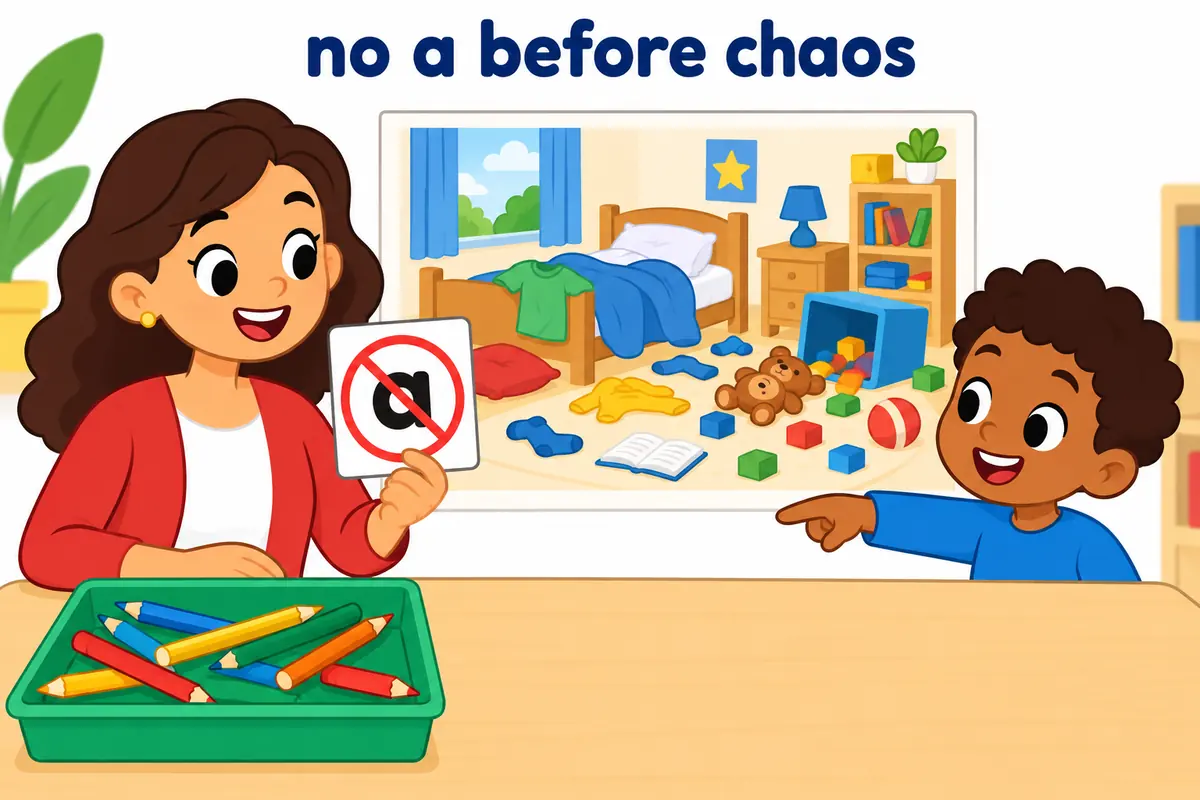
Chaos in a sentence: examples across contexts
Chaos keeps its meaning across every register, but the sentence around it changes: a classroom story needs a picture, a news report needs a cause, and a scientific paragraph needs a fixed system that behaves unpredictably. Each example below names what fell apart and what triggered it.
| Context | Example sentence | Why this works |
|---|---|---|
| Classroom | Chaos broke out when the fire alarm rang during the test. | A sudden event makes the noun concrete for children. |
| Home | The kitchen was chaos after three children baked a cake. | The state sense fits an ordinary, familiar scene. |
| News report | The cancelled trains caused chaos for commuters. | A cause verb gives the report a clear actor. |
| Sports writing | Chaos reigned in the final minutes of the match. | The short subject-and-verb frame suits fast reporting. |
| Business email | The late change of supplier left the schedule in chaos. | In chaos states the consequence without blame. |
| Weather writing | The storm turned the harbour into a scene of chaos. | A countable frame gives a large event a human scale. |
| Science writing | Chaos theory explains why small errors grow in weather models. | Names the technical sense precisely and honestly. |
| History essay | The succession left the kingdom in utter chaos. | An intensifier matches a period of real breakdown. |
| Conversation | It was absolute chaos when everyone tried to leave at once. | The intensifier carries the speaker’s exasperation. |
| Travel writing | Rumours of a strike sowed chaos at the airport. | A vivid verb links a cause to the disorder. |
| Library | A dropped trolley caused brief chaos among the quiet shelves. | A small cause in a calm setting sharpens the contrast. |
| Online class | The chat filled with chaos when the video link stopped working. | A current setting keeps the example familiar. |
Notice how many examples pair chaos with a trigger: an alarm, a storm, a cancellation, a succession. Out of context the word floats; with a cause in the sentence it lands. The calmest settings, such as a library or an online lesson, make the contrast sharpest of all.
Chaos vs chasm
Chaos is confused most often with chasm, a word it does not resemble in meaning at all. Chaos names disorder, while chasm names a deep opening in the earth or, figuratively, a wide difference between people. The two share the first three letters, which is why spellcheckers catch the mix-up only sometimes. Where a gap in understanding is meant, anarchy in the streets is not the right word either; it describes the absence of authority rather than a personal gap.
| Attribute | chaos | chasm |
|---|---|---|
| Core meaning | Complete disorder and confusion | A deep gap, literal or figurative |
| Part of speech | Uncountable noun | Countable noun |
| Typical use | Chaos erupted after the announcement. | A chasm opened beneath the path. |
| Figurative use | Chaos in the market | A chasm between the two sides |
| Spelling trap | chaos after ch | chasm after ch |
Verdict: keep chaos for disorder and chasm for a gap that divides. If you mean a breakdown of order in society, the closer synonyms are pandemonium at the station for noise and movement, and turmoil after the vote for prolonged uncertainty.
Word forms and grammar of chaos
Chaos has a full adjective and adverb, but no ordinary plural. The adjective chaotic describes the scene directly, and the adverb chaotically describes how something is done. Writers who want a countable noun often reach for mess from the party, which names the untidy result without claiming total breakdown.
| Form | Part of speech | Example |
|---|---|---|
| chaos | noun, uncountable | The room was in chaos. |
| chaotic | adjective | The chaotic schedule ruined the launch. |
| chaotically | adverb | Papers lay chaotically across the desk. |
| chaoses | noun, non-standard | Use scenes of chaos, not chaoses. |
| a chaos | noun, non-standard | Use chaos, or a scene of chaos, without an article. |
How strong is chaos?
Chaos sits near the top of a scale of disorder, and each of its neighbours claims less. The table ranks five nouns from a local untidiness to a full breakdown, with the subject each one usually takes.
| Noun | Strength | Typical subject | Example sentence |
|---|---|---|---|
| mess | Mild and local | An untidy room or task | Clear up that mess before dinner. |
| confusion | Moderate and mental | A crowd or a mind | The delay caused confusion about the gate. |
| disarray | Moderate and visible | A place or a plan | The shelves were left in disarray. |
| chaos | Severe and situational | An event or a system | Chaos erupted when the power failed. |
| pandemonium | Extreme and noisy | A hall or a crowd | Pandemonium broke out when the doors opened. |
| turmoil | Prolonged and emotional | A person or a nation | The country was in turmoil for months. |
The scale is the practical point: mess fits a bedroom, pandemonium fits a concert hall, and only chaos covers a whole system breaking down. Choosing one step lower than the feeling suggests is the surest way to keep the claim credible.
Common mistakes with chaos
- Incorrect:
The meeting ended in a chaos.Correct: The meeting ended in chaos. Rule: Chaos is uncountable and takes no article. - Incorrect:
The room was full of chaoses.Correct: The room was full of chaos. Rule: The noun has no ordinary plural. - Incorrect:
Chaos was happened after the game.Correct: Chaos followed the game. Rule: Chaos is a noun, so it cannot take a passive verb. - Incorrect:
The traffic was very chaos.Correct: The traffic was chaotic. Rule: Use the adjective chaotic after a linking verb. - Incorrect:
The chaos people ran outside.Correct: In the chaos, people ran outside. Rule: Chaos is a state, not a label for people.
Practice using chaos
Work through the six items, then check the reasoning rather than only the answer.
- Fill the gap: ______ erupted when the referee sent off two players.
- Choose the better word: The schedule was so disorganised that it was (chaos / chaotic).
- Correct the error: The office was in a total chaos.
- Build a sentence: use cause chaos about a delayed train.
- Spot the register: which belongs in a news report — Chaos ensued after the announcement, or It was totally mad?
- Rewrite with the adjective: The market fell into disorder. Use chaotic.
Answers
- Chaos — the uncountable noun is the subject of erupted.
- chaotic — the adjective follows the linking verb was.
- The office was in total chaos — no article is used with an uncountable noun.
- Model answer: One delayed train can cause chaos across the whole network.
- Chaos ensued after the announcement — a report prefers the short formal frame.
- The market became chaotic — the adjective describes the state after the verb.

The bottom line
Use chaos in a sentence to name a state of complete disorder, and let a verb such as erupt, reign or cause do the work around it. Two facts decide most sentences: the noun is uncountable, so it takes no article, and it claims total breakdown, so it overstates an untidy desk. When a prolonged crisis is meant, upheaval in the region may fit better than a single moment of chaos.
Frequently asked questions about chaos
Is chaos a countable noun?
No, chaos is uncountable in ordinary English, so it takes no article and has no everyday plural. Write the room was in chaos, not in a chaos, and the streets fell into chaos, not into chaoses. When you need a countable form, use a frame such as a scene of chaos or a state of chaos.
Which verbs go with chaos?
The natural pairings are chaos erupts, chaos reigns, chaos ensues and chaos follows. To name a cause, use cause chaos, create chaos or sow chaos. Saying chaos happened is grammatical but dull; these fixed verb partners are what make a sentence sound as though a native speaker wrote it.
What is the difference between chaos and anarchy?
Chaos means complete disorder and confusion, while anarchy means the absence of authority or government. A busy kitchen can be chaos without any politics, and a country can slip into anarchy while daily life still runs in an orderly way. Choose chaos for mess and confusion, anarchy for the breakdown of rule.
What is chaos theory?
Chaos theory is the branch of science that studies systems whose behaviour is unpredictable even though their rules are fixed, because tiny differences in starting conditions grow quickly. Weather is the classic example. In everyday writing, chaos alone means disorder; chaos theory is the technical term, and it should only appear when science is genuinely meant.