
Keep in the loop means to keep someone informed and included in what is happening. To use keep in the loop in a sentence, name the person between keep and in the loop: “Please keep me in the loop about the schedule.” The phrase is a workplace idiom, and the person it refers to must be spelled out.
Keep in the loop at a glance
- Keep in the loop is a verb phrase, and its fixed core is keep + someone + in the loop.
- It means to share updates with someone so they stay informed and involved.
- The usual subjects are managers, colleagues, clients and teammates writing about a project.
- It belongs to workplace and business writing, where it can slide into cliche if used without care.
- The commonest error is dropping the person, as in please keep in the loop, which leaves the phrase incomplete.
What does keep in the loop mean?
Keep in the loop is a phrase meaning to keep someone informed about a situation and included in its decisions. The Cambridge entry for keep in the loop and the Merriam-Webster entry both define the related idiom in the loop as being part of a group that shares information.
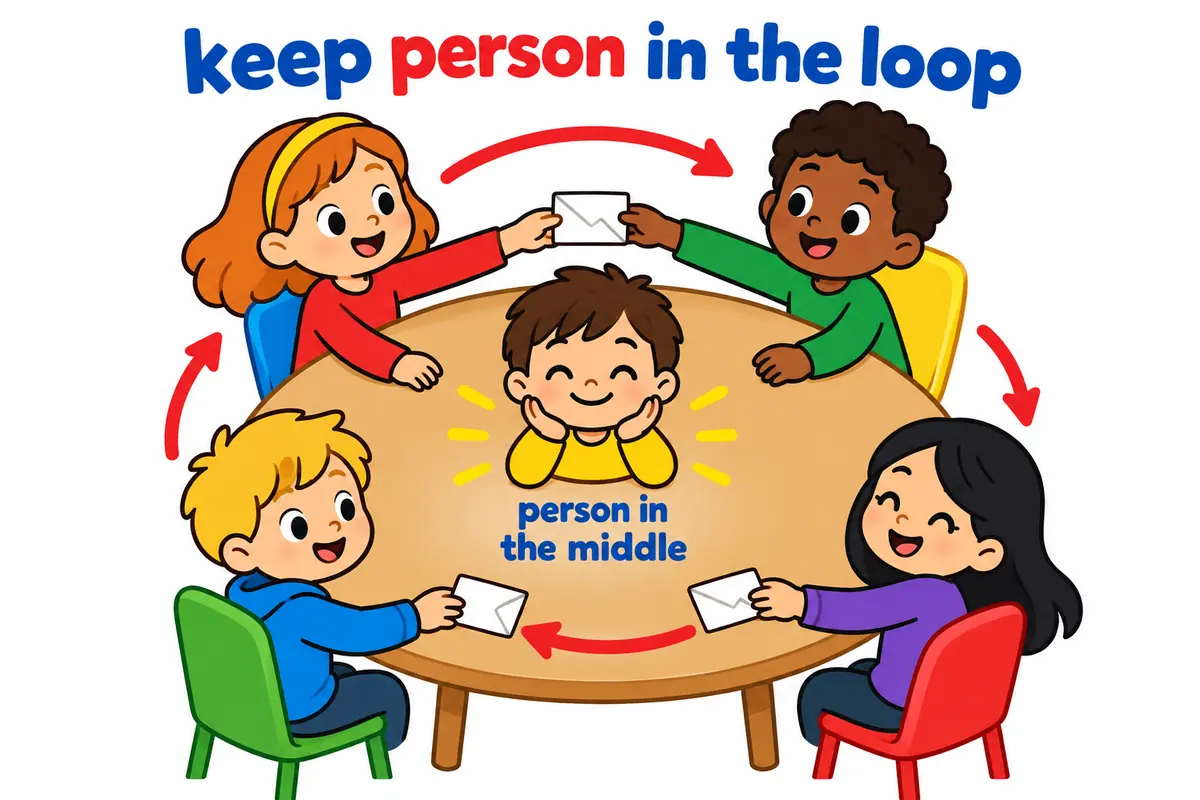
The image behind the phrase is a circle of people who all hear the same news. Someone in the loop receives updates; someone kept in the loop is deliberately included by another person. That is why the phrase needs two parts, a keeper and a kept: the manager keeps the team in the loop, and the team stays in the loop.
The phrase carries no legal or technical weight. Where a contract needs precision, writers choose a plain verb such as inform or notify, because keep in the loop describes a habit of communication rather than a single duty.
How do you use keep in the loop in a sentence?
The phrase follows a fixed shape: keep, then the person, then in the loop, then the topic introduced by about or on. The patterns below move from a direct request to a description of the opposite state, out of the loop.
| Pattern | Example | What it signals |
|---|---|---|
| keep + someone + in the loop | Please keep me in the loop about the launch. | The standard request, person named in the middle. |
| keep + someone + in the loop on + topic | She kept the board in the loop on costs. | On introduces a narrower subject than about. |
| stay in the loop | I stayed in the loop through the weekly email. | Describes the person receiving updates, not sending them. |
| bring + someone + into the loop | We brought the new designer into the loop. | A change of state, from outside to inside. |
| out of the loop | He felt out of the loop after the transfer. | The opposite state, exclusion from news. |
Notice how each pattern keeps the loop as a fixed unit. Writers may add a topic after it, but they do not change the words inside it or swap the preposition in for on or into.
Keep in the loop in a sentence: examples across contexts
Keep in the loop appears wherever a group shares news, so its company runs from a school project to a client update. The twelve sentences below keep the phrase intact and show which topic word follows it.
| Context | Example sentence | Why this works |
|---|---|---|
| Classroom | The group leader kept everyone in the loop about the science fair. | Names both keeper and topic. |
| Workplace email | Please keep me in the loop on the budget changes. | Polite, direct and correctly ordered. |
| Client update | We will keep you in the loop as the build progresses. | Reassures without promising a date. |
| Team meeting | Let us keep the night shift in the loop about the handover. | Extends the phrase to a whole group. |
| Project note | Added Priya so the finance team stays in the loop. | Uses stay for the receiving side. |
| Customer service | I will keep you in the loop once the courier replies. | About is implied by the clause. |
| News report | Residents were kept in the loop at a monthly forum. | Passive form for an official context. |
| Charity writing | Donors are kept in the loop through a short newsletter. | Names the channel as well as the people. |
| Freelance contract | The brief asks us to keep the editor in the loop weekly. | Adds a frequency for precision. |
| Technical writing | Keep the on-call engineer in the loop during the migration. | Uses a role instead of a name. |
| Conversation | Just keep me in the loop and I will help where I can. | The everyday spoken version. |
| Academic prose | Supervisors keep candidates in the loop about submission dates. | Formal subject and topic. |
Each row names the person and the topic, which is what separates a complete sentence from a fragment. The phrase also travels well between registers, though it always keeps a slightly businesslike tone.
Keep in the loop vs keep posted
Keep in the loop and keep posted mean almost the same thing, and they differ in flavour. Keep posted is shorter and sounds neutral; keep in the loop sounds collaborative and modern. Both are mild workplace cliches, so a careful writer often replaces them with update or include.
| Attribute | keep in the loop | keep posted |
|---|---|---|
| Core meaning | Keep someone informed and involved | Keep someone informed |
| Degree of involvement | Implies membership in the group | Implies only future news |
| Typical topic marker | about or on | usually none needed |
| Register | Business and collaborative | Neutral, used anywhere |
| Cliché risk | High in overused office email | Moderate |
Verdict: choose keep in the loop when someone is genuinely part of the group and keep posted when a short heads-up will do. If a plainer verb fits, prefer it, because neither phrase adds meaning that inform or brief cannot carry.
When should you not use keep in the loop?
Three settings call for something else. In a legal or formal document the phrase is too loose, so use apprise or notify. When the reader is outside the group and needs a single fact, a short sentence beats an idiom. And when the phrase appears three times in one email, it starts to look like padding, so vary it with notify or a date.
A practical test is to ask whether the person needs ongoing involvement or one update. Ongoing involvement earns keep in the loop; a single fact does not. The phrase also sits awkwardly in bad news, where a direct sentence respects the reader more than an idiom does.
Word forms and variations of keep in the loop
The expression is fixed at its core, and only a few parts may change. The table shows what stays the same, what may move, and what learners wrongly build.
| Form | Part of speech | Example |
|---|---|---|
| keep + person + in the loop | fixed core | Keep me in the loop. |
| stay in the loop | variant, receiving side | She stayed in the loop all year. |
| bring + person + into the loop | variant, change of state | They brought me into the loop. |
| in the loop | adjectival idiom | The brief kept the whole team in the loop. |
| out of the loop | opposite idiom | I was out of the loop for a week. |
| keep in the loop about | topic marker | Keep them in the loop about the date. |
| keep on the loop | preposition – non-standard | Use in the loop, not on the loop. |
Common mistakes with keep in the loop
- Incorrect:
Please keep in the loop me about the changes.Correct: Please keep me in the loop about the changes. Rule: The person sits between keep and in the loop, never after the whole phrase. - Incorrect:
Thanks for keeping in the loop.Correct: Thanks for keeping me in the loop. Rule: The phrase needs an object, so the person must be named. - Incorrect:
Keep me on the loop.Correct: Keep me in the loop. Rule: The fixed preposition is in, not on. - Incorrect:
I will keep you in the loop of the meeting.Correct: I will keep you in the loop about the meeting. Rule: Use about or on for the topic, never of. - Incorrect:
Per my last email, kindly keep me in the loop going forward.Correct: Please update me after the meeting. Rule: Stacked business idioms read as padding; a plain verb is clearer. - Incorrect:
Keep in the loop the client.Correct: Keep the client in the loop. Rule: English places the object right after the verb, not at the end.
Practice using keep in the loop
Work through the six items, then check the reason beside each answer.
- Fill the gap: Please keep me ______ the loop about the timetable.
- Choose the better word: For a contract clause, (keep in the loop / notify) the customer in writing.
- Correct the error: She kept in the loop the new intern.
- Build a sentence: use bring into the loop about a new teammate joining a project.
- Spot the register: which belongs in a formal email – We will keep you in the loop on progress, or We will keep you posted, yeah?
- Rewrite for brevity: Keep me in the loop about the decision. Use a plain verb instead.
Answers
- in – the fixed phrase is in the loop, never on the loop.
- notify – a contract needs a precise verb, not an idiom about habits.
- She kept the new intern in the loop – the object goes straight after the verb.
- Model answer: We brought the new teammate into the loop about the launch plan.
- We will keep you in the loop on progress – it keeps the formal register and drops the filler yeah.
- Please tell me the decision – tell is plainer and carries the same meaning.
The bottom line
Use keep in the loop in a sentence when you want to promise someone ongoing updates and involvement, and always put the person between keep and in the loop. The two facts that settle most sentences are that the phrase is fixed at its core, so the preposition stays in, and that it suits workplace writing better than a contract. Where a single fact is enough, inform, brief and tell are the plainer choices.

Frequently asked questions about keep in the loop
Is keep in the loop formal or informal?
It sits in the middle. The phrase is too casual for a legal contract yet too idiomatic for the most formal reports, so it fits ordinary workplace email and team chat best. In a formal document, notify, inform or apprise carries the same meaning without the conversational tone.
What is the opposite of keep in the loop?
The direct opposite is the idiom out of the loop, which describes someone who has not received the news. You can also say keep someone out of the loop, though that usually sounds deliberate and a little unfriendly, so most writers prefer the neutral phrase left out of the discussion.
Can you keep yourself in the loop?
You can keep yourself in the loop by reading updates, but the phrasing is odd because the idiom normally needs two people. Most writers say I will stay in the loop or I will follow the thread instead. Keep yourself in the loop mainly appears in guides and advice columns as a deliberate echo.
Is keep in the loop a cliche?
It has become one in workplace email, where it repeats in almost every thread. The phrase is still useful and clear, so a single use is fine. The problem starts when it appears several times in one message, where update, brief or simply tell makes the writing fresher.