Bail out means to rescue someone or something from trouble, usually by giving money or practical help. To use bail out in a sentence, decide what is being saved — a company, a person or a boat: “The investors bailed out the struggling bakery.” The phrase is a separable phrasal verb with several senses.
Bail out at a glance
- Bail out is a separable phrasal verb, so bail and out may split around the object.
- The two main senses are rescuing with money or help, and quitting a failing situation.
- Transitive uses take a company, a person or a boat; the intransitive use takes of.
- The noun form is bailout, written as one word, as in a government bailout.
- The commonest error is leaving the particle attached when the object is a pronoun.
What does bail out mean?
Bail out is a phrasal verb meaning to rescue a person, business or plan from failure, most often by supplying money. The Cambridge entry for bail out records the financial sense alongside the literal one of emptying water from a boat. The phrase travels easily between registers: it is standard in aviation and boating, informal in business reporting and finance.
| Sense | Plain meaning | Example sentence |
|---|---|---|
| Financial rescue | Give money to save a failing business | The treasury bailed out the airline before winter. |
| Help out of trouble | Rescue a person from a difficult situation | His sister bailed him out of debt. |
| Withdraw from a plan | Quit a failing deal or arrangement | Two investors bailed out of the project in May. |
| Leave an aircraft | Escape a plane with a parachute | The crew was told to bail out over the coast. |
| Empty a boat | Remove water with a bucket | They bailed out the dinghy after every wave. |
Two limitations are worth stating. Bail out is not a compliment: it implies the thing being saved could not survive alone. It also does not mean to repair. A bailed-out railway still needs new signals; the money only buys time. For a purely physical rescue, extract a passenger is the more precise verb when movement out of danger is what matters.
How do you use bail out in a sentence?
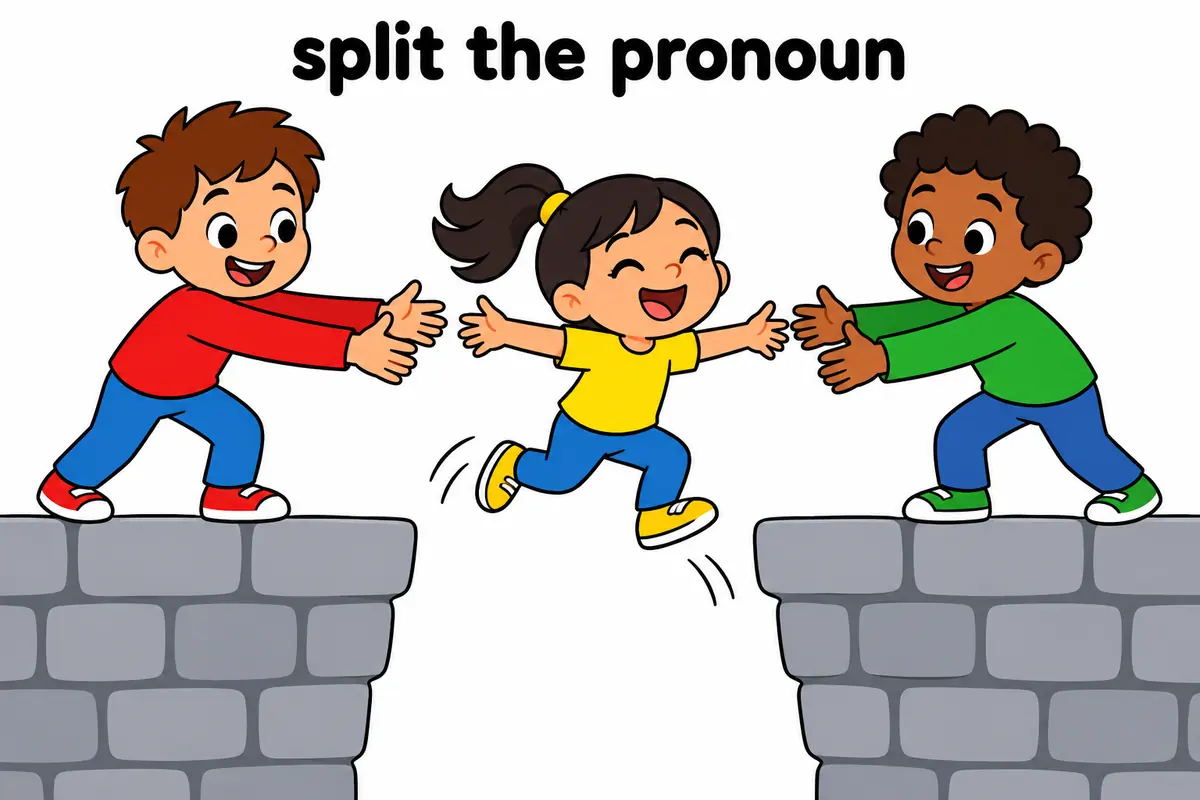
Bail out is separable, which means the object may sit either after the whole phrase or between the verb and its particle. Say the bank bailed out the firm or the bank bailed the firm out. The rule that never bends concerns pronouns: with object pronouns the particle must go last, so write bailed them out, never bailed out them.
| Pattern | Example | What it signals |
|---|---|---|
| bail out + object | The state bailed out the shipyard. | Particle stays with the verb before a noun object. |
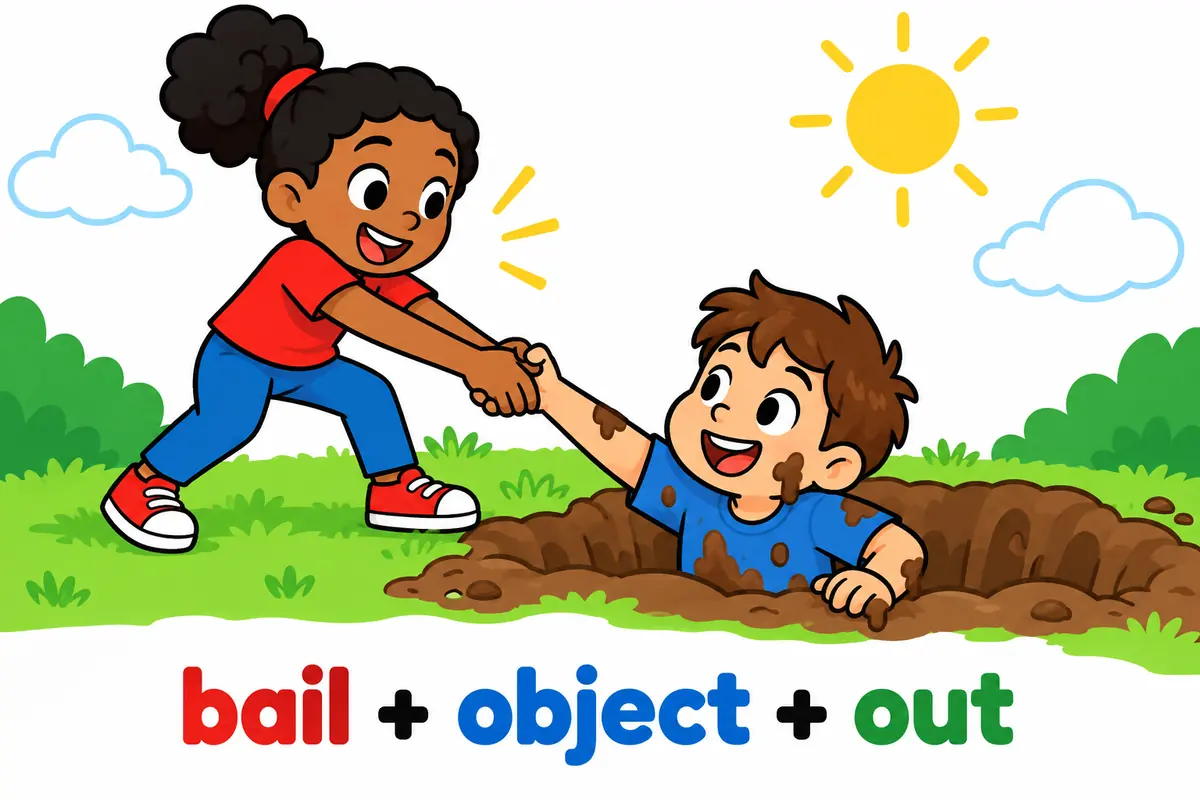
| bail + object + out | The state bailed the shipyard out. | The object splits the phrase; the commoner spoken order. |
| bail + pronoun + out | The state bailed it out. | Mandatory split; bail out it is ungrammatical. |
| bail out of + noun | She bailed out of the scheme. | Intransitive: withdraw from something. |
| bail out + object, literal | The crew bailed out the lifeboat. | The water sense; also separable. |
The particle out may strand at the end of a clause in the passive, as in the airline was bailed out by the government. Two other phrasal verbs with the same particle, back out and blow out, show the opposite behaviour, so learners should test separability one phrase at a time.
Bail out in a sentence: examples across contexts
The twelve sentences below keep the same phrase and move through finance, aviation and ordinary conversation. Each row names the part of the meaning doing the work.
| Context | Example sentence | Why this works |
|---|---|---|
| News report | The government bailed out the national carrier to protect regional routes. | Names the rescuer and the public reason in one clause. |
| Finance page | Three banks were bailed out within a single week. | Passive keeps attention on the failing banks, not the payer. |
| Workplace email | Can you bail me out on the morning shift? | Pronoun forces the split and gives an everyday favour. |
| Politics | Critics argued the state should not bail out a profitable firm. | The negative form carries the debate about fairness. |
| Small business | Her uncle bailed the cafe out of its rent arrears. | Specifies the exact trouble being lifted. |
| Aviation account | The pilot ordered the crew to bail out at four thousand feet. | The literal escape sense, with a precise detail. |
| Boating | We bailed out the canoe for twenty minutes after the storm. | The water sense, clearly physical through the object. |
| Startup pitch | No investor would bail out the founders without a new plan. | Links the rescue to a condition, which is realistic. |
| Family | His parents bailed him out when the first invoice arrived. | Shows the help sense with the pronoun split. |
| Regulatory writing | The regulator refused to bail out the insurer, citing depositor risk. | Formal, agentless-friendly, with a stated reason. |
| Conversation | I am not going to bail you out again this month. | The phrase survives in speech as a firm boundary. |
| Sports commentary | A late goal bailed the manager out of another defeat. | Transfers the rescue to a sporting result. |
Bail out vs rescue, save and salvage
Bail out overlaps with three plainer verbs and is interchangeable with none of them. Rescue covers physical danger; save is the broadest; salvage means recovering what is left from a wreck.
| Attribute | bail out | rescue | save | salvage |
|---|---|---|---|---|
| Core job | Rescue from failure with money or help | Free someone from danger | Keep from harm or loss | Recover value from a wreck |
| Usual object | Company, person, boat | Person, animal | Person, life, money | Goods, reputation, remains |
| Implied trouble | Debt or collapse | Immediate physical threat | Any loss | Damage already done |
| Register | Informal to formal, common in business | Neutral and serious | Neutral, very common | Formal, technical |
| Separable | Yes | No | No | No |
Verdict: use rescue for danger to life, save for anything kept from loss, salvage for recovering what survives a wreck, and bail out when money or timely help pulls a person or business back from failure.
Word forms and grammar of bail out
The verb inflects regularly, and the noun compresses the whole event into one word. A page on the same root, spring someone from a place, carries the rescue idea without the financial overtones.
| Form | Part of speech | Example |
|---|---|---|
| bail out | phrasal verb, base form | Officials agreed to bail out the ferry operator. |
| bails out | verb, third person singular | She bails out her brother almost every term. |
| bailed out | verb, past and past participle | The bank was bailed out in a single weekend. |
| bailing out | verb, present participle | They are still bailing out the old print division. |
| bailout | noun, one word | The bailout cost more than the original loan. |
| bail-out | attributive adjective | A bail-out package was announced on Friday. |
The spelling split matters. Write the noun as one word, the verb as two, and keep the hyphen only in the attributive adjective that stands before a noun.
Common mistakes with bail out
- Incorrect:
The state bailed out it.Correct: The state bailed it out. Rule: A pronoun object must sit between verb and particle; the particle cannot follow it. - Incorrect:
The company was bailed out of the government.Correct: The company was bailed out by the government. Rule: The rescuer takes by, because it is the agent; of marks what someone withdraws from. - Incorrect:
She bailed out on the plan.Correct: She bailed out of the plan. Rule: The withdrawal sense takes of; on marks letting a person down. - Incorrect:
He bailed the horse into the barn.Correct: He bailed the hay into the barn. Rule: Bail is not bale; bale refers to bundles of hay, and the two are often confused. - Incorrect:
The rescue was a bail out.Correct: The rescue was a bailout. Rule: The noun is one word, so two-word bail out in a noun slot is a spelling error. - Incorrect:
They bailed out him from prison.Correct: They bailed him out of prison. Rule: Split the phrase around the pronoun, then add of for the place he left.
Practice using bail out
Work through the seven items, then check the reasoning rather than only the answer.
- Fill the gap: The bank agreed to ______ the small brewery ______ before the audit.
- Choose the better word: The lifeguard (bailed out / rescued) the swimmer caught in the current.
- Correct the error: The government bailed out it at the last minute.
- Build a sentence: use bail out of about a band leaving a failing tour.
- Spot the register: which fits a news report — ministers bailed out the carrier, or ministers forked out for the carrier?
- Rewrite with the noun: The state bailed out the steel plant. Use bailout instead.
- Explain the split: why is bailed them out correct but bailed out them wrong?
Answers
- out, out — the noun object can sit after out, and the second gap closes the phrase.
- rescued — the danger was physical, so rescue fits; bail out would imply money or a business.
- The government bailed it out — a pronoun object must split the verb and particle.
- Model answer: The drummer bailed out of the tour when the tickets stopped selling.
- Ministers bailed out the carrier — it keeps the standard, neutral news register.
- The steel plant received a state bailout — the noun replaces the whole verb phrase.
- Because a pronoun carries no weight of its own, it must go between verb and particle; only a full noun phrase may follow out.
The bottom line
Use bail out in a sentence when money or timely help pulls a person, business or boat back from failure, and treat it as a separable phrasal verb. The two decisions that settle most sentences are where the object sits and which sense you mean: rescue, withdrawal, parachute or water. With a pronoun the particle must come last, so write bailed them out and never the reverse. For physical danger, rescue remains clearer.
Frequently asked questions about bail out
Is bail out one word or two?
The verb is always two words, as in the state will bail out the bank. The noun is one word, as in a federal bailout. The hyphenated form bail-out is correct only as an adjective before a noun, as in a bail-out deal, so the spelling depends entirely on the job the word is doing.
What does bail out of a deal mean?
Bail out of a deal means to withdraw from it before it finishes, usually because it is failing or no longer suits you. The phrasing is intransitive: nothing is rescued, and the person simply leaves. It is common in business writing about investors, partners and contractors who pull out early.
Can you say bailed out on someone?
Yes, in informal, chiefly American English. To bail out on someone means to let them down by not turning up or not helping when you had agreed to. It differs from bail out of, which is about leaving a thing or plan. Keep bail out on for conversation rather than formal reports.
Is bail out formal or informal?
Bail out spans both. It is the standard term in aviation for leaving an aircraft and in boating for emptying water. In finance it is widely used but somewhat informal compared with rescue financing, so a regulator might prefer liquidity support. Match the phrase to your audience.