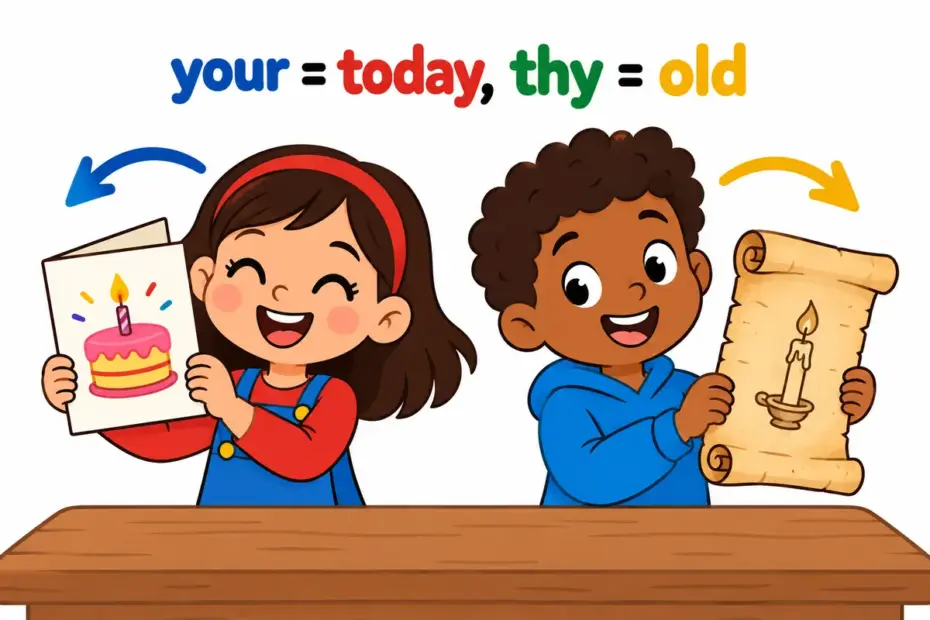
For your vs thy, use your in all modern English and keep thy for archaic, religious or deliberately old-fashioned writing. Both are second-person possessives, but your pairs with you for one person or many, while thy pairs with thou in an older grammar. The choice is about century, not formality.
Your vs thy at a glance
- Your is the modern second-person possessive; thy is its archaic singular counterpart.
- Your works with both singular and plural you; thy works only with thou.
- Thy survives chiefly in prayers, hymns, poetry and historical fiction.
- The archaic possessive is thy before a consonant and thine before a vowel or when standing alone.
- The commonest error is using thy for a plural or mixing it with you in one sentence.
Your vs thy: how the two pronouns differ
The master table below settles almost every real question. Read it by row: the two words agree on meaning but separate on number, register and the subject pronoun they follow.
| Decision | your | thy |
|---|---|---|
| People addressed | One person or many | One person only |
| Subject it pairs with | you | thou |
| Verb partner | you are | thou art |
| Number | Singular or plural | Singular only |
| Register | Every modern register | Archaic, religious and literary |
| Stand-alone form | yours | thine |
| Typical settings | Speech, email, reports, school | Bible, hymns, Shakespeare, fantasy |
| Example | Bring your coat. | Honour thy father. |
Notice that neither word is more polite than the other. Thy once marked a single close hearer, not respect, so treating it as a formal version of your is a modern misunderstanding, discussed under the common mistakes below.
What does your mean?
Your is the possessive form of you, used before a noun to show that something belongs to the person or people addressed. The Cambridge entry for your lists it simply as the possessive of you. It never changes for number, so one friend and a whole class both receive your attention. Its stand-alone partner is yours, which replaces the noun entirely, as in the red umbrella is yours.
What does thy mean?
Thy is the archaic possessive form of thou, the old singular pronoun for you. The Cambridge entry for thy marks it as old use. It appears before a noun in the same slot your occupies today, so thy word and your word fill one position in the sentence. Its stand-alone partner is thine, and its object form is thee.
One limitation is worth stating plainly. Thy is the wrong choice for a modern letter, a report or a message, where it reads as parody unless the setting is genuinely old. Even in fiction it works only when the surrounding grammar keeps thou, thee and the -st verb endings consistent, which is why most writers leave it to quotation.
How do you use your and thy in a sentence?
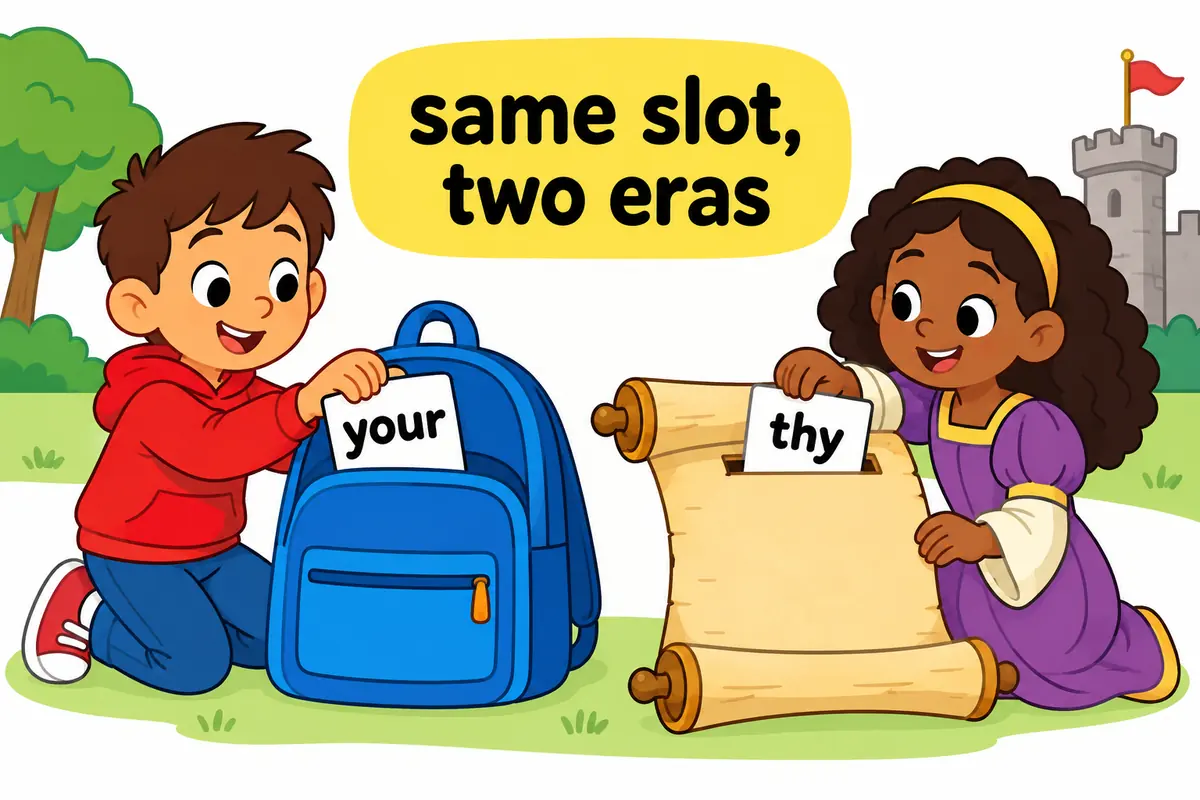
Both words sit in the same grammatical slot, directly before a noun, so the pattern is identical and only the century changes. The table pairs each modern form with its archaic twin, using the same noun in every row.
| Pattern | Example | What it signals |
|---|---|---|
| your + noun | Please bring your notebook. | Modern possessive before any noun. |
| your + noun, plural | Choose your seats quickly. | Works for several people at once. |
| yours, standing alone | The blue pencil is yours. | Possessive pronoun replacing the noun. |
| thy + noun, consonant | Honour thy father and mother. | Archaic singular before a consonant. |
| thine, vowel or alone | To thine own self be true. | Archaic form before a vowel or standing alone. |
| thou + thy together | Thou shalt keep thy word. | Old grammar keeps subject and possessive in one style. |
The test a careful writer applies is agreement: if the subject is you, the possessive must be your; if the subject is thou, it must be thy or thine. A sentence that says thou are with your friend is broken twice.
Your and thy in a sentence: examples across contexts
The ten sentences below move from a modern inbox to a hymn book. Watch how the setting, not the meaning, decides which form appears.
| Context | Example sentence | Why this works |
|---|---|---|
| Modern email | Please send your report by Friday. | Everyday workplace request with the modern form. |
| Classroom | Bring your questions to the seminar. | Addresses a whole group, which thy cannot do. |
| Product instruction | Check your password before signing in. | Direct modern instruction with singular or plural you. |
| Wedding speech | Thank you for your kindness to our family. | Formal but completely modern, so your is right. |
| Prayer | Hallowed be thy name. | The fixed religious register that keeps thy alive. |
| Hymn | Thy word is a lamp to my feet. | Quotation from a sacred text, so the archaic form stays. |
| Poetry | I keep thy letter in a drawer. | The poet chooses an old voice deliberately. |
| Historical novel | Thy brother waits at the gate, my lady. | Period dialogue keeps thy with thou nearby. |
| Joke or parody | Prepare thy wallet for the theme park. | Comic mock-archaic effect, used once and not sustained. |
| Quotation | To thine own self be true. | An established line, where thine replaces thy before a vowel. |
Which should you use?
Four everyday decisions cover nearly every case. The rule in all of them is the same: match the word to the world the sentence describes, not to how important the reader feels.
| Your situation | Use | Why |
|---|---|---|
| A school essay about modern life | your | The grammar is present-day, so the modern possessive fits. |
| An email, report or message | your | Thy would read as an error or a joke to any colleague. |
| A prayer, hymn or scripture quotation | thy and thine | The fixed religious text uses the archaic pair. |
| Fantasy or historical dialogue | thy, used consistently | It works only beside thou, thee and old verb forms. |
| A single comic line | thy, sparingly | Mock-archaic charm fades fast when it is repeated. |
If you are unsure, choose your. The archaic form is a costume, and a borrowed archaic word worn without the rest of the outfit looks worse than plain modern English.
Word forms and grammar of your and thy
Each possessive belongs to a small family of pronouns, and the two families should never be mixed. The possessive adjective and the possessive pronoun are separate jobs, which is why yours and thine stand alone.
| Form | Belongs to | Example |
|---|---|---|
| you, subject | Modern | You are early today. |
| your, possessive adjective | Modern | Your coat is on the chair. |
| yours, possessive pronoun | Modern | The coat on the chair is yours. |
| yourself, reflexive | Modern | Look after yourself this week. |
| thou, subject | Archaic | Thou art early today. |
| thy, possessive adjective | Archaic | Thy coat is on the chair. |
| thine, possessive pronoun | Archaic | The coat on the chair is thine. |
| thee, object | Archaic | I thank thee for the gift. |
| thyself, reflexive | Archaic | Look to thyself this week. |
The distribution is exact: thy before a consonant sound, thine before a vowel sound or when the noun is left out. A modern writer never needs the right-hand column except to quote or to build a period voice.
Common mistakes with your and thy
- Incorrect:
Give me thy books, all of you.Correct: Give me your books, all of you. Rule: Thy addresses one person only, so it cannot cover a group. - Incorrect:
Thy are welcome here.Correct: You are welcome here, or Thou art welcome here. Rule: Thy is a possessive, never a subject; the subject is thou or you. - Incorrect:
Honour your father and thy mother.Correct: Honour thy father and thy mother, or use your for both. Rule: Keep the archaic and modern families out of the same sentence. - Incorrect:
To thy own self be true.Correct: To thine own self be true. Rule: Use thine before a vowel sound, and thy before a consonant. - Incorrect:
Please sign thy form at the bottom.Correct: Please sign your form at the bottom. Rule: Thy is archaic and wrong in a modern instruction or form. - Incorrect:
Thy is more polite than your.Correct: Neither is more polite; thy simply marks an older singular. Rule: The pair differs by century, not by politeness.
Practice using your and thy
Work through the seven items, then check the reasoning rather than only the answer.
- Choose the better word: Children, put (your / thy) bags by the door.
- Fill the gap: Hallowed be ______ name, in the old prayer.
- Correct the error: Thy are late, my friend.
- Build a sentence: use thine before a vowel in a quotation from old poetry.
- Spot the register: which belongs in a modern report — complete your survey, or complete thy survey?
- Explain the difference: why can your address a whole class but thy cannot?
- Rewrite in modern English: To thine own self be true.
Answers
- your — the speaker addresses a group, and thy is singular only.
- thy — the fixed prayer uses thy before a consonant sound.
- You are late — thy is a possessive and cannot act as the subject of are.
- Model answer: I read thy letter and kept thine answer beside it.
- Complete your survey — a modern report never uses the archaic possessive.
- Because your is the possessive of you, which is singular and plural, while thy belongs to the singular thou.
- Be true to yourself — the modern reflexive replaces the archaic object and possessive.
The bottom line
Choose your for every modern sentence and reserve thy and thine for prayer, hymn, poetry or period dialogue. The your vs thy decision turns on number and century rather than politeness: your covers one hearer or many, while thy covers one archaic hearer. Keep each possessive inside its own family of pronouns, and never mix thou with your in a single sentence.
Frequently asked questions about your and thy
Is thy still used today?
Thy survives in fixed religious and literary language, such as prayers, hymns and quotations from older texts. Outside those settings it is no longer part of standard English, so a modern email or report would use your instead. Writers of fantasy and historical fiction may still use it for flavour, provided the whole sentence stays in the old style.
What is the difference between thy and thine?
Both are archaic possessives, but they split by sound. Use thy before a word beginning with a consonant sound, as in thy word, and thine before a vowel sound, as in thine answer. Thine also stands alone as a possessive pronoun, as in the book is thine, exactly as yours does in modern English.
Is your singular or plural?
Your is both. It is the possessive of you, which serves one person and a whole crowd, so your seat works for one hearer and your seats for many. The form never changes, and the noun after it carries the number. This flexibility is one reason your replaced thy so completely.
Why do prayers and hymns use thy?
Religious texts preserve an older stage of English in which thou, thee and thy were the ordinary singular pronouns. Prayers were written and memorised in that period, so the wording stayed fixed even after everyday speech moved to you and your. The archaic form now signals reverence and shared tradition.