Pare back is a phrasal verb meaning to reduce something gradually and deliberately, usually spending, staff or plans. The verb is transitive and separable, so you can write pare back the budget or pare the budget back: “The board pared the budget back.” A passive such as costs were pared back keeps the particle in place.
Pare Back at a glance
- Pare back is a separable, transitive phrasal verb; its forms are pares back, pared back and paring back.
- The object may sit between the verb and the particle, as in pare the budget back.
- It usually reduces something step by step rather than removing it completely.
- Common collocations are pare back costs, pare back spending and pare back staff.
- The commonest error is treating pare back as a synonym of cut out, which means to remove entirely.
What does pare back mean?
Pare back is a phrasal verb meaning to reduce something little by little, especially money, staff, plans or length. It is transitive, so it always has an object, and separable, so the object may come between pare and back. The Cambridge entry for pare back keeps the reduce sense, and the plain verb reduce covers the same ground without the suggestion of careful trimming.
| Sense | Plain meaning | Example sentence |
|---|---|---|
| Reduce spending | Cut a budget by stages | The board pared back the marketing budget by a tenth. |
| Reduce staff or scale | Shrink a plan or a workforce | The studio pared back its plans after a weak opening. |
| Trim growth | Cut back a plant or hedge | He pared back the hedge along the path. |
| Shorten text | Reduce length to what matters | The editor pared back the report to four pages. |
One limitation is worth stating plainly. Pare back means reduce, not remove. A pared-back service still exists, and a pared-back team still works, so the phrasal verb is wrong wherever something disappears altogether. Where the result is tidier and simpler, the near-synonym trim is often the more natural choice.
How do you use pare back in a sentence?
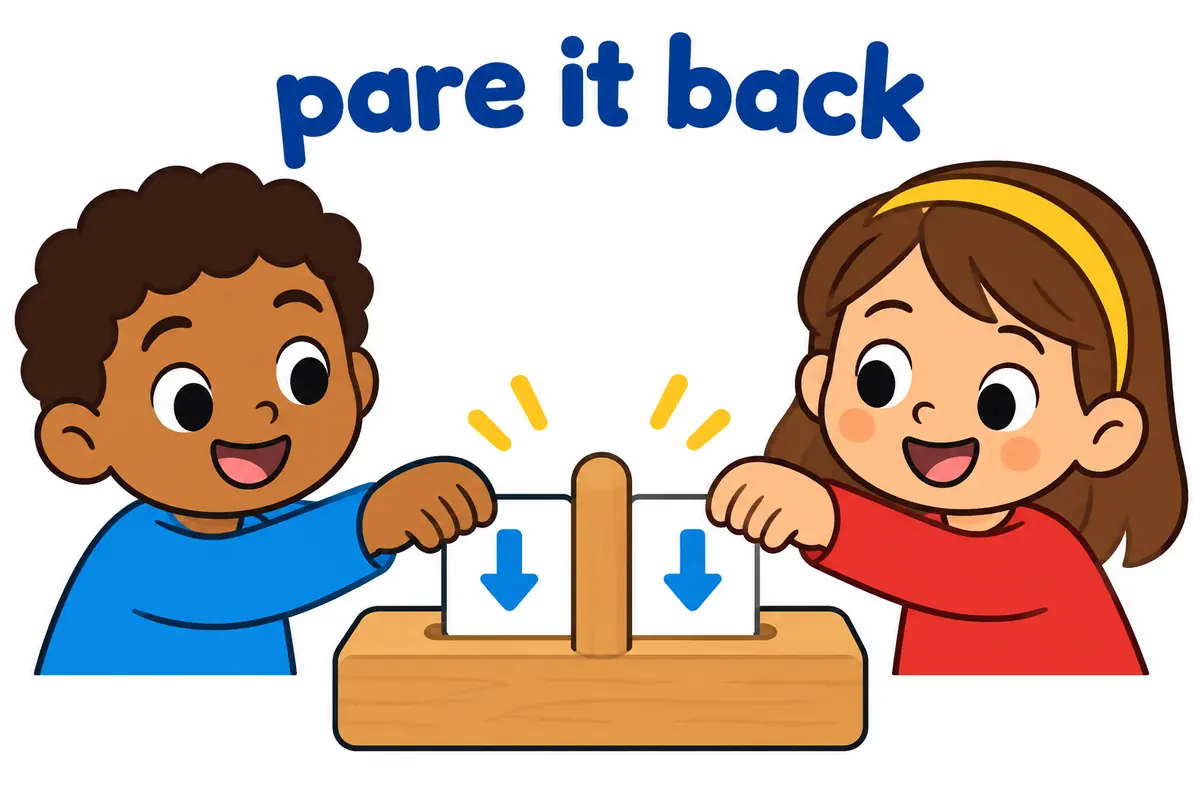
The main decision with this verb is where to put the object. Pare back is separable, which means a noun object can follow the particle or sit between the two words, but a pronoun must sit between them.
| Pattern | Example | What it signals |
|---|---|---|
| pare back + noun | The firm pared back costs. | The standard order, particle first. |
| pare + noun + back | The firm pared costs back. | Separated form, common in news writing. |
| pare + pronoun + back | They pared them back in June. | A pronoun must split the verb; never say pare back them. |
| be pared back | Spending was pared back over two years. | Passive form, common in reports. |
| pare back on + noun | The council pared back on new projects. | British usage with on before the target. |
| pare back + to + level | Output was pared back to half. | Names the level the reduction reaches. |
The particle back never strands at the end of a clause. You write the budget was pared back, not the budget was pared. That is why the passive above keeps back attached, and why the pronoun rule matters so much: pare it back is correct, and pare back it is not.
Pare back in a sentence: examples across contexts
Pare back moves easily between a household budget and a corporate report, and each register picks a slightly different object. The eleven sentences below show the reductions a reader meets in real writing.
| Context | Example sentence | Why this works |
|---|---|---|
| Household talk | We pared back the food shop to one delivery a week. | A concrete routine made smaller. |
| Workplace email | The department pared back its travel budget this quarter. | Names the budget as the object. |
| News report | The airline pared back its winter schedule by a fifth. | A measured reduction, stated in numbers. |
| Business writing | We pared the launch plan back to three markets. | Shows the separated form and a target level. |
| Council minutes | The committee pared back on road repairs to fund the new bridge. | British on-pattern, with a purpose. |
| Editing | She pared the chapter back and cut two characters. | Applies the verb to text and plot. |
| Gardening | They pared back the overgrown shrubs along the fence. | Returns the word to its literal cutting sense. |
| Sports report | The club pared back its squad before the season. | Staff or roster sense, common in sport. |
| Project update | Features were pared back to keep the deadline. | Passive form with a clear reason. |
| Academic writing | The authors pared back their model to two variables. | Reduction toward a simpler design. |
| Charity newsletter | Discretionary spending was pared back, but services stayed open. | Shows what survives a reduction. |
Three verbs sit close by and split the work. Whittle suggests a slow, repeated reduction, cut is blunt and can remove entirely, and pare back sits between them as a careful, partial reduction.
Pare back vs pare down
Pare back and pare down share the base verb and differ only in the particle, yet the particles point the reduction in different directions.
| Attribute | pare back | pare down |
|---|---|---|
| Direction of the cut | Reduces growth from the outside | Reduces toward a core or minimum |
| What it focuses on | Quantity and spending | Essentials and simplicity |
| Typical object | Budget, staff, schedule | List, wardrobe, essay, options |
| Register | Business and news | Everyday and editing |
| Particle suggests | Reversing something that has grown | Stripping to a base |
Verdict: pare back a budget, a schedule or a workforce, and pare down a list, a bag or an essay. The two are close enough that either works in many sentences, but the particle quietly changes the image. Where the aim is to stop something expanding rather than to strip it, the related verb curtail makes that limit explicit, and where the whole thing is removed, cut is the honest word.
Word forms and grammar of pare back
Pare back inflects on the base verb, so the particle never changes. The table also shows the literal forms of pare, which still appear in the kitchen and the garden.
| Form | Part of speech | Example |
|---|---|---|
| pare back | phrasal verb, base form | We must pare back the budget. |
| pares back | verb, third person singular | The office pares back its printing each year. |
| pared back | verb, past and past participle | Spending was pared back sharply. |
| paring back | verb, present participle | They are paring back the summer schedule. |
| pare | verb, base form, literal | Pare the apple before slicing it. |
| parings | noun, plural | The parings went into the compost. |
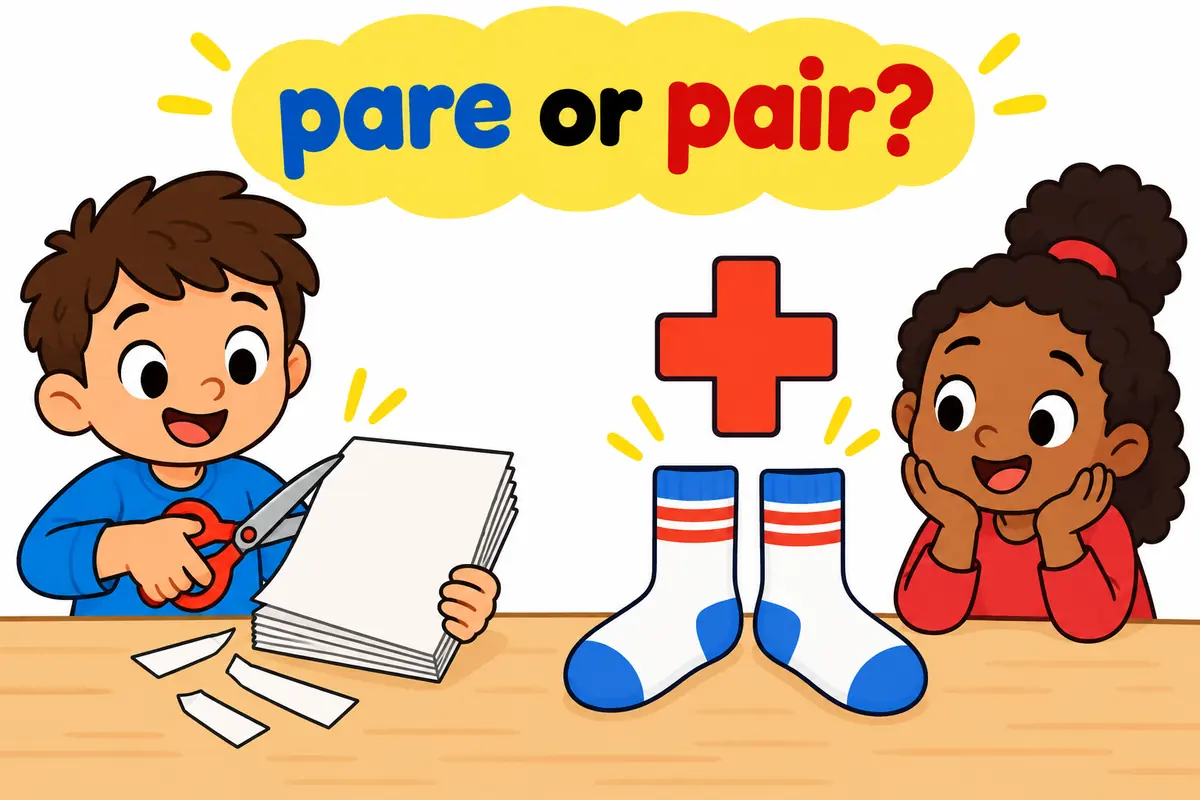
Keep the spelling of pare clear of its homophone. Pair means to match two things, so the company that pares back costs is not pairing anything. A narrow escape is also spelled down to the wire: the film was pared back, not paired back.
Common mistakes with pare back
- Incorrect:
The company pared back them.Correct: The company pared them back. Rule: A pronoun object must sit between the verb and the particle. - Incorrect:
We need to pare back.Correct: We need to pare back the budget. Rule: The verb is transitive, so an object is required. - Incorrect:
We must pair back the costs.Correct: We must pare back the costs. Rule: Pare means trim; pair means match two things. - Incorrect:
They pared out the whole department.Correct: They cut out the whole department. Rule: Pare back reduces; cut out removes completely. - Incorrect:
The budget was pared back down.Correct: The budget was pared back. Rule: Do not stack two particles on one phrasal verb. - Incorrect:
The council pared back on of the repairs.Correct: The council pared back on the repairs. Rule: The on-pattern takes a noun directly.
Practice using pare back
Work through the seven items, then read the reasoning rather than only the answer.
- Fill the gap: The firm plans to ______ the advertising budget before spring.
- Choose the better word: We had to (pare back / cut out) the team, not lose it entirely.
- Correct the error: The manager pared back them last month.
- Build a sentence: use pare back on about a school reducing its paper use.
- Spot the register: which belongs in a business report — spending was pared back, or we spent less money?
- Rewrite in the separated form: The airline pared back its winter schedule. Put the object between the verb and the particle.
- Fix the homophone: The company paired back its costs. Use the correct verb.
Answers
- pare back — the advertising budget is the object being reduced.
- pare back — the team survives in a smaller form, so cut out is too strong.
- The manager pared them back last month — the pronoun belongs between verb and particle.
- Model answer: The school pared back on paper use to save money.
- Spending was pared back — a report keeps the passive, formal verb.
- The airline pared its winter schedule back — the object now sits before back.
- The company pared back its costs — pare means trim, while paired means matched.
The bottom line
Use pare back in a sentence to reduce spending, staff or plans in careful stages, and remember that the verb is transitive and separable, so a pronoun must split it. The two nuances that decide most sentences are the particle, which keeps the thing alive in smaller form, and the object position, which changes nothing in meaning but much in naturalness. When something disappears altogether, cut is the better verb.
Frequently asked questions about pare back
Is pare back a separable phrasal verb?
Yes. A noun object can follow the particle, as in pare back the budget, or sit between the two words, as in pare the budget back. A pronoun object must sit between them, so pare it back is right and pare back it is wrong. The particle never strands at the end of the clause.
What is the difference between pare back and cut?
Pare back reduces something gradually and leaves it in place, while cut can remove it entirely. A pared-back service still runs on a smaller scale, but a cut service may stop. Cut is also blunter in tone, so business writing often prefers pare back when the change is partial and planned.
Can you say pare back on costs?
Yes, in British English. The pattern pare back on plus a noun is common in news and council writing, as in the council pared back on new projects. American writing usually drops the on and makes the noun a direct object, as in pared back new projects. Both are grammatical.
Is pare back formal?
It sits in neutral to formal writing, appearing often in business and news reports. The literal sense of paring a hedge or an apple is older and more everyday. In casual speech many people simply say cut back or trim, which carry the same idea with less polish.