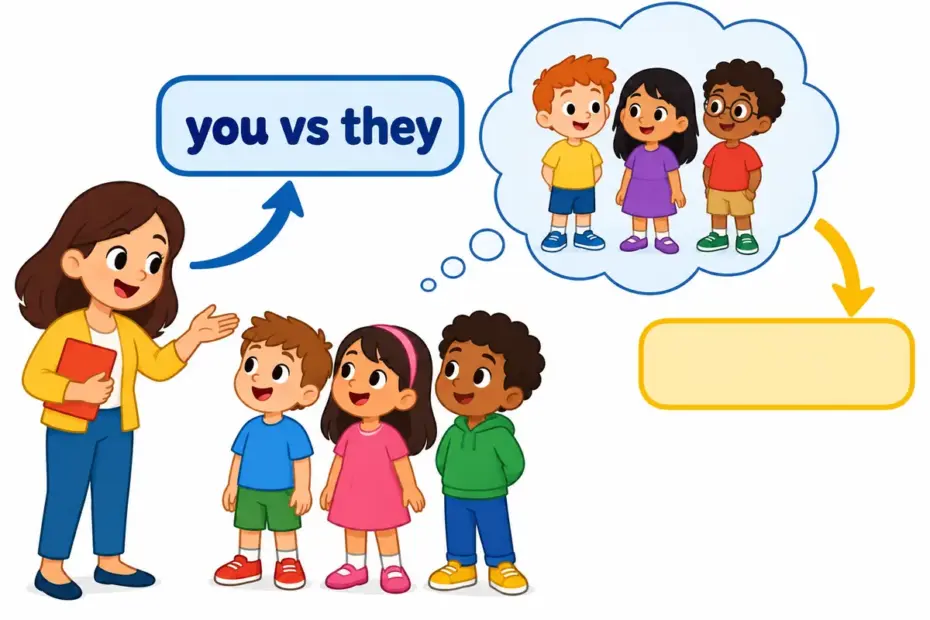
The choice between yourselves vs themselves is settled by the subject of the sentence: use yourselves for the group you are addressing, and themselves for a group you are speaking about. “Help yourselves” speaks to the people in front of you, while “they helped themselves” reports them to somebody else.
What do yourselves and themselves mean?
Yourselves and themselves are plural reflexive pronouns. Yourselves is the second-person plural form, so it points back to the plural you being addressed, and it appears in commands and invitations. Themselves is the third-person plural form, so it points back to a group already named in the sentence, and the third-person plural reports what that group did. The Cambridge entry for yourselves and its counterpart for themselves record both senses.
Both words do two jobs. In the reflexive job, the object of the verb is the same group as the subject: you hurt yourselves, they taught themselves. In the emphatic job, the pronoun simply stresses the noun it follows: you yourselves decided, the players themselves agreed. Neither word ever serves as the subject; the subject is the noun or pronoun that comes first.
| Word | Person and number | Points back to | Example sentence |
|---|---|---|---|
| yourselves | second person plural | the people being addressed | Please help yourselves to the fruit. |
| themselves | third person plural | a group already mentioned | The children dressed themselves quickly. |
| yourselves (emphatic) | second person plural | the people being addressed | You yourselves set the deadline. |
| themselves (emphatic) | third person plural | a group already mentioned | The teachers themselves were surprised. |
One limitation is worth stating. Neither word is a possessive, so they cannot replace your or their, and neither can act as a subject. Where the two groups act on each other rather than on themselves, the reciprocal pronoun pair each other is the correct choice instead.
Yourselves vs themselves: the master comparison
The two forms are identical in structure and differ only in person, which is why one decision settles almost every sentence. The table weighs the criteria that readers actually need.
| Criterion | yourselves | themselves |
|---|---|---|
| Person | Second person: the people spoken to | Third person: the people spoken about |
| What it agrees with | A plural you | A plural they, or a named group |
| Reflexive example | You should treat yourselves kindly. | They should treat themselves kindly. |
| Emphatic example | You yourselves wrote the rules. | The owners themselves wrote the rules. |
| Typical setting | Instructions, invitations, welcome messages | Reports, narratives, descriptions |
| Can it be the subject? | No; the subject is the you it echoes | No; the subject is the group it echoes |
| Related singular | yourself, for one person | themself, sometimes used with singular they |
Read the two right-hand columns against each other and the pattern is plain: the pronoun copies the person of the subject. A sentence that begins with you takes yourselves, and a sentence that begins with they or a named group takes themselves.
Which should you use?
Match the reader or subject to one of the five situations below, and the choice makes itself.
- You are giving instructions to a group in front of you: use yourselves, as in please see yourselves out.
- You are inviting a group to take something: use yourselves, as in help yourselves to the cake.
- You are writing about a group in the third person: use themselves, as in the staff organised themselves.
- You want to stress that a group addressed directly acted on its own: use yourselves after the noun, as in you yourselves voted for it.
- You want to stress that a described group acted on its own: use themselves after the noun, as in the witnesses themselves admitted it.
How do you use yourselves and themselves in a sentence?
Both words follow the same grammar, so the patterns are parallel. The pronoun sits after a verb or a preposition in its reflexive job, and directly after the noun it emphasises in its emphatic job.
| Pattern | Example | What it signals |
|---|---|---|
| verb + yourselves | You must prepare yourselves for the test. | The action returns to the addressees. |
| verb + themselves | They prepared themselves for the test. | The action returns to the group described. |
| preposition + yourselves | Keep the news to yourselves. | The pronoun follows a preposition, not a verb. |
| preposition + themselves | The class kept the secret to themselves. | The same pattern in the third person. |
| noun + yourselves (emphatic) | You students yourselves asked for the change. | Adds emphasis without changing the subject. |
| noun + themselves (emphatic) | The organisers themselves were late. | Stresses that the named group, not others, acted. |
The plural is what matters most. A single person takes yourself, and a plural or formal group takes yourselves, so please help yourself is correct for one guest while please help yourselves is correct for many.
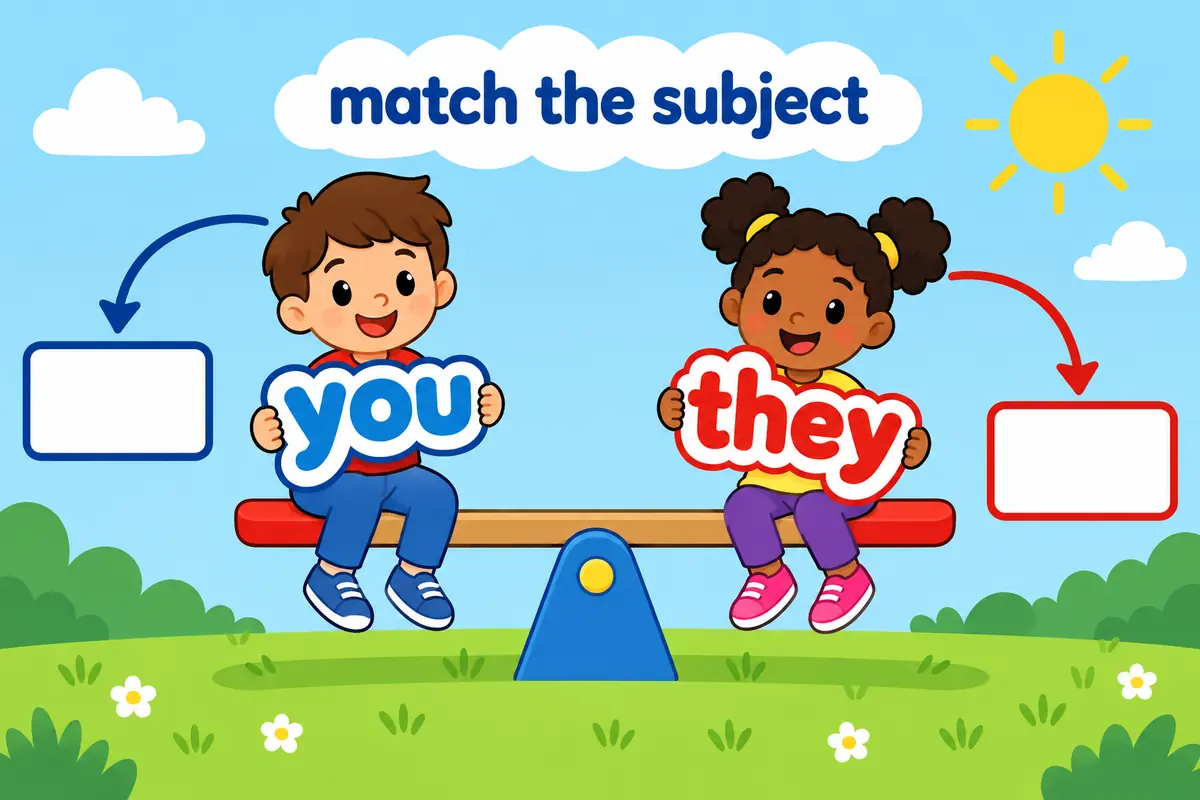
Yourselves and themselves in a sentence: examples across contexts
The two pronouns appear in the same kinds of sentence, so the examples below are deliberately paired: a setting where you would address a group, and the report you would write about one. The ten sentences show the register of each.
| Context | Example sentence | Why this works |
|---|---|---|
| Classroom instruction | Help yourselves to a worksheet from the tray. | A direct address to a group of pupils. |
| Classroom report | The pupils helped themselves to the spare pencils. | The same action described in the third person. |
| Workplace email | Please familiarise yourselves with the new policy. | A polite plural instruction to colleagues. |
| Meeting minutes | The committee familiarised themselves with the proposal. | A neutral report about a named group. |
| Invitation | Come in and make yourselves at home. | A warm direct address to guests. |
| Narrative | The guests made themselves at home at once. | The same welcome retold by a narrator. |
| Safety notice | You must not lift these boxes by yourselves. | Uses yourselves after a preposition for emphasis on the group. |
| News report | The residents rebuilt the garden themselves. | Emphatic themselves stresses who did the work. |
| Welcome sign | Enjoy yourselves at the summer fair. | A friendly imperative aimed at everyone attending. |
| Sports reporting | The players blamed themselves for the defeat. | The reflexive returns the blame to the group. |
| Speech | You yourselves wrote this charter. | Emphatic yourselves after you adds weight. |
| Description | The machines switch themselves off at midnight. | A neat third-person reflexive about objects. |
Notice that every yourselves example is spoken to the group, while every themselves example is spoken about one. That single shift of direction is the whole difference, and it is what readers notice when the wrong form appears.
Word forms and grammar of yourselves and themselves
Both pronouns belong to the reflexive set, and the table below places them beside the forms they are most often confused with. ourselves is the first-person plural partner, and myself is its singular counterpart.
| Form | Person and number | Example |
|---|---|---|
| yourself | second person singular | You should give yourself a break. |
| yourselves | second person plural | You should give yourselves a break. |
| myself | first person singular | I taught myself to swim. |
| ourselves | first person plural | We taught ourselves to cook. |
| himself and herself | third person singular | He blamed himself; she blamed herself. |
| themselves | third person plural | They blamed themselves. |
| themself | third person singular, singular they | Each student must ask themself a question. |
The pairs are strictly parallel, which makes them easy to learn as a set. The only irregular member is themself, a singular form that many style guides still avoid, and its non-standard cousin theirselves, which is never correct.
Common mistakes with yourselves and themselves
- Incorrect:
Please help yourself to the sandwiches, everyone.Correct: Please help yourselves to the sandwiches, everyone. Rule: Everyone is plural here, so the reflexive pronoun must be plural. - Incorrect:
The players blamed theirselves for the loss.Correct: The players blamed themselves for the loss. Rule: Theirselves is not a word; the correct third-person plural reflexive is themselves. - Incorrect:
You need to believe in yourself, all of you.Correct: You need to believe in yourselves, all of you. Rule: All of you names a group, so the pronoun takes the plural form. - Incorrect:
Them themselves finished the job.Correct: They themselves finished the job. Rule: The subject must be they, not them, because the pronoun is not a subject. - Incorrect:
We should thank yourselves for the idea.Correct: We should thank you for the idea. Rule: Yourselves is reflexive, so a direct object group is named with you, not yourselves.
Practice using yourselves and themselves
Work through the six items, then check the reasoning, because the person and the singular-plural choice cause most real errors.
- Fill the gap: Children, please behave ______ while I speak to the driver.
- Choose the correct form: The hikers found (themselves / theirselves) lost in the fog.
- Correct the error: You should all be proud of yourself.
- Build a sentence: use themselves in the emphatic position about a team that ignored advice.
- Spot the register: which belongs in an invitation, enjoy yourselves, or you all enjoy?
- Rewrite for one guest: Please help yourselves to the buffet.
Answers
- yourselves — the speaker addresses the group of children directly.
- themselves — theirselves is non-standard and never appears in edited writing.
- You should all be proud of yourselves — all makes the group plural.
- Model answer: The players themselves had ignored the coach’s warning.
- Enjoy yourselves — an invitation uses the plural reflexive for a group.
- Please help yourself to the buffet — one guest takes the singular yourself.
The bottom line
Use yourselves when you address a group and themselves when you describe one, because the pronoun must copy the person of the subject. Two nuances settle nearly every sentence: neither word can be the subject, so them themselves is always wrong, and the plural form is required even for formal greetings to several people. To see the same choice one person at a time, compare yourselves with herself and the other third-person singular forms.
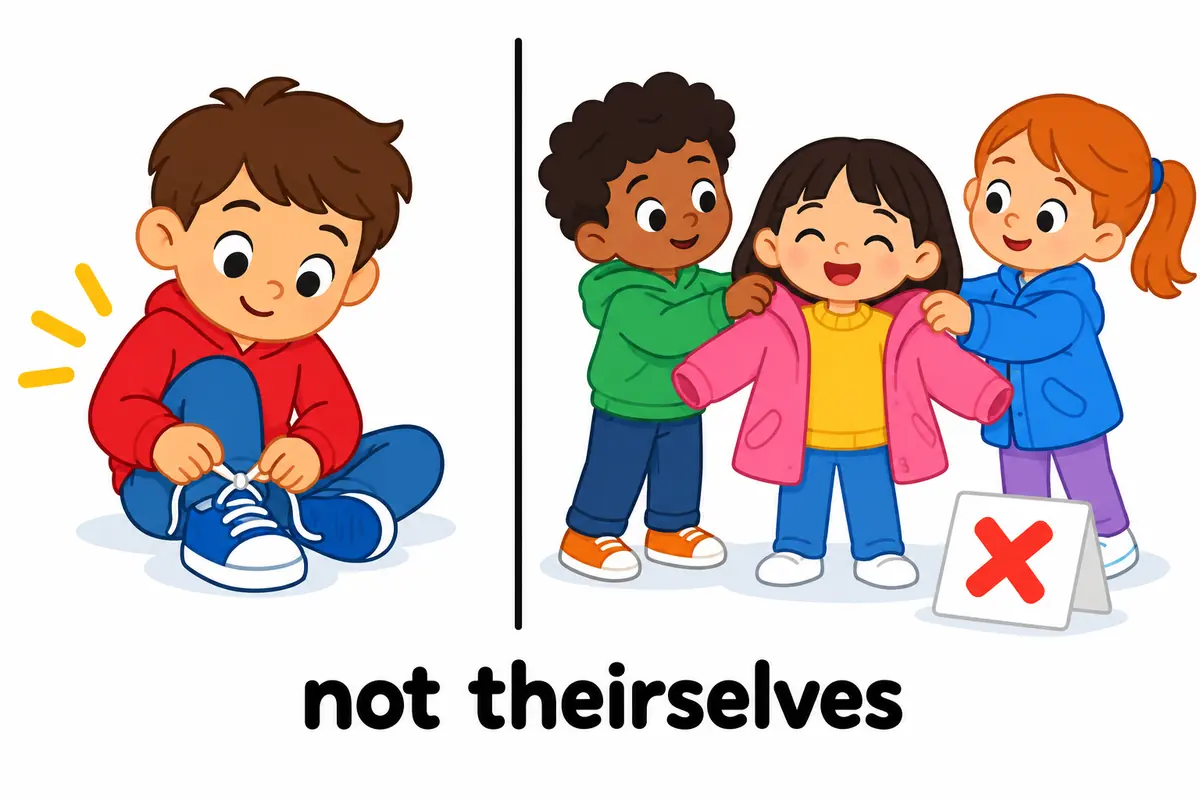
Frequently asked questions about yourselves vs themselves
Why is theirselves wrong?
Theirselves is a blend of their and themselves, and English never formed a reflexive with their. The possessive form their and the reflexive form themselves are separate words with separate jobs, so the correct third-person plural reflexive is always themselves, however tempting the hybrid spelling looks on the page.
Is themself a real word?
Themself is a genuine singular form used alongside singular they, as in each student asked themself a question. Many style guides still prefer themselves in that position, so themself is acceptable but less formal. Both are far better than theirselves, which is never correct.
Can yourselves be singular?
Yourselves is plural and refers to more than one person. A single reader or listener takes the singular yourself, as in help yourself. Older formal writing did address one important person as yourselves, but modern English reserves the plural form for genuine groups and uses yourself otherwise.
Do they ever work as the subject?
No. Reflexive pronouns such as yourselves and themselves can never be the subject of a clause. They either follow a verb or a preposition, or they sit after a noun for emphasis. Writing them themselves finished it is wrong because it puts the reflexive where the subject they must stand.