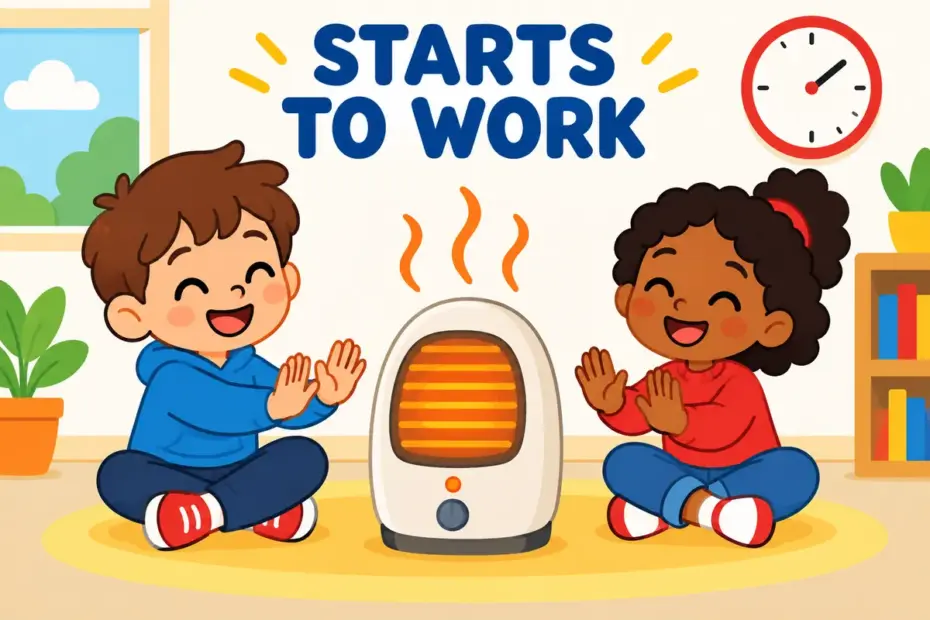
Kick in means to start working after a delay, as when a machine, a rule or a medicine begins to take effect. To use kick in in a sentence, name the thing that starts and let it be the subject: “The heating kicked in at dusk.” In this sense the verb is intransitive, so it takes no object.
Kick in at a glance
- Kick in is a phrasal verb whose main sense is to start working or to take effect.
- A second sense means to contribute money, as in everyone kicked in for a gift.
- A third, separable sense means to break something inward with a foot.
- In the take-effect sense the verb is intransitive and the particle stays after it.
- The commonest error is adding an object to the intransitive sense: the alarm kicked in, not kicked in the alarm.
What does kick in mean?
Kick in is a phrasal verb with three senses that share a picture of something switching on with force. The main sense, take effect, describes a delay followed by a sudden start; the second sense means to contribute money; the third means to break a door or panel inward. The Cambridge entry for kick in records the take-effect sense, and the nearest single verb is activate the system, which is more mechanical and formal.
| Sense | Plain meaning | Example sentence |
|---|---|---|
| Take effect | Start working after a delay | The painkiller kicked in within twenty minutes. |
| Contribute money | Pay a share towards a shared cost | Everyone kicked in ten pounds for the present. |
| Break inward | Force a door or panel inwards | Rescuers kicked in the damaged door. |
Three collocations sit closest to the main sense, and each keeps the starting thing as the subject:
- kick in after a delay — the doctor said the injection would kick in soon.
- kick in automatically — the timer makes the hall lights kick in at seven.
- kick in next month — the new fare rules kick in next month.
- kick in for a shared cost — the whole class kicked in for a leaving gift.
One limitation matters. In the take-effect sense kick in is intransitive, so it cannot name what it affects, and it carries a hint of suddenness that a smooth verb like begin lacks. For a gradual start, begin is the clearer choice, and kick in would overstate the jolt.
How do you use kick in in a sentence?
Kick in behaves differently in each sense, so the grammar is the real lesson. In the take-effect sense it is intransitive and inseparable: the subject is the thing starting and nothing follows the particle. In the contribute sense it is transitive and separable, so the money may sit between the words. The break-inward sense is also separable. Where an engine engages rather than starts, engage the engine is more precise.
| Pattern | Example | What it signals |
|---|---|---|
| subject + kick in (no object) | The cooling fans kicked in. | Intransitive take-effect sense; the subject is the thing starting. |
| subject + kick in + time phrase | The new law kicks in next April. | A future date fixes when an effect begins. |
| kick in + amount (separable) | We each kicked ten dollars in. | Contribute sense; the amount may sit between kick and in. |
| kick + object + in (break) | He kicked the panel in. | Separable break-inward sense, with a physical object. |
| be kicked in (passive) | The door was kicked in during the storm. | Passive break sense, agent usually unnamed. |
Only the first two patterns take no object. The moment an object appears, the sentence has shifted to the contribute sense or the break sense, so the meaning changes along with the grammar. That double change is the quiet trap in this phrasal verb, and it is why the same three words can describe a heater and a burglary.
Kick in in a sentence: examples across contexts
The take-effect sense appears wherever a delay is followed by a start, from medicine to law to weather. Each sentence keeps the starting thing as the subject, which is what keeps the intransitive pattern correct. Where something begins rather than switches on, start working is plainer.
| Context | Example sentence | Why this works |
|---|---|---|
| Health | The medicine kicked in after about half an hour. | A time phrase shows the delay before the effect. |
| Weather | The sea breeze kicked in around noon. | A natural force as subject suits the take-effect sense. |
| Law | The new rules kick in at the start of the year. | A future date marks when an obligation begins. |
| Machines | The backup generator kicked in without a sound. | A machine as subject is the clearest use of all. |
| Finance | Overdraft charges kicked in once the balance fell. | A condition triggers an automatic effect. |
| Sports | Fatigue kicked in during the final ten minutes. | An abstract subject names a bodily effect. |
| Community | Neighbours kicked in for a new playground gate. | Here the verb is transitive and means contribute. |
| Emergency | Firefighters kicked in the locked door. | The separable sense means break inward. |
| Technology | Two-factor checks kicked in after the update. | An automatic process starts on its own. |
| Home | The old fridge kicked in with a loud hum at midnight. | A domestic appliance shows the automatic start. |
| Transport | The de-icing system kicks in below freezing. | A threshold triggers the effect, so a condition leads the sentence. |
| School | Extra tutoring kicked in once the exams neared. | An abstract arrangement starts after a trigger. |
Where people give money together without effort, contribute to a fund is the cooler, more formal option.
Kick in vs kick off
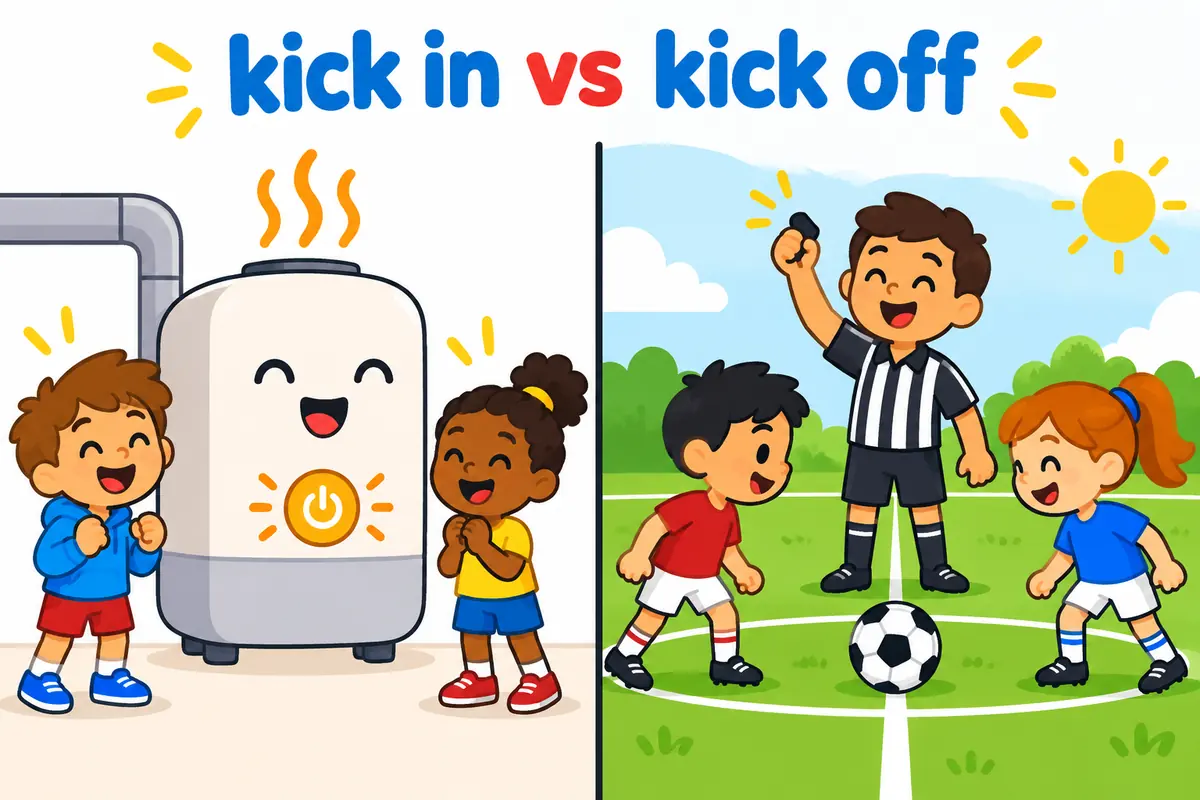
Kick in and kick off share the base verb kick and describe different moments. Kick in is something starting to take effect from within; kick off is an event or process being launched, often by someone.
| Attribute | kick in | kick off |
|---|---|---|
| Core job | Start to take effect | Begin an event or process |
| Transitivity | Intransitive in the main sense | Transitive or intransitive |
| Implied timing | After a delay | At a scheduled start |
| Typical subject | A machine, rule, drug or effect | A match, meeting or campaign |
| Who acts | The thing itself, on its own | Often a person who launches it |
Verdict: choose kick in when an effect starts by itself after a delay, and kick off when an event is launched on a schedule.
Timing is the cleanest test. If the question is when something is scheduled to begin and a person or clock supplies the answer, kick off fits. If the answer describes a delay before something takes hold on its own, kick in fits, and the sentence needs no object at all.
Word forms and grammar of kick in
The tense changes on kick alone, and separability depends on the sense. In the take-effect sense the particle is fixed, but the contribute and break senses allow the object in between. A related particle verb, break in, shares the particle in but has its own meanings.
| Form | Part of speech | Example |
|---|---|---|
| kick in | phrasal verb, base form | Relief should kick in soon. |
| kicked in | phrasal verb, past tense | The air conditioning kicked in at noon. |
| kicking in | phrasal verb, -ing form | You can feel the effect kicking in. |
| kicked in (separable) | verb + object + particle | They kicked the door in. |
| kicked in (contribute) | verb + amount + particle | She kicked twenty pounds in. |
| kick in (noun, informal) | noun, rare | The kick-in of new charges surprised us. |
The noun form is rare and informal, so a learner almost never needs it. What matters far more is the past tense, which is always kicked in; the invented forms kick ined and kick-in-ed are mistakes no editor will pass.
Common mistakes with kick in
- Incorrect:
The alarm kicked in the whole building.Correct: The alarm kicked in across the whole building. Rule: in the take-effect sense kick in is intransitive, so it takes no object. - Incorrect:
The law will kick in at effect in June.Correct: The law will kick in in June. Rule: the particle already carries the effect; add only a time phrase. - Incorrect:
Everyone kicked in for the present ten pounds.Correct: Everyone kicked ten pounds in for the present. Rule: in the contribute sense the amount may sit between kick and in. - Incorrect:
They kicked in the door to break it.Correct: They kicked the door in. Rule: with the break sense, the object comes before the particle.
Practice using kick in
Work through the seven items, then read the reasoning rather than only the answer.
- Fill the gap: The generator ______ within seconds of the outage.
- Choose the better word: The concert will (kick in / kick off) at eight.
- Correct the error: The new charges kicked in our bills.
- Build a sentence: use the contribute sense of kick in about a class gift.
- Spot the register: which belongs in a news report — The levy kicks in in April, or The levy starts biting in April?
- Rewrite in the passive: Someone kicked in the shop door.
- Add a time phrase: The cooling fans kicked in.
Answers
- kicked in — the take-effect sense is intransitive and needs no object.
- kick off — an event is launched at a scheduled time, which is kick off.
- The new charges kicked in with the April bills — the verb cannot take bills as an object.
- Model answer: Each pupil kicked in two pounds for the class gift.
- The levy kicks in in April — a report prefers the neutral particle verb.
- The shop door was kicked in — the break sense passivises cleanly.
- Model answer: The cooling fans kicked in after ten minutes.
The bottom line
Use kick in in a sentence for something starting to take effect after a delay, and keep the starting thing as the subject with no object. Two details decide most sentences: the take-effect sense is intransitive, and the contribute and break senses are separable, so the object may sit before the particle. When an effect stops rather than starts, cease abruptly is the opposite verb.
Frequently asked questions about kick in
Is kick in one word or two?
As a verb it is written as two words, kick in, with the tense change on kick alone. A rare informal noun, kick-in, is hyphenated and names the moment something starts. In ordinary writing, keep the verb split and let the context show which of the three senses you mean.
Is kick in formal or informal?
Kick in is neutral and slightly informal, common in conversation, news and technical writing about machines or rules. It suits explaining a delay before an effect, such as a drug or a charge. A formal report might prefer take effect or come into force instead.
Can kick in take an object?
Only in some senses. The take-effect sense is intransitive, so it takes no object and cannot be passivised. The contribute sense is transitive and separable, as in kicked ten pounds in, and the break sense is also separable, as in kicked the door in. Check the meaning before adding an object.
What is the difference between kick in and kick off?
Kick in describes something starting to take effect after a delay, with the thing itself as the subject, like a fan or a drug. Kick off describes an event or process being launched, often by a person, like a match or a campaign. One switches on from within; the other is set going.