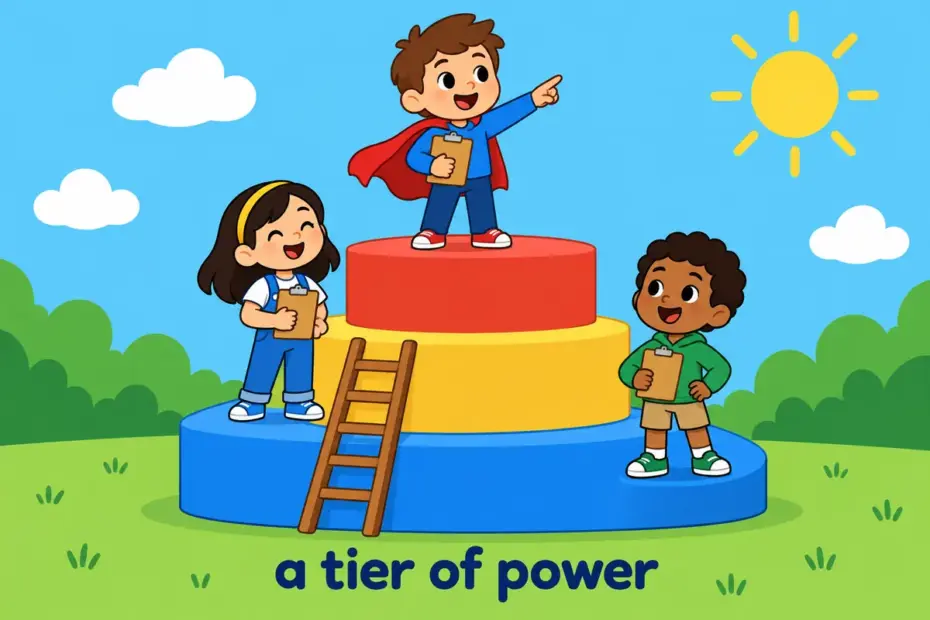
Echelon means a level or rank within a hierarchy, especially one that carries power or status. To use echelon in a sentence, picture a ladder: decisions move through the upper echelons before they reach the shop floor. The word usually appears in its plural form when it names a whole layer of people.
Echelon at a glance
- Echelon is a noun meaning a rank or tier in an organisation or society.
- Its plural echelons is standard in the phrase the upper echelons.
- A second, military sense describes troops arranged in step-like rows.
- Echelon belongs to formal, business and journalistic writing.
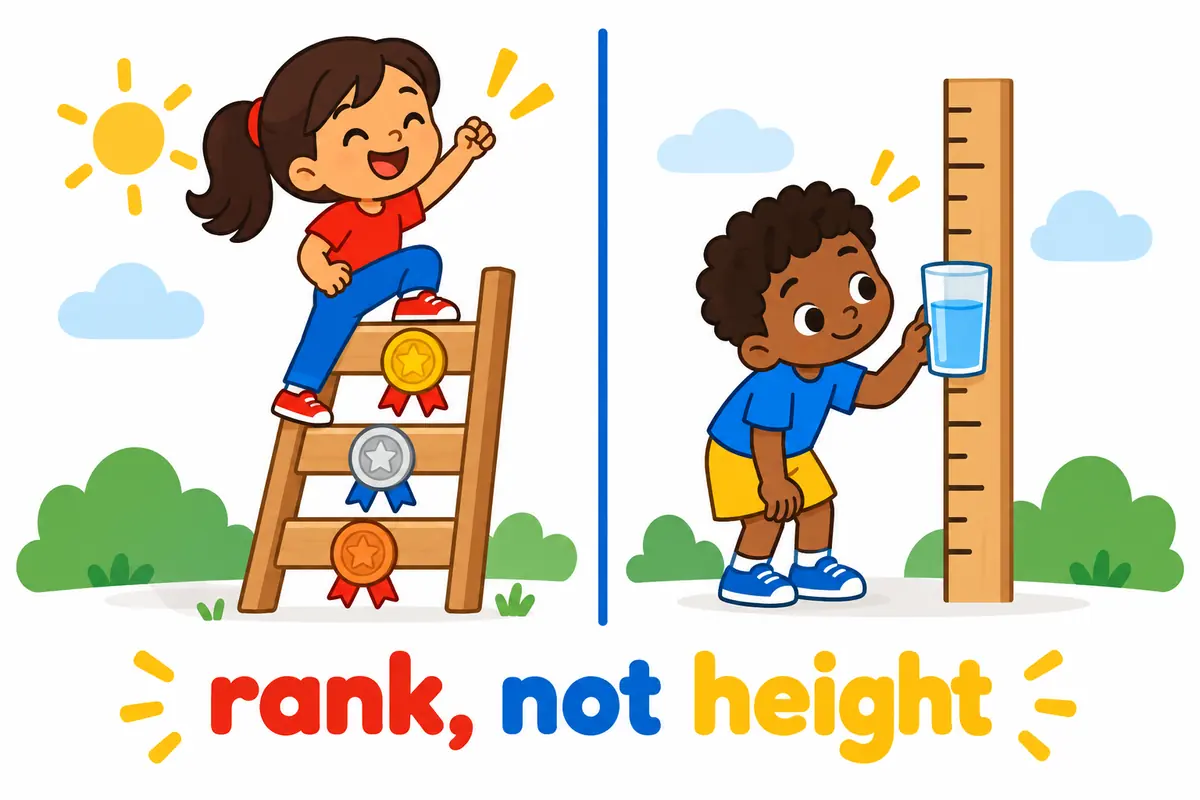
- The commonest error is using it for any physical height rather than rank.
- Related forms are echeloned and echeloning, used mainly in the military sense.
What does echelon mean?
Echelon is a noun meaning a level or rank in a graded system, and it carries a stronger sense of power than the plain word level. The Cambridge entry for echelon records both the rank sense and the military one, and modern usage keeps the two apart: a business talks about the upper echelons, while a historian describes partisans fighting in echelon. The rank sense is far more common in ordinary writing.
| Sense | Plain meaning | Example sentence |
|---|---|---|
| Rank or tier | A level in a hierarchy | Graduates enter the lower echelons of the civil service. |
| Layer of power | The people who hold authority | The upper echelons of the party resisted the change. |
| Military formation | Troops arranged in a stepped line | The aircraft flew in echelon. |
One limitation is worth stating plainly. Echelon implies a hierarchy and, usually, power, so it is the wrong word for a plain physical height or for a flat group with no ranking. Where no ladder exists, start at the bottom and level describe the same position without overstating the structure. The plural upper echelons also lends a grand tone, so a small charity might sensibly write the managers instead.
How do you use echelon in a sentence?
Decide whether you mean one tier or a whole layer, then choose singular or plural accordingly. Five patterns cover almost every real sentence, and the phrase upper echelons is the one a reader will meet most often.
| Pattern | Example | What it signals |
|---|---|---|
| upper/lower echelons of + noun | The upper echelons of the company resisted change. | The plural names a whole layer of people. |
| the top echelon | Only the top echelon saw the report. | The singular names the highest single tier. |
| a new echelon | Automation created a new echelon of technicians. | A freshly formed tier within the structure. |
| in the … echelon | She works in the middle echelon of the ministry. | Places a person inside a tier. |
| echelon formation | The planes flew in echelon formation. | A military attributive use. |
The plural is not random. A single rank is an echelon, but the phrase upper echelons treats the top of a hierarchy as a band of people, which is why it is almost always plural. Use the singular when one clearly bounded tier is meant, and the plural when the reference is to the group that fills the highest order of a ranking.

Echelon in a sentence: examples across contexts
The word keeps its shape but changes its company across registers. The twelve sentences below move from a board room to a battlefield, and each one names the layer and what it does.
| Context | Example sentence | Why this works |
|---|---|---|
| Business | The upper echelons of the bank approved the merger. | Plural names the layer that holds authority. |
| Politics | Reform rarely reaches the top echelon of a party. | Singular names one highest tier. |
| Military | The squadron attacked in echelon formation. | Shows the technical formation sense. |
| Academia | The higher echelons of the university set the budget. | A formal institution suits a formal noun. |
| Civil service | New recruits join the lowest echelon in the spring. | Names an entry tier in a graded system. |
| Sports | Athletes from every echelon of the sport attended. | The plural covers a whole range of ranks. |
| Journalism | Leaks reached the upper echelons within a week. | A short, weighty phrase fits a news sentence. |
| Technology | A new echelon of specialists emerged with the tool. | Shows a freshly created tier. |
| Finance | Only the senior echelon knew the true figures. | Singular stresses one privileged layer. |
| Fiction | She rose through the echelons of a rigid court. | The plural implies a long climb through ranks. |
| Conversation | That decision came from a higher echelon than us. | Even in speech the word keeps its hierarchical sense. |
| Diplomatic | The two delegations met at the same echelon. | Names matching rank between two bodies. |
Across all twelve, the word presumes a ladder of some kind. Where the sentence describes a flat group, a class of new trainees or a simple group is the better term, because echelon would imply a ranking that is not there.
Echelon vs level
Echelon and level are close, but echelon ranks people while level measures almost anything. The difference shows in their favourite phrases: the upper echelons of power against sea level. The image behind echelon is a rung of a ladder, which is why it always suggests a climb through rank.
| Attribute | echelon | level |
|---|---|---|
| Core meaning | A rank or tier in a hierarchy | A position, amount or height |
| Connotation | Power, status, exclusivity | Neutral and measurable |
| Typical phrase | the upper echelons | sea level, entry level |
| Plural | Common and often preferred | Rare and usually unnecessary |
| Register | Formal and often grand | Neutral, everyday to technical |
| What it implies | A ladder of authority | No ranking unless stated |
Verdict: choose echelon when the point is rank and power, and choose reach a new level when the point is a measured position with no hierarchy attached.
Word forms and grammar of echelon
Echelon is a regular noun in the rank sense. The verb forms belong to the military formation sense and are much rarer. The last row shows a flat group that echelon cannot describe, because no ladder exists.
| Form | Part of speech | Example |
|---|---|---|
| echelon | noun, singular | She reached the top echelon at forty. |
| echelons | noun, plural | The upper echelons decided quickly. |
| echelon | noun, attributive | Echelon formation kept the line steady. |
| echeloned | verb, past and adjective (military) | The units were echeloned along the ridge. |
| echeloning | verb, present participle (military) | They were echeloning the columns at dusk. |
| echelon of friends | non-standard: a flat group | Wrong; echelon needs a real hierarchy. |
The related word rank above a colleague names one position, while echelon names the layer that contains many such positions. That is the single distinction worth keeping in mind when you choose between them.
Common mistakes with echelon
- Incorrect:
The hikers climbed to a higher echelon of the mountain.Correct: The hikers climbed to a higher point on the mountain. Rule: Echelon is about rank, not physical height. - Incorrect:
The team has a good echelon of players.Correct: The team has a strong group of players. Rule: Echelon needs a real hierarchy; a flat group is not a tier. - Incorrect:
She was promoted to a superior echelon.Correct: She was promoted to a more senior position. Rule: Use echelon for the layer, not for one person’s post. - Incorrect:
The upper echelon of the firm were worried.Correct: The upper echelons of the firm were worried. Rule: A whole layer of people takes the plural. - Incorrect:
The echelon of command gave the order.Correct: The chain of command gave the order. Rule: The fixed term for authority passing down is chain of command.
Practice using echelon
Work through the eight items, then read the answers for the reason behind each key.
- Fill the gap: Decisions were made in the upper ______ of the ministry.
- Choose the better word: The diver measured the (echelon / level) of the water.
- Correct the error: She climbed to a higher echelon of the hill.
- Build a sentence: use upper echelons of about a large company.
- Spot the register: which suits a business report — The upper echelons approved the plan, or The bosses said yes?
- Rewrite in the singular: The upper echelons resisted the change.
- Fill the gap: The planes flew in ______ formation.
- Correct the error: A new echelon of volunteers met on Tuesday.
Answers
- echelons — a whole layer of people takes the plural form.
- level — the diver measured height, not rank, so echelon is wrong.
- She climbed to a higher point on the hill — echelon describes rank, not ground.
- Model answer: The upper echelons of the company approved the plan — the plural names the top layer.
- The upper echelons approved the plan — a report keeps the formal noun.
- The top echelon resisted the change — the singular names one highest tier.
- echelon — echelon formation is the fixed military phrase.
- The volunteers met on Tuesday — a flat group has no ladder, so echelon does not fit.
The bottom line
Use echelon in a sentence for a tier of rank or power, and keep the plural echelons for a whole layer of people. The word presumes a hierarchy, so it misdescribes a flat group or a physical height, where level is the neutral choice. Two nuances decide most sentences: the singular names one tier while the plural names the band that fills it, and the military sense of a stepped formation is a separate, technical use. Reach for echelon when status matters, and reach for grade the quality of a product when you are simply sorting things by standard.
Frequently asked questions about echelon
What does echelon mean in business?
In business, an echelon is a tier of rank or authority, and the plural upper echelons means the senior leaders of a company. It suggests a hierarchy with real distance between levels. A sentence such as the upper echelons approved the budget signals that only a small, powerful group decided.
Why is upper echelons plural?
The phrase names a whole layer of people rather than one post, so it takes the plural echelons. You would write one echelon only when a single, clearly bounded tier is meant. Because the top of a hierarchy is a band that many people fill, the plural is the natural and far more common form.
What is the difference between echelon and level?
Echelon ranks people within a hierarchy and carries a sense of power or status. Level is neutral and can describe height, amount or standard as well as rank. The upper echelons of the party is about authority; sea level and entry level are about measurement, with no ladder implied.
What is echelon in the military?
In military use, an echelon is a formation in which troops or aircraft are arranged in step-like rows, one behind and to the side of another. The phrase in echelon describes that arrangement. This technical sense is separate from the everyday rank sense, though both keep the idea of stepped levels.