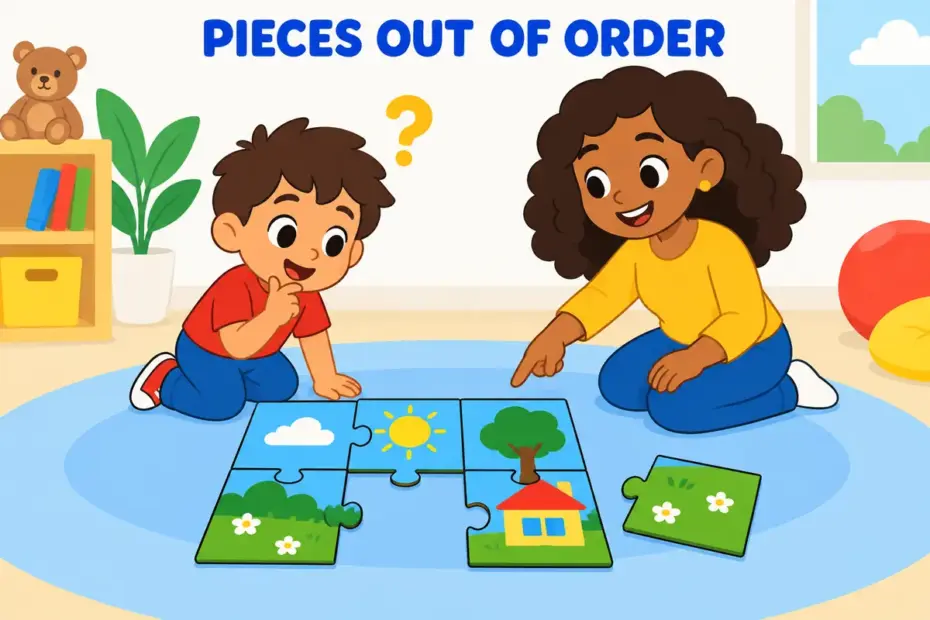
Disjointed in a sentence describes something whose parts do not connect smoothly, so it jumps from one idea to the next. To use disjointed, point at the whole that lacks order rather than a single gap: “The presentation felt disjointed after the slides were reordered.” The adjective usually follows feel, seem or sound.
Disjointed at a glance
- Disjointed is an adjective meaning lacking a smooth connection between parts.
- It describes talks, writing, stories, plans and even movements.
- It commonly follows linking verbs: feel, seem, sound, become.
- It is negative but milder than incoherent, which means the meaning is lost.
- The commonest error is applying it to one small gap instead of the whole.
What does disjointed mean?
Disjointed is an adjective meaning not smoothly connected, so the parts of something do not follow one another in a clear order. The Cambridge entry for disjointed ties it to speech and writing that jump about, and its natural opposite is coherent, where each part leads into the next. Three shades of the word are worth separating.
| Sense | Plain meaning | Example sentence |
|---|---|---|
| Badly ordered | All the parts are present but poorly linked | The film was disjointed after the studio cut two scenes. |
| Lacking logic | Ideas that do not follow from one another | His argument sounded disjointed and unclear. |
| Physically disconnected | Separated at the joints | The disjointed limbs of the puppet lay on the table. |
One limitation deserves stating plainly. Disjointed judges the joins, not the content, so a disjointed essay may still be full of good ideas. It is not a synonym for wrong, dull or difficult, and it is weaker than incoherent, which says the meaning itself has collapsed.
How do you use disjointed in a sentence?
Most sentences attach disjointed to a linking verb or place it before the noun that names the flawed whole. Five patterns cover nearly all of them.
| Pattern | Example | What it signals |
|---|---|---|
| feel, seem or sound + disjointed | The meeting felt disjointed. | The everyday predicative pattern. |
| a disjointed + noun | a disjointed narrative | Attributive; names the flawed whole. |
| become disjointed | The talk became disjointed after the questions. | Marks a change over time. |
| leave + noun + disjointed | Poor editing left the report disjointed. | Names the cause of the break. |
| as disjointed as | The notes were as disjointed as a spilled jigsaw. | A comparison that makes the flaw vivid. |
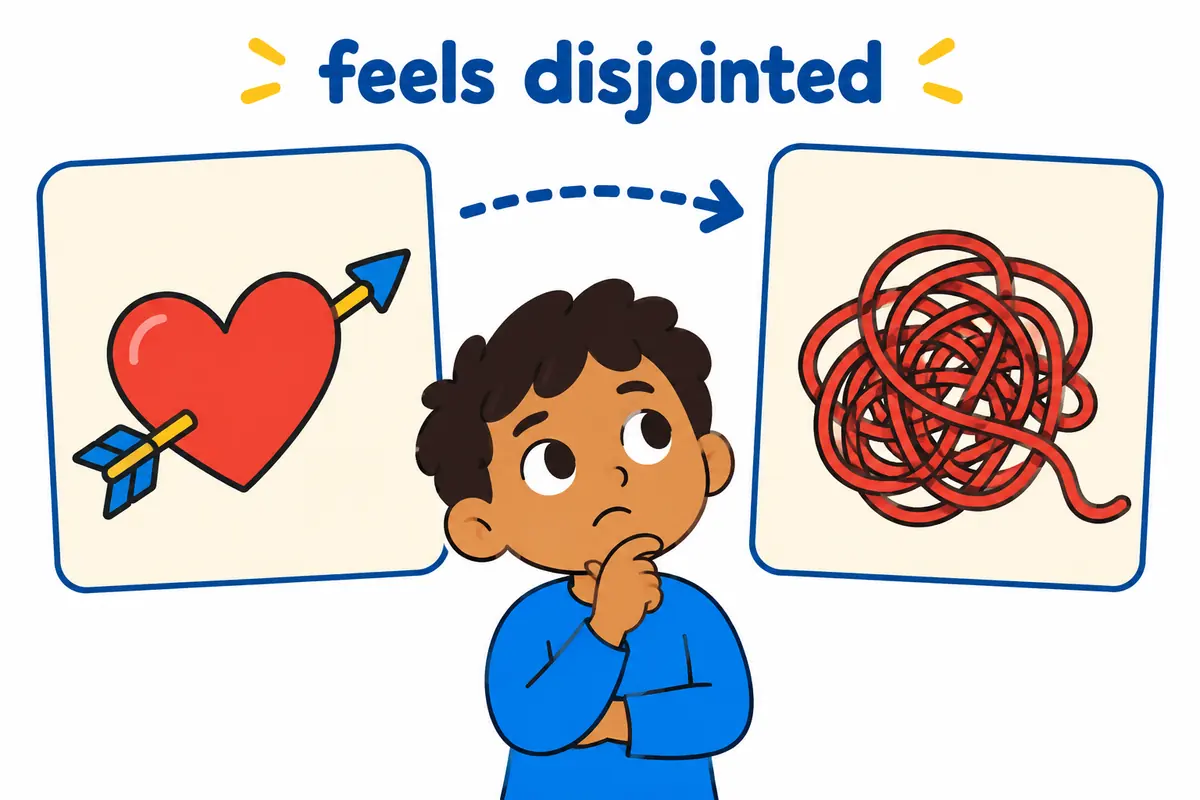
Disjointed in a sentence: examples across contexts
The adjective keeps its meaning while the setting changes, and each sentence below names a whole whose parts fail to link. Watch how often the sentence also names the cause.
| Context | Example sentence | Why this works |
|---|---|---|
| Classroom | The group project felt disjointed because nobody shared the plan. | Names the cause behind the poor joins. |
| Workplace email | Her update read as disjointed after the deadline slipped. | Uses read as to judge the writing itself. |
| News report | Critics called the season disjointed and hard to follow. | Shows the word in a published verdict. |
| Film review | The middle act is disjointed, jumping between three cities. | Illustrates the jumps with a concrete list. |
| Academic prose | A disjointed argument loses the reader before its conclusion. | Connects the flaw to a real consequence. |
| Music writing | The album is disjointed, its songs recorded years apart. | Offers an external reason for the gaps. |
| Conversation | Our chat was disjointed because we kept getting interrupted. | Shows the everyday predicative use. |
| Sports report | The team’s disjointed display lacked any pattern. | Applies the adjective to movement and play. |
| Public speaking | The speech became disjointed once the teleprompter failed. | Uses became to mark the change. |
| Therapy notes | Sleep loss can leave thinking disjointed and slow. | Uses the word for mental flow, not writing. |
| Design brief | A disjointed layout confuses readers within seconds. | Extends the word to visual arrangement. |
| Book review | The memoir is moving but disjointed in its timeline. | Praise and criticism in one balanced sentence. |
Disjointed vs incoherent
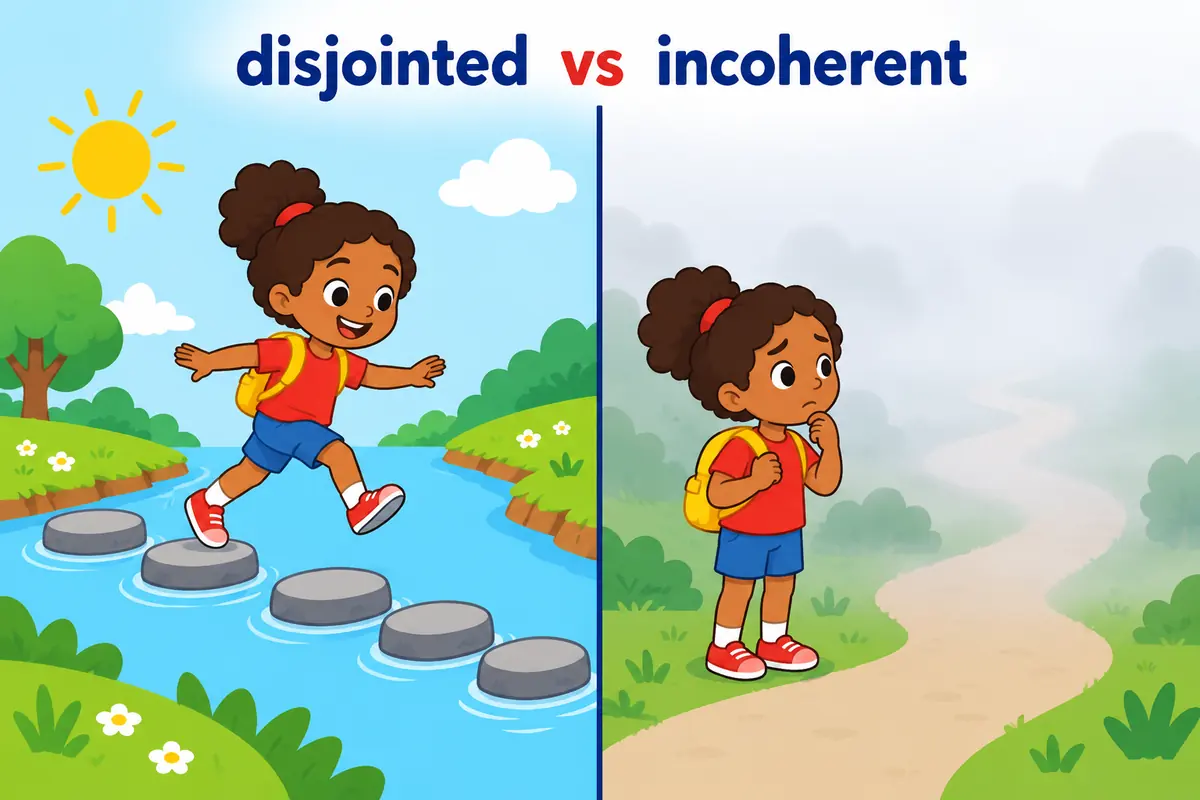
Disjointed and incoherent both criticise order, but they differ in degree. When a text is disjointed, the separate parts still make sense on their own and only the links fail. When it is incoherent, the meaning itself collapses and even single sentences stop making sense. The word scattered describes things spread out in space rather than poorly linked in sequence.
| Attribute | disjointed | incoherent |
|---|---|---|
| Core meaning | Parts poorly connected | Meaning impossible to follow |
| Degree | Mild to moderate | Severe |
| What survives | The parts still make sense alone | Even the parts stop making sense |
| Typical nouns | narrative, talk, plan, movement | argument, speech, rage, text |
| Opposite | smooth, coherent | coherent, lucid |
Verdict: reach for disjointed when the pieces exist but the joins are wrong, and for incoherent when the audience cannot recover the meaning at all.
Disjointed in writing and in speech
Writing becomes disjointed through editing more often than through weak ideas. When a paragraph is moved or a transition deleted, the sentences may each be fine while the sequence stops flowing, and readers feel the stumble even if they cannot name it. A rambling text has the opposite fault, wandering at length without a clear end, yet both leave a reader unable to follow the thread.
Speech is naturally disjointed in a way writing should not be. A conversation jumps because speakers interrupt, change their minds and answer questions that were never finished, and listeners rebuild the sense from context. A transcribed talk therefore looks more disjointed than it sounded, which is one reason transcripts are poor models for written style.
The practical fix for a disjointed draft is not prettier sentences but clearer links. Name the relationship between each part with a transition, an order word or a repeated subject, so the reader knows why the next sentence follows. If the links are genuine, the prose reads smoothly even when the underlying ideas are complex.
Word forms and grammar of disjointed
Disjointed is the past participle of the verb disjoint used as an adjective, and it forms a small, tidy family. The rarer verb disjoin means to separate things that belonged together.
| Form | Part of speech | Example |
|---|---|---|
| disjointed | adjective | The essay was disjointed. |
| disjointedly | adverb | He spoke disjointedly for ten minutes. |
| disjointedness | noun | The disjointedness of the plot confused readers. |
| disjoint | verb | To disjoint means to separate at the joints. |
| disjoin | verb, rare | Careful editors disjoin the strands before rebuilding them. |
Common mistakes with disjointed
- Incorrect:
The report had a disjointed paragraph on page three.Correct: The report was disjointed around page three. Rule: The word judges a whole, not a single paragraph. - Incorrect:
His talk was disjointed and completely impossible to understand.Correct: His talk was incoherent and impossible to understand. Rule: If the meaning is lost, incoherent is the stronger and correct word. - Incorrect:
The chairs were disjointed across the hall.Correct: The chairs were scattered across the hall. Rule: Scattered describes things spread out; disjointed describes poor links. - Incorrect:
The plan is very disjointed.(when only one step is missing) Correct: The plan has one missing step. Rule: Disjointed describes many weak joins, not a single gap. - Incorrect:
She disjointed the meeting by asking a question.Correct: Her question broke the flow of the meeting. Rule: The adjective rarely works as an active verb about a person. - Incorrect:
The disjointed film was boring.Correct: The disjointed film was hard to follow. Rule: The adjective marks poor order, not lack of interest.
Practice using disjointed
Work through the eight items, then check the reasoning rather than only the answer.
- Fill the gap: The interview felt ______ because the recorder stopped twice.
- Choose the better word: After the flood destroyed half the archive, the records were (disjointed / incoherent).
- Correct the error: The essay was disjointed and no reader could follow a single sentence.
- Build a sentence: use became disjointed about a rehearsal that lost its rhythm after a break.
- Spot the register: which belongs in a formal review, the second act is disjointed, or the second act is all over the shop?
- Rewrite with the noun: The plot was disjointed. Use disjointedness.
- Choose the better word: The scattered toys lay (disjointed / scattered) across the floor.
- Build a sentence: use as disjointed as to compare a set of notes with a shuffled deck.
Answers
- disjointed — the parts exist but the recording broke their connection.
- incoherent — the records no longer made sense, which is stronger than disjointed.
- The essay was incoherent and no reader could follow a single sentence — incoherent fits a total loss of meaning.
- Model answer: The rehearsal became disjointed after the lights failed and the cast lost its places.
- The second act is disjointed — a formal review avoids the idiom all over the shop.
- The disjointedness of the plot confused readers — the noun names the quality itself.
- scattered — scattered describes objects spread out, not poorly linked.
- Model answer: The notes were as disjointed as a deck of cards dropped on the floor.
The bottom line
Use disjointed in a sentence when the parts of something exist but their connections fail, and let the sentence name the whole rather than a single gap. Two nuances decide most sentences: the word judges the joins rather than the content, since a disjointed draft can still hold good ideas, and its natural home is a linking verb such as feel, seem or become. A piece that reads well is one whose parts form a connected chain, and when the meaning itself has collapsed, incoherent is the accurate choice.
Frequently asked questions about disjointed
Is disjointed a formal word?
Disjointed works in both formal and everyday English, though reviews, reports and academic writing use it most. It is neutral in tone rather than slangy, so a film review and a staff email can both say the result felt disjointed without sounding out of place or too casual.
What is the difference between disjointed and disconnected?
Disconnected means simply not joined, and it can be a factual statement about wires, ideas or people. Disjointed adds the judgement that the parts should have connected but do not flow. Every disjointed thing is disconnected in a sense, but a deliberately disconnected set of facts need not be disjointed.
Can a person be described as disjointed?
People are described as disjointed mainly through their output, such as disjointed speech, disjointed thinking or a disjointed performance. The word is not usually applied to a person as a character trait. Say the speaker sounded disjointed rather than the speaker was a disjointed person.
Does disjointed always mean badly organised?
Not always. It can describe something physically separated at the joints, as in the disjointed parts of a puppet. In most modern use, though, the word means poorly linked, so a reader meeting it about writing, a talk or a plan should read it as a comment on order.