Equitable means fair and impartial, treating everyone by the same consistent standard rather than by favour. To use equitable in a sentence, attach it to the thing being shared, such as pay, access or a settlement: “The committee asked for an equitable split of the funds.” The adjective describes the decision, not the person who makes it.
Equitable at a glance
- Equitable is an adjective; its adverb is equitably, its noun is equity, and its opposite is inequitable.
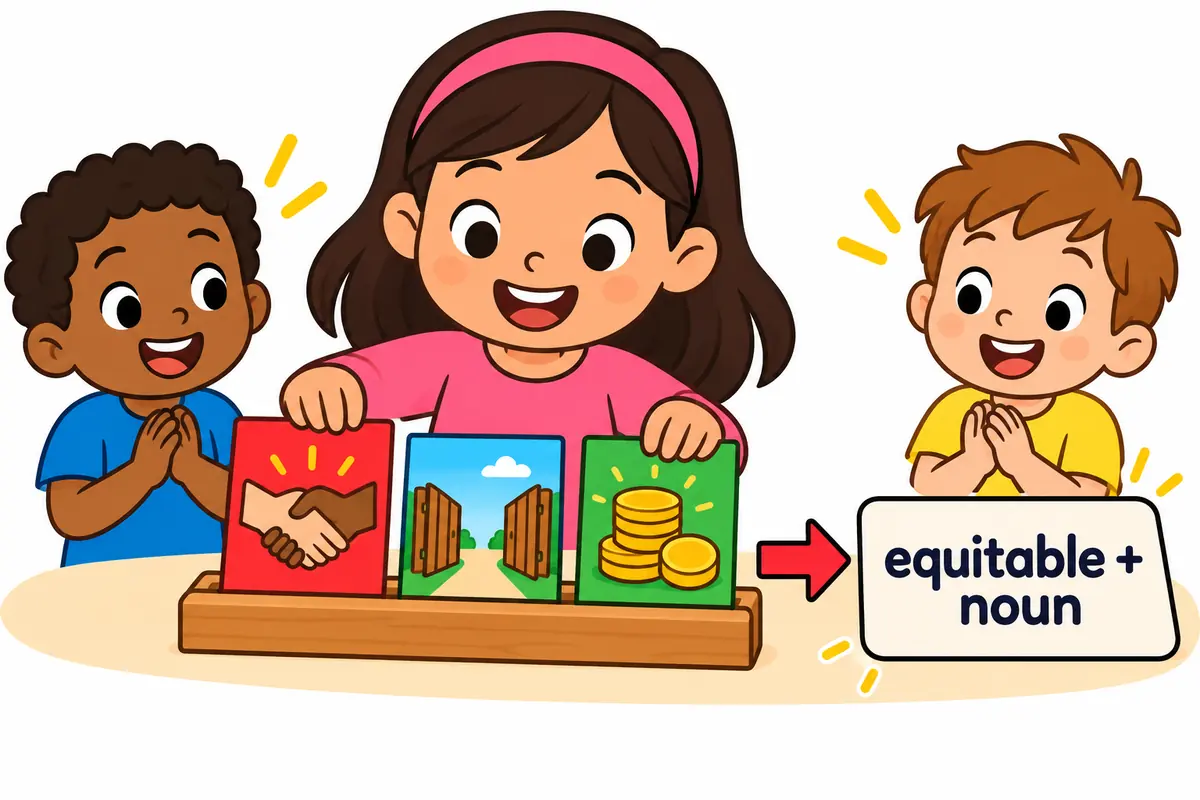
- The adjective usually sits directly before its noun: an equitable settlement, equitable access, equitable pay.
- It describes a fair process or outcome, not identical amounts handed to everyone.
- Equitable belongs to formal writing, especially law, policy, human resources and public administration.
- The commonest learner error is treating equitable and equal as interchangeable.
- The legal sense refers to remedies and principles of equity rather than to strict statute.
What does equitable mean?
Equitable is an adjective meaning fair and reasonable because it applies one consistent standard to everyone affected. Most dictionaries give two linked senses, and the second is the one lawyers and policy writers lean on. The Cambridge entry for equitable records both the everyday sense of fair treatment and the legal sense grounded in equity, so an impartial referee and an equitable rule belong to the same idea.
| Sense | Plain meaning | Example sentence |
|---|---|---|
| Fair and impartial | Applies the same consistent standard to all | The supervisor drew up an equitable rota for weekend shifts. |
| Legally just | Rests on principles of equity rather than strict statute | The court awarded an equitable remedy to the tenant. |
| Balanced in distribution | Shares a cost or benefit in fair proportion | An equitable share of the river water was agreed upstream. |
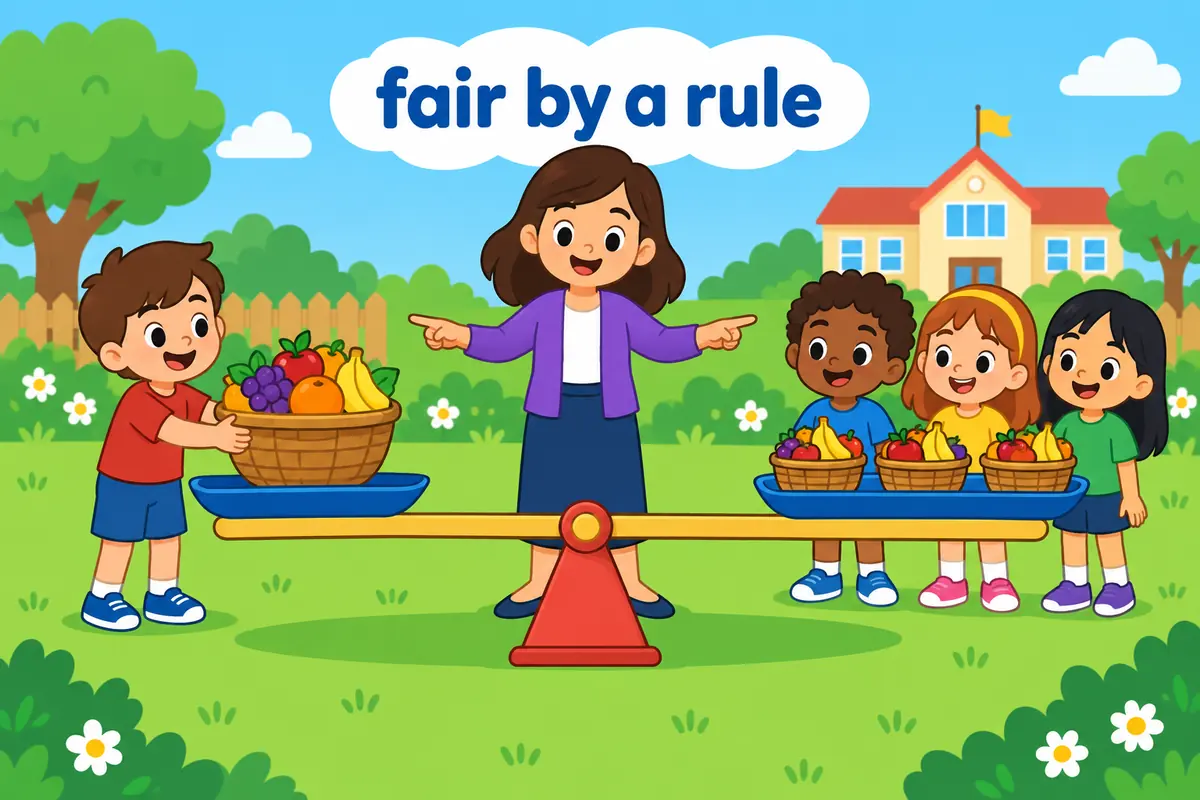
One limitation deserves stating plainly. Equitable does not mean identical, and it does not describe a generous person. An equal share gives every person the same amount, while an equitable split gives each person what fairness requires, and the two answers can differ sharply when needs or contributions differ.
How do you use equitable in a sentence?
Equitable is a descriptive adjective, so it normally sits immediately before the noun it judges and rarely needs a preposition of its own. Five patterns cover almost every real sentence, and the first is by far the most frequent.
| Pattern | Example | What it signals |
|---|---|---|
| equitable + noun | The board reached an equitable settlement. | The quality sits on the decision itself. |
| verb + equitable + noun | Residents demanded equitable access to the archive. | Names the thing being shared fairly. |
| make + something + equitable | The mediator tried to make the fee structure equitable. | Focuses on the process of adjustment. |
| it is equitable to + verb | It is equitable to charge larger households more. | States a judgement with an infinitive. |
| equitable + between / among | The will was equitable between the three cousins. | Names the parties doing the sharing. |
A quick test separates the two near-synonyms: replace equitable with fair and the sentence still reads naturally, but replace it with equal and the meaning shifts. The adjective almost never takes a preposition, which is why equitable to sounds wrong while equal to does not.
Equitable in a sentence: examples across contexts
Equitable keeps its meaning across registers but changes its neighbours. The nine sentences below move from a classroom to a tribunal, and each one names the thing being shared fairly.
| Context | Example sentence | Why this works |
|---|---|---|
| Classroom | The pupils agreed on an equitable way to share the art supplies. | The noun way keeps the focus on the method, not the materials. |
| Workplace email | We need an equitable schedule for the holiday rota. | The adjective modifies a plan, which is its most natural role. |
| News report | The inquiry found the funding formula was not equitable across districts. | A negated form suits reporting that exposes an inconsistency. |
| Legal writing | The court imposed an equitable charge on the property. | Uses the technical sense tied to equity rather than fairness alone. |
| Policy document | The rules aim at more equitable access to public transport. | Pairs the adjective with a goal, the standard policy pattern. |
| Academic prose | A theory of justice treats equitable distribution as a matter of fair procedure. | Keeps the claim impersonal and the standard procedural. |
| Human resources | An equitable review process scores every applicant against the same rubric. | Names the instrument that makes the outcome consistent. |
| Environment report | An equitable treaty shares the clean-up cost among all polluters. | Shows proportional sharing rather than identical payments. |
| Conversation | My sister thought the chore chart was the most equitable solution. | The only everyday setting where the word still sounds comfortable. |
Only the last sentence carries a personal opinion. That asymmetry is the clearest signal of where the word lives: equitable thrives in impersonal, written rules and thins out as speech becomes casual.
Two further observations help writers. The adjective never takes an article of its own, so an equitable settlement and equitable access are both correct while an equitable access is not. Equitable also prefers nouns of sharing such as access, distribution, share and settlement, which is why it clusters in policy writing.
Equitable vs fair
Fair is the plain word and equitable is its formal cousin; they overlap constantly but are not synonyms. Fair treatment is the everyday phrase, able to describe a feeling, a bargain or a person, while equitable belongs to the language of written rules and distributions.
| Attribute | equitable | fair |
|---|---|---|
| Register | Formal, legal and policy writing | Neutral, everyday through to formal |
| Precision | Tied to consistent rules and proportional shares | General; can mean reasonable or just |
| Typical subject | A decision, formula, settlement or process | A person, a price, a game or a judgement |
| Implies measurement | Yes; invites comparison of shares or outcomes | Not necessarily |
| Opposite | inequitable | unfair |
Equitable names the rule, while a biased decision names the person who ignores it. An unbiased reader still needs the shared standard spelled out, because the adjective asserts consistency without proving it.
Verdict: choose fair in conversation and general prose, and equitable when a written rule distributes something and you want to stress that the method treats every case the same way.
Word forms and grammar of equitable
Equitable changes shape across four related words, and the noun is the one most often used where the adjective is needed. The table sets out each form and the role it plays.
| Form | Part of speech | Example |
|---|---|---|
| equitable | adjective | The panel proposed an equitable division of the estate. |
| equitably | adverb | The estate was divided equitably among the heirs. |
| equity | noun | The charity works for equity in school funding. |
| inequitable | adjective, opposite | The old policy was plainly inequitable. |
| inequity | noun, opposite | The report measured inequity between regions. |
Do not stretch the adjective into equitableness when you need the noun, and do not use equity where equitable is required: equity is the thing you seek, while equitable describes how the arrangement works.
Common mistakes with equitable
- Incorrect:
The teacher gave equitable pencils to every child.Correct: The teacher gave equal pencils to every child. Rule: Identical amounts are equal; equitable describes the fairness of the rule, not the count. - Incorrect:
The decision was full of equitableness.Correct: The decision was perfectly equitable. Rule: The adjective ends in -able and the noun is equity, so equitableness is not used. - Incorrect:
They treated the workers equitable.Correct: They treated the workers equitably. Rule: An adverb modifies a verb, so the -ly form is required after treated. - Incorrect:
He is an equitable person.Correct: He is a fair person. Rule: Equitable describes arrangements and decisions, not personality. - Incorrect:
The manager wanted equity treatment for all staff.Correct: The manager wanted equitable treatment for all staff. Rule: Before a noun you need the adjective equitable, not the noun equity.
Practice using equitable
Work through the six items, then read the reasoning rather than only the answer.
- Fill the gap: The charity called for ______ access to clean water.
- Choose the better word: Each child received an (equal / equitable) slice of cake, exactly the same size.
- Correct the error: The referee was equitable in every decision.
- Build a sentence: use equitable + noun about sharing playground time.
- Spot the register: which belongs in a council report, the city needs equitable bus funding, or the bus money should be shared out fairer?
- Rewrite with the noun: The teacher arranged the groups equitably. Use equity instead.
Answers
- equitable — the blank precedes a noun and names a fair distribution, the adjective’s core use.
- equal — the slices are identical, so the count word applies rather than the fairness word.
- The referee was fair in every decision — equitable describes rules and outcomes, not people.
- Model answer: The teacher drew up an equitable plan for playground time.
- The city needs equitable bus funding — a council report favours the formal adjective over shared out fairer.
- The teacher arranged the groups with equity in mind — equity is the noun that names the fairness.
The bottom line
Use equitable in a sentence when a decision or rule distributes something fairly and consistently, and let the adjective sit before its noun. The two nuances that decide most sentences are these: equitable describes methods and outcomes rather than people, and it is not the same as equal, because fairness can require unequal shares. Where a plainer word will do and no written rule is involved, fair is the better choice, and where the wrong is plain an unjust arrangement is the phrase to reach for.
Frequently asked questions about equitable
Is equitable the same as equal?
No. Equal means the same amount for everyone, while equitable means fair according to a consistent standard. A teacher who gives every pupil the same book offers an equal share; a teacher who gives extra help to a pupil learning English is being equitable, because fairness can require different treatment.
Can equitable describe a person?
Rarely, and it sounds wrong in modern prose. Equitable describes decisions, rules, settlements and processes, not personalities, so a fair-minded colleague is described as fair rather than equitable. When writers do apply it to people, the effect is dated and legalistic, which is why style guides steer the adjective towards the arrangement instead.
What is the opposite of equitable?
The adjective opposite is inequitable, and the noun opposite is inequity. Both keep the same root and the same negating prefix. A court may overturn an inequitable contract, and a report may measure inequity between two neighbourhoods, so choose the adjective or the noun to match the sentence you need.
When should I use equitable instead of fair?
Use equitable in formal writing about rules, distributions and legal remedies, where you want to stress that one consistent standard applies. Use fair everywhere else, especially in speech, where equitable sounds bureaucratic. A tribunal writes of an equitable remedy, while a friend says the split was fair.