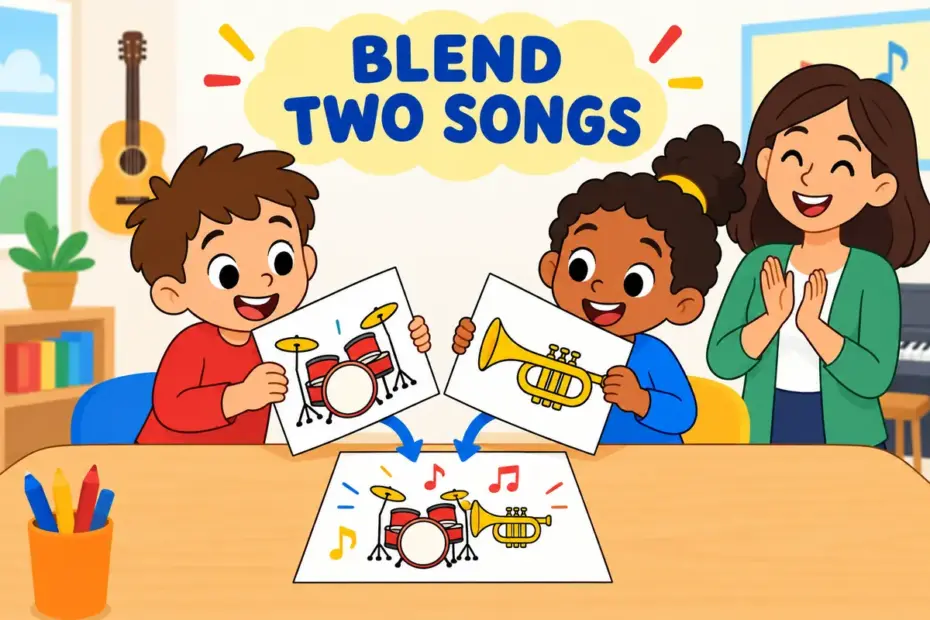
Mash up means to combine separate things, especially songs, pictures or ideas, into one new whole. To use mash up in a sentence, let it take a direct object and choose where the particle goes: “The DJ mashed two old songs up into one track.” A second, older sense means to crush food into a soft pulp.
Mash up at a glance
- Mash up is a transitive phrasal verb; its object is always expressed.
- It is separable: mashing the songs up and mashing up the songs are both correct.
- With a pronoun the particle must follow the object: mash them up, never mash up them.
- The creative sense combines finished works; the kitchen sense crushes food into pulp.
- The noun is usually written mash-up or mashup, but the verb stays two words.
- The register is informal and journalistic rather than academic.
What does mash up mean?
Mash up is a phrasal verb meaning to combine separate works or ingredients into one new thing. The Cambridge entry for mash up records both the creative sense and the cookery sense, and the two are closer than they look, because each one presses different things into a single mass. Where the parts stay recognisable and equal, blend is the quieter verb.
| Sense | Plain meaning | Example sentence |
|---|---|---|
| Combine creative works | Fuse finished songs, clips or styles into one piece | The producer mashed up two dance tracks. |
| Crush food | Press soft food until it forms a pulp | Mash up the banana for the baby. |
| Noun: a combination | A single piece made from mixed sources | The show was a mash-up of drama and dance. |
One limitation is worth stating plainly. Mash up is informal, and it belongs to music, media and cooking. In a formal report, combine or merge does the same job without the playful tone, so a policy paper would never speak of mashing up two budgets.
How do you use mash up in a sentence?
Mash up is a separable phrasal verb, which is the single most useful fact about it. The object may sit after the whole phrase or between the verb and its particle, but a pronoun can only go in the middle. Five patterns cover almost every real sentence.
| Pattern | Example | What it signals |
|---|---|---|
| mash up + object | The editor mashed up three news clips. | The default order, particle next to the verb. |
| mash + object + up | The editor mashed three news clips up. | The same meaning with the object moved in. |
| mash + pronoun + up | Mash them up in one pot. | Pronouns must sit between verb and particle. |
| be mashed up | The tracks were mashed up by a student. | Passive voice, used when the maker is unknown. |
| mash up + into | She mashed up two genres into one song. | Names the single result the parts become. |
Separability changes the rhythm of a sentence rather than its meaning, so a careful writer chooses the order that keeps the object closest to the reader. The passive, be mashed up, appears in reviews when the maker matters less than the result, as in the two themes were mashed up beyond recognition.
Mash up in a sentence: examples across contexts
Mash up changes its neighbours across registers but keeps the sense of pressing separate parts together. The nine sentences below move from a kitchen to a media report, and each one shows the particle in a slightly different place.
| Context | Example sentence | Why this works |
|---|---|---|
| Kitchen | Mash up the avocado with a fork and a little salt. | The recipe sense, object after the particle. |
| Music class | The pupils mashed two folk tunes up into one round. | A separable verb in a school setting. |
| Radio review | The album is a mash-up of jazz, folk and drum machine. | The noun is hyphenated and names the whole. |
| Video editing | She mashed up the interviews into a two-minute film. | Combines separate clips into a finished piece. |
| News report | Protesters mashed up two famous slogans on their signs. | Shows the verb applied beyond music. |
| Food writing | Mash them up with butter until the lumps disappear. | The pronoun sits correctly between verb and particle. |
| Fashion prose | The collection mashes up school uniform and evening wear. | A present-tense journalistic use. |
| Classroom | Mash the pictures up and deal them again. | An imperative with the object moved in. |
| Conversation | I mashed up your playlist with mine and it works. | The everyday creative sense, first person. |
The particle up in mash up does not mean upward, and the same is true of other verbs built on it. To add up figures is to total them, and to back up a file is to copy it, so the particle carries the idea of completeness rather than direction.
Mash up vs mix
Mix is the broader word and mash up is the more vivid one. Mixing can be neat and reversible, as when you mix paints on a palette, while a mash up fuses separate finished things into a new whole whose parts still show. Both are informal to neutral, but only mash up carries a hint of playful collision.
| Attribute | mash up | mix |
|---|---|---|
| Core meaning | Fuse separate works or foods into one | Put elements together in any proportion |
| Are the parts recognisable | Usually yes, and that is the point | Sometimes, and often deliberately hidden |
| Typical objects | Songs, clips, styles, soft food | Ingredients, colours, signals, social groups |
| Transitivity | Transitive and separable | Transitive and generally not separable |
| Register | Informal, media and kitchen | Neutral, usable anywhere |
Verdict: choose mix when the elements simply go together, and mash up when the joining is the whole event and the sources are meant to be heard in the result.
The reverse operation, to split one whole into separate parts, comes from a different family of verbs, which is why mash up has no natural opposite and is defined by what it joins rather than what it breaks.
Word forms and grammar of mash up
The verb and the noun are written differently, and that spelling split trips up more writers than the grammar does. The table sets out each form and the job it does.
| Form | Part of speech | Example |
|---|---|---|
| mash up | phrasal verb, two words | They mash up two songs every week. |
| mashed up | verb, past and participle | The chef mashed up the potatoes. |
| mashing up | verb, present participle | She is mashing up the clips now. |
| mash-up / mashup | noun, hyphenated or joined | The track is a clever mash-up. |
| mash | verb alone, to crush | Mash the fruit before you add it. |
Keep the two-word spelling for the action and the hyphen or the joined form for the thing, and never write a noun as mash up in edited prose. When a pronoun is the object, the particle still follows it: mash it up, not mash up it.
Common mistakes with mash up
- Incorrect:
Mash up it before serving.Correct: Mash it up before serving. Rule: A pronoun object must sit between the verb and the particle. - Incorrect:
The song is a mash up of two hits.Correct: The song is a nice mash-up of two hits. Rule: The noun is hyphenated or joined, not two loose words. - Incorrect:
She mashed up.Correct: She mashed up the tracks. Rule: The verb is transitive, so the object cannot be left out. - Incorrect:
We mash up the budget for next year.Correct: We combine the two budgets for next year. Rule: Mash up is informal and does not suit a formal document. - Incorrect:
He mashed up to the top of the hill.Correct: He mashed the potatoes up. Rule: The up does not mean upward, so mash up never describes movement.
Practice using mash up
Work through the six items, then read the reasoning rather than only the answer.
- Fill the gap: The producer ______ two old songs up into one track.
- Choose the better word: The recipe says to (mash up / mix up) the bananas until smooth.
- Correct the error: Please mash up them for the baby.
- Build a sentence: use mash + object + up about two class posters.
- Spot the register: which belongs in a music review, the single is a bold mash-up of two styles, or the single mixes up two styles a lot?
- Rewrite with the noun: The artist mashed up three paintings. Use mash-up instead.
Answers
- mashed — the past tense is needed, and the particle follows the verb.
- mash up — the fruit is pressed into a pulp, which is the kitchen sense.
- Please mash them up for the baby — the pronoun goes between verb and particle.
- Model answer: The pupils mashed two class posters up into one display.
- The single is a bold mash-up of two styles — a review prefers the hyphenated noun.
- The artist made a mash-up of three paintings — the noun names the finished thing.
The bottom line
Use mash up in a sentence when separate works or foods are pressed into one new whole, and remember that the verb is separable while the noun is hyphenated. The two nuances that decide most sentences are these: a pronoun object must sit between mash and up, and the particle never means upward, so the word describes joining rather than movement. For a neutral statement of the same idea, merge the parts or combine them.
Frequently asked questions about mash up
Is mash up one word or two?
The verb is two words, as in they mash up two songs, while the noun is usually written mash-up with a hyphen or mashup as one word. The split follows what the word is doing: an action stays open, and a thing that results from the action is joined or hyphenated.
Is mash up a separable phrasal verb?
Yes. The object can go after the whole phrase or between the verb and the particle, so mash up the tracks and mash the tracks up are both correct. A pronoun, however, must stay in the middle, which is why we say mash them up and never mash up them.
What does a mash-up mean in music?
In music a mash-up is a track built by combining parts of two or more finished songs, so the original sources remain recognisable inside the new piece. The technique grew out of DJ culture, where blending familiar vocals over an unrelated backing track became a form of commentary in itself.
Can mash up be used formally?
Not comfortably. Mash up carries a playful, informal tone that suits music writing, recipes and casual conversation. A formal report would say that two budgets were combined, that two datasets were merged, or that styles were blended, keeping the precise verb and leaving the informal phrase for discussion.