
Esteem means respect and admiration, and as a verb it means to respect and admire someone. In a sentence the noun usually appears in the fixed frame hold someone in high esteem, while the verb is formal and takes a direct object. A teacher might say she esteems her students’ honesty.
Esteem at a glance
- Esteem is both a noun and a verb; the noun means respect and admiration and the verb means to respect and admire.
- The forms are esteems, esteemed and esteeming, and the adjective esteemed is far more common than the verb.
- As a noun it almost always follows the preposition in, as in hold someone in high esteem.
- The verb is transitive, so every sentence must name the person or quality that is esteemed.
- Self-esteem is a fixed compound noun meaning a person’s judgement of their own worth.
What does esteem mean?
Esteem is a noun and a verb. The noun means a feeling of respect and admiration for someone, and the verb means to respect and admire them. The Cambridge entry for esteem records both parts of speech, and the split matters in practice: the noun does the everyday work, while the verb survives mainly in formal writing. As a noun it also names the admiration a person earns over time, so it sits close to a feeling of admiration. The noun also grades the height of the regard, which is why high and low sit naturally before it.
| Sense | Plain meaning | Example sentence |
|---|---|---|
| Noun: respect and admiration | A high opinion earned by qualities or conduct | The whole school holds the head teacher in high esteem. |
| Verb: to respect and admire | To think highly of someone or something | Historians esteem her for the reforms she passed. |
| Compound noun: self-esteem | A person’s sense of their own worth | Steady praise can protect a child’s self-esteem. |
One limitation is worth stating. Esteem is not the same as affection or love, because a person can be esteemed without being liked. The feeling responds to qualities such as honesty or skill rather than to warmth. Its opposite, contempt, is an active lack of respect, and the verb is too formal for casual speech, where respect or admire is the plainer choice.
How do you use esteem in a sentence?
The noun is almost fixed: hold someone in esteem. The verb is freer but formal, and it always needs a direct object. The five patterns below cover nearly every natural sentence, and the first two are the ones a learner should master first.
| Pattern | Example | What it signals |
|---|---|---|
| hold + person + in + esteem | The staff hold the director in high esteem. | The fixed noun phrase, and the commonest use. |
| be held in + esteem | She is held in high esteem by her peers. | Passive form, which keeps attention on reputation. |
| esteem + person or quality | Few critics esteem the later novels. | The formal verb with a direct object. |
| high or low + esteem | The new policy met with low esteem among teachers. | An adjective grades the noun. |
| self-esteem | Steady praise protects self-esteem. | The compound noun names self-worth. |
Notice that nothing comes between in and esteem, and that the verb never takes an infinitive: a sentence says critics esteem the novels, not critics esteem the novels to be good. Where the tone is everyday, value someone’s judgement is the natural substitute and keeps the sentence plain. The adjective highest softens the frame into the kind of superlative praise a formal letter can carry.

Esteem in a sentence: examples across contexts
Esteem changes little across registers, so the sentences below keep the word still while the setting moves. A close cousin, honor someone, stresses public recognition, while esteem describes the quieter high opinion behind it.
| Context | Example sentence | Why this works |
|---|---|---|
| Classroom | The class holds the visiting author in high esteem. | Uses the fixed noun frame in a familiar setting. |
| Workplace email | The board holds the retiring engineer in the highest esteem. | A formal compliment that suits professional writing. |
| News report | The judge is held in high esteem across the legal community. | The passive form keeps the report neutral. |
| Academic writing | Later scholars esteem the theory for its predictive power. | The formal verb with an abstract object. |
| Conversation | I have great esteem for my old coach. | The noun carries praise without sounding stiff. |
| Performance review | Her colleagues esteem her judgement on difficult cases. | The verb reports professional respect. |
| Literature | The villagers held the healer in quiet esteem. | Pairs the noun with a mood adjective. |
| Sports | Fans esteem the captain for staying loyal to the club. | The verb names respect earned through conduct. |
| Charity work | The foundation holds its volunteers in high esteem. | Shows the frame in an organisational context. |
| Public ceremony | The city holds its fire crews in the highest esteem. | A civic register suits the noun. |
| Diplomacy | Both delegations esteem the mediator for her patience. | The verb works between institutions. |
| Family | The children hold their grandfather in affectionate esteem. | A warm adjective softens the formal noun. |
| Mentoring | New teachers hold the head of department in high esteem. | The frame works for professional respect. |
| Community | The village esteems the nurse who stayed through the winter. | The verb reports a collective high opinion. |
Esteem vs respect
Esteem and respect overlap so heavily that many sentences can use either, and the difference is one of warmth and formality. Respect is the plain everyday word, while esteem belongs to formal praise and to the fixed phrase hold in high esteem. Both name admiration for qualities rather than affection.
| Attribute | esteem | respect |
|---|---|---|
| Core job | Admiration earned over time | Admiration or courteous regard |
| Strength | Formal and somewhat literary | Neutral and everyday |
| Register | Formal writing and speeches | Speech and writing alike |
| Typical frame | hold someone in high esteem | show respect for someone |
| Opposite | contempt | disrespect |
| What it implies | A lasting high opinion | Fair treatment and regard |
Verdict: choose respect for almost every everyday sentence, and reach for esteem when the frame hold in high esteem or a formal tone is exactly what you want.
Word forms and grammar of esteem
Esteem inflects regularly, and its most useful relative is the adjective esteemed, which describes a respected person or institution. The verb has no common passive beyond be esteemed, and the table lists the forms learners try to build as well as the ones that work.
| Form | Part of speech | Example |
|---|---|---|
| esteem | base verb and noun | I esteem her patience, and her esteem grew. |
| esteems | third person singular verb | The college esteems its founders. |
| esteemed | past, participle and adjective | He is esteemed for his fairness. |
| esteeming | present participle | Esteeming good work is part of good leadership. |
| self-esteem | compound noun | Sport can build a teenager’s self-esteem. |
| estimable | adjective, formal | An estimable record of public service. |
Keep the word esteemed in mind when a sentence needs an adjective: an esteemed colleague carries the same respect as a colleague held in esteem, and the adjective is far more common than the verb.
Common mistakes with esteem
- Incorrect:
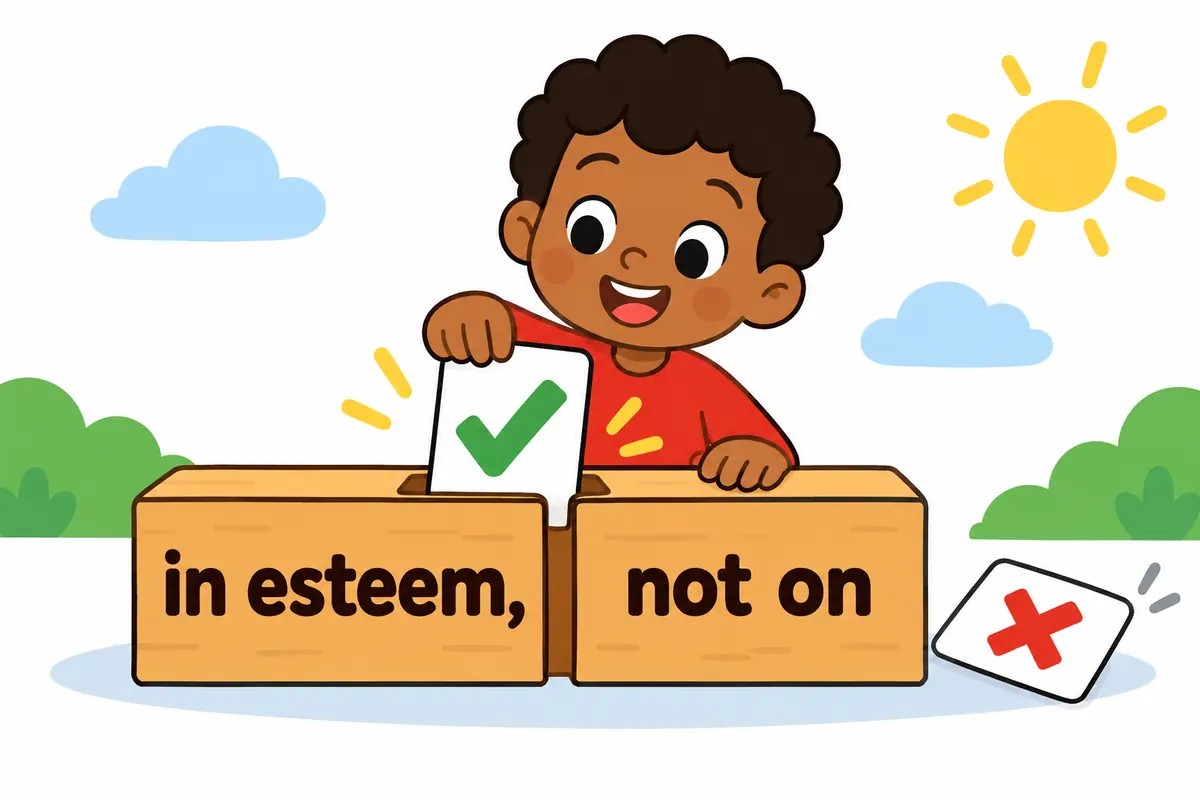
I hold my teacher on high esteem.Correct: I hold my teacher in high esteem. Rule: The noun pairs with in, never on. - Incorrect:
She esteems to be honest.Correct: She is esteemed as honest. Rule: Esteem takes a noun phrase, not an infinitive. - Incorrect:
He esteems that she works hard.Correct: He esteems her hard work. Rule: The verb cannot take a that-clause; name the quality directly. - Incorrect:
Children need self esteem to learn.Correct: Children need self-esteem to learn. Rule: The compound self-esteem is hyphenated. - Incorrect:
My esteem of the team is high.Correct: My esteem for the team is high. Rule: The noun takes for before the person or group admired.
Practice using esteem
Work through the six items, then check the reasoning rather than only the answer.
- Fill the gap: The village ______ the old doctor for treating everyone freely.
- Choose the better word: In a thank-you note, the committee holds the chair in (esteem / contempt).
- Correct the error: The club holds its founder on high esteem.
- Build a sentence: use hold in high esteem about a helpful librarian.
- Spot the register: which fits a speech — The town esteems its volunteers, or The town really likes its volunteers.
- Rewrite with the adjective: The city holds the architect in high esteem. Use esteemed.
Answers
- esteems — the singular subject village takes esteems, and the doctor is the object.
- esteem — contempt is the opposite, and a thank-you note is meant to praise.
- The club holds its founder in high esteem — the noun takes in, not on.
- Model answer: Students hold the librarian in high esteem for tracking down rare books.
- The town esteems its volunteers — a speech keeps the formal verb, while really likes is too casual.
- The city honours an esteemed architect — the adjective replaces the whole phrase.
The bottom line
Use esteem in a sentence as a noun for respect and admiration, and remember that the noun lives inside one fixed frame, hold someone in high esteem. The verb is transitive and formal, so it always names the person or quality it respects. Where the tone is everyday, respect and value are the plainer substitutes, and where the point is self-worth, the compound self-esteem does the job.
Frequently asked questions about esteem
Is esteem a noun or a verb?
Esteem is both. As a noun it means respect and admiration, as in the team holds the coach in high esteem. As a verb it means to respect and admire, as in historians esteem her for the reforms. The noun is far more common in everyday writing, while the verb belongs to formal prose.
What does it mean to hold someone in high esteem?
To hold someone in high esteem means to have a high opinion of them because of their qualities or conduct. The phrase is fixed, so the preposition is always in. A school might hold a long-serving teacher in high esteem for years of patient work with students.
Is esteem the same as respect?
They are close synonyms, but esteem is warmer and more formal. Respect can simply mean treating someone fairly, while esteem always means admiring them. A colleague can be respected for being efficient without being esteemed, because esteem needs a genuine high opinion formed over time.
How is self-esteem different from esteem?
Self-esteem is a compound noun meaning a person’s judgement of their own worth. Esteem on its own is admiration directed at someone else. So a teacher can earn the esteem of colleagues through good work, while a child builds self-esteem through praise and success.