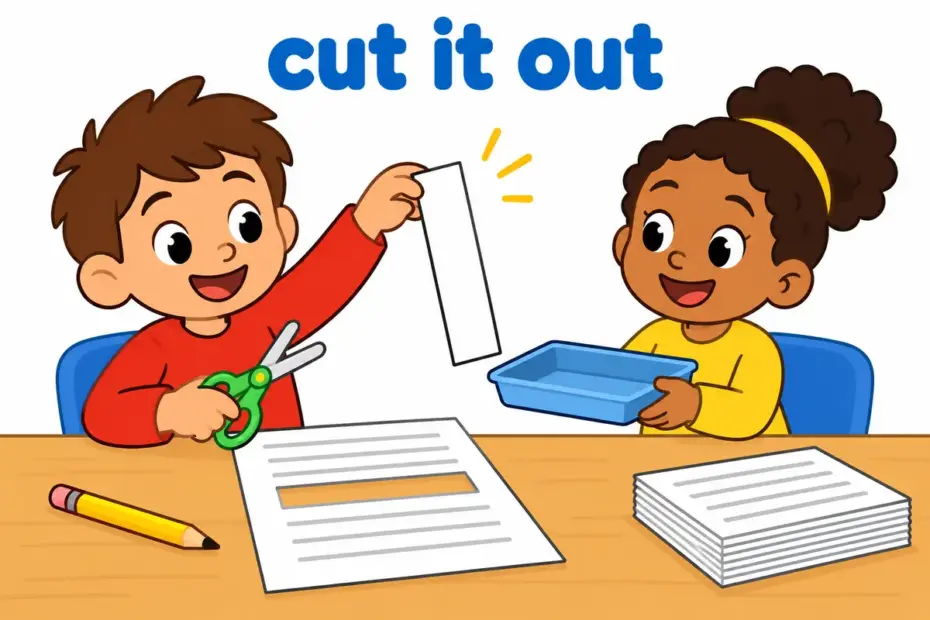
Excise in a sentence refers to cutting something out, and the same spelling names a tax on goods. The verb is transitive and takes from, so you excise a paragraph from an essay or a growth from the body, which makes the removal deliberate and complete. The tax sense is a noun, as in a duty charged on fuel.
Excise at a glance
- Excise is mainly a transitive verb meaning to remove or cut out; it is also a noun for a tax on goods.
- Its forms are excise, excises, excised, excising and the noun excision.
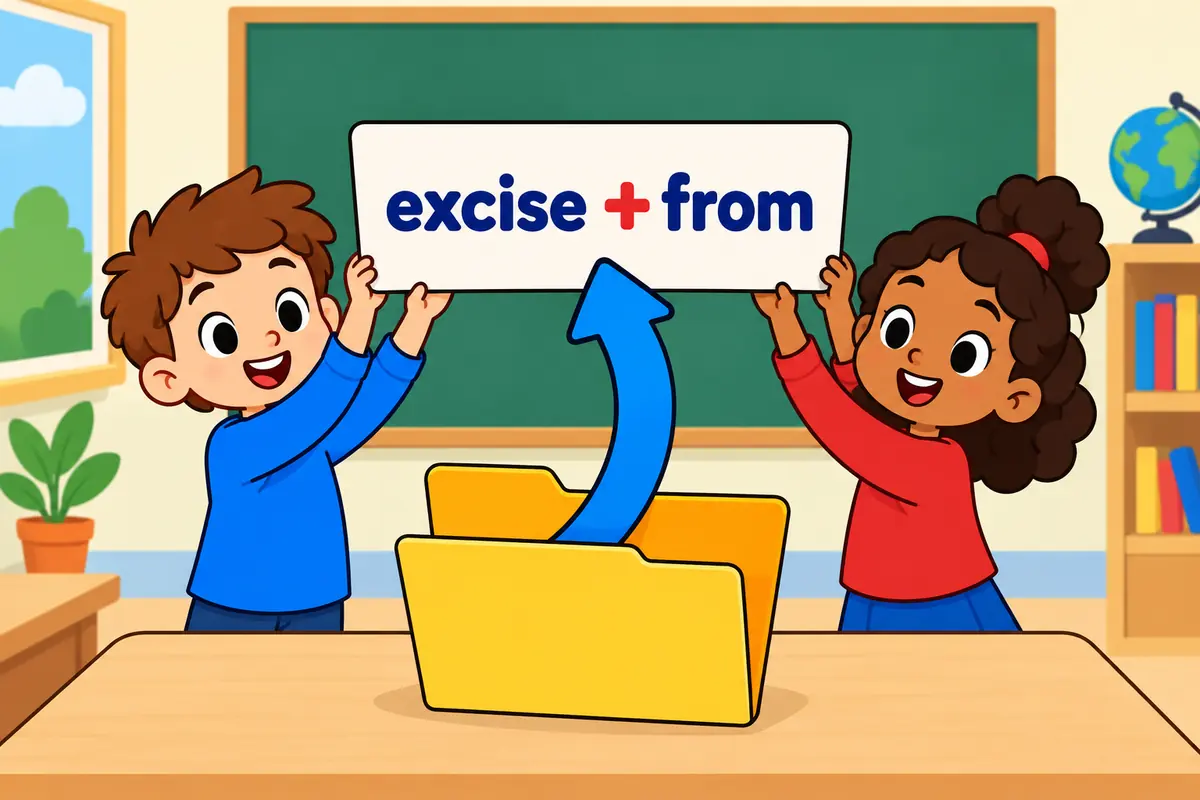
- The verb pattern is excise + object + from + source.
- The noun appears in fixed phrases such as excise duty and excise tax.
- Register: the verb is formal and editorial or medical; the noun is administrative and legal.
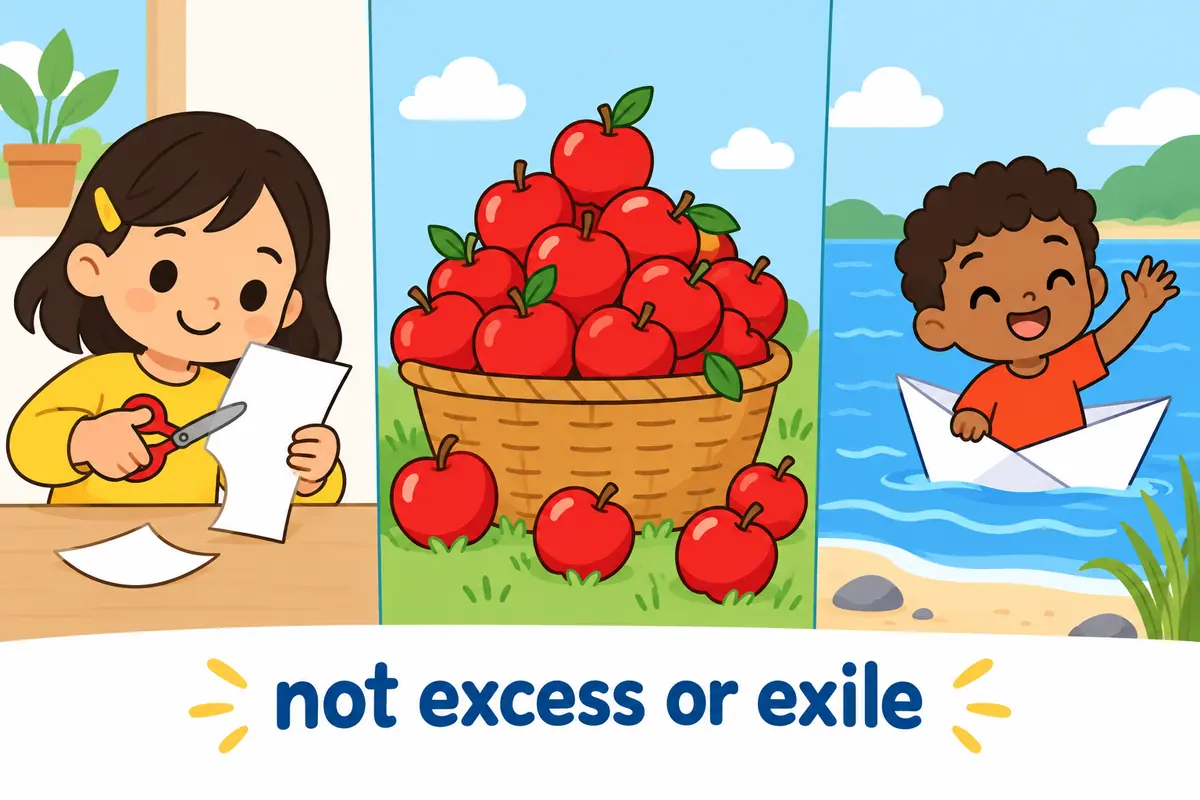
- The nearest lookalikes are excess, a noun for too much, and exile, forced absence.
What does excise mean?
Excise is a verb meaning to remove something completely, usually by cutting, and a noun meaning a tax levied on particular goods. The Cambridge entry for excise separates the two, and they behave very differently: the verb needs an object and a source, while the noun sits in fixed tax phrases. The verb sense is stronger than a tidy edit, because it implies the piece is gone for good.
| Sense | Plain meaning | Example sentence |
|---|---|---|
| Verb, remove | Cut something out completely | The editor excised two paragraphs from the report. |
| Verb, surgery | Remove tissue or an organ | The surgeon excised the mole under local anaesthetic. |
| Noun, tax | A duty charged on certain goods | The budget raised excise on tobacco. |
One limitation is worth stating plainly. Excise does not mean to soften or shorten; it means to take something out entirely. Nor is it spelled like exercise, which is a different word for practice or physical activity.
How do you use excise in a sentence?
The verb takes the thing removed as its object and, in most sentences, a from-phrase to name the source. When the source is obvious the from-phrase can be dropped, but then the reader still needs to know what was removed. The noun never takes an object at all.
| Pattern | Example | What it signals |
|---|---|---|
| excise + object + from + source | The lawyer excised the clause from the contract. | Full pattern, naming what is removed and where from. |
| excise + object | The surgeon excised the growth quickly. | Object only, when the body part is understood. |
| be excised | Three scenes were excised before release. | Passive, keeping attention on the removed material. |
| excise + object + from + record | Editors excised the names from the archive. | Names a formal record as the source. |
| pay excise on + noun | Drivers pay excise on fuel at the pump. | Noun sense, fixed tax pattern. |
Writers who only mean deleting a word or two usually choose the plainer cut a passage, which is less formal than excise but far more common in speech; to erase a mark is gentler and less final again.
Excise in a sentence: examples across contexts
Excise moves easily between editing, medicine and tax administration without changing shape. The sentences below show how the same verb or noun shifts register while the meaning stays put.
| Context | Example sentence | Why this works |
|---|---|---|
| Editorial | The editor excised three sentences that repeated the opening. | The object is the text, and the removal is complete. |
| Medical writing | The surgeon excised the cyst during a short procedure. | Standard clinical verb for removal by cutting. |
| Tax administration | Officials raised excise on imported spirits by two percent. | Noun sense inside a fixed tax phrase. |
| Legal writing | The court excised the offending words from the order. | Formal register, naming the document as source. |
| Academic prose | Reviewers asked the author to excise the unsupported claim. | A claim, not a physical object, can still be excised. |
| Workplace email | Please excise the client names before you share the file. | The request is a formal instruction, softened by please. |
| News report | The censor excised several minutes from the broadcast. | Names an authority doing deliberate removal. |
| Conversation | They excised that whole boring bit from the film. | The verb survives in speech, but sounds deliberate. |
| Historical writing | Later scribes excised the king’s name from the chronicle. | The object is a name, the source a written record. |
| Science writing | The protocol excises the ambiguous step from the method. | A procedure can be the thing cut out, not only text. |
| Sports reporting | The replay editor excised the disputed frame from the clip. | One small unit is removed from a longer record. |
Excise vs excess and exile
Three words share the shape ex- and trip up spellers. excess is a noun for an amount that is too much, and exile is the noun or verb for forced absence from home. Only excise carries the idea of cutting something out.
| Attribute | excise | excess | exile |
|---|---|---|---|
| Core meaning | Cut out completely | More than is needed | Forced absence from home |
| Part of speech | Verb, and tax noun | Noun and adjective | Noun and verb |
| Typical pattern | excise X from Y | an excess of X | go into exile |
| Whom or what it names | Text, tissue, a tax | Amounts and quantities | People and places |
| Register | Formal, editorial or medical | Neutral to formal | Formal and literary |
Verdict: choose excise when something is removed, excess when there is too much, and exile when someone is banished. A single extra letter separates the first two, so slow down when you proofread them.
Excise in formal and everyday writing
Excise carries weight, so it suits writing that needs to sound final. In an editorial memo or a clinical note, the verb tells the reader that material is gone rather than merely trimmed. Naming the register this way helps a learner decide between a formal report and a quick message.
- In a medical note, excise signals a completed operation rather than a plan.
- In an editorial note, excise means the text cannot be recovered from the page.
- In a budget line, excise names a fixed, countable duty on listed goods.
- Remove and delete are the plain verbs for everyday instructions.
- Exclude only keeps something out; it does not imply cutting it away.
Word forms and grammar of excise
Excise inflects regularly for a verb of its shape, and its noun excitation is not related. The table also flags the spelling learners invent by analogy with exercise.
| Form | Part of speech | Example |
|---|---|---|
| excise | verb, base form | They will excise the redundant clause. |
| excises | verb, third person singular | The cleaner excises every trace of glue. |
| excised | verb, past and past participle | The panel excised the weaker examples. |
| excising | verb, present participle | Excising a whole scene is a bold edit. |
| excision | noun | The excision of the passage improved the essay. |
| excisable | adjective | Fuel is an excisable good. |
| excize | non-standard spelling | Avoid excize; the correct spelling is excise. |
The noun for the act is removal, but in editing and medicine the precise noun is excision, which keeps the surgical edge of the verb.
Common mistakes with excise
- Incorrect:
The editor excised the paragraph of the report.Correct: The editor excised the paragraph from the report. Rule: The source takes from, not of. - Incorrect:
She excised out the last line.Correct: She excised the last line. Rule: Excise already means remove, so out is redundant. - Incorrect:
The doctor excised the patient.Correct: The doctor excised the growth from the patient. Rule: The object is the thing removed, not the person it came from. - Incorrect:
He needs more excise.Correct: He needs more exercise. Rule: Exercise means physical activity; excise is removal or a tax. - Incorrect:
There was an excise of sugar in the diet.Correct: There was an excess of sugar in the diet. Rule: Too much is excess; excise is a verb or a tax.
Practice using excise
Work through the six items, then read the reasoning rather than only the key.
- Fill the gap: The committee ______ the disputed line ______ the minutes.
- Choose the better word: Eating too much sugar is an (excise / excess) that many people ignore.
- Correct the error: The surgeon excised out the damaged tissue.
- Build a sentence: use be excised about a scene removed from a film.
- Spot the register: which belongs in a tax notice — excise on fuel rises in April, or fuel got a bit pricier?
- Rewrite with the noun: They excised the whole appendix. Use excision instead.
- Combine: use excise tax in a sentence about a government budget.
- Choose the better word: The reviewer asked the author to (excise / extract) the whole section.
Answers
- excised … from — the line is the object and the minutes are the source, joined by from.
- excess — too much sugar is a surplus, so the noun is excess, not the removal verb.
- The surgeon excised the damaged tissue — excise already contains the idea of out.
- Model answer: The final chase was excised after the test screening.
- Excise on fuel rises in April — a tax notice uses the noun and avoids the casual phrasing.
- The excision of the whole appendix changed the argument — the noun needs an article.
- Model answer: The new budget raised excise tax on fuel to fund road repairs.
- excise — the whole section is removed, which is stronger than extract.
The bottom line
Use excise in a sentence when something is cut out of a text, a body or a record, and name the source with from. The two nuances that decide most sentences are that the verb always takes the removed thing as its object, and that the noun is a tax rather than an act. Where the removal is casual, extract or delete usually reads more naturally.
Frequently asked questions about excise
Is excise pronounced the same as exercise?
No. The verb excise ends with a sound like size, while exercise ends with a sound like eyes plus a soft z. The tax noun is closer to the first syllable of exercise but still distinct. The two words are also spelled differently, so a spellchecker will catch the slip.
Does excise mean the same as censor?
Not exactly. Censor names the act of suppressing material on grounds of taste or policy, and it belongs to official bodies. Excise only describes the removal itself and stays neutral about why. A censor may excise a scene, but a surgeon excises tissue without censoring anything.
What is excise tax?
Excise tax, or excise duty, is a tax charged on specific goods such as fuel, alcohol and tobacco rather than on income or general sales. The noun usually appears in fixed phrases like excise on spirits or excisable goods. It is common in budget reports and customs documents.
Can excise mean to remove a tumour?
Yes. In medicine, excise is the standard verb for removing tissue or a growth by cutting, and the operation is called an excision. The pattern is the same as elsewhere: the surgeon excises the growth from the patient, with the removed tissue as the object.