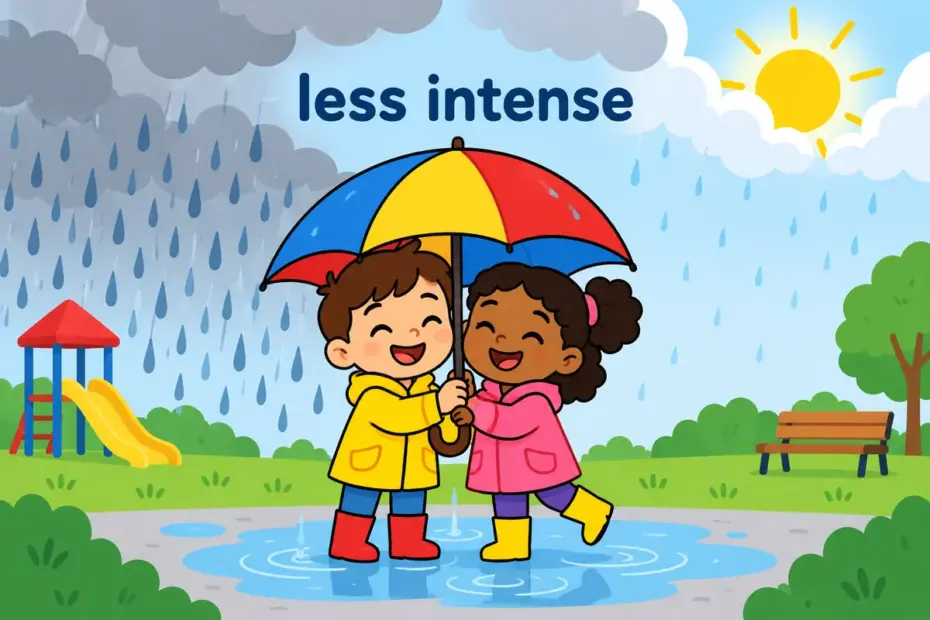
Ease up means to become less intense or to reduce the pressure you put on someone. To use ease up in a sentence, leave it without an object or add on: “The rain eased up at noon.” The phrasal verb covers weather, work, pain and strictness, and it always points the same way, towards less.
Ease up at a glance
- Ease up is an intransitive phrasal verb meaning to become less intense or less severe.
- Its forms are ease up, eases up, eased up and easing up.
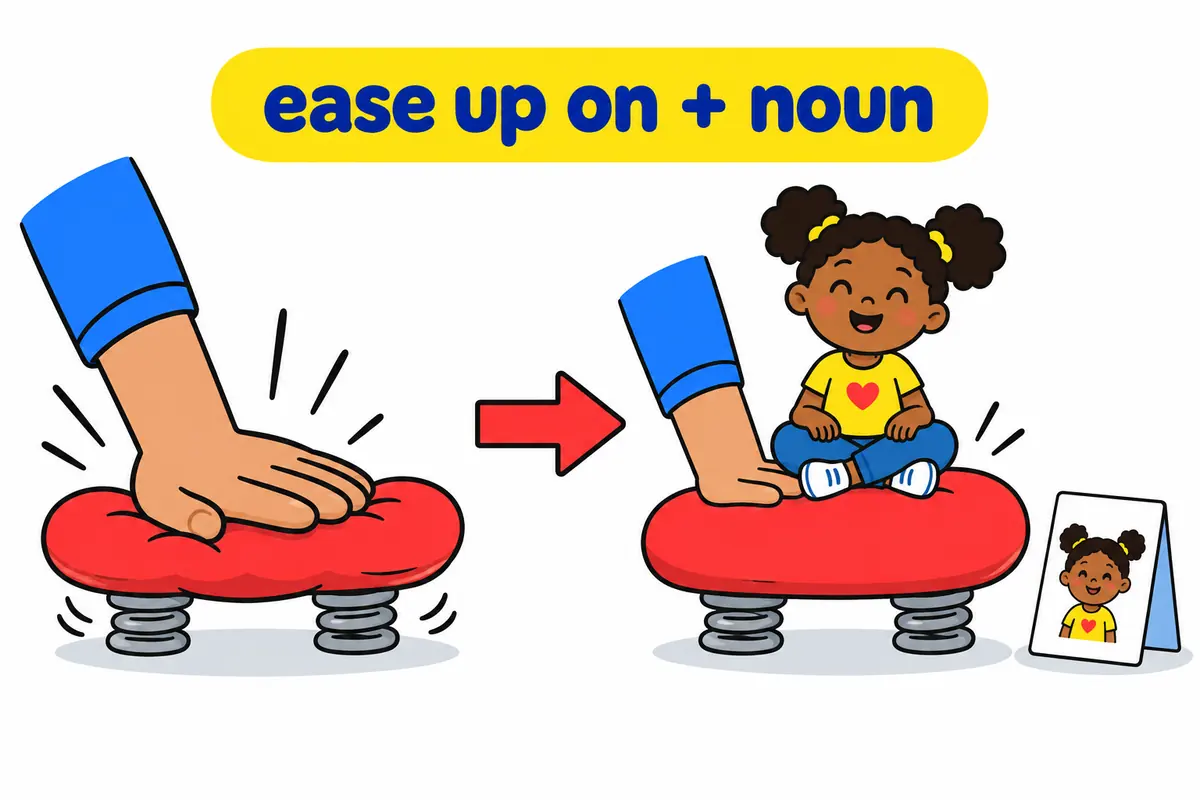
- To name what is treated less harshly, add on: ease up on the rules, ease up on your brother.
- The particle never splits from the verb, so ease it up is not English.
- The commonest error is giving the verb a direct object, as in ease up the rope.
What does ease up mean?
Ease up is an intransitive phrasal verb meaning to become less intense, less severe or less demanding. The Cambridge entry for ease up records the sense of something slackening or slowing as well as the sense of treating someone less strictly. For a formal synonym in weather and pain writing, abate carries the same meaning in a more measured register.
| Sense | Plain meaning | Example sentence |
|---|---|---|
| Become less intense | Something strong grows weaker | The storm eased up by the evening. |
| Reduce your effort | Slow down or rest a little | You have done enough for today, so ease up. |
| Treat less strictly | Stop pressing someone so hard | The coach eased up on the new players. |
Ease up does not mean stop. Something that eases up continues at a gentler level, so rain that eases up may still fall lightly. It also does not mean give in: a teacher who eases up on homework has reduced the amount, not abandoned the subject.
How do you use ease up in a sentence?
Ease up works in two shapes, alone or with on. Separability is never an issue because the verb has no object to move: ease up the rope is wrong, and ease it up is wrong too. When you want a target, put on before it.
| Pattern | Example | What it signals |
|---|---|---|
| ease up alone | The wind eased up at dusk. | States the change without a target. |
| ease up on + person | Ease up on your brother. | Asks for less pressure on someone. |
| ease up on + activity | The doctor told him to ease up on sugar. | Names the thing to reduce. |
| ease up a little | Ease up a little and take a break. | Soften the instruction with a degree phrase. |
| ease up + time phrase | The noise eased up after midnight. | Places the change at a point in time. |
In speech, ease up often appears as an imperative, as in ease up, will you, because it is a way to ask someone to be gentler. The verb relax overlaps in the rest sense, but it does not describe weather or rules growing milder.
Ease up in a sentence: examples across contexts
Ease up is comfortable in weather reports, clinics, classrooms and family kitchens. These twelve sentences show how the same verb moves between them.
| Context | Example sentence | Why this works |
|---|---|---|
| Weather report | The rain eased up just before the match. | Natural subject for the intensity sense. |
| Classroom | The teacher eased up on homework before the holidays. | Shows the on pattern with an activity. |
| Workplace email | We can ease up on the overtime now that the launch is done. | Polite collective suggestion. |
| Medical advice | Try to ease up on salt for a few weeks. | Names a habit to reduce. |
| Parent to child | Ease up on your sister, she is tired too. | Gentle instruction with a reason. |
| Sports coaching | The trainer told him to ease up in the final lap. | Advises lower effort, not stopping. |
| Conversation | Ease up, nobody is blaming you. | Imperative that calms a person. |
| News report | Wind speeds eased up as the front moved inland. | Formal description with a measured subject. |
| Academic prose | The criticism eased up once the data were corrected. | Abstract subject in careful prose. |
| Business writing | Regulators may ease up on small firms next year. | on names the affected group. |
| Fiction | The pain eased up and she finally slept. | Physical sense in narrative. |
| Everyday planning | Once the traffic eased up, the drive was quick. | Conditions growing milder. |
| Insurance letter | Repair costs may ease up once parts are available. | Formal prediction with a measured subject. |
What is the difference between ease up, ease off and slacken?
The three verbs all point towards less, but they sit in slightly different registers. slacken means to become less active or tight, moderate means to make something less extreme, and relent means to finally become less strict after refusing.
| Attribute | ease up | ease off | slacken |
|---|---|---|---|
| Core idea | Become less intense | Become less intense | Become less active or tight |
| Register | Everyday and neutral | Everyday, often British | Formal and literal |
| Typical subject | Rain, pain, a teacher | Pressure, pace, effort | Trade, grip, rain |
| Takes an object | No, needs on | No, needs on | No, needs a preposition |
| Implies stopping | No | No | No |
Verdict: ease up and ease off are close twins and often interchangeable, with ease up slightly more common in American speech; slacken belongs in formal writing, and relent adds the sense of a person giving way at last.
Common collocations with ease up
Ease up keeps a small, stable set of partners. Learning them as whole phrases saves you from inventing combinations that native speakers never use.
| Collocation | Example | What it adds |
|---|---|---|
| ease up on | Ease up on the accelerator. | The fixed way to name a target. |
| ease up a bit | Could you ease up a bit? | Softens the request. |
| ease up soon | The rain should ease up soon. | Predicts a change in the near future. |
| ease up gradually | The wind eased up gradually. | Describes a slow change. |
| ease up at last | The pressure eased up at last. | Signals relief after a long spell. |
| tell someone to ease up | His doctor told him to ease up. | Reports advice. |
Word forms and grammar of ease up
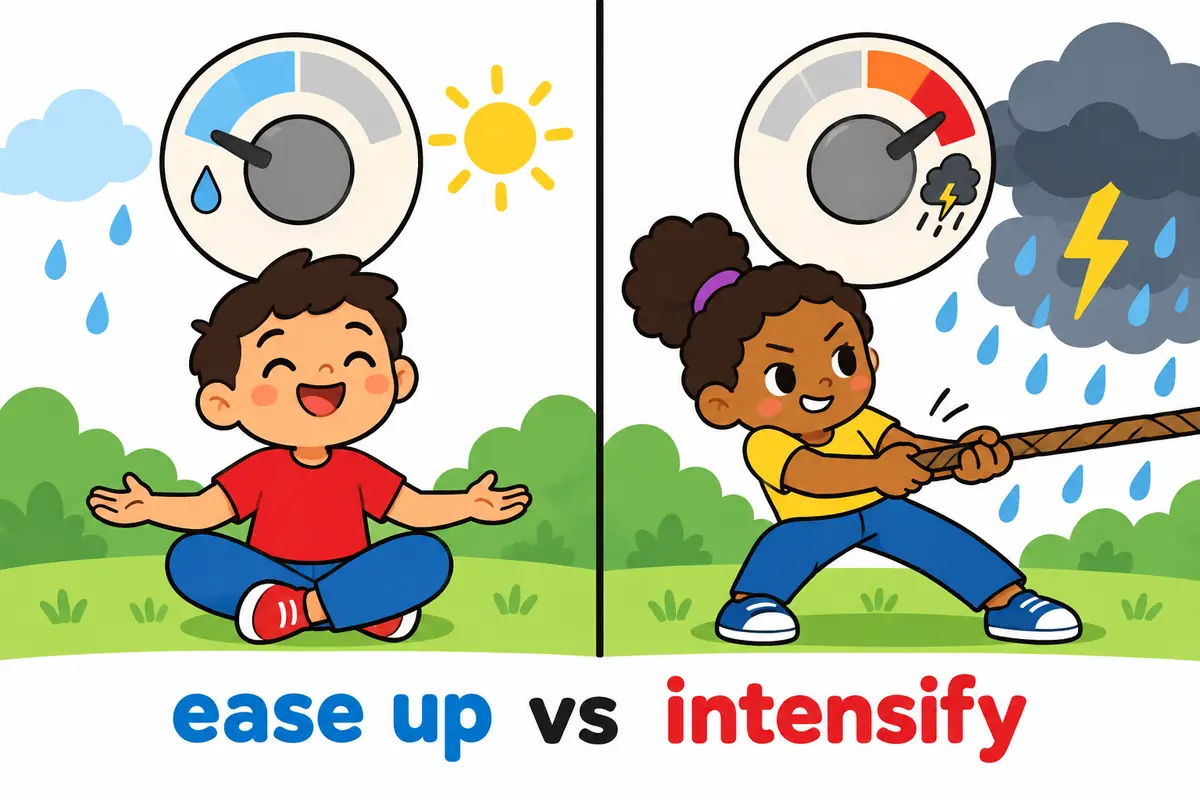
Ease up inflects on ease alone, and its opposite is intensify. There is no passive form, because the verb has no object to turn into a subject.
| Form | Part of speech | Example |
|---|---|---|
| ease up | phrasal verb, base form | Please ease up on the questions. |
| eases up | phrasal verb, third person | The traffic eases up after nine. |
| eased up | phrasal verb, past and participle | The wind eased up overnight. |
| easing up | phrasal verb, present participle | The pressure is easing up at last. |
| ease | verb, base form of the root | The pain will ease with rest. |
| ease off | phrasal verb, near synonym | Ease off the pace for a minute. |
Common mistakes with ease up
- Incorrect:
Please ease up the rope.Correct: Please ease up on the rope. Rule: Ease up is intransitive, so a target needs the preposition on. - Incorrect:
You should ease up to work so hard.Correct: You should ease up on working so hard. Rule: The verb takes on plus a noun or -ing form, not an infinitive of purpose. - Incorrect:
The teacher eased up the homework.Correct: The teacher eased up on the homework. Rule: Without on, the verb has no object and the sentence is ungrammatical. - Incorrect:
His pain eased up him.Correct: His pain eased up. Rule: The subject is the thing that changes, so no object follows. - Incorrect:
The rain eased it up after lunch.Correct: The rain eased up after lunch. Rule: The particle never splits, so no pronoun goes between ease and up.
Practice using ease up
Work through the six items, then read the reasons to check both the pattern and the meaning.
- Fill the gap: The storm finally ______ ______ before dawn.
- Choose the better word: The coach told her to (ease up / ease up on) the training schedule.
- Correct the error: Please ease up the pressure on the team.
- Build a sentence: use ease up on someone about a friend who is being teased.
- Spot the register: which belongs in a medical note — The patient was advised to ease up on salt, or Take it easy with the salt, yeah?
- Rewrite with the -ing form: rewrite He should work less using ease up on.
Answers
- eased up — the storm changes on its own, so no object is needed.
- ease up on — the schedule is the target, and on links it to the verb.
- Please ease up on the pressure on the team — or more simply, ease the pressure, because ease up needs on.
- Model answer: Ease up on your friend, because the teasing has gone too far.
- The patient was advised to ease up on salt — a medical note keeps the formal phrase and drops the tag.
- He should ease up on working so hard — on takes the -ing form, not an infinitive.
The bottom line
Use ease up in a sentence when something grows gentler or when someone should press less hard, and remember that the verb never takes a direct object. Two points decide most choices: add on before any target, and keep the particle attached to ease. Where the tone is formal, slacken or abate work better, and where a person finally gives way, relent is the precise verb.
Frequently asked questions about ease up
Is ease up formal or informal?
Ease up sits in the neutral middle, so it works in speech, email and straightforward reporting. Weather bulletins use it comfortably, and doctors use the on phrase with patients. For a more formal tone, choose slacken, abate or moderate, which belong in reports and academic prose.
What does ease up on mean?
Ease up on means to treat something or someone less strictly or to reduce the amount of it. Adding on supplies the target that the intransitive verb cannot take directly, so you can ease up on your brother, on sugar or on overtime. Without on, the verb must stand alone.
Can you say ease up the rope?
No. Ease up the rope is ungrammatical because ease up is intransitive and cannot take an object. Say ease up on the rope or, if you want a transitive verb, loosen the rope. The same rule explains why ease it up is also wrong, since the particle never splits.
What is the opposite of ease up?
The opposite is intensify, meaning to become stronger or more severe. Where a storm eases up, it grows weaker, and where conditions intensify, they grow worse. In speech the everyday opposite is pick up, as when the wind picks up after easing up earlier in the day.