Run off is a phrasal verb with three jobs: to leave quickly, to drain away, and to print copies fast. Its meaning depends on whether off is a particle or a preposition, so separability changes by sense: “the dog ran off” stays fixed, while “run the dog off” splits. The object decides.
Run off at a glance
- Run off is a phrasal verb; the verb is always two words and the past form is ran off.
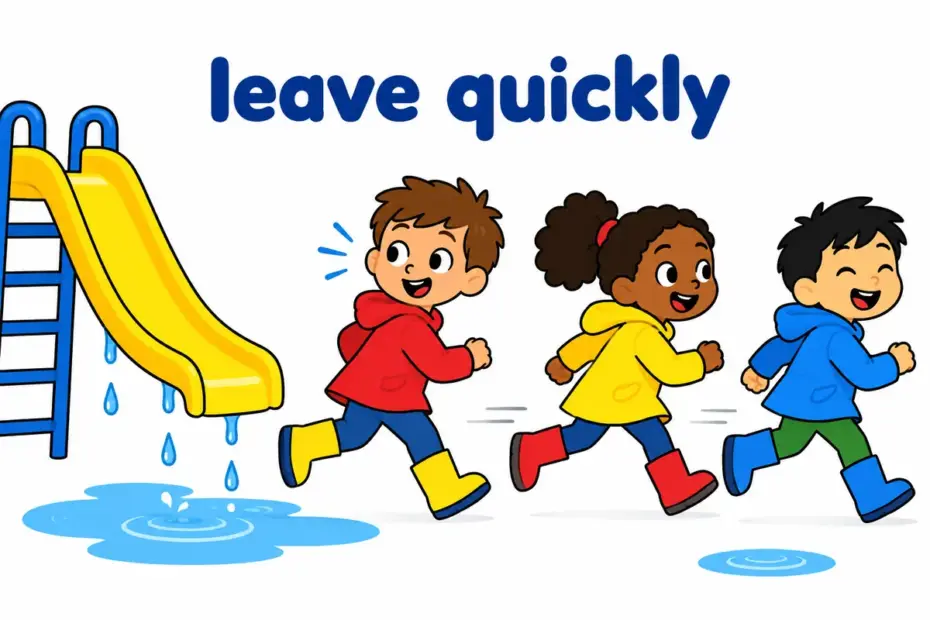
- The commonest sense is to leave quickly, as in the children ran off across the field.
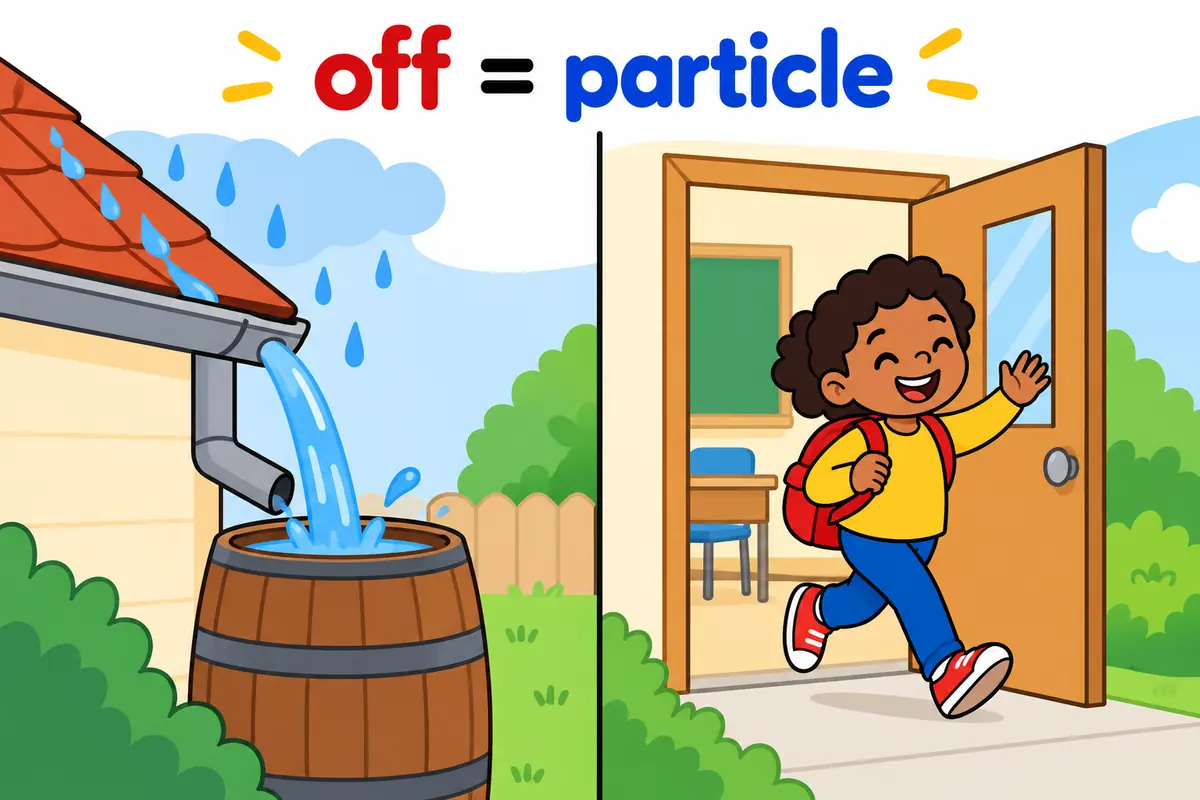
- Off can be a particle that separates, as in run the dog off, or a preposition that does not, as in water runs off the roof.
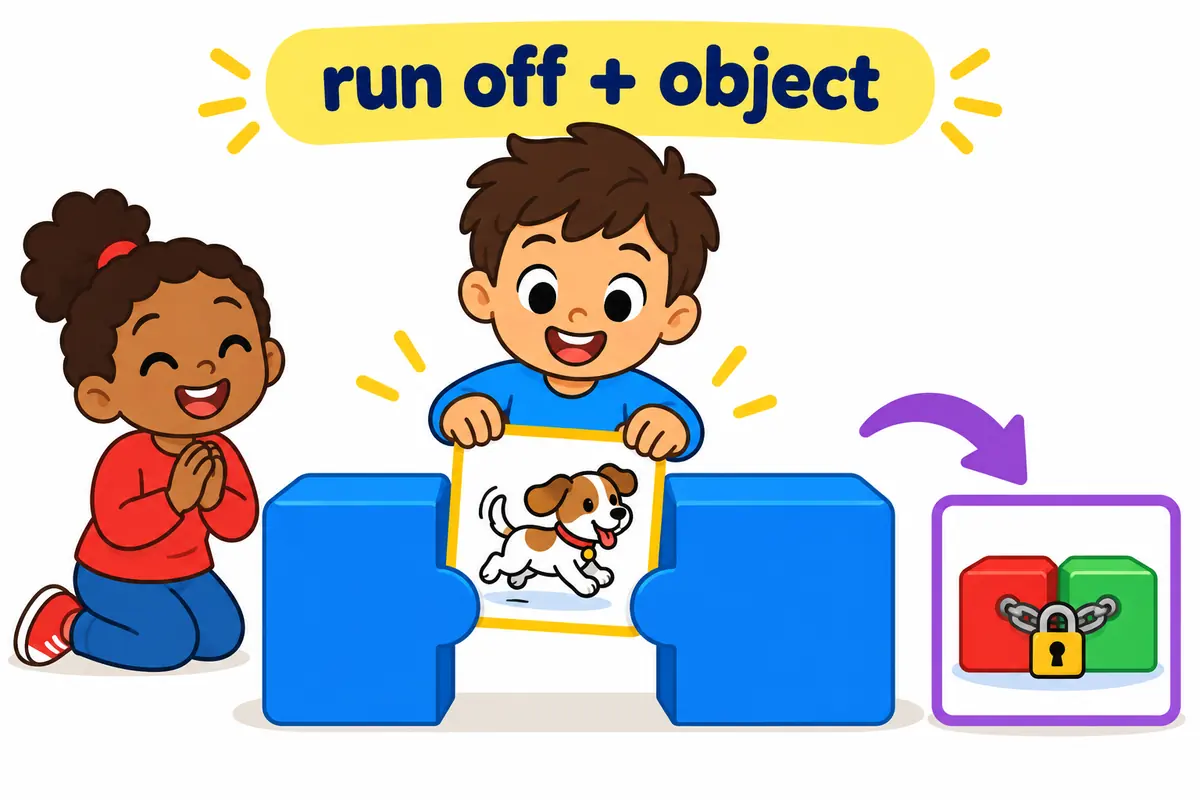
- The printing sense is transitive and separable: run off fifty copies or run fifty copies off.
- The hyphenated noun run-off means an extra contest after a tie, as in a run-off election.
- The commonest error is adding from after the flee sense, as in ran off from the room.
What does run off mean?
Run off is a phrasal verb meaning to leave quickly, to let liquid flow away, or to produce copies fast. The Cambridge entry for run off records the senses of running away and of printing, and the surrounding words tell you which one is meant. A sentence such as “the tap ran off into the drain” uses the liquid sense, while “two players ran off the pitch” uses the fleeing sense. Where the meaning is simply to escape, flee is the more formal single verb.
| Sense | Plain meaning | Example sentence |
|---|---|---|
| Leave quickly | Run away from a place | The puppy ran off down the lane. |
| Drain away | Liquid flows off a surface | Rainwater runs off the flat roof. |
| Print copies | Produce copies quickly | Run off thirty handouts before class. |
| Drive away | Force a person or animal to leave | The farmer ran the intruders off. |
One honest limitation is worth stating. Run off does not mean stop working, and it does not mean use up. An engine that quits has run down or cut out, and a supply that ends has run out. When you mean either of those, the correct particle is not off, and swapping one phrasal verb for another changes the sense completely.
How do you use run off in a sentence?
The pattern after run off depends on whether off is a particle or a preposition. A particle can move to the end of the sentence, so the object may sit between the verb and off. A preposition stays with the noun that follows it and never moves. This single test separates the senses better than any list.
| Pattern | Example | What it signals |
|---|---|---|
| run off (intransitive) | The cat ran off at midnight. | The flee sense; nothing can separate the two words. |
| run + object + off (separable) | The guard ran the stray dog off. | The drive-away sense; off is a movable particle. |
| run off + object (separable) | Please run off twenty copies. | The printing sense; the order can also reverse. |
| run off + surface (preposition) | Oil runs off the engine block. | The drain sense; off belongs to the noun after it. |
| run-off (hyphenated noun) | The tie goes to a run-off. | A deciding contest, never a verb. |
A useful contrast is the shared particle in back off, where off again marks withdrawal but the verb stays fixed in the sense of retreating. English keeps these look-alike phrases apart by their particles, not by their spelling.
Run off in a sentence: examples across contexts
Run off changes register more than it changes meaning. The twelve sentences below keep the same phrase while moving from a kitchen to a courtroom, and each one shows whether off is working as a particle or as a preposition.
| Context | Example sentence | Why this works |
|---|---|---|
| Classroom | The class hamster ran off behind the bookshelf during story time. | The flee sense with a clear starting point. |
| Home | Rainwater runs off the shed roof into a barrel. | The drain sense, where off is a preposition. |
| Workplace email | Please run off twenty copies of the agenda before the meeting. | The printing sense, transitive and separable. |
| News report | Two suspects ran off on foot after the alarm sounded. | Neutral reporting of a quick departure. |
| Farm or country | The farmer ran the trespassers off before dusk. | The drive-away sense, with the object between verb and particle. |
| Sports | The race will be decided in a run-off on Sunday. | The hyphenated noun for a deciding contest. |
| Technical writing | Lubricant runs off the bearing and collects in the tray. | A precise description of liquid movement. |
| Conversation | Do not run off yet; we have not finished. | The everyday plea to stay a little longer. |
| Finance or legal | The audit found that funds had run off into two hidden accounts. | A figurative drain of money from its proper place. |
| Literature essay | The hero runs off to sea, leaving the village behind. | The fleeing sense driving a plot forward. |
| Recipe or instructions | Let the excess oil run off before serving. | An imperative using the drain sense. |
| History writing | Settlers were run off the land by rival claims. | The passive of the drive-away sense. |
Two sentences use off as a preposition and the rest use it as a particle, which is why only some of them can be reordered without sounding wrong.
Run off vs run out, run over and run down
Run off is one of a family of phrasal verbs built on run, and the particle does all the work. Confusing them changes the meaning from leaving to running out of time, to striking something, to losing power.
| Attribute | run off | run out | run down |
|---|---|---|---|
| Core meaning | Leave, drain or print | Be used up or expire | Decline or lose power |
| Typical subject | People, animals, liquid, copies | Supplies, time, contracts | Batteries, health, businesses |
| Transitive use | Yes in the print and drive-away senses | Rarely | Yes, in the criticize sense |
| Past form | ran off | ran out | ran down |
| Register | Neutral, spoken and written | Neutral | Neutral |
Verdict: choose run off for leaving, draining or printing, run out for something being used up, and run down for a gradual loss of power or health. Where someone escapes a place formally, escape or abscond is the sharper single verb.
Word forms and grammar of run off
The verb keeps its two words in every tense, and only the hyphenated noun changes shape. The table also shows the shared verbs and the noun that learners most often mistake for a verb.
| Form | Part of speech | Example |
|---|---|---|
| run off | base phrasal verb | They run off the leaflets each morning. |
| runs off | third person singular | She runs off whenever the phone rings. |
| ran off | past | The puppy ran off across the field. |
| running off | present participle | Water is running off the roof. |
| run-off | hyphenated noun | The seat was decided in a run-off. |
| run out | related phrasal verb | Our time ran out before the vote. |
| run over | related phrasal verb | The talk ran over by ten minutes. |
Keep the verb and the noun apart: run off is an action, while run-off is the extra contest that follows a tie.
Common mistakes with run off
- Incorrect:
Water is running off on the roof.Correct: Water is running off the roof. Rule: in the drain sense, off is a preposition and takes the surface directly, with no on. - Incorrect:
He ran the dog off away.Correct: He ran the dog off. Rule: the particle off already carries the direction, so away is redundant. - Incorrect:
They will run off a run-off.Correct: They will hold a run-off. Rule: the noun run-off is a contest; the verb run off means to leave or print. - Incorrect:
The engine ran off after ten minutes.Correct: The engine cut out after ten minutes. Rule: run off never means to stop working; that is run down or cut out. - Incorrect:
She ran off from the room.Correct: She ran off. Rule: with the flee sense, off already marks the departure, so from is unnecessary.
Practice using run off
Work through the six items, then read the reasoning beside each answer rather than only the key.
- Fill the gap: The crowd ______ when the fireworks ended suddenly.
- Choose the better phrase: Rain (runs off / runs out) the new awning in a steady stream.
- Correct the error: The clerk ran off from the counter to fetch the files.
- Build a sentence: use run + object + off about a stray cat in a garden.
- Spot the register: which belongs in a set of office instructions — Run off forty copies, or the copier went brrr and we got the pages?
- Rewrite with the noun: The election went to an extra contest after a tie. Use run-off.
Answers
- ran off — the flee sense is intransitive and keeps the two words together.
- runs off — off is a preposition after a surface, so the water drains away on it.
- The clerk ran off to fetch the files — the flee sense does not take from before the place left.
- Model answer: We ran the stray cat off before it reached the bird table.
- Run off forty copies — an instruction uses the plain printing sense, not a sound effect.
- The election went to a run-off — the hyphenated noun names the deciding contest.
The bottom line
Use run off in a sentence for leaving quickly, for liquid draining away, or for printing copies, and let the object tell you whether off separates. The two nuances worth keeping are these: off is a movable particle in the print and drive-away senses but a fixed preposition in the drain sense, and the hyphenated run-off is a noun for an extra contest. Where a supply simply ends, reach for run out instead.
Frequently asked questions about run off
Is run off one word or two?
The verb is always two words: run off. The noun for an extra contest is hyphenated, run-off, as in a run-off election. Keep the two apart, because a reader who sees run-off in a sentence about leaving will expect a race. The past form of the verb is ran off.
Can you separate run off?
Only in some senses. When off is a particle and the verb is transitive, the object can sit between them, as in run the dog off or run off the dog. In the flee sense the verb is intransitive, so nothing splits it. In the drain sense, off is a preposition and the noun that follows belongs to it.
What is the difference between run off and run out?
Run off means to leave quickly or to print copies, while run out means to be used up or to come to an end. Milk runs out; a guest runs off. A contract runs out, not off. The shared verb run is the only link, and the two phrases never substitute for each other.
Is run off informal?
The fleeing sense is neutral and common in speech and writing alike, as in the dog ran off. The printing sense is informal to neutral and typical of offices. The noun run-off belongs to politics and sports reporting. None of the senses is slang, so it works in a school essay as well as a quick message.