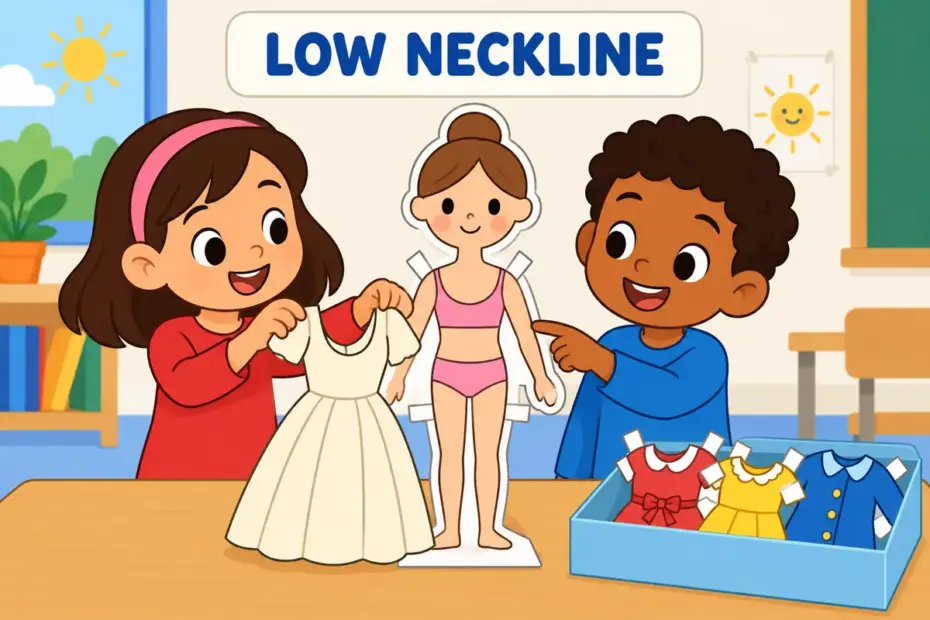
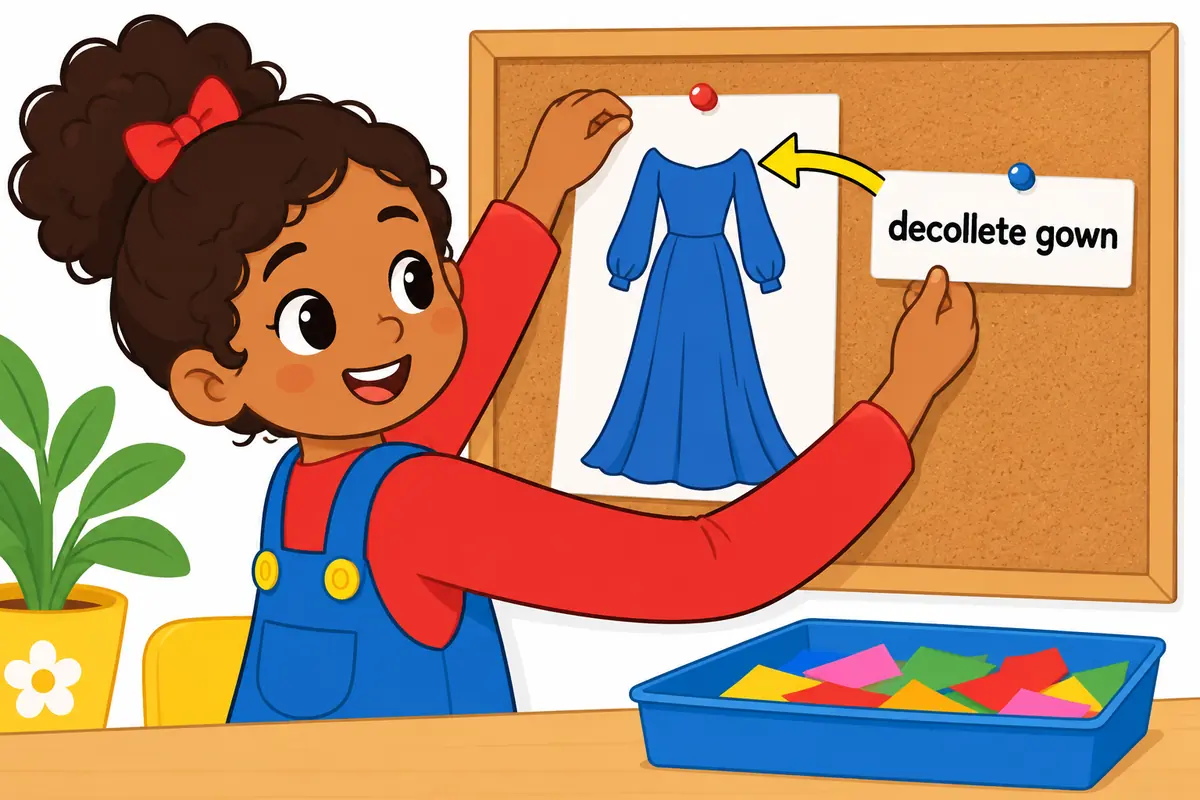
Decollete is an adjective describing a garment cut low at the neck so the collarbones and shoulders are exposed: a decollete gown leaves the throat and shoulders bare. The word comes from fashion writing and appears most often before the noun it describes, as in a decollete dress, while the related noun decolletage names the neckline itself.
Decollete at a glance
- Decollete is mainly an adjective, and it normally precedes the garment it describes.
- The dominant pattern is decollete + dress, gown or neckline.
- It belongs to fashion and costume writing rather than general conversation.
- The noun decolletage is far commoner than the noun use of decollete.
- The commonest errors are pairing it with a covered neckline and misspelling it with two t’s.
What does decollete mean?
Decollete is an adjective meaning cut low at the neck, so that the neck, collarbones and shoulders are exposed. The Cambridge entry for decollete treats the word as a description of a garment’s neckline, and the same source shows the noun decolletage alongside it.
| Sense | Plain meaning | Example sentence |
|---|---|---|
| Adjective, low-cut garment | Describes a dress or top cut low at the front | She chose a decollete gown for the gala. |
| Noun, the low neckline | Names the neckline itself, a rarer use | The collection featured a deep decollete. |
| Related noun, decolletage | The exposed upper chest or neckline | The portrait shows a jewelled decolletage. |
One limitation is worth stating plainly. Decollete is a fashion term and it concerns the neckline alone; it is not a general word for anything revealing. Where a plain description will do, low-cut is clearer, and the visible line a low neckline creates is simply called cleavage in everyday English.
Because the spelling is unfamiliar, many writers simply avoid the term and reach for low-cut, which is why the word survives mainly in fashion copy and costume history rather than in general prose.
How do you use decollete in a sentence?
Decollete is an adjective, so it leans on the noun that follows it and rarely stands alone. Because the word belongs to fashion writing, the nouns it modifies cluster tightly around clothing, and the verb usually reports how a garment is cut or worn.
| Pattern | Example | What it signals |
|---|---|---|
| decollete + dress or gown | She wore a decollete gown in deep green. | The standard adjectival use before a garment. |
| decollete + neckline | The decollete neckline framed a simple pendant. | Names the part being described. |
| a decollete cut | The designer favoured a decollete cut for evening wear. | Treats the word as a style label. |
| the noun decolletage | The gown’s decolletage was edged with lace. | Switches to the usual noun form. |
| keep + object + decollete | She kept the neckline decollete but the sleeves long. | Uses the adjective predicatively, a rarer choice. |
Decollete in a sentence: examples across contexts
Decollete keeps the same meaning as it moves from a sewing pattern to an art catalogue; what changes is how much the writer explains. The ten contexts below show the word doing different jobs with the same core sense.
| Context | Example sentence | Why this works |
|---|---|---|
| Fashion writing | The runway show closed with a decollete gown in ivory silk. | Names the cut as a design choice. |
| Wedding feature | The bride chose a decollete bodice with long lace sleeves. | Balances a low neckline with a covered sleeve. |
| Costume history | Portraits of the period favour a decollete line above a stiff bodice. | Ties the word to a documented style. |
| Retail report | Buyers ordered more decollete styles for the summer range. | Uses the adjective as a product label. |
| Conversation | That dress is quite decollete for a school concert. | Shows the word surfacing informally. |
| Art history | The sitter wears a decollete gown with a plain linen collar. | Describes a painted garment precisely. |
| Film review | The costume team kept every ballroom gown decollete. | Uses the adjective predicatively. |
| Sewing pattern | Cut the front panel along the decollete line marked on the sheet. | Uses the word as a technical instruction. |
| News feature | Guests arrived in decollete evening wear and floor-length skirts. | Places the adjective in a public report. |
| Textiles class | The students compared a decollete neckline with a high collar. | Sets the word against its opposite. |
A dress is the commonest noun the adjective describes, with an evening gown close behind, and a decollete cut leaves the throat and shoulders bare.
Read the table as a grid of register rather than a list. The fashion and art rows keep the term technical, the retail and news rows use it as a product label, and the conversational row shows how quickly it can sound out of place away from clothing copy.
Decollete vs plunging
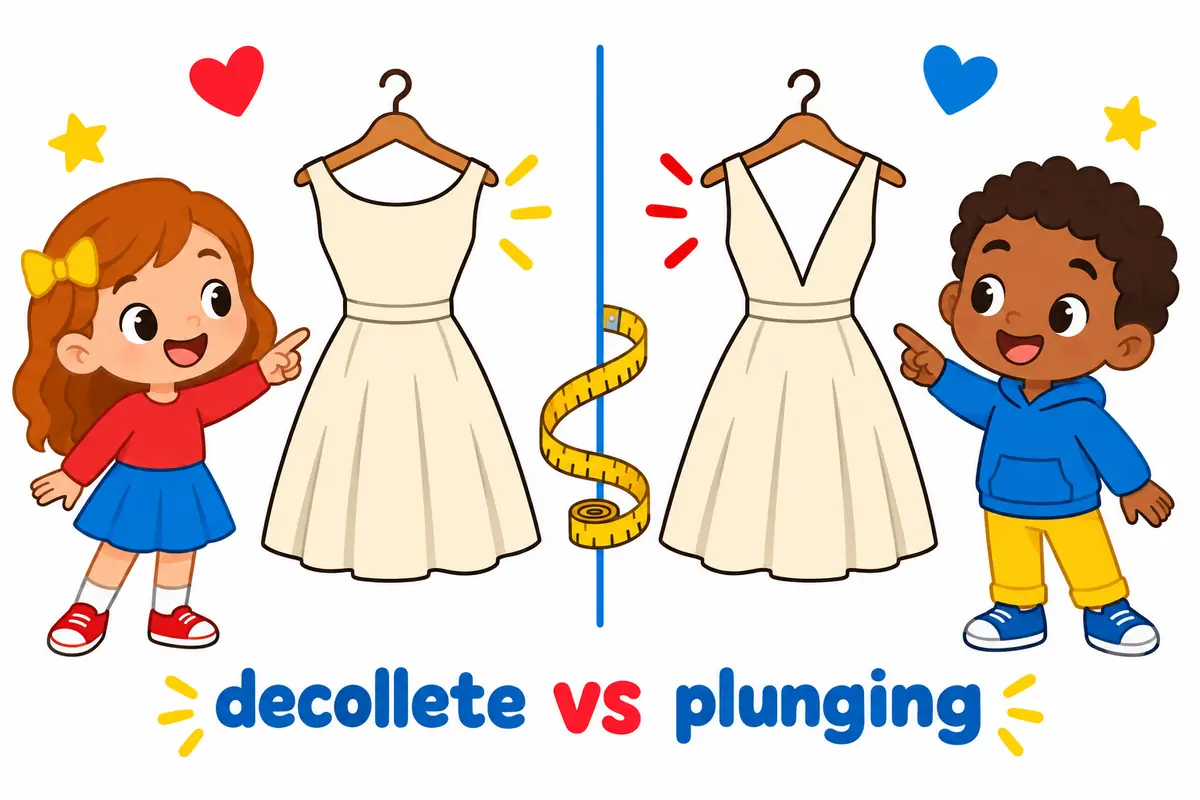
Decollete and plunging both describe a low neckline, but they picture different shapes. A decollete neckline runs low and broad across the collarbones, while a plunging neckline drops into a deep V. The first reads as classical and restrained, the second as dramatic and vertical.
| Attribute | decollete | plunging |
|---|---|---|
| Shape | Broad, gently curved low line | Narrow, deep V |
| Direction | Across the collarbones | Straight down the chest |
| Degree | Usually moderate | Can be very deep |
| Typical garment | Evening gown, bridal bodice | Evening dress, summer top |
| What it stresses | The shoulders and neck | The vertical drop |
| Register | Fashion and costume writing | Fashion and general style writing |
Verdict: choose decollete for the classic broad, low neckline and plunging for the deep V. Its plain opposites are a modest neckline that keeps the collarbones covered and, at the far end of the range, a prim collar high at the throat.
Word forms and grammar of decollete
Decollete has few forms, and the spelling is the part that trips writers. English borrowed the word from French, where it is written décolleté with two accents; English almost always drops them. The adjective describes the garment, and the related noun decolletage names the neckline or the exposed upper chest.
| Form | Part of speech | Example |
|---|---|---|
| decollete | adjective | The decollete bodice was lined in silk. |
| decollete | noun, rare | The collection featured a deep decollete. |
| decolletage | noun, common | The lace framed her decolletage. |
| decollete neckline | noun phrase | The decollete neckline had a hidden seam. |
| decollette | not standard | The spelling decollette with two t’s is a common error. |
Two spelling habits keep the word tidy. Drop the accents in ordinary English prose, and keep the single t in the middle, because the double-t form belongs to no dictionary. In an academic costume-history paper, the accented French form is acceptable if you use it consistently.
When in doubt, treat the word as a label rather than a sentence subject. It modifies, it does not act, and a reader who meets a decollete gown needs no further explanation. The moment a sentence needs a definition, the plainer low-cut is doing the job better.
Common mistakes with decollete
- Incorrect:
The gown was decollete, with a high lace collar up to the chin.Correct: The gown was decollete, with a neckline that left the collarbones bare. Rule: decollete means low at the neck, so it cannot describe a high, covered neckline. - Incorrect:
She bought a decollete for the party.Correct: She bought a decollete dress for the party. Rule: as an adjective, decollete needs the noun it describes; for the noun, use decolletage. - Incorrect:
She admired the decollete of the gown.Correct: She admired the decolletage of the gown. Rule: decolletage is the noun for the low neckline, while decollete is the adjective. - Incorrect:
The neckline was decollete right up to the throat.Correct: The neckline was modest and high at the throat. Rule: use high or modest for a covered neckline, and keep decollete for the opposite. - Incorrect:
He wore a decollette shirt.Correct: He wore a shirt cut low at the neck. Rule: decollette is a misspelling, and a plain description is clearer for a low-cut shirt.
Practice using decollete
Work through the seven items, then read the reasons as closely as the answers.
- Fill the gap: The designer sent a ______ gown down the runway in pale gold.
- Choose the better word: A neckline that drops into a deep V is (decollete / plunging).
- Correct the error: She wore a decollete neckline that reached her chin.
- Build a sentence: use decollete gown about a costume in a school play.
- Spot the register: which belongs in a fashion review — a decollete bodice in ivory silk, or a low-cut top, you know the one?
- Rewrite with the noun: The dress had a low neckline. Use decolletage.
- Choose the better word: For a covered neckline, write (decollete / modest).
Answers
- decollete — the adjective modifies gown and names its low neckline.
- plunging — a deep V is plunging, while decollete is a broad low line.
- She wore a decollete neckline that left her collarbones bare — decollete cannot describe a chin-high cut.
- Model answer: The queen in the school play wore a decollete gown with long sleeves.
- A decollete bodice in ivory silk — a review keeps the precise fashion adjective.
- The dress had a deep decolletage — decolletage is the noun for the neckline itself.
- modest — a covered neckline is modest; decollete means the opposite.
The bottom line
Use decollete in a sentence to describe a garment cut low and broad at the neck, and normally place the adjective before the dress or gown it describes. Two nuances decide most sentences: decollete is the adjective while decolletage is the noun, and a broad low line is not the same as a plunging V. In everyday writing, the plainer phrase low-cut usually reads better than the fashion term.
Frequently asked questions about decollete
Is decollete spelled with accents?
English normally drops the accents and writes decollete, while French keeps them as décolleté. British and American fashion writing both favour the plain spelling. Use the accented form only in a text that is already quoting French, and then keep it consistent through the piece.
What is the difference between decollete and decolletage?
Decollete is an adjective describing a garment cut low at the neck, as in a decollete gown. Decolletage is a noun naming the low neckline or the exposed upper chest itself, as in a lace-framed decolletage. Choose the adjective before a garment and the noun for the feature.
Can decollete describe a covered neckline?
No. Decollete means the opposite of covered, so it describes a neckline that sits low and leaves the collarbones and shoulders bare. For a neckline that reaches the throat, write modest, high or prim. Mixing decollete with a high collar cancels the meaning of the sentence.
Is decollete used for men’s clothing?
In practice the word is rare for men’s garments, because published fashion writing applies it mainly to women’s necklines. For a low-cut shirt, a direct description such as a shirt cut low at the neck is clearer and avoids an unusual pairing. The meaning itself is not restricted to one gender.