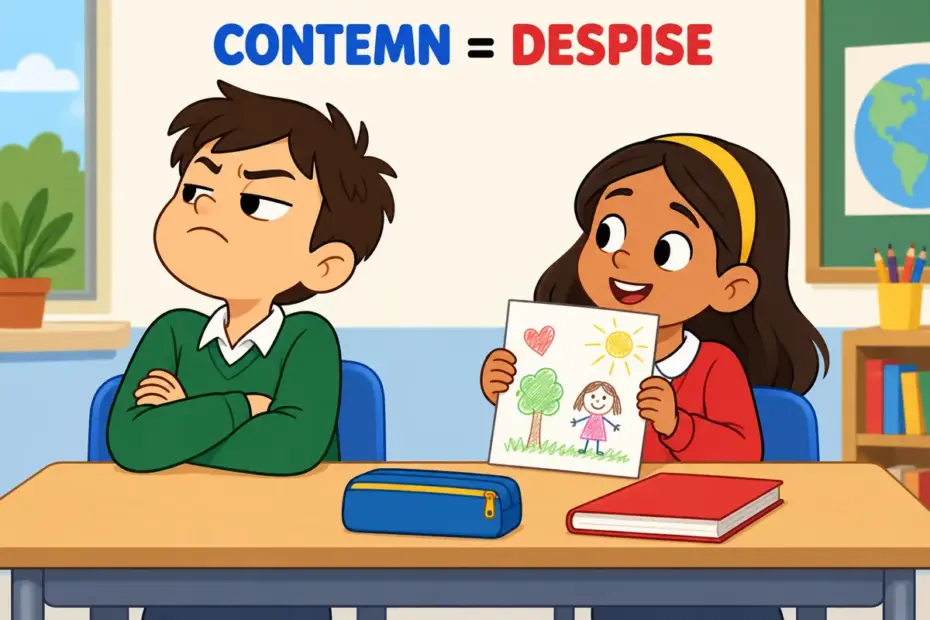
Contemn means to treat a person or thing as worthless; it is a formal verb that rarely appears in everyday speech. To use contemn in a sentence, place it before the person or practice being despised: “The report contemns the delay.” It is transitive, so it always needs an object.
Contemn at a glance
- Contemn is a transitive verb meaning to despise or treat as worthless.
- Its verb forms are contemns, contemned and contemning.
- Its noun is contempt, and its adjective is contemptuous.
- Contemn belongs to formal, literary and legal writing, not casual talk.
- The verb usually takes a person, a practice or a rule as its object.
- The commonest error is writing contemn when condemn is meant.
What does contemn mean?
Contemn is a transitive verb meaning to regard a person or thing as worthless, or to reject something as unworthy of respect. The Cambridge entry for contemn records the sense of treating with contempt. It is stronger than dislike and colder than hate: the speaker has judged the object and found it beneath regard.
| Sense | Plain meaning | Example sentence |
|---|---|---|
| Despise a person | Regard someone as beneath respect | The old foreman contemned the workers who raised complaints. |
| Reject as unworthy | Dismiss a rule, custom or idea with scorn | The pamphlet contemns every convention of polite debate. |
| Refuse a low motive | Reject an offer or habit as beneath one | She contemned flattery and never used it. |
An honest limit matters with a word this rare. Contemn names an attitude, not an action, so it cannot mean to criticise, to punish or to defeat. Where you mean mild dislike, a plainer verb such as distrust or disapprove carries the same idea without the arch tone, and where a court passes a sentence the right word is condemn. Contemn also cannot report a passing mood; it states a settled judgement.
How do you use contemn in a sentence?
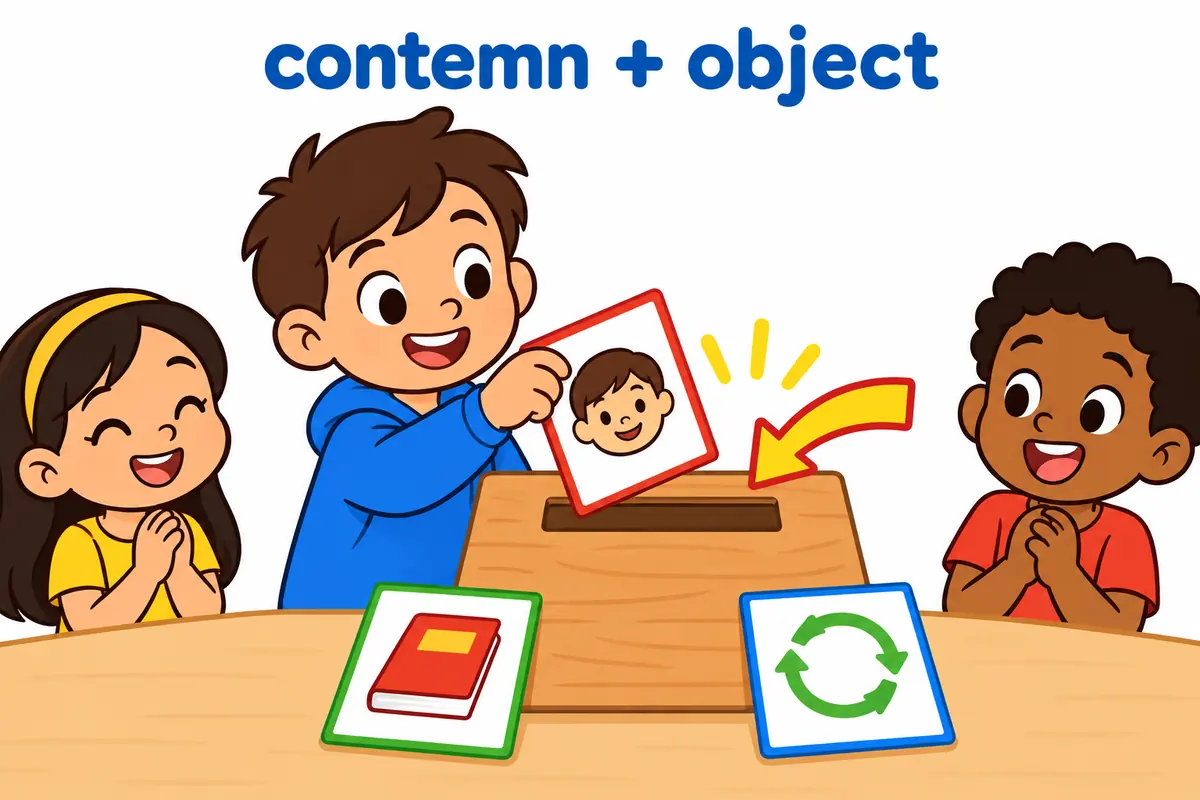
Contemn behaves like other verbs of attitude: the subject holds the scorn and the object receives it. Because the verb is transitive, no sentence is complete until it names what is contemned, and the passive appears whenever the writer wants that scorn to sound general rather than personal.
| Pattern | Example | What it signals |
|---|---|---|
| contemn + person | The critic contemned the novelist in a single line. | a person receives the scorn |
| contemn + practice | The code contemns any form of bribery. | an abstract practice is judged worthless |
| contemn + a rule or authority | The rebels contemned the court’s order. | the object is a formal authority |
| be contemned by | Such habits were contemned by every officer present. | passive, used when the scorn is shared |
| contemn + abstract noun | He contemned weakness of any kind. | the object is a quality, not a person |
The passive is the form to watch. Writers reach for was contemned when they want to report that a view met widespread scorn without naming who held it. The active with a named subject is more forceful, and because the verb is rare, a sentence that uses the active voice usually carries more weight than one that hides the agent.
Contemn in a sentence: examples across contexts
Contemn keeps one meaning but changes company as it moves between registers. The examples below pair the verb with the kinds of subject and object each setting actually produces.
| Context | Example sentence | Why this works |
|---|---|---|
| Literary criticism | The review contemns the memoir as a vanity project. | a critic delivers a judgement on a work |
| Legal opinion | The judgment notes that the tenant contemned the terms he had signed. | a formal instrument is treated with disregard |
| Historical writing | The chronicler contemns the king who fled the field. | a moral verdict in old-fashioned prose |
| Academic prose | Few scholars now contemn oral history as mere anecdote. | a change in scholarly attitude over time |
| Newspaper editorial | The paper contemns the delay but offers no remedy. | public scorn with no practical proposal |
| Formal letter | We do not contemn your position, though we disagree with it. | a polite disclaimer of contempt |
| Translation | The translator renders the phrase as she contemned his advice. | a close rendering of a foreign verb |
| Historical fiction | The footman contemned the guests who mocked his accent. | a quiet, personal scorn in a period scene |
| Religious writing | The sermon warns that pride contemns both neighbour and grace. | a moral failing named in abstract nouns |
| Speech | A leader who contemns the rules invites the same contempt. | a warning drawn from conduct |
| School essay | The essay contemns cheating without offering a reason. | an abstract practice as the object |
Contemn vs condemn
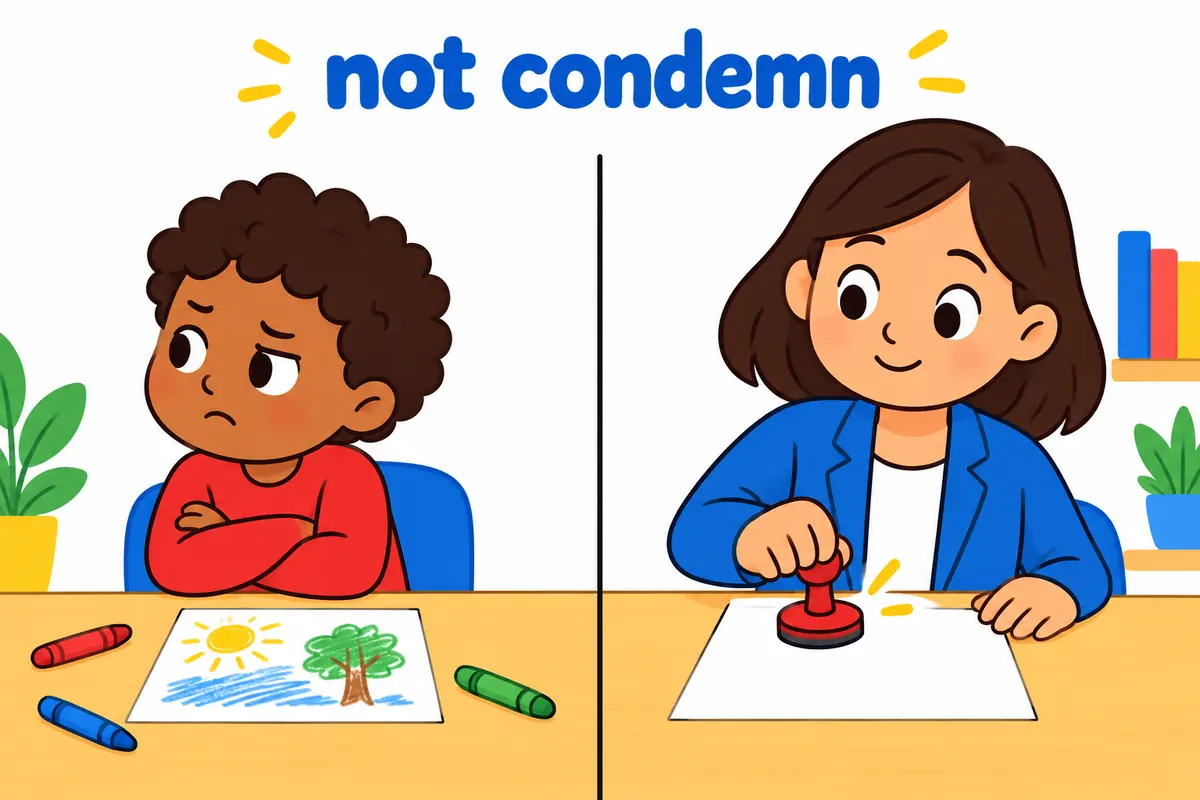
Contemn and condemn differ by a single letter and are confused more than almost any other pair. Condemn names a formal judgement or a sentence; contemn names the attitude of scorn itself. A judge condemns, a cynic contemns, and the two verbs only rarely share a sentence.
| Attribute | contemn | condemn |
|---|---|---|
| Core meaning | to hold in contempt | to declare wrong or pass sentence |
| What it names | an attitude | an act or verdict |
| Typical object | a person, practice or rule | a person, action or building |
| Legal use | rare | central, as in condemned to pay costs |
| Register | literary and rare | formal but current |
Verdict: choose condemn whenever a formal judgement or a sentence is meant, and keep contemn for the narrower case where the scorn itself is the point. A building is condemned as unsafe, never contemned; a rule-breaker may be condemned by a court and contemned by his neighbours.
Word forms and grammar of contemn
Contemn inflects regularly, and its noun contempt outnumbers the verb in current writing. The table sets out the family and flags the relatives that look close but mean something else.
| Form | Part of speech | Example |
|---|---|---|
| contemn | verb, base form | Some critics contemn the whole genre. |
| contemns | verb, third person singular | He contemns every rule he cannot bend. |
| contemned | verb, past and past participle | The proposal was contemned on all sides. |
| contemning | verb, present participle | Contemning advice, she acted alone. |
| contemner | noun, rare | The contemner of custom is not always a rebel. |
| contempt | noun | Her contempt for the plan was plain. |
| contemptuous | adjective | He gave a contemptuous shrug. |
Keep the adjective apart from the verb: contemptuous describes the person who feels scorn, while contemn names the act of feeling it. Two look-alikes are false friends. The page on contemplate shares the opening letters but means to think about, and contemporary simply means belonging to the present, with no scorn in it at all.
Common mistakes with contemn
- Incorrect:
The court contemned him to pay the costs.Correct: The court condemned him to pay the costs. Rule: condemn delivers a formal sentence; contemn only reports scorn. - Incorrect:
She was very contemn of the offer.Correct: She was contemptuous of the offer. Rule: the adjective is contemptuous, not contemn. - Incorrect:
The report contemns.Correct: The report contemns the delay. Rule: contemn is transitive, so the object cannot be left out. - Incorrect:
The council contemned that the plan was wasteful.Correct: The council condemned the plan as wasteful. Rule: contemn takes a noun phrase, never a that-clause. - Incorrect:
He contemned the soup and sent it back.Correct: He disliked the soup and sent it back. Rule: contemn names deep scorn, far too strong for a small complaint. - Incorrect:
Do not contain the rules of the club.Correct: Do not contemn the rules of the club. Rule: contain means to hold inside; contemn means to scorn. - Incorrect:
The rivals contend the agreement.Correct: The rivals contemn the agreement. Rule: contend means to argue or compete, not to despise.
Practice using contemn
- Fill the blank: The old judge ______ any attempt to flatter him.
- Choose the better word: The building was (contemned / condemned) as unsafe.
- Correct the error: The editor contemned that the writer was lazy.
- Build a sentence: use contemn with an abstract noun about a school rule against cheating.
- Spot the register: which fits a formal essay — the pamphlet contemns the fashion, or the pamphlet really hates the fashion?
- Rewrite with the noun: He contemned the proposal. Use contempt instead.
- Fill the adjective: Her ______ shrug told everyone what she thought.
- Correct the error: The witness contemned in court.
Answers
- contemned — the judge is the subject holding scorn, and flattery is the object.
- condemned — a formal judgement about safety takes condemn, not contemn.
- The editor contemned the writer’s laziness — contemn takes a noun phrase, not a that-clause.
- Model answer: The school contemns cheating in any form — the object is an abstract practice.
- The pamphlet contemns the fashion — a formal essay keeps the precise verb and drops the emotional hates.
- He held the proposal in contempt — the noun needs the frame held in contempt.
- contemptuous — the adjective describes the person who feels the scorn.
- The witness showed contempt in court — contemn needs an object, so the noun phrase replaces it.
The bottom line
Contemn in a sentence means to hold a person, practice or rule in contempt, and it always needs an object to receive the scorn. The two facts that decide most uses are that the verb is transitive and that it names an attitude rather than an action, so it cannot deliver a sentence or a punishment. Keep condemn for formal judgements, use a plainer verb for everyday dislike, and reach for contemn only when its cold, literary weight is exactly what the sentence needs.
Frequently asked questions about contemn
Is contemn still used today?
Contemn is rare in modern speech and survives mainly in literary, legal and historical writing. You are far more likely to meet its noun contempt and its adjective contemptuous. Using the verb in ordinary conversation sounds deliberately old-fashioned, so reserve it for formal prose where its cold weight suits the sentence.
What is the difference between contemn and condemn?
Condemn means to declare something wrong or to pass a sentence, as a court condemns a defendant. Contemn means to hold a person or thing in contempt. Condemn names an act or verdict and contemn names an attitude, which is why a building is condemned but never contemned.
Does contemn need an object?
Yes. Contemn is transitive, so every sentence must name what or whom is contemned. You cannot write the board contemned and stop; you need the board contemned the proposal. When no single object fits, rewrite with the noun, as in the board showed contempt for the proposal.
What part of speech is the adjective for contemn?
The adjective is contemptuous, meaning full of contempt, and the noun is contempt. Contemn itself is only a verb. Do not build an adjective from the verb by dropping a letter, because contemnful and contemnous are not English words; write contemptuous instead, as in a contemptuous remark.