Heraldry is the system for designing, describing and studying coats of arms. To use heraldry in a sentence, treat it as a noun naming the whole craft: “She studies medieval heraldry.” The word usually appears in the phrase the study of heraldry or beside terms such as arms, crest and blazon.
Heraldry at a glance
- Heraldry is an uncountable noun, so it has no plural and takes a singular verb.
- Its two main senses are the academic study of arms and the craft of designing them.
- The usual collocations are medieval heraldry, the language of heraldry and heraldry and genealogy.
- Heraldry belongs to formal, historical and technical writing about arms and ancestry.
- The commonest error is confusing heraldry with herald, the official who carries a message.
What does heraldry mean?
Heraldry is a noun meaning the study and system of coats of arms, together with the rules for describing them. The Cambridge entry for heraldry treats the word as both the study and the practice, and the difference matters when you choose a sentence: one sense names a field of research, the other names an activity carried out by designers and officers of arms.
| Sense | Plain meaning | Example sentence |
|---|---|---|
| The study of arms | The academic study of coats of arms and their history | Her degree is in medieval heraldry. |
| The craft of arms | The design and description of armorial bearings | The museum runs a short course in heraldry. |
| Ceremonial display | The pageantry of banners, badges and processions | The state occasion was thick with heraldry. |
One limitation is worth stating plainly. Heraldry is not a synonym for genealogy, and it says nothing about rank on its own: a merchant or a town can hold arms, and plenty of noble families never registered any. A sentence that uses heraldry to mean pure ancestry describes arms with a blazon going beyond what the word actually claims. A coat of arms is one finished design, while heraldry is the system that explains how it is built and read.
How do you use heraldry in a sentence?
Heraldry names an uncountable field, so it rarely takes an article and never takes a plural. Five patterns cover almost every real sentence, and each one places the word after a phrase that narrows the field to a period, a place or a branch.
| Pattern | Example | What it signals |
|---|---|---|
| the study of + heraldry | Her thesis examines the study of heraldry in Tudor England. | Frames the field as an academic subject. |
| adjective + heraldry | Scottish heraldry follows rules that differ from English practice. | Limits the tradition to one country. |
| heraldry + and + another field | The archive links heraldry and genealogy for local historians. | Pairs the subject with a neighbouring discipline. |
| from or in + heraldry | The lion came straight from heraldry, not from nature. | Names the source of an image or term. |
| heraldry + noun | A heraldry expert checked the shield before the festival. | Forms a compound that labels a person or rule. |
Two grammatical habits set the word apart. Because it is uncountable, a sentence never says a heraldry or several heraldries; and because the field is abstract, the verb is always singular, as in heraldry is taught at that college. Readers who notice those two points stop making the commonest mistakes. A final test is to ask whether the sentence would still work if the word were replaced by the whole subject of arms; if it would, heraldry is doing its proper job, and if the sentence needs a person or one concrete object, another word fits better.

Heraldry in a sentence: examples across contexts
Heraldry keeps the same meaning wherever it appears, but the surrounding words change with the setting. The nine sentences below move from a lecture hall to a city ceremony, and each one shows the phrase that makes the noun feel natural.
| Context | Example sentence | Why this works |
|---|---|---|
| University | The course covers the heraldry of northern Europe after 1200. | An academic subject takes a period qualifier. |
| Museum label | This shield is a fine example of late medieval heraldry. | Names the tradition the object belongs to. |
| Historical novel | The author studied heraldry before describing the tournament. | Shows research that grounds the fiction. |
| Genealogy website | Family historians often turn to heraldry for a family crest. | Links the field to a practical search. |
| City ceremony | Civic heraldry filled the hall with banners and badges. | Uses the word for public pageantry. |
| Design studio | The team borrowed from heraldry for the club badge. | Names a source of visual ideas. |
| Tourism guide | Visitors learn to read heraldry on the castle gate. | Turns the field into a walking activity. |
| Church record | The parish register mentions heraldry on the tomb. | Connects the word to a dated document. |
| Newspaper feature | The restoration drew experts in heraldry from three countries. | Names a body of specialists. |
Only the ceremony sentence uses heraldry for spectacle rather than study, which is the sense most often missed. In the other rows the noun sits after a phrase that names a period, a place or a purpose, and that phrase is what keeps the sentence concrete.
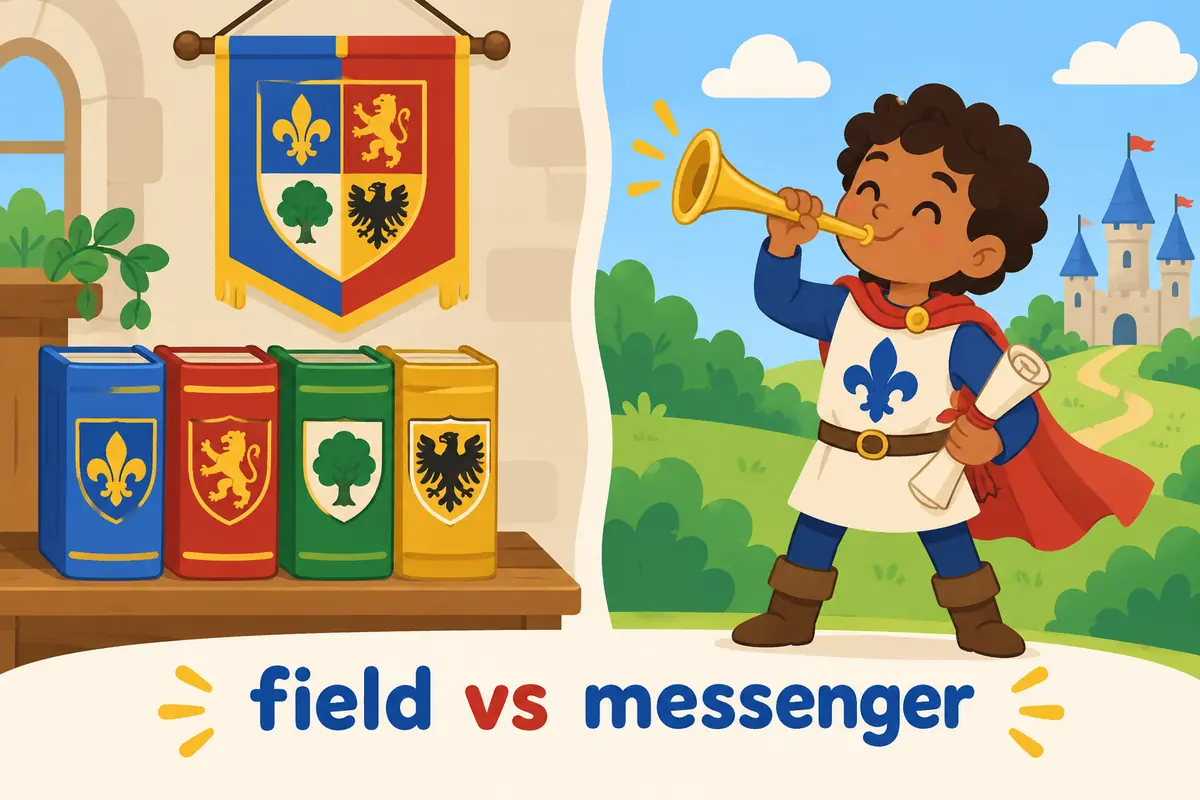
Heraldry vs herald
Heraldry and herald share a root and almost nothing else. A herald is a person, historically an officer who carried messages and later supervised tournaments, while heraldry is the whole system those officers helped to record. The two words cannot replace each other in a sentence.
| Attribute | heraldry | herald |
|---|---|---|
| Core meaning | The system and study of coats of arms | An official who announces or proclaims |
| Part of speech | Noun only | Noun and verb |
| What it names | An abstract field | A person or an act of announcing |
| Countable | No, it is uncountable | Yes, one herald, two heralds |
| Typical phrase | the study of heraldry | a herald announced the truce |
Verdict: use heraldry for the field and its rules, and use herald for the person or the act of proclaiming; a sentence about a messenger needs herald every time.
Word forms and grammar of heraldry
Heraldry sits in a small family of words built on the same root. The adjective heraldic describes anything belonging to the field, and the adverb heraldically describes how something is arranged or described in those terms.
| Form | Part of speech | Example |
|---|---|---|
| heraldry | noun, uncountable | The library holds a large collection on heraldry. |
| heraldic | adjective | The heraldic lion faces left on this shield. |
| heraldically | adverb | The animals are arranged heraldically in two rows. |
| heraldist | noun, a person | A heraldist identified the quarterings at once. |
| herald | noun and verb, different sense | Trumpets heralded the arrival of the king. |
| heralds | noun plural and verb, different sense | Two heralds read the proclamation aloud. |
The last two rows are the trap: herald and heralds belong to the family of announcing, not to the study of arms, so they never stand in for heraldry. A person trained in the field is a heraldist, a form worth remembering because it has no everyday substitute.
Common mistakes with heraldry
- Incorrect:
The king sent a heraldry to announce the peace.Correct: The king sent a herald to announce the peace. Rule: A herald is the messenger; heraldry is the field. - Incorrect:
She studied many heraldries at university.Correct: She studied heraldry at university. Rule: Heraldry is uncountable and has no plural form. - Incorrect:
Heraldry are difficult to learn.Correct: Heraldry is difficult to learn. Rule: The uncountable noun takes a singular verb. - Incorrect:
He is a heraldry at the college of arms.Correct: He is a heraldist at the college of arms. Rule: A person is a heraldist, never a heraldry. - Incorrect:
They heraldried the new king on the steps.Correct: They heralded the new king on the steps. Rule: Herald is the verb; heraldry has no verb form.
Practice using heraldry
Work through the six items, then read the reasons in the answer key rather than only checking the key word.
- Fill the gap: The exhibition explains how ______ developed across medieval Europe.
- Choose the better word: A uniformed (heraldry / herald) read the royal proclamation.
- Correct the error: The old shield shows several heraldries from different families.
- Build a sentence: use heraldry with an adjective that names a country.
- Spot the register: which belongs in a museum label — fine medieval heraldry, or some cool heraldry stuff?
- Rewrite with the adjective: The lion belongs to the traditions of heraldry. Use heraldic instead.
Answers
- heraldry — the field is uncountable and names the subject of the exhibition.
- herald — the sentence needs the person, not the field.
- The old shield shows heraldic devices from different families — heraldry does not take a plural, so the adjective carries the plurality.
- Model answer: Scottish heraldry uses different marks for younger sons.
- Fine medieval heraldry — a label stays formal and precise, with no filler words.
- The lion is a heraldic animal — the adjective modifies the noun directly.
The bottom line
Use heraldry in a sentence for the system and study of coats of arms, not for a single emblem or for ancestry by itself. The two details that decide most sentences are that the word is uncountable, so it never becomes heraldries, and that it names a field rather than a person, so herald stays separate. A sentence that keeps those two rules straight will sound right in any historical or formal setting.
Frequently asked questions about heraldry
Is heraldry a countable noun?
No. Heraldry is uncountable, so a sentence says heraldry is taught here and never a heraldry or many heraldries. When a writer needs to count individual designs, the countable words are arms, shields, devices or coats, as in three coats of arms above the door. The adjective heraldic also carries plurality without a plural noun.
What is the difference between heraldry and a coat of arms?
Heraldry is the whole system of rules, vocabulary and study, while a coat of arms is one completed design belonging to a person, family or town. A coat of arms is a countable object you can point at, and heraldry is the field that explains how it is built and described. The two words work together rather than as substitutes.
Who studies heraldry?
Historians, archivists, genealogists and designers study heraldry, and in some countries official officers of arms still record and grant it. A specialist is called a heraldist. Universities, museums and family-history societies all teach the subject, usually alongside genealogy and local history, because the records overlap heavily with wills, deeds and parish registers.
Is heraldry still used today?
Yes. Towns, schools, regiments, clubs and some families still keep coats of arms, and new designs are granted in several countries. Modern use is mostly civic and ceremonial rather than military, so banners appear at parades and logos rather than on the battlefield. The rules survive because they make each design unique and easy to describe.