Go round means to circulate, to make a detour, or to be enough for everyone, and it is the British form of go around. To use go round in a sentence, let it stand alone or add a preposition: “A rumour went round the office.” The phrase is intransitive, so it never takes a direct object.
Go round at a glance
- Go round is an intransitive phrase meaning to circulate, visit, detour or be enough.
- It is the common British form; American writing usually prefers go around.
- The forms are go round, goes round, went round and going round.
- Typical subjects are rumours, illnesses, plates of food, buses and people out visiting.
- Common patterns are go round the room, go round to a friend and enough to go round.
- The commonest error is adding a direct object, as in go round the rumour.
What does go round mean?
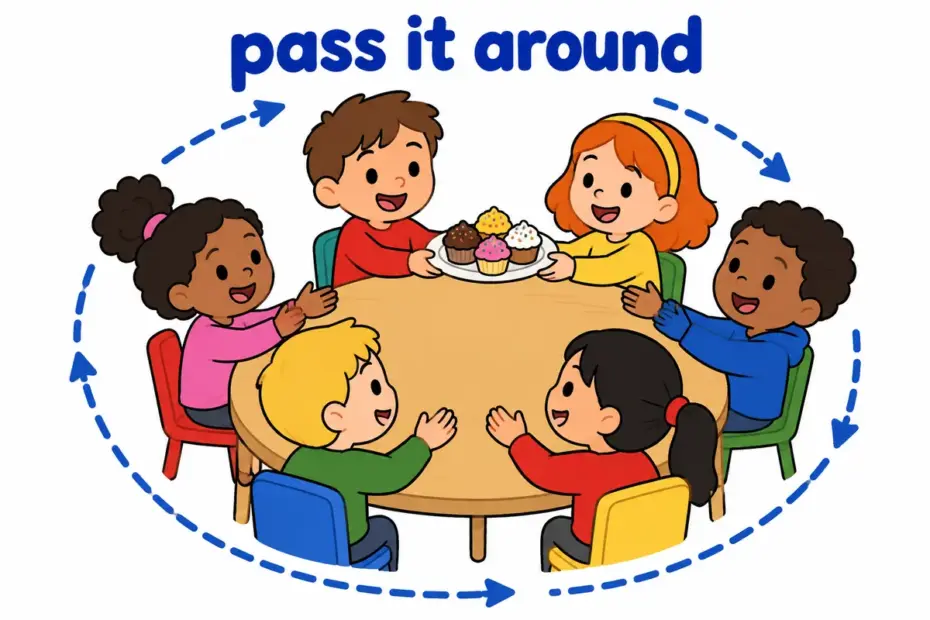
Go round is an intransitive phrasal phrase with several linked senses: to move from person to person, to travel around rather than through, and to be enough for everybody present. The Cambridge entry for go round separates the physical movement from the sense of sufficiency, and the two appear in quite different sentences. The image behind all of them is a circle, which is why the phrase covers a rumour, a wheel and a plate of cakes passed around a room.
| Sense | Plain meaning | Example sentence |
|---|---|---|
| Circulate | Move from person to person or place to place | A rumour went round the office. |
| Make a detour | Travel around rather than through | We went round the flooded road. |
| Be enough | Be sufficient for everybody | There is enough cake to go round. |
| Turn or rotate | Move in a circle | The wheels went round slowly. |
One limitation is worth stating plainly. Go round is chiefly British and Commonwealth usage, so American readers may find it unfamiliar in print even though they would say it aloud. It is also intransitive, which means it cannot carry a direct object. Where you need a plain verb, circulate describes the same movement of news or illness without the regional flavour. A closely related word, surround, means to be on every side rather than to move in a circle.
How do you use go round in a sentence?
Go round needs a preposition or nothing at all, never a direct object. The five patterns below cover circulation, visiting, sufficiency and the fixed idiom, and the visiting sense is the one learners meet least often.
| Pattern | Example | What it signals |
|---|---|---|
| go round + place | A virus went round the school. | Circulates within a place. |
| go round to + person | I went round to Aunt Mays flat. | Visiting, chiefly British. |
| enough to go round | There is enough soup to go round. | Sufficiency for a whole group. |
| go round + verb-ing | He went round telling everyone the news. | Repeated behaviour across many people. |
| go round in circles | The committee went round in circles for weeks. | Fixed idiom meaning make no progress. |
Compare the literal meaning of turning. A wheel will revolve on its axle, and a fan blade will rotate, but people go round a room on foot. That human, moving-about sense is the heart of the phrase and the reason it fits rumours, visitors and shared food so naturally.
Go round in a sentence: examples across contexts
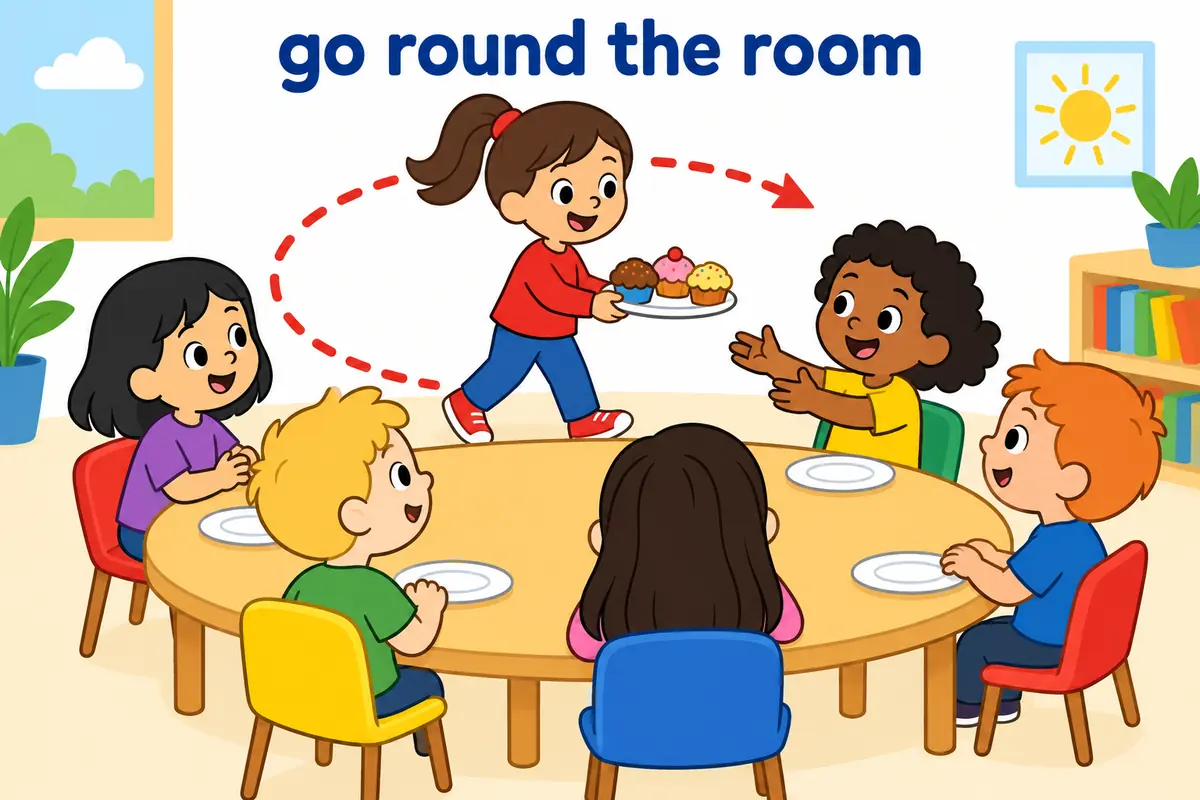
Go round keeps its circular meaning while moving from a school corridor to a road report. The eleven sentences below each show what is moving and how far it travels.
| Context | Example sentence | Why this works |
|---|---|---|
| Classroom | A cold went round the class before the holidays. | Shows something spreading between people. |
| School notice | The sign-up sheet went round every form room. | Traces a loop through a building. |
| Workplace email | Please let the memo go round the department today. | Turns the phrase into an instruction. |
| News report | Rumours went round the city after the announcement. | Uses circulation as the main sense. |
| Travel | We went round the roadworks and still arrived on time. | Shows the detour sense clearly. |
| Hospitality | There was just enough stew to go round. | Uses the sufficiency sense with a group. |
| Conversation | I will go round to my sisters after lunch. | Uses the British visiting pattern. |
| Mechanics | The old clock went round once and then stopped. | Uses the rotate sense for an object. |
| Meeting notes | The debate went round in circles for an hour. | Uses the idiom for lack of progress. |
| Tourism | A bus goes round the museum every twenty minutes. | Describes a fixed circular route. |
| Charity appeal | Volunteers went round the neighbourhood collecting tins. | Combines visiting with a purpose. |
The sufficiency rows are the ones learners miss, because go round there has nothing to do with movement at all. To bypass a town means to go round it on a road built for the purpose, and you might avoid a puddle by going round it, but neither verb covers the sense of there being enough to share.
Go round vs go around
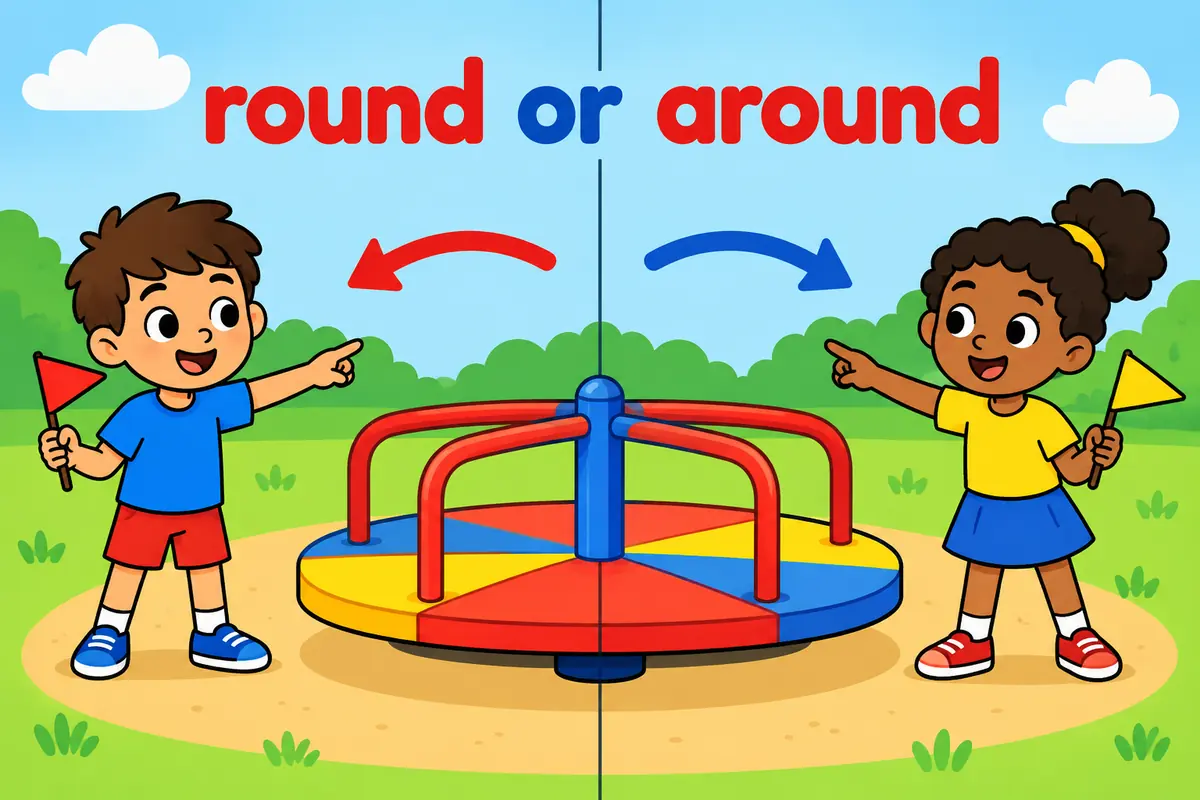
Go round and go around are the same phrase in two regional spellings. British and Commonwealth writers reach for go round, while American writers use go around almost everywhere. The choice is about house style rather than meaning, so an American news report and a British novel can describe the same circulating rumour with different words.
| Attribute | go round | go around |
|---|---|---|
| Meaning | Circulate, visit, detour or suffice | Identical |
| Usual region | Britain and the Commonwealth | The United States |
| Formality | Neutral, slightly informal | Neutral |
| Typical sentence | A rumour went round the office. | A rumor went around the office. |
| Noun form | a go-round | a go-around |
| Risk if mixed | Looks dated to American readers | Looks imported to British readers |
Verdict: choose go round for British and Commonwealth audiences and go around for American ones, then keep the choice consistent so a single page never mixes the two.
Word forms and grammar of go round
Go round changes through the verb go and can also appear as a hyphenated noun. The table lists the forms that matter, including the regional variant and the idiom.
| Form | Part of speech | Example |
|---|---|---|
| go round | phrasal phrase, base | The plates go round the table. |
| goes round | phrasal phrase, third person | A rumour goes round every term. |
| went round | phrasal phrase, past | The flu went round the village last winter. |
| going round | phrasal phrase, participle | There are two bugs going round. |
| go around | American variant | The bus goes around the square hourly. |
| a go-round | noun | Give everyone a go-round on the swing. |
| go round in circles | fixed idiom | We are going round in circles again. |
The noun go-round is a separate word with a hyphen, and it means a turn or an attempt, as in one more go-round. Do not confuse it with the verb phrase, and do not write the idiom as go round circles, because the preposition in carries the whole image of pointless repetition.
Common mistakes with go round
- Incorrect:
The news went round the office every desk.Correct: The news went round the office. Rule: Go round is intransitive, so it cannot take a second object. - Incorrect:
We went round to visit his house.Correct: We went round to his house. Rule: Go round to already means visit, so adding visit repeats the idea. - Incorrect:
American reports usually say go round.Correct: American reports usually say go around. Rule: American English prefers the around form. - Incorrect:
We are going round the same circles.Correct: We are going round in circles. Rule: The fixed idiom keeps the preposition in. - Incorrect:
Is there enough biscuits to go round for us?Correct: Are there enough biscuits to go round? Rule: Enough to go round already covers the group, and biscuits is plural. - Incorrect:
The rumour went round of the school.Correct: The rumour went round the school. Rule: Go round takes a direct place phrase, not of.
Practice using go round
Work through the seven items, then read the reasons, because each reason names the rule in play.
- Fill the gap: A stomach bug ______ the whole school last week.
- Choose the better form: American readers would expect go (round / around) the square.
- Correct the error: We are going round circles and getting nowhere.
- Build a sentence: use enough to go round about a plate of sandwiches.
- Spot the register: which fits a British report, the bus goes round the museum hourly, or the bus loops the museum each hour?
- Rewrite with a plain verb: A rumour went round the office. Use circulate.
- Explain the contrast: write one sentence using go round in the visiting sense.
Answers
- went round — the bug moved from pupil to pupil, and the past form fits last week.
- around — American English prefers go around, so round looks imported there.
- We are going round in circles and getting nowhere — the idiom needs the preposition in.
- Model answer: There are enough sandwiches to go round, so nobody will go without.
- The bus goes round the museum hourly — a British report keeps the round form.
- A rumour circulated through the office — circulate is the plain verb for the same movement.
- Model answer: I will go round to my grandmother after school on Friday.
The bottom line
Use go round in a sentence for something that circulates, a visit, a detour or a fair share, and remember that it never takes a direct object. Two points decide most sentences: the phrase is the British form of go around, so American writing usually swaps the words, and the sufficiency sense in enough to go round has nothing to do with movement. Where you want to be plain, circulate covers the same ground.
Frequently asked questions about go round
Is go round British or American?
Go round is the usual British and Commonwealth form, while go around is standard in American English. The two mean exactly the same thing, so the choice is a matter of regional house style rather than grammar. A writer aiming at an international audience should pick one and stay with it throughout the page.
What does go round mean?
Go round means to circulate from person to person, to travel around rather than through, or to be enough for everyone. It also describes something turning, as a wheel does. All the senses share the idea of a circle, which is why the phrase covers rumours, detours, shared food and rotating objects with equal ease.
What does going round in circles mean?
Going round in circles means discussing or doing the same thing repeatedly without making progress. The image is a walk that returns to its starting point, so the effort is real but the destination never changes. It fits a stalled meeting, a repeated argument or a project that keeps revisiting the same decision.
Is there a noun form of go round?
Yes. A go-round, written with a hyphen, is a turn or an attempt, as in give everyone a go-round on the swing. It is a countable noun and takes an article. The hyphen matters, because the unhyphenated go round in a sentence is the verb phrase meaning to circulate or visit.