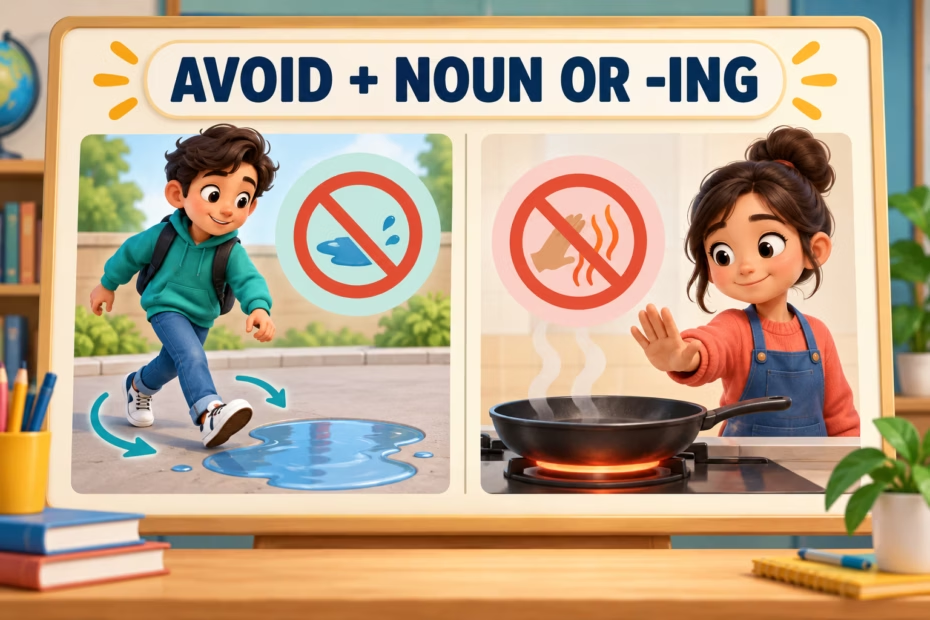
Avoid means to stay away from a person or thing, choose not to do an action, or keep something undesirable from happening. To use avoid in a sentence, follow it with a noun or with a verb ending in -ing. The examples below show this pattern and explain how avoid differs from prevent.
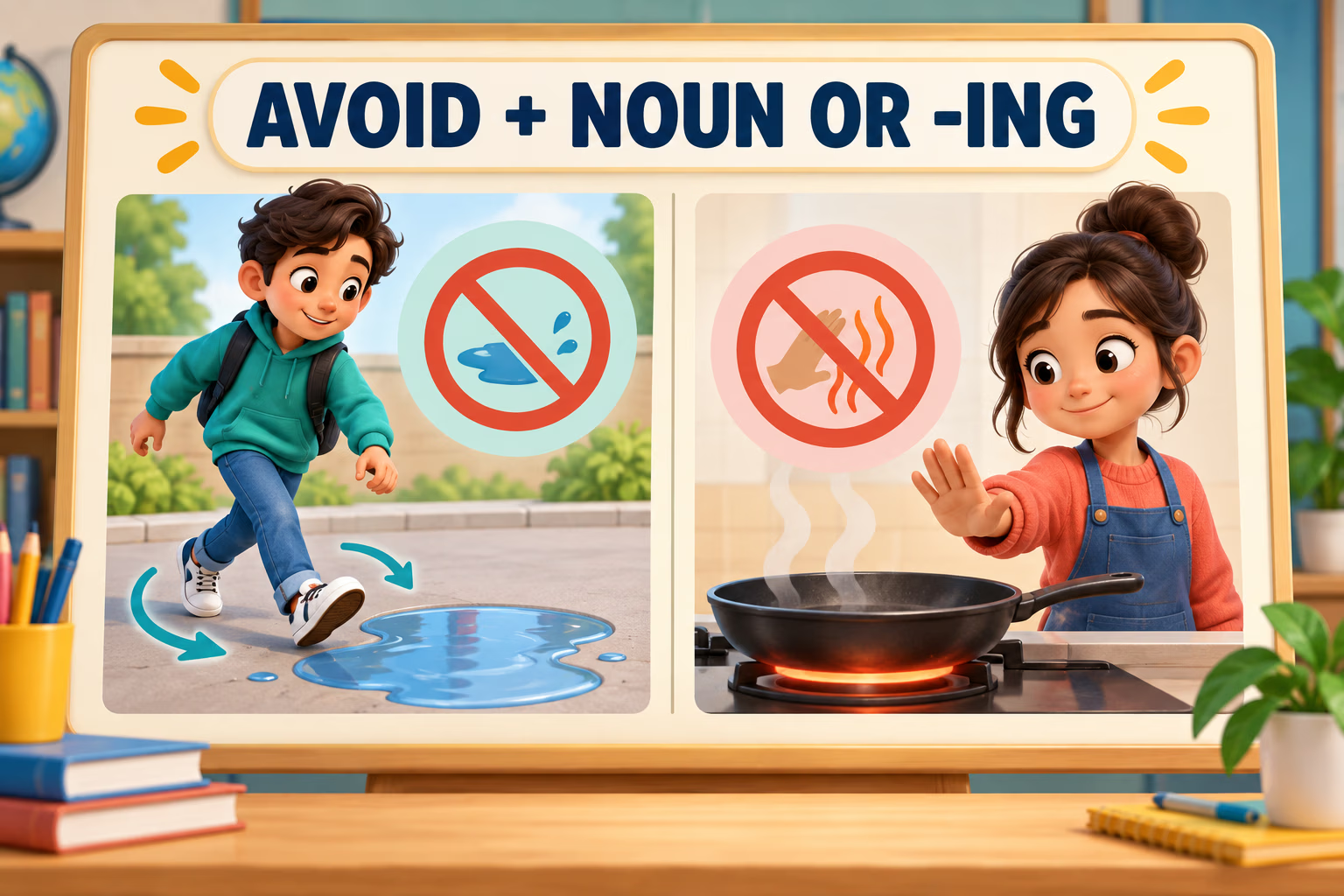

How to Use Avoid in a Sentence
| Pattern | Example sentence | Why it works |
|---|---|---|
| avoid + noun | We left early to avoid traffic. | “Traffic” is the noun naming what we wanted to stay away from. |
| avoid + object pronoun | She avoids them during the busy hour. | “Them” is the object of the verb. |
| avoid + verb-ing | He avoids driving in heavy snow. | When a verb follows avoid directly, use its -ing form. |
| avoid + verb-ing in a purpose clause | I took another route to avoid getting stuck. | “To avoid” explains the purpose; “getting” is the -ing complement after avoid. |
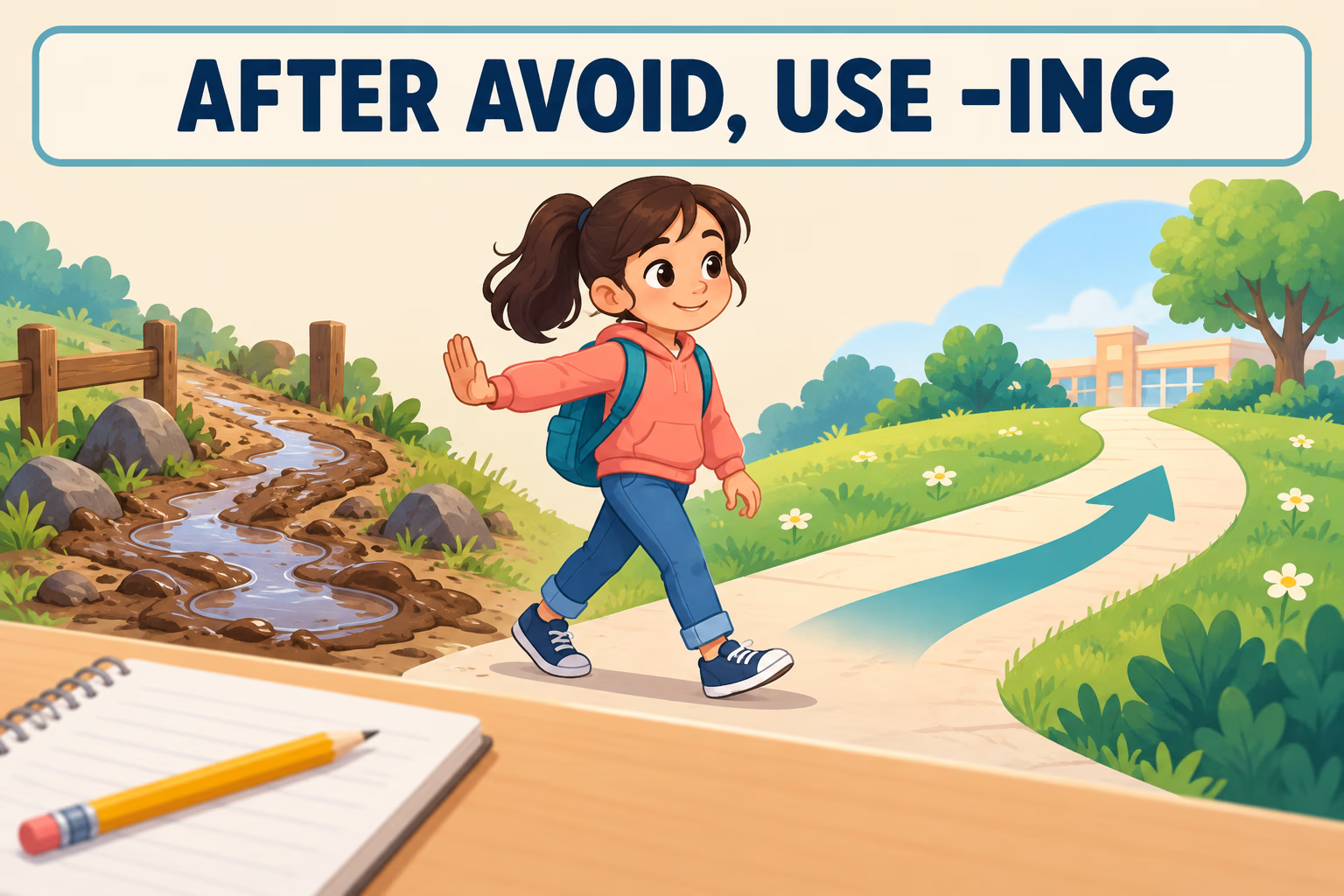
Why do we say “avoid doing,” not “avoid to do”?
When avoid is followed directly by a verb, use the -ing form: “avoid making a mistake,” not “avoid to make a mistake.” This also applies when to avoid introduces a purpose: “She checked her work to avoid making an error.” Here, to marks the purpose, while making is the verb form that follows avoid. See Cambridge Grammar’s avoid pattern guide.
How does “avoid” change with the subject and tense?
Avoid is a regular verb: add -s with a third-person singular subject in the present, and use avoided for the simple past and past participle. The complement pattern stays the same across tenses.
| Form | Example | What changes |
|---|---|---|
| Present, I/you/we/they | They avoid driving in snow. | The base form follows a plural subject. |
| Present, he/she/it | She avoids driving in snow. | Add -s to the verb. |
| Past | She avoided the icy road. | Use avoided for a completed past action. |
| After a modal | We should avoid driving in snow. | Use the base form after should. |
In all four examples, the object can be a noun (“the icy road”) or an -ing form (“driving”). Oxford Learner’s Dictionaries lists these verb forms and both complement patterns.
How is “avoid” different from “prevent”?
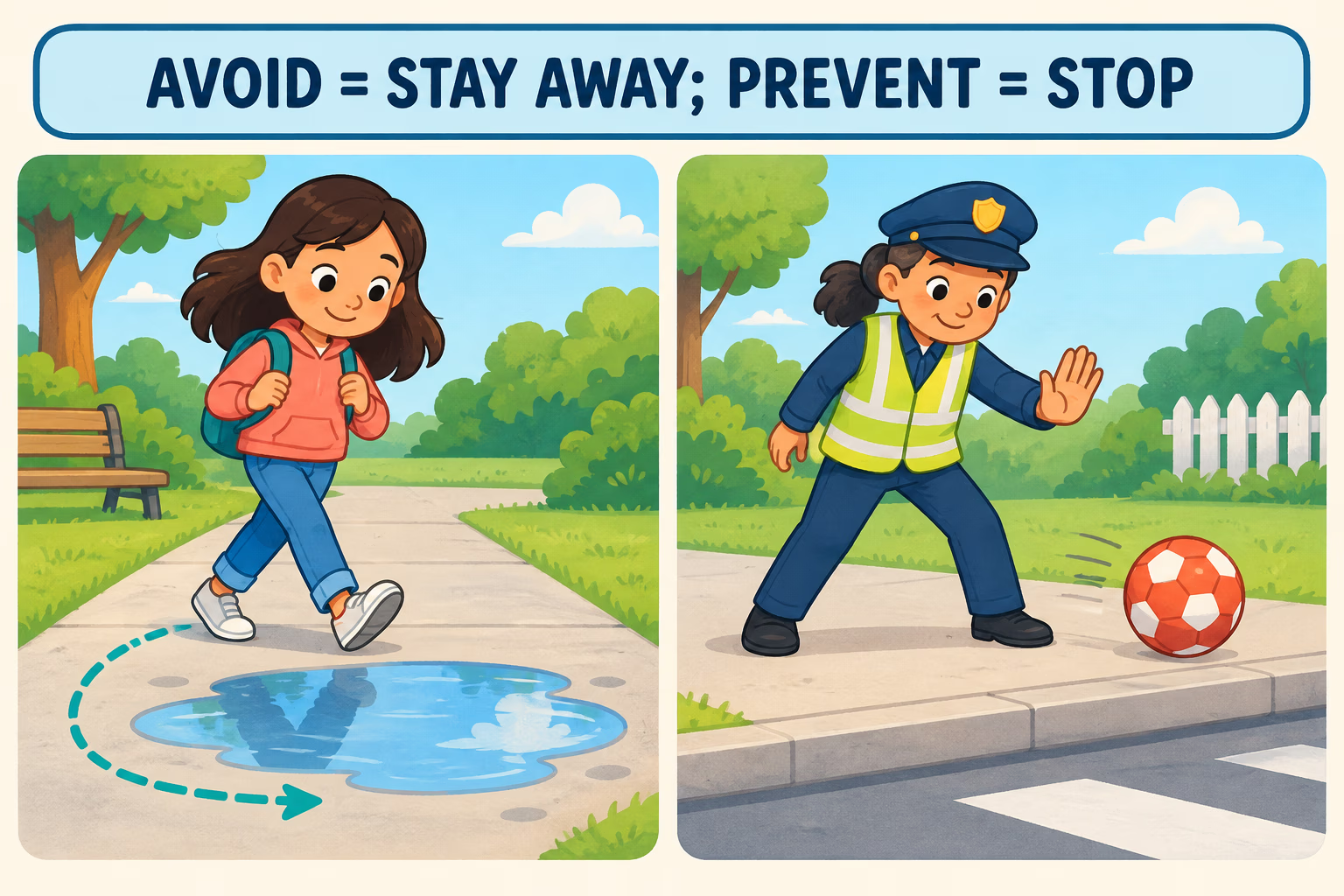
Avoid describes staying away from something or choosing not to do it: “I avoided the puddle” or “I avoided stepping in the puddle.” Prevent describes stopping an event or stopping someone from doing something: “The barrier prevented the ball from rolling into the road.” Compare Cambridge Grammar’s guide to avoid and prevent. The words overlap in some contexts, but their sentence patterns and meanings are not identical.
| Verb | Common pattern | Example |
|---|---|---|
| avoid | avoid + noun or -ing form | We avoided the road. / We avoided driving there. |
| prevent | prevent + person/event + from + -ing | The barrier prevented the ball from rolling into the road. |
“I avoided my neighbor” means I kept away from that person; “I prevented my neighbor from leaving” means I stopped the person from leaving. Use the verb that matches the action you mean, and check the complement pattern after it.
More example sentences with “avoid”
- I avoid checking messages while I am in a meeting.
- They took the side street to avoid the parade crowd.
- Please avoid leaving bags in the doorway.

Frequently Asked Questions About Avoid in a Sentence
Can “avoid” be followed by “to”?
Not when to introduces an infinitive verb directly after avoid: write “avoid driving,” not “avoid to drive.” In “I left early to avoid driving in rush-hour traffic,” the first to marks purpose; driving is still the complement of avoid.
Can a noun follow “avoid”?
Yes. Avoid takes a noun or object pronoun, as in “avoid traffic” or “avoid them.” It can also take a verb in the -ing form, as in “avoid waiting.” The intended meaning determines which object you choose.
Is “avoid” the same as “prevent”?
No. Avoid usually means keeping away from something or refraining from an action; prevent means stopping an event or person from doing something. Their grammar differs too: “avoid driving” but “prevent someone from driving.”
What is the past tense of “avoid”?
The simple past and past participle are both avoided: “They avoided the busy road,” and “The delay was avoided.” In the present tense, use avoids with a third-person singular subject and avoid with other subjects.
Use “avoid” correctly in a sentence
To use avoid in a sentence, choose the meaning you need, then follow the verb with a noun, pronoun, or -ing form. Use prevent when the sentence means that someone or something stops an event or action.
For fuller definitions and usage examples, see Oxford Learner’s Dictionaries: “avoid”.
Sources: Cambridge Grammar, “Word patterns: avoid doing something”; Cambridge Grammar, “Word choice: avoid or prevent?”; Oxford Learner’s Dictionaries, “avoid”.
Note on the original examples: The source below is preserved unchanged. Its examples include child-safety, driving, health, and study advice; they illustrate sentence structure and are not complete professional guidance. For decisions about health, nutrition, road safety, pools, hot surfaces, or sharp objects, follow current expert and local safety guidance. The grammar guidance above clarifies that a verb directly following avoid takes the -ing form.
Avoiding common mistakes in writing is crucial for effective communication. In its essence, to “avoid” means to keep away from or prevent something from happening. When writing, it means steering clear of errors that can hinder clarity and impact.
One prevalent error to avoid is using vague language or being overly wordy, which can confuse readers and dilute the message. Instead, strive for concise and precise wording to convey your thoughts effectively. Another mistake to steer clear of is neglecting proper grammar and punctuation, as these elements play a significant role in ensuring your writing is polished and professional. By being mindful of these errors and making a conscious effort to avoid them, you can take your writing to the next level.
7 Examples Of Avoid Used In a Sentence For Kids
- Avoid touching hot objects.
- Avoid running near the swimming pool.
- Sit down and avoid jumping on the bed.
- Avoid eating too many candies before dinner.
- Avoid talking loudly in the library.
- Hold hands and avoid crossing the road alone.
- Avoid using sharp objects without adult supervision.
14 Sentences with Avoid Examples
- Avoid procrastinating on assignments and start working on them well in advance.
- Make sure to avoid plagiarism by properly citing all your sources in your research papers.
- Avoid skipping classes as it can negatively impact your understanding of the subject.
- To maintain a healthy lifestyle, avoid consuming too much junk food and opt for nutritious meals instead.
- Avoid relying solely on lecture notes, try to actively engage with the material through additional reading.
- Avoid getting involved in campus politics if it hinders your academic performance.
- Avoid oversleeping and missing important exams or deadlines.
- Avoid pulling all-nighters on a regular basis and prioritize a consistent sleep schedule.
- Avoid distractions such as social media while studying to improve concentration.
- Before exams, avoid cramming the night before and focus on a well-structured study plan.
- Avoid taking on too many extracurricular activities that can overwhelm your schedule.
- Avoid skipping library sessions if you need a quiet place to focus on your studies.
- Avoid ignoring feedback from professors as it can help you improve your academic performance.
- Avoid engaging in plagiarism or cheating during exams as it can have serious consequences on your academic career.
How To Use Avoid in Sentences?
Avoid means to stay away from something or not engage in a particular action.
To use Avoid in a sentence, you can follow these simple steps:
-
Identify the situation: Think about what you want to prevent or not do.
-
Choose the main word: Select the word Avoid to express your intention of staying away from something.
-
Construct the sentence: Form a sentence that includes Avoid and the action or situation you want to stay away from.
For example:
- Avoid eating sugary snacks before bedtime to improve your sleep quality.
- Make sure to Avoid touching hot surfaces to prevent burns.
- Avoid leaving your personal belongings unattended in crowded places to avoid theft.
- Remember to Avoid using your phone while driving for safety reasons.
- It is important to Avoid using harsh chemicals when cleaning to protect the environment.
By following these steps, you can effectively incorporate Avoid into your sentences to communicate your intention of steering clear of specific actions or situations. Remember, using Avoid can help you express your desire to prevent negative outcomes and make safer or healthier choices.
Conclusion
In conclusion, the examples of sentences using the keyword “avoid” illustrate the importance of steering clear of potentially harmful situations or actions. By avoiding distractions while driving, one can reduce the risk of accidents on the road. Similarly, avoiding sugary snacks can help maintain a healthy diet and prevent tooth decay.
It is clear that by being mindful of what we choose to avoid, whether it be negative behaviors or detrimental habits, we can improve our well-being and overall quality of life. Overall, making conscious efforts to avoid certain things can lead to positive outcomes and a happier, healthier lifestyle.


