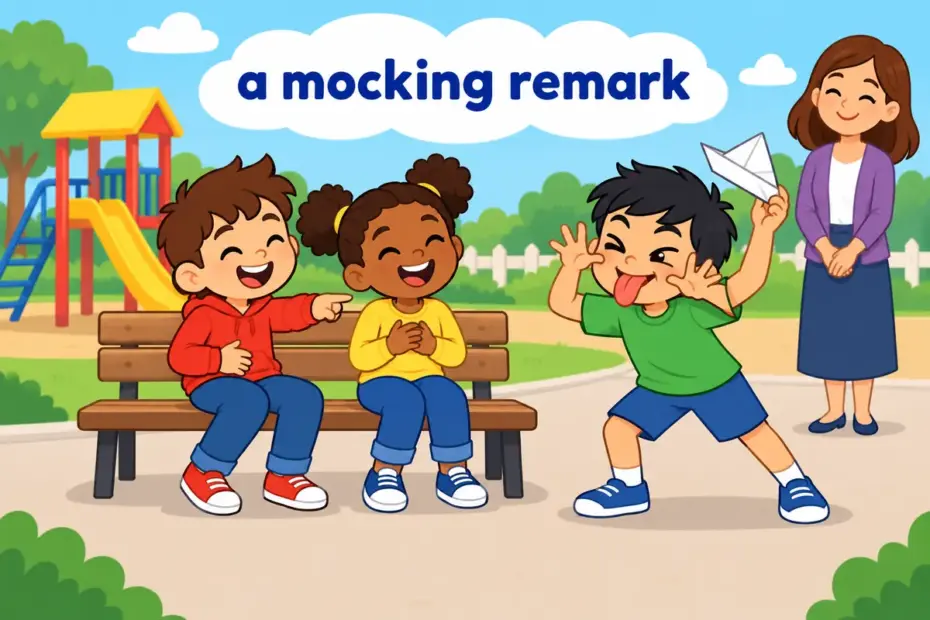
Gibe means a mocking remark, and as a verb it means to taunt somebody with such remarks. To use gibe in a sentence, name the target and keep the tone light: “The crowd gibed at the referee.” The word is formal and slightly literary, so it suits written reports more than everyday talk.
Gibe at a glance
- Gibe is a noun and a verb; its forms are gibes, gibed and gibing.
- The noun means a mocking remark, and the verb means to make one, usually at somebody.
- The verb is intransitive and takes at before its target: gibe at a referee.
- The usual collocations are trade gibes, aim a gibe and a gibe about something.
- The commonest error is confusing gibe, which mocks, with jibe, which usually means to agree.
What does gibe mean?
Gibe is a noun meaning a mocking or taunting remark, and a verb meaning to make such remarks. The Cambridge entry for gibe lists both the noun and the verb, and it records the variant spelling jibe. A gibe is aimed at a person and is meant to sting a little, so it sits between a joke and an insult; it is rarely cruel enough to count as abuse.
| Sense | Plain meaning | Example sentence |
|---|---|---|
| Noun, a taunt | A mocking remark aimed at someone | He ignored the gibes of the older boys. |
| Verb, to taunt | To mock somebody with such remarks | The crowd gibed at the referee. |
| Variant spelling | The same word written as jibe | The column was full of jibes about his speech. |
One honest limitation belongs here. Gibe is a mild, literary word for a mocking remark, so it does not mean any criticism, and it never means a threat. In ordinary speech people say dig, jab or snide remark instead. A mock can be silent and theatrical, while a gibe is always a remark somebody actually makes.
How do you use gibe in a sentence?
Gibe works as a countable noun or as a verb that points at its target with at. The five patterns below cover the forms that appear in real writing, and the verb pattern is the one learners get wrong most often.
| Pattern | Example | What it signals |
|---|---|---|
| a gibe about + topic | He laughed off a gibe about his haircut. | Names the subject of the mockery. |
| trade / exchange gibes | The two friends traded gibes all evening. | Shows mockery that both sides enjoy. |
| gibe at + person | The crowd gibed at the referee. | Verb pattern; at marks the target. |
| aim a gibe at + person | She aimed a gibe at the front row. | Turns the noun into a deliberate act. |
| gibes (plural subject) | His gibes were sharp but never cruel. | Describes a habit of mocking. |
Notice that the verb never takes a direct object. You gibe at somebody, you do not gibe somebody, which is why a sentence such as she gibed him reads as an error. The noun is countable, so it needs an article or a plural, as in a gibe or a stream of gibes.
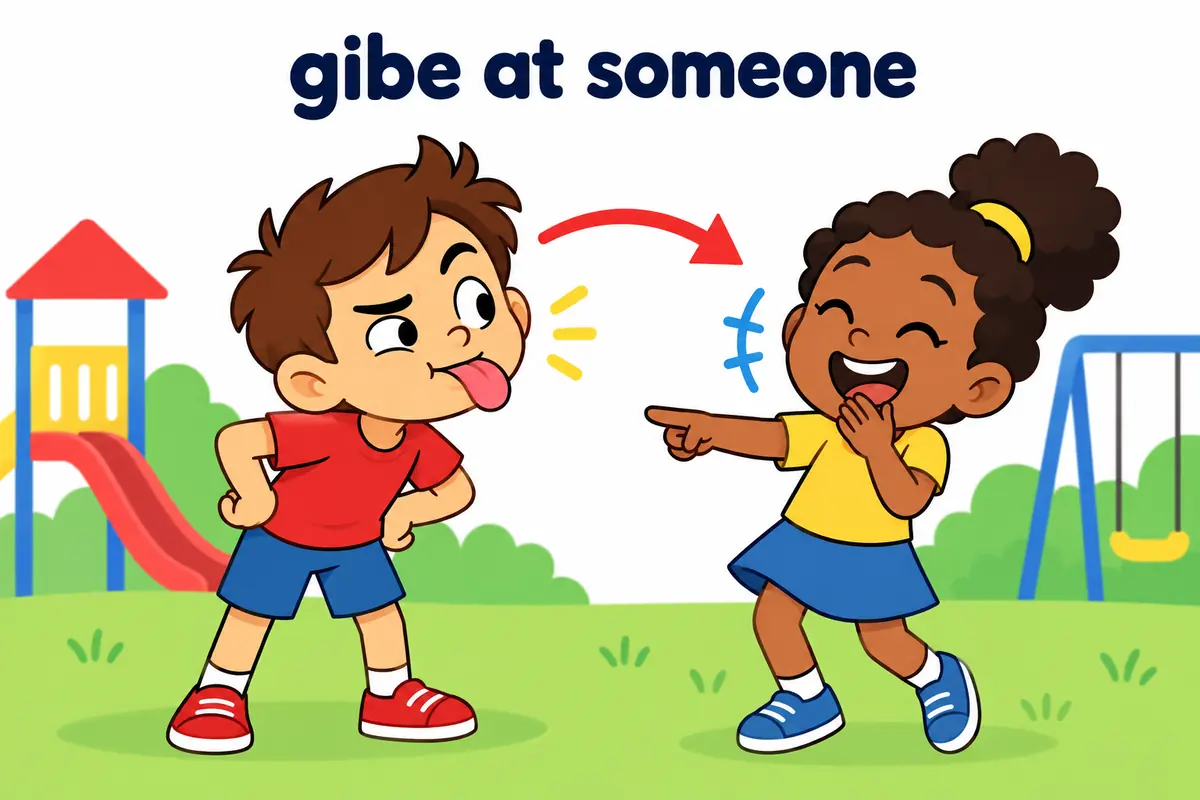
Gibe in a sentence: examples across contexts
Gibe keeps one meaning while moving from a playground to a newspaper column. The eleven sentences below each name the person the mocking remark is aimed at and how hard it lands.
| Context | Example sentence | Why this works |
|---|---|---|
| Playground | The older boys traded gibes across the playing field. | Shows mockery that both sides share. |
| Classroom | A gibe about his new glasses made the whole row laugh. | Names the topic and the reaction. |
| Sports report | The home crowd gibed at the referee after the penalty. | Uses the at-pattern with a public target. |
| News report | Reporters gibed at the minister for dodging the question. | Pairs the verb with a reason. |
| Workplace email | Keep the gibes out of the memo and stick to the figures. | Turns the noun into friendly advice. |
| Literary review | The novel is full of sly gibes at its own narrator. | Shows a gentle, self-aware form of mockery. |
| Political speech | Her speech landed a gibe at the opposing benches. | Uses the noun for a pointed but brief jab. |
| Comedy writing | The comedian aimed a gibe at the front row. | Shows mockery as performance. |
| Academics | One gibe in the seminar broke the tension. | Places a single remark in a formal setting. |
| Conversation | They gibed at their captain until he finally smiled. | Keeps the tone affectionate rather than cruel. |
| History essay | Pamphleteers escaped punishment for their gibes at the crown. | Uses the plural for an ongoing habit. |
Only the sports, news and conversation rows use the verb; the rest use the countable noun, which is the more flexible form. A taunt is usually louder and more hostile than a gibe, so the two words are close but not equal in force.
Gibe vs jibe
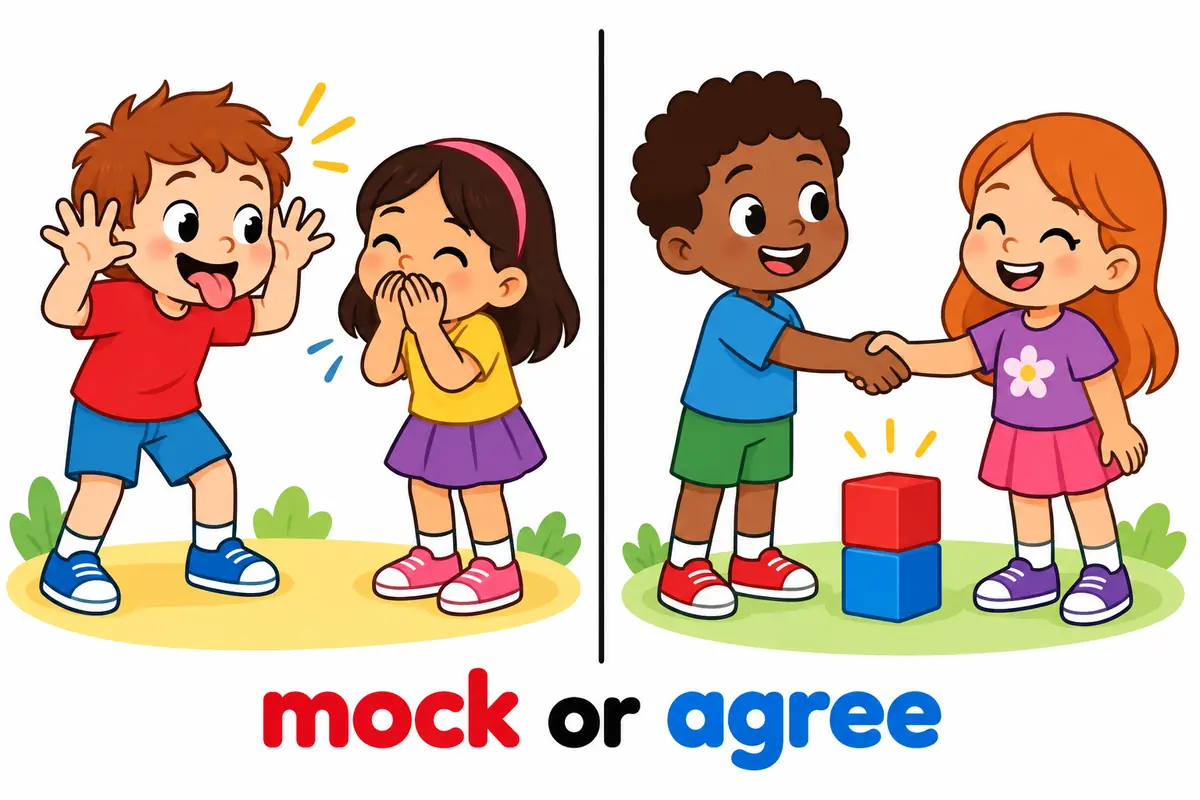
Gibe and jibe are the same pronunciation written two ways, and their histories keep crossing. The jibe spelling appears in older texts for the mocking sense, and it also carries two senses that gibe does not: to be in accord, as in the two accounts jibe, and to shift a sail across a boat in a following wind. Modern writers usually keep gibe for mockery and jibe for agreement, which is the cleanest split to follow.
| Attribute | gibe | jibe |
|---|---|---|
| Common meaning | A mocking remark | To agree or match |
| Second sense | None in modern use | To shift a sail across a boat |
| Typical sentence | He gibed at the referee. | The figures do not jibe with the report. |
| Tone | Playfully cutting | Neutral, about consistency |
| Part of speech | Noun and verb | Verb mainly |
| Risk if confused | Sounds like agreement | Sounds like mockery |
Verdict: choose gibe when somebody is being mocked, and jibe when facts or opinions agree, because mixing the two turns an argument about evidence into an argument about teasing.
Word forms and grammar of gibe
Gibe inflects like any regular verb, and its spelling is the part that trips writers. The table lists the forms and the trap that each one holds.
| Form | Part of speech | Example |
|---|---|---|
| gibe | noun, singular | One gibe spoiled the good mood. |
| gibes | noun, plural | The gibes grew louder as the game went on. |
| gibe | verb, base form | Children gibe at whatever seems different. |
| gibes | verb, third person | He gibes at his brother but never means harm. |
| gibed | verb, past and participle | The crowd gibed at the referee. |
| gibing | verb, present participle | They were gibing at the umpire again. |
| jibe | verb, different sense | Her story does not jibe with the timings. |
Keep the spelling under control by asking what the sentence means. If somebody is being made fun of, write gibe with a g; if two things agree or a sail moves, write jibe with a j. A close relative in meaning is jeer, but a jeer is a loud, public noise of disapproval rather than a clever remark.
Common mistakes with gibe
- Incorrect:
He made a gibe to the referee.Correct: He made a gibe at the referee. Rule: A gibe is aimed at somebody, so the preposition is at, not to. - Incorrect:
She gibed him about his jacket.Correct: She gibed at him about his jacket. Rule: The verb gibe does not take a direct object; the person follows at. - Incorrect:
Their accounts gibe perfectly.Correct: Their accounts jibe perfectly. Rule: The sense of agreeing is normally written jibe, not gibe. - Incorrect:
The gibe was a serious threat.Correct: The gibe was a mocking remark. Rule: A gibe is mocking, not threatening, so it cannot describe a threat. - Incorrect:
He gibed loudly with a whistle.Correct: He jeered loudly with a whistle. Rule: A loud, wordless show of disapproval is a jeer; a gibe is a spoken remark.
Practice using gibe
Work through the seven items, then read the reasons, because each reason names the rule that decides the answer.
- Fill the gap: A ______ about his old bicycle made him grin rather than frown.
- Choose the better word: The two reports simply do not (gibe / jibe) on the figures.
- Correct the error: The fans gibed the players for the whole second half.
- Build a sentence: use a gibe at about a politician avoiding a question.
- Spot the register: which fits a formal essay, the pamphleteers exchanged gibes, or the lads had a right laugh at him?
- Rewrite as the verb: The teammates made gibes about his accent. Use gibe at.
- Explain the contrast: write one sentence using jibe in its agreeing sense.
Answers
- gibe — a mocking remark takes the noun gibe and the preposition about before its topic.
- jibe — the sense of agreeing is normally spelled jibe, so the reports fail to match.
- The fans gibed at the players for the whole second half — the verb needs at before its target.
- Model answer: The reporter aimed a gibe at the minister for dodging the question.
- The pamphleteers exchanged gibes — an essay keeps the literary word and avoids slang.
- The teammates gibed at his accent — the verb points at the person with at.
- Model answer: Her account of the meeting does not jibe with the written minutes.
The bottom line
Use gibe in a sentence for a mocking remark or the act of making one, and point the verb at its target with at. Two points decide most sentences: gibe is a mild, literary word that never means a threat, and it must not be confused with jibe, which usually means to agree. Where you want a louder, cruder kind of mockery, jeer or taunt is the better choice.
Frequently asked questions about gibe
Is gibe a real word?
Yes, and dictionaries list it as both a noun and a verb. It appears in journalism, fiction and political writing, often for a remark that stings without wounding. Because the spelling jibe is more familiar, some readers mistake gibe for a typo, so a quick example such as the crowd gibed at the referee helps.
How do you pronounce gibe?
Gibe is pronounced to rhyme with tribe, using the same sound as the j in jump. The g is soft, not hard, so it does not sound like gibber. The variant jibe is pronounced in exactly the same way, which is the main reason the two spellings are so often mixed up.
Can gibe be used as a verb?
Yes. The verb means to make mocking remarks and always points at its target with at, as in the crowd gibed at the referee. It never takes a direct object, so she gibed him is wrong. The noun is countable, so it appears as a gibe or the gibes of the crowd.
Is gibe the same as jibe?
They sound alike and once shared a mocking sense, but modern use separates them. Gibe means to mock, while jibe usually means to agree or match, as in the figures do not jibe. Jibe also names shifting a sail across a boat. Keeping gibe for mockery and jibe for agreement avoids most confusion.