
Filter out means to remove or block something unwanted so that only what you want remains. To use filter out in a sentence, put the unwanted thing after out or between the verb and the particle: “The app filters out spam.” The phrasal verb is transitive and separable, and it also describes people leaving a place gradually.
Filter out at a glance
- Filter out is a transitive phrasal verb; its forms are filters out, filtered out and filtering out.
- It means to remove or block what is unwanted from a group, stream or mixture.
- The particle is separable, so a pronoun sits in the middle: filter them out.
- The phrase appears in technical and everyday writing, and in a related sense for crowds leaving.
- The commonest error is reversing the meaning and filtering out the good part.
What does filter out mean?
Filter out is a phrasal verb meaning to remove or block something unwanted, leaving the rest in place. The Cambridge entry for filter out records the idea of removing or separating, and that idea covers software that eliminate duplicates, curtains that block light, and crowds that drift away.
| Sense | Plain meaning | Example sentence |
|---|---|---|
| Remove unwanted items | Separate out what is not wanted | The software filters out duplicate entries. |
| Block what would pass through | Stop noise, light or signals | These curtains filter out bright sunlight. |
| Leave gradually (intransitive) | Move out one by one | The crowd filtered out of the stadium. |
One limitation is worth stating plainly. Filter out is not the same as filter. To filter a liquid is to pass it through a barrier, and the liquid you keep is the point. To filter out is to discard the unwanted part, so the sentence names what is taken away rather than what is kept. When a rule keeps a person away from the start, exclude a name is the accurate verb.
How do you use filter out in a sentence?
Filter out is transitive and separable, so the particle can stay beside the verb or move after the object. Five patterns cover the real uses, and the pronoun test is the quick way to check the order.
| Pattern | Example | What it signals |
|---|---|---|
| filter out + object | The program filters out bad data. | Particle first, with the object after it. |
| filter + object + out | The program filters bad data out. | Split form, with the object between verb and particle. |
| filter + pronoun + out | A good editor filters them out. | A pronoun must sit in the middle. |
| filter + object + out of + place | We filtered the stones out of the soil. | Names the source the thing is removed from. |
| be filtered out | Bad reviews were filtered out. | Passive with the unwanted item as subject. |
A fine mesh can remove the grit from a drink, and careful editors retain the good data while discarding the rest. The pronoun rule never changes: filter them out is correct, and filter out them is not.

Filter out in a sentence: examples across contexts
Filter out keeps its sense of discarding the unwanted while the setting changes. The ten sentences below move from a classroom science bench to a concert hall, and each one names what is removed.
| Context | Example sentence | Why this works |
|---|---|---|
| Classroom science | The paper filter removes the sand and filters out the cloudy bits. | A physical process makes the verb concrete. |
| Software | The app filters out spam before it reaches the inbox. | Names the unwanted stream and the benefit. |
| Workplace email | Our rule filters out messages from unknown senders. | Shows an automatic rule doing the work. |
| News report | The system filters out false alarms at the station. | Uses the verb for safety equipment. |
| Home | These curtains filter out the glare from the street. | Applies the blocking sense to light. |
| Music | The headphones filter out background noise on the train. | Everyday technology with a clear benefit. |
| Sport | Coaches filter out the weakest trials before the final squad. | Uses the verb for people chosen out of a group. |
| Academic writing | We filtered out incomplete surveys before analysis. | Describes a careful, repeatable method. |
| Conversation | The crowd filtered out of the hall as the rain eased. | Intransitive sense of people drifting away. |
| Gardening | A coarse sieve filters out the stones from the compost. | Names both the tool and the source. |
Notice that the intransitive crowd sentence is the odd one out, because it has no object at all. To sift out the best is slower and more deliberate, while a sieve or a rule does the filtering quickly.
Filter out vs exclude and sift out
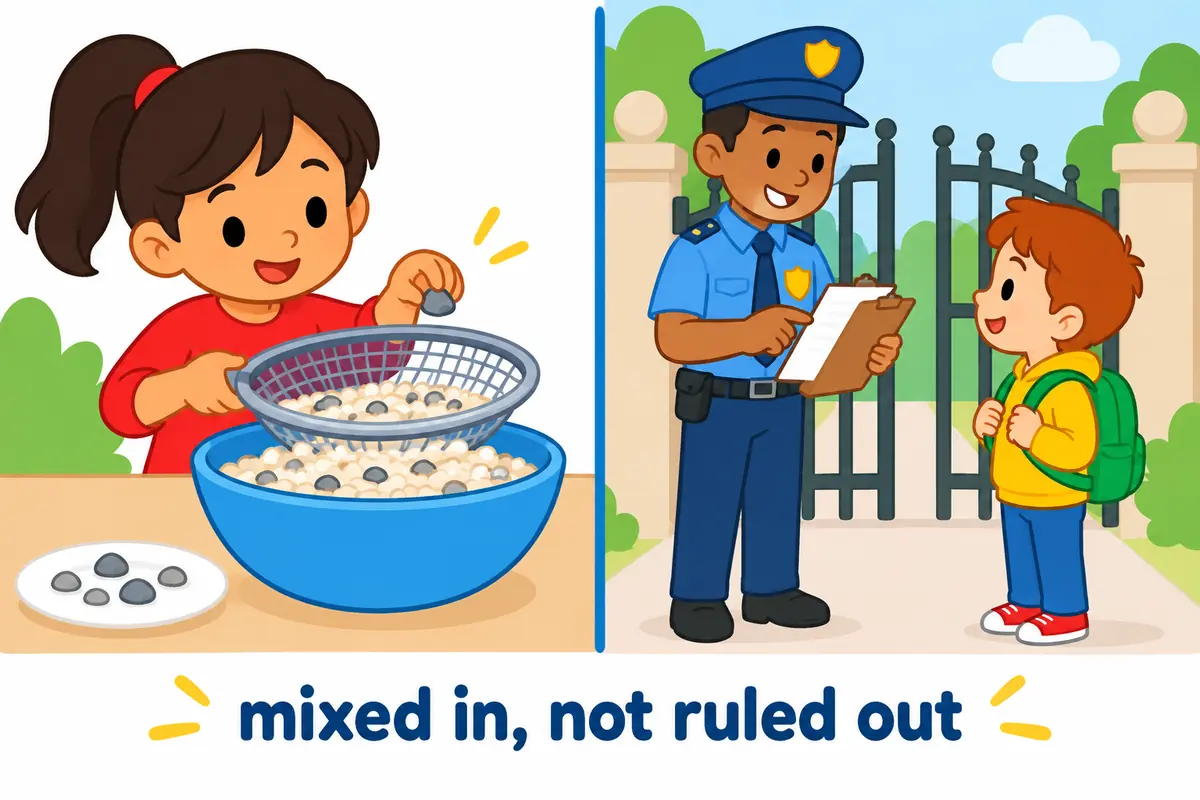
Filter out overlaps with two neighbours and matches neither exactly. A machine can separate the stones from rice, but only a rule excludes a person before anything is mixed.
| Attribute | filter out | exclude | sift out |
|---|---|---|---|
| Core job | Remove unwanted items from a stream | Keep someone out by rule | Separate fine from coarse by working through |
| Mechanism | A filter or process does the work | A decision or rule does the work | Careful examination does the work |
| Typical object | Data, spam, light, noise | People, groups, options | Evidence, flour, candidates |
| Register | Technical and everyday | Formal, often official | Neutral and methodical |
| What it implies | The unwanted part was mixed in | The unwanted part was never admitted | A slow deliberate separation |
| Example | filter out the noise | exclude someone from a list | sift out the best |
Verdict: choose filter out when something is mixed in and must be removed, exclude when a rule keeps it out from the start, and sift out when patient sorting finds the few that matter.
Word forms and grammar of filter out
Filter out follows the pattern of a separable phrasal verb, and the intransitive crowd sense uses a different preposition. The table shows both, plus the passive that reports are fond of.
| Form | Part of speech | Example |
|---|---|---|
| filter out | phrasal verb, base | Set the app to filter out spam. |
| filters out | third person singular | The mesh filters out the grit. |
| filtered out | past and past participle | The system filtered out the errors. |
| filtering out | present participle | She is filtering out the weakest bids. |
| filter out of | intransitive pattern | Fans filtered out of the ground. |
| be filtered out | passive | Spam messages are filtered out. |
The plain verb filter takes an object too, but it names what is kept, as in filter the water. That single difference explains why a sentence can be right with filter and wrong with filter out if the meaning has been reversed.
Common mistakes with filter out
- Incorrect:
Filter out the good stuff and keep the rest.Correct: Filter out the bad stuff and keep the rest. Rule: Filter out removes what is unwanted. - Incorrect:
The app filters out on spam.Correct: The app filters out spam. Rule: Filter out takes a direct object with no preposition. - Incorrect:
People filtered out the room.Correct: People filtered out of the room. Rule: The intransitive leaving sense needs out of. - Incorrect:
We filtered out the water to keep it.Correct: We filtered the water to keep it. Rule: Use plain filter when you keep what passes through, and filter out when you discard the unwanted part. - Incorrect:
The stones were filtered out from the soil.Correct: The stones were filtered out of the soil. Rule: Use out of, not from, to name the source.
Practice using filter out
Work through the six items, then read the answers for the reasoning rather than only the key.
- Fill the gap: Good software ______ out obvious spam.
- Choose the better verb: The committee (filtered out / filtered) the muddy water and kept it for the plants.
- Correct the error: The team filtered out on weak applications.
- Build a sentence: use filter out about noise in a recording studio.
- Spot the register: which fits a formal report, we filtered out the bad rows or we ditched the junk?
- Rewrite with the pronoun: The editor removed the weak quotes. Use filter out with them.
Answers
- filters — the subject is software, so the third person form is required.
- filtered — the committee kept the water, so plain filter is correct.
- The team filtered out weak applications — no preposition follows the object.
- Model answer: The engineer filtered out the hum before mixing the track.
- We filtered out the bad rows — it is plain and precise enough for a report.
- The editor filtered them out — the pronoun goes between the verb and the particle.
The bottom line
Use filter out in a sentence to remove or block something unwanted from a mixture, stream or group, and put a pronoun between the verb and its particle. The two details that decide most sentences are these: it is separable, so filter them out is right, and it removes what was mixed in, which is what separates it from exclude.
Frequently asked questions about filter out
What does filter out mean?
Filter out means to remove or block the part you do not want so that the useful part remains. Software filters out spam, curtains filter out light, and a sieve filters out stones. The focus always falls on what is taken away, which is why the phrase names the unwanted item rather than the good one.
Is filter out separable?
Filter out is separable, so the object can follow the particle or sit between the verb and out. The sentence the app filters out spam is fine, and so is the app filters spam out. A pronoun must take the middle position, so the app filters it out is correct and the app filters out it is not.
What is the difference between filter and filter out?
To filter something is to pass it through a barrier, and the point is usually what you keep, as in filter the water. To filter out is to discard the unwanted part, as in filter out the grit. The two verbs name opposite results, so reversing them changes the meaning of a sentence.
Can people be filtered out?
People can be filtered out of a group when a process removes those who do not qualify, as in weak applications were filtered out. The intransitive crowd sense also exists, as in fans filtered out of the ground after the whistle. Both uses treat people as a stream with parts removed or leaving.