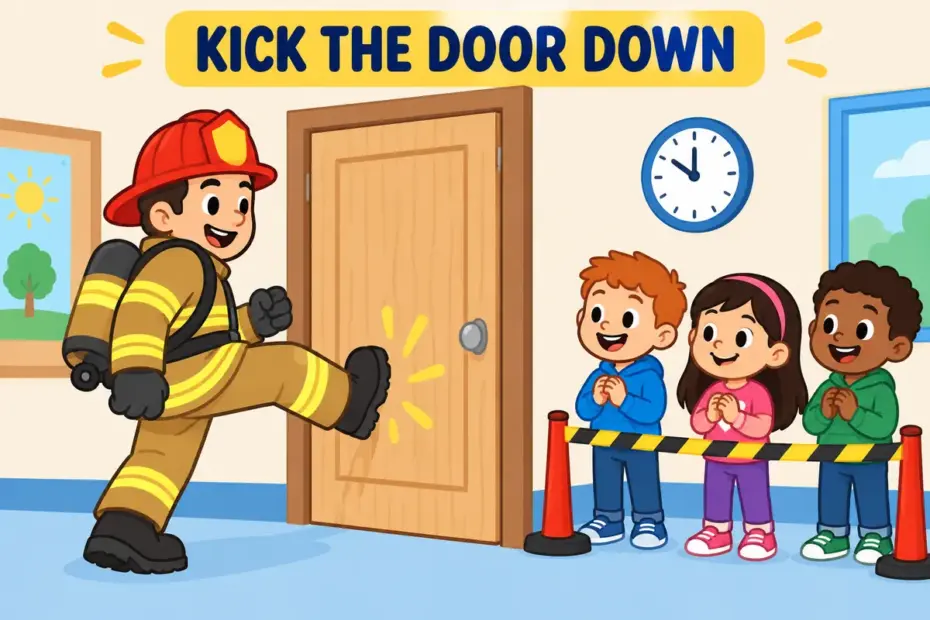
Kick down means to break something open or knock it to the ground with kicks, and the verb is separable, so the object may follow the particle or sit between verb and particle. Name what is brought down: The police kicked down the door. A pronoun must go in the middle, as in kick it down.
Kick down at a glance
- Kick down is a separable phrasal verb meaning to break something open or knock it to the ground with kicks.
- It is transitive, so it always needs an object: kick down a door, or kick a door down.
- The particle may follow the object or sit between verb and object, but a pronoun must go in the middle.
- It has a literal sense for doors and barriers and a figurative sense for obstacles and resistance.
- The commonest error is leaving out the object, because an intransitive kick sounds incomplete.
What does kick down mean?
Kick down is a transitive phrasal verb meaning to force something down or open with kicks. The Cambridge entry for kick down records the literal sense of bringing a door or barrier to the ground, and the figurative extension follows from the same image of force applied from below. Where the point is removing a structure rather than striking it, demolish a wall is the broader verb.
| Sense | Plain meaning | Example sentence |
|---|---|---|
| Literal: break open | Force a door or barrier down with kicks | The firefighters kicked down the locked door. |
| Literal: knock to the ground | Bring a standing object down with a kick | He kicked down the sandcastle with one boot. |
| Figurative: remove an obstacle | Force your way past resistance | The campaign kicked down every barrier in its path. |
| Idiomatic: spend freely | Hand over money without fuss, informal | The whole team kicked down for the leaving present. |
One limitation is worth stating. Kick down is the wrong verb when no foot is involved, so a wave that destroys a pier and a car that flattens a fence both need a different word. The idiom also leans physical, so a formal safety report may prefer force open or break down, even though it keeps the vivid image that plain verbs lose.
How do you use kick down in a sentence?
Kick down is transitive and separable. The object can follow the particle, as in kick down the door, or slide between verb and particle, as in kick the door down. When the object is a pronoun it must sit in the middle, so the sentence says kick it down and never kick down it. In the passive the particle stays attached to the verb: the door was kicked down.
| Pattern | Example | What it signals |
|---|---|---|
| kick down + object | Police kicked down the front door. | The particle follows the verb, the neutral order. |
| kick + object + down | Police kicked the front door down. | The object sits between verb and particle. |
| kick + pronoun + down | Police kicked it down in seconds. | A pronoun must sit in the middle; kick down it is wrong. |
| be kicked down | The barricade was kicked down at noon. | Passive form keeps the particle attached to the verb. |
| kick down + abstract obstacle | She kicked down every objection to the plan. | The figurative sense of clearing resistance. |
Because the verb names a forceful action, the subject is usually a person or a group acting deliberately. If the point is that something collapses on its own, break apart under pressure fits better, while kick down claims a person did the damage on purpose.
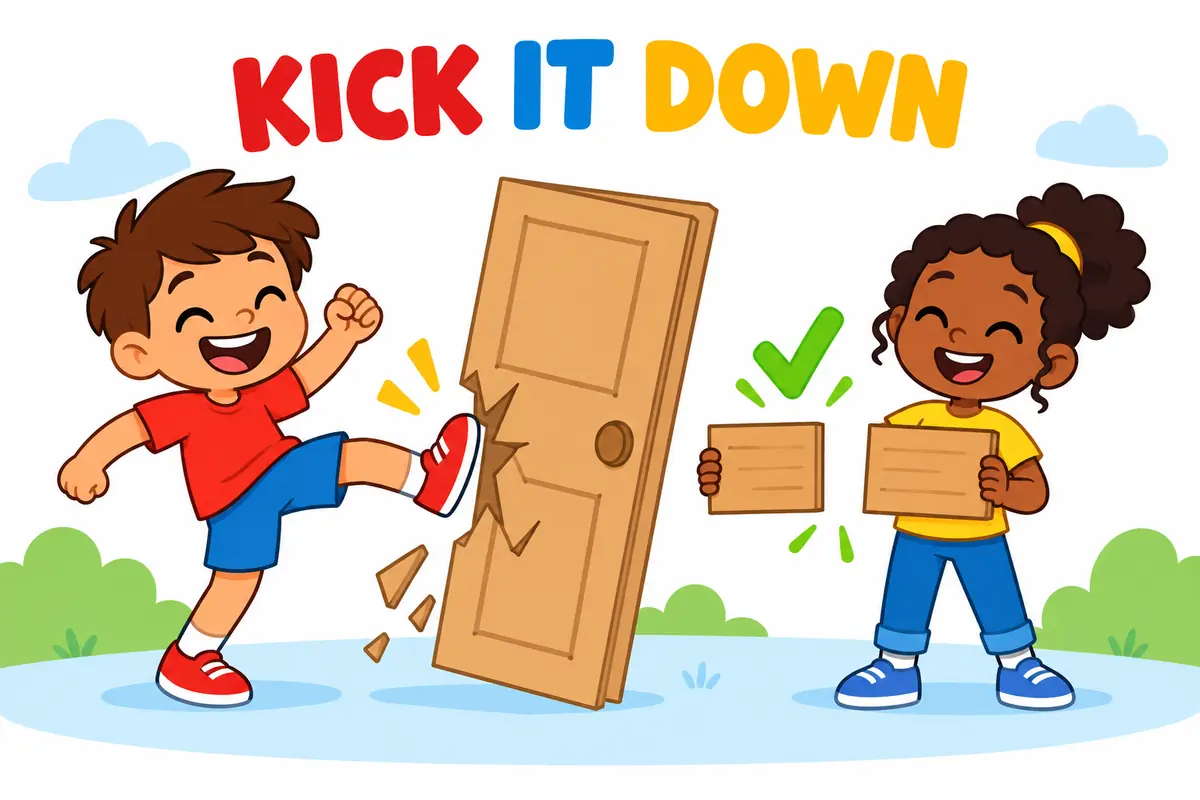
Kick down in a sentence: examples across contexts
The verb keeps its meaning while the setting moves, because the image of a foot forcing something down travels well from a fire drill to a video game. In every sentence below something solid is brought down, which is the detail that makes the verb fit.
| Context | Example sentence | Why this works |
|---|---|---|
| Everyday story | He kicked down the garden gate when the latch jammed. | Names a concrete object and a reason. |
| News report | Protesters kicked down a barrier outside the town hall. | The subject is a group and the act is public. |
| Fire service | Crews kicked down the door of the smoke-filled flat. | A formal register with a rescue purpose. |
| Detective story | The sergeant kicked the office door down and walked in. | The split order adds dramatic weight. |
| Sports commentary | The striker kicked down the corner flag in frustration. | A literal, vivid action in a familiar setting. |
| Classroom | The toddler kicked down the tower of blocks again. | A harmless, playful use of the literal sense. |
| Workplace email | The maintenance team kicked down the damaged partition. | A plain, factual sentence for a report. |
| Motivational writing | She kicked down every doubt that stood in her way. | The figurative obstacle-clearing sense. |
| Historical account | A crowd kicked down the wooden gates at dawn. | The subject and time give the scene detail. |
| Video game review | The hero kicks down doors and never slows. | The present tense suits fast-paced action. |
| Renovation diary | We kicked down the old plaster panels ourselves. | The first person and the object keep it concrete. |
| Children story | The giant kicked down the beanstalk the boy had climbed. | A literal act inside a familiar tale. |
Kick down vs knock down
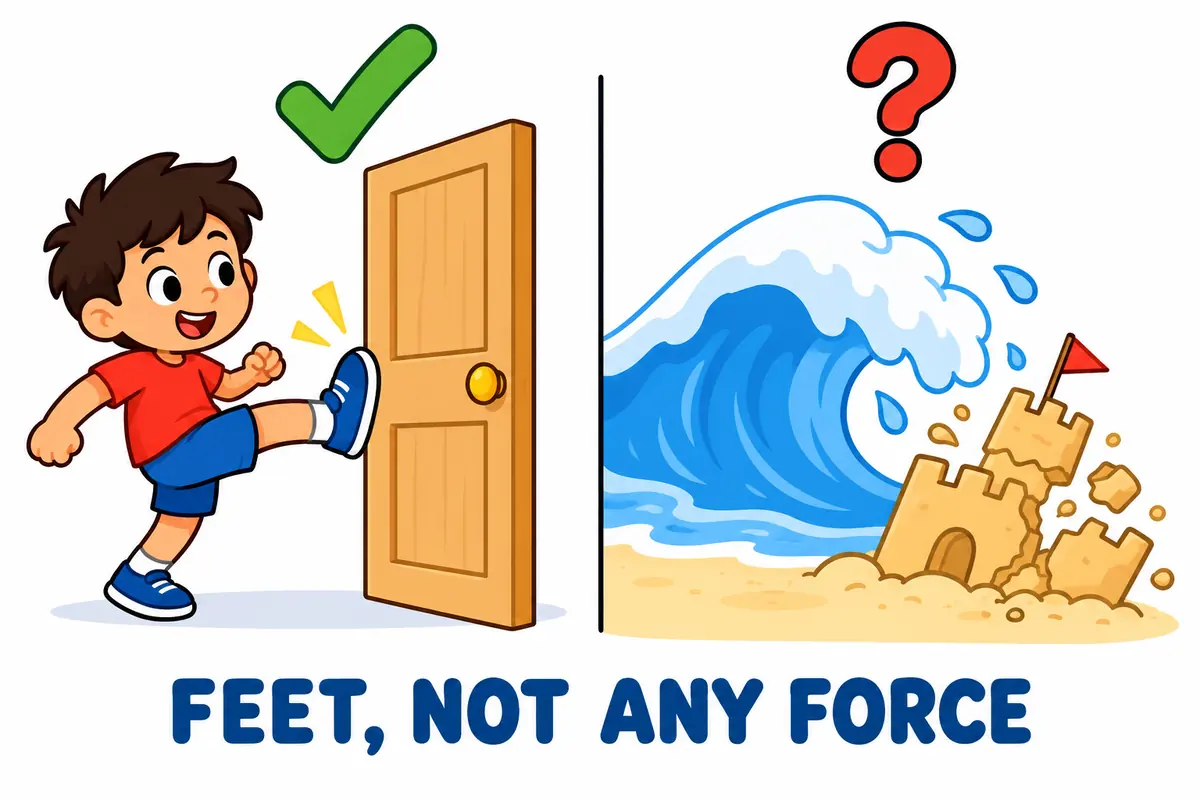
Kick down and smash through an obstacle overlap in their violence, and the difference lies in the method. Kick down always uses the feet; knock down allows any force, from a wave to a vehicle. A writer who needs the broader idea should not reach for kick down.
| Attribute | kick down | knock down |
|---|---|---|
| Core job | Bring something down using kicks | Cause something to fall by an impact |
| Typical subject | A person using a foot | A person, a vehicle or a wave |
| Typical object | A door, a barrier, a tower of blocks | A wall, a price, a pedestrian |
| Method | Always the foot | Any force, often a hand or a machine |
| Register | Neutral, slightly physical | Neutral and very broad |
Verdict: choose kick down when the foot is the tool and the object is a door, gate or barrier, and knock down when the cause could be anything from a fist to a freight train.
Word forms and grammar of kick down
Kick down inflects through kick, and the particle never changes. The table lists the forms learners need plus the very different phrasal verb, kick off, which swaps the particle and changes the meaning entirely.
| Form | Part of speech | Example |
|---|---|---|
| kick down | base phrasal verb | They plan to kick down the fence. |
| kicks down | third person singular | The crowd kicks down the fragile gate. |
| kicked down | past and past participle | The door was kicked down in the raid. |
| kicking down | present participle | He is kicking down the last of the boxes. |
| kick-down | noun for a gear shift, technical | The kick-down dropped the car into a lower gear. |
| kick off | related phrasal verb, different meaning | The match will kick off at three. |
Keep the particle attached in the passive, and keep a pronoun in the middle in the active. Those two rules explain nearly every mistake below, because both come from the same fact: kick down is separable only when its object is a full noun phrase. The base verb turns into an expulsion in kick out, where the object leaves rather than falls, and the particle down carries a different sense again in back down, which means to withdraw a demand.
Common mistakes with kick down
- Incorrect:
The police kicked down.Correct: The police kicked down the door. Rule: Kick down is transitive, so it needs a direct object. - Incorrect:
He kicked down it with one boot.Correct: He kicked it down with one boot. Rule: A pronoun must sit between the verb and the particle. - Incorrect:
The gate was kicked down by him forcefully open.Correct: The gate was kicked down by him. Rule: Kick down already carries the idea of force, so a trailing adjective is wrong. - Incorrect:
She kicked down to open the box.Correct: She kicked the box down. Rule: The verb takes a noun phrase, not an infinitive of purpose. - Incorrect:
They kicked down that the door was locked.Correct: They kicked down the locked door. Rule: The verb cannot take a that-clause; name the object it moves.
Practice using kick down
Work through the seven items, then check the reasoning rather than only the answer.
- Fill the gap: In the storm the wind alone ______ the wooden shed door.
- Choose the better word: The crowd (kicked down / knocked down) the fence with their boots.
- Correct the error: He kicked down it without a word.
- Build a sentence: use kicked down about a stuck classroom door during a fire drill.
- Spot the register: which fits a fire service report — Crews kicked down the door, or The firefighters booted the door down?
- Rewrite in the passive: The guard kicked down the barrier. Begin with The barrier.
- Rewrite in the figurative sense: The team removed every objection. Use kick down.
Answers
- kicked down — the shed door is the object that the force brought down.
- kicked down — the boots show the act was done with feet, which is what kick down names.
- He kicked it down without a word — the pronoun goes between the verb and the particle.
- Model answer: The caretaker kicked down the jammed door after the handle broke.
- Crews kicked down the door — a formal report avoids the slangy booted.
- The barrier was kicked down by the guard — the particle stays with the verb in the passive.
- The team kicked down every objection — an abstract obstacle takes the figurative sense.
The bottom line
Use kick down in a sentence when a foot forces a door, gate or barrier to the ground, and remember that the verb is separable but a pronoun must sit in the middle. The two facts that decide most sentences are that the object can never be dropped and that the particle stays attached in the passive. Where the force is not a foot, knock down or demolish is the plainer choice.
Frequently asked questions about kick down
Is kick down separable?
Yes. The object may follow the particle, as in kick down the door, or sit between verb and particle, as in kick the door down. Both orders are correct and mean the same thing. The one fixed rule concerns pronouns, which must always sit in the middle, so you write kick it down and never kick down it.
What does kick down mean?
Kick down means to break something open or knock it to the ground with kicks. The object is usually a door, a gate or a barrier, and the force always comes from a foot. A figurative use extends the image to obstacles and resistance, as in a campaign that kicks down every barrier in its path.
What is the difference between kick down and knock down?
Both bring something to the ground, and the difference is the method. Kick down always uses the feet, so its objects are doors, gates and low structures. Knock down is broader and covers any impact, from a wave to a vehicle to a single blow, and it also has a commercial sense of lowering a price.
Can a pronoun go after kick down?
No. A pronoun must sit between the verb and the particle, so the correct form is kick it down. Writing kick down it is a common learner error and sounds wrong to a native speaker. A full noun phrase, by contrast, may sit on either side of the particle without changing the meaning.