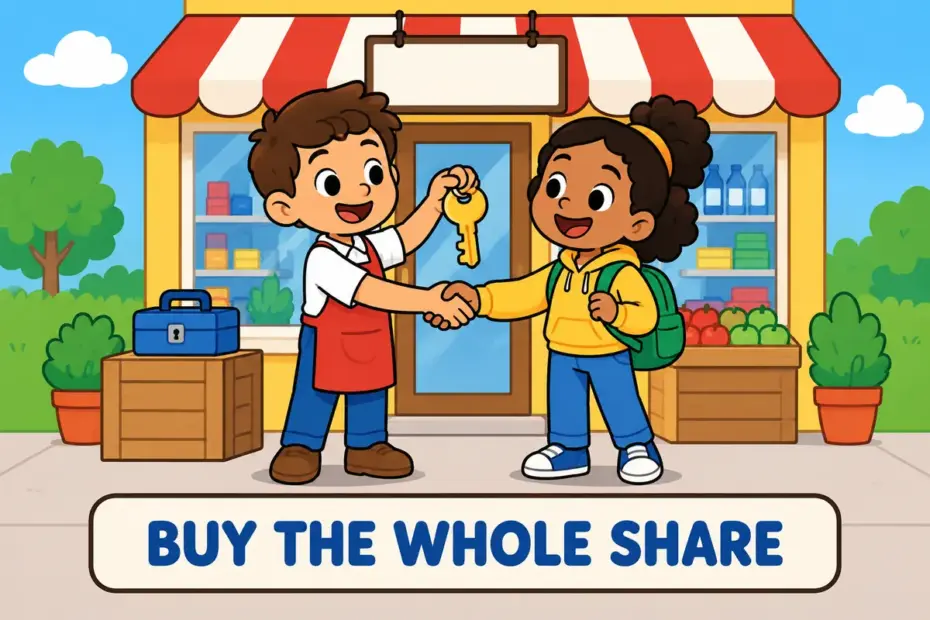
Buy out means to purchase a partner’s whole share of a business, or to buy all the stock a seller has. To use buy out in a sentence, make the buyer the subject and the partner the object: “The founders bought out their investor.” The verb is separable, so a pronoun sits between buy and out.
Buy out at a glance
- Buy out is a transitive phrasal verb with the forms buy, buys, buying and bought.
- It is separable, so buy out the partner and buy the partner out are both correct.
- A pronoun goes between the verb and the particle: buy them out.
- The two senses are taking over a share and clearing a seller’s whole stock.
- The register is business and neutral, used in news and contracts.
What does buy out mean?
Buy out is a phrasal verb meaning to purchase all of someone’s share or interest in a business, or to buy the whole of a seller’s stock. The Cambridge entry for buy out centres on the ownership sense, and the three uses below differ in what is being cleared.
| Sense | Plain meaning | Example sentence |
|---|---|---|
| Take over a share | Buy someone’s stake in a company | The founders bought out their investor. |
| Clear a stock | Buy everything a seller has | Shoppers bought out the whole shelf. |
| End a contract | Pay someone to leave an agreement | The club bought out his contract. |
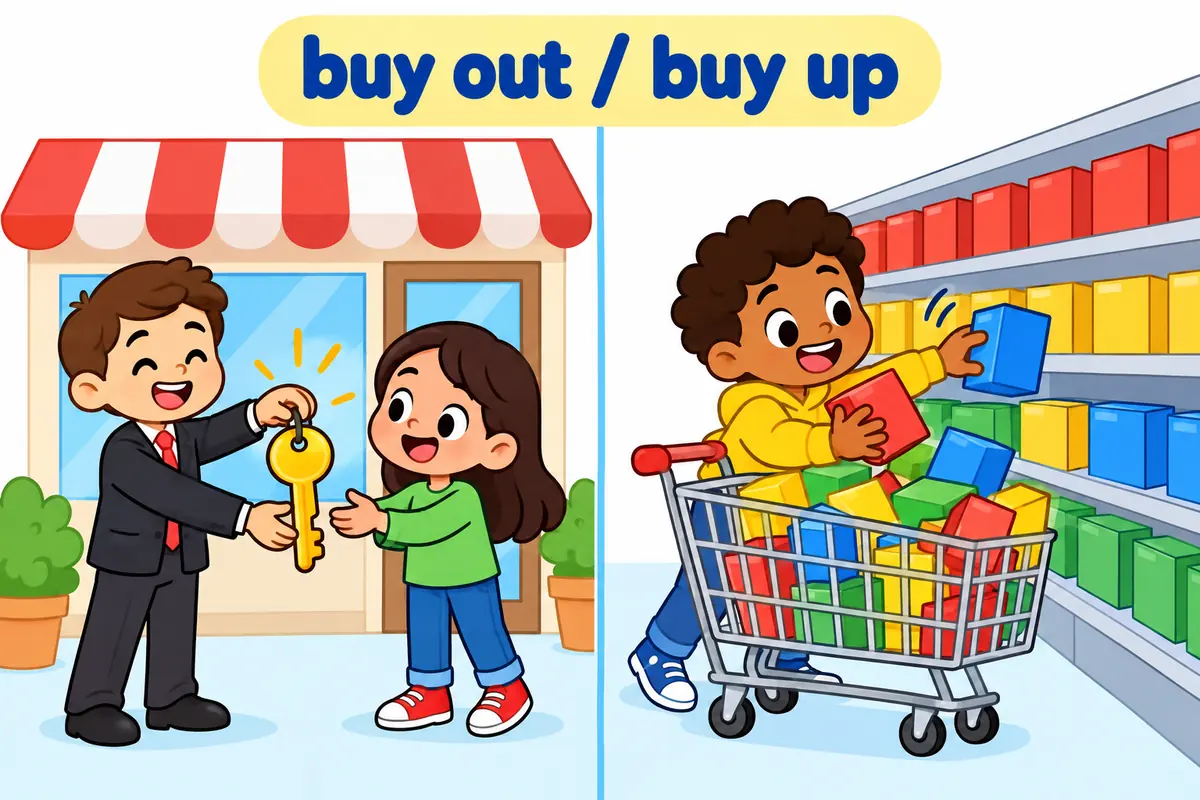
One limitation is worth stating plainly: buy out is not the same as buy up, which takes many separate items, and it is not the same as a merger, where two companies combine. The verb always implies that one side is paid to step away. The verb also says something about the finish: after a buyout the seller has no stake left, which is why the word suits a partner retiring or an investor exiting, and not a share sale that leaves the seller holding part of the business. A partial purchase is simply a sale, however large the sum.
How do you use buy out in a sentence?
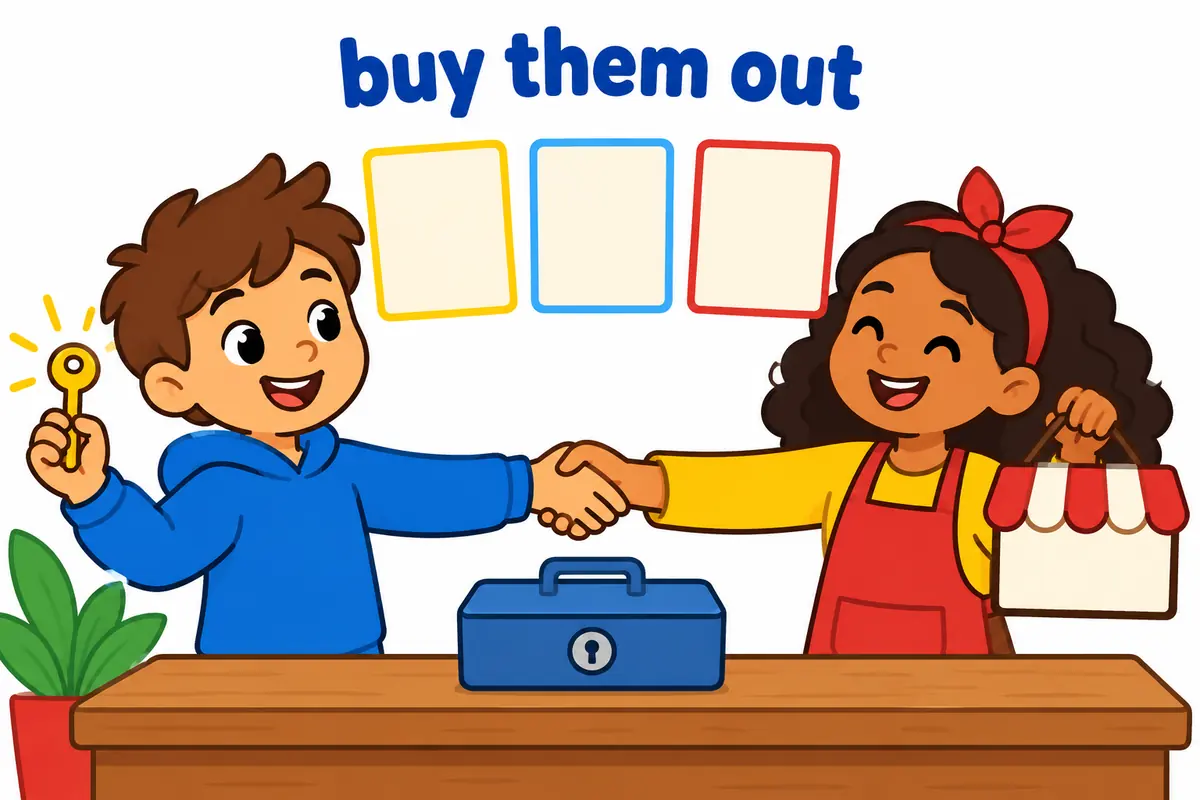
Buy out is separable: the particle may follow the object, as in buy the partner out, and it must follow a pronoun, as in buy them out. The verb is transitive, so the person, share or stock being cleared is always present.
| Pattern | Example | What it signals |
|---|---|---|
| buy out + object | The firm bought out its rival. | Neutral order; the particle stays before a long noun. |
| buy + object + out | The firm bought its rival out. | Separated order, common when the object is short. |
| buy + pronoun + out | They bought them out. | A pronoun must sit between verb and particle. |
| buy out + someone’s share | She bought out her brother’s share. | Names the ownership stake explicitly. |
| be bought out | The family was bought out in 2019. | Passive, used when the seller matters more than the buyer. |
Where the focus is the takeover of a whole company, acquire is the formal verb, and purchase works for a single named asset.
Buy out in a sentence: examples across contexts
Buy out belongs to money and ownership, so most of its sentences name a stake or a stock. The ten examples below move from a corner shop to a boardroom, and each one shows who is being cleared.
| Context | Example sentence | Why this works |
|---|---|---|
| Small business | The baker bought out her partner and kept the shop. | Names the person whose share is cleared. |
| Boardroom | A larger group bought out the family firm. | The whole company is the object. |
| News report | Investors bought out the founder for a reported sum. | Keeps the report neutral and factual. |
| Retail | Customers bought out every loaf before the storm. | The stock sense with a plural object. |
| Sports | The club bought out the last year of his deal. | The contract sense with a clear object. |
| Startup | She bought out her co-founder to keep control. | Shows the purpose behind the purchase. |
| Conversation | They bought him out, and he left quietly. | The pronoun between verb and particle is mandatory. |
| Business writing | The group will buy out the remaining shares next year. | Future form inside a planning document. |
| History | By 1990 the partners had bought out the last outside holder. | Past perfect for a completed takeover. |
| Market report | Traders bought out the offer and the price rose. | The stock sense in financial reporting. |
| Family firm | Two cousins bought out the third and split the work between them. | Several buyers clearing one share. |
| Music retail | Fans bought out the singer’s entire first pressing. | The stock sense with a possessive object. |
Buy out vs acquire and buy up
Buy out overlaps with acquire and buy up, and the three differ in scale and in what is being cleared. The table separates them by meaning and by object.
| Attribute | buy out | acquire | buy up |
|---|---|---|---|
| Core idea | Buy someone’s whole share or stock | Gain ownership of a company | Buy many items or a whole supply |
| Typical object | A partner, a stake, a shelf | A firm, a rival, an asset | Land, tickets, shares |
| Implies someone leaves | Yes, the seller steps away | Not necessarily | No |
| Register | Business and neutral | Formal and corporate | Neutral and journalistic |
Verdict: choose buy out when one side is paid to give up a stake, acquire for a formal takeover of a whole company, and buy up when many separate items or a whole supply are being snapped up. A quick test separates the three: if one seller loses everything, the verb is buy out; if a buyer gains a company wholesale, the verb is acquire; and if shelves or markets are emptied item by item, the verb is buy up.
Word forms and grammar of buy out
Buy out inflects like the irregular verb buy, and the noun buyout is one word while the attributive buy-out keeps a hyphen. Where a stake is sold back to the company, a seller might release it instead, and the forms below cover every ordinary use. A buyer who wants the name will retain the brand and sell the rest.
| Form | Part of speech | Example |
|---|---|---|
| buy out | phrasal verb, base | They plan to buy out the partner. |
| buys out | phrasal verb, third person | She buys out a rival each year. |
| buying out | phrasal verb, present participle | They are buying out the founder. |
| bought out | phrasal verb, past and participle | The group bought out the family. |
| buyout | noun | The buyout took two months to agree. |
| buy-out | attributive adjective | They signed a buy-out clause. |
The paired noun forms are the ones learners mix: the deal itself is a buyout, while a buy-out clause is an adjective describing the clause. The hyphen is the clue: a buy-out clause modifies the noun clause, while a buyout stands alone as the name of the deal. When the phrase acts as a modifier, keep the hyphen, and when it names the transaction, write one word.
Common mistakes with buy out
- Incorrect:
The founders bought out them.Correct: The founders bought them out. Rule: A pronoun object must sit between the verb and the particle. - Incorrect:
The company bought out.Correct: The company bought out its rival. Rule: Buy out is transitive, so the object cannot be dropped. - Incorrect:
They bought up their business partner.Correct: They bought out their business partner. Rule: A partner is a single share, so buy out fits; buy up takes many separate items. - Incorrect:
The two firms bought out to merge.Correct: One firm bought out the other and they merged. Rule: Buy out needs an object, and a merger is a separate event.
Practice using buy out
Work through the six items, then read the reasons rather than only the answers.
- Fill the gap: The two sisters decided to ______ their uncle ______ of the business.
- Choose the better word: The group moved to (buy out / buy up) its only competitor.
- Correct the error: The investor bought out them for a fair price.
- Build a sentence: use buy out about a partner who wants to leave.
- Spot the register: which belongs in a contract — the buyer shall buy out the seller’s entire holding, or we bought him out?
- Rewrite with a pronoun: Buy out the remaining shareholders.
- Choose the better word: The chain plans to (buy out / buy up) every rival in the region.
Answers
- buy their uncle out — the separated order is natural with a possessive object.
- buy out — a single competitor is one stake, so buy out fits better than buy up.
- The investor bought them out for a fair price — the pronoun goes between verb and particle.
- Model answer: The owner bought out her partner so she could run the shop alone.
- The first sentence belongs in a contract — it is formal, while bought him out is conversational.
- Buy them out — a pronoun replaces the noun and moves between verb and particle.
- buy up — every rival is a series of separate purchases, while buy out takes one whole stake at a time.
The bottom line
Use buy out in a sentence when one side pays to take over another’s whole share or stock. The two facts that decide most sentences are these: the verb is separable, so a pronoun must sit between buy and out, and it is transitive, so something must always be bought out. Where the focus is a formal takeover of a whole company, absorb or liquidate may describe the next step. The verb is also neutral about how the deal is received, so a hostile buyout and a friendly one take exactly the same words.
Frequently asked questions about buy out
Is buy out one word or two?
The verb is two words, as in buy out a partner. The noun that names the deal is one word, a buyout, and the adjective that describes a clause keeps a hyphen, as in a buy-out clause. The spelling changes with the job the word is doing.
Is buy out separable?
Yes. You can say buy out the partner or buy the partner out, and both are correct. A pronoun must sit between the verb and the particle, so the order is always buy them out. The separated form is common when the object is short.
What is the difference between buy out and buy up?
Buy out takes one person’s whole share or a seller’s entire stock, and it implies that someone steps away. Buy up takes many separate items or a whole supply, as in buying up all the tickets. Scale and ownership tell them apart.
Can you buy out a contract?
Yes. To buy out a contract is to pay someone to leave it early, and a sports club buying out a player’s deal is the usual example. The object is the agreement rather than a person, but the sense of paying to end an obligation stays the same.