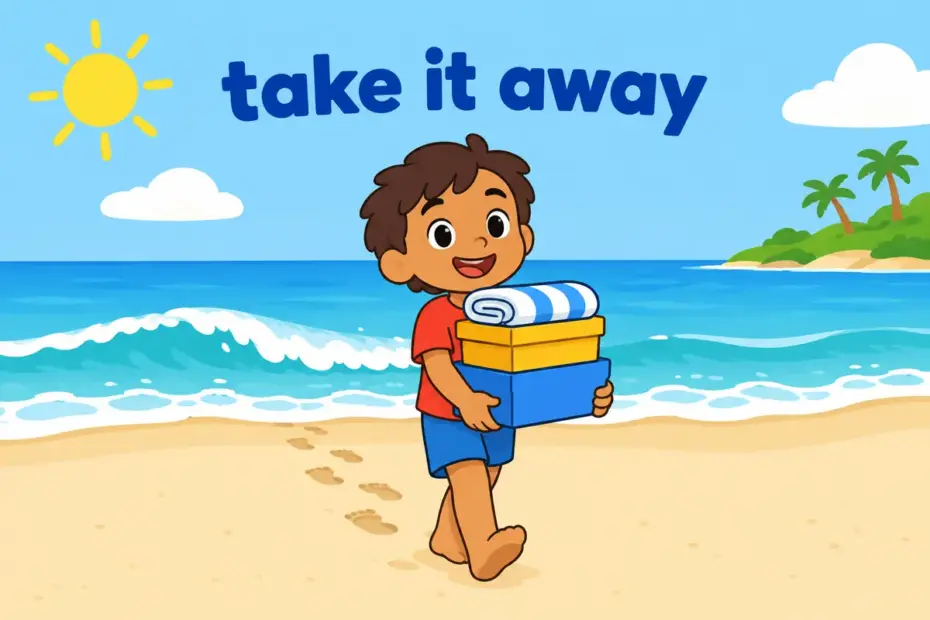
Carry away is a phrasal verb meaning to remove something from a place, to overwhelm someone with feeling, or, in the passive, to lose self-control. To use carry away in a sentence, give the verb a physical object or use the fixed idiom get carried away: “The current carried the raft away,” and “he got carried away with the decorations.”
Carry away at a glance
- Carry away is a phrasal verb; its forms are carries away, carried away and carrying away.
- The literal sense takes a movable object: carry the boxes away, or carry away the boxes.
- A pronoun must sit between the verb and the particle: carry it away, never carry away it.
- The passive idiom is get, become or be carried away, and it means losing self-control.
- In sport and competition, carry away means to win and take the prize.
- The commonest errors are putting the pronoun after away and writing get carry away.
What does carry away mean?
Carry away is a phrasal verb meaning to take something away from a place, to transport someone with strong feeling, or, in the passive forms get, become or be carried away, to lose control of yourself. The Cambridge entry for carry away records both the literal and the emotional senses, and the object after the verb almost always shows which one is in play.
One limitation belongs here. The literal sense is neutral and can be replaced by remove, which formal writing often prefers, as in workers removed the rubble. The idiom get carried away is informal and mildly self-critical, so a report would say the crowd became unruly rather than the crowd got carried away. Where something is taken by force, seize reads more sharply than carry away.
| Sense | Plain meaning | Example sentence |
|---|---|---|
| Remove physically | Take something away from a place | The tide carried the sandcastle away. |
| Transport with feeling | Move someone deeply, as if elsewhere | The slow movement carried the audience away. |
| Lose self-control | Be overwhelmed by excitement or emotion | He got carried away and ordered far too much food. |
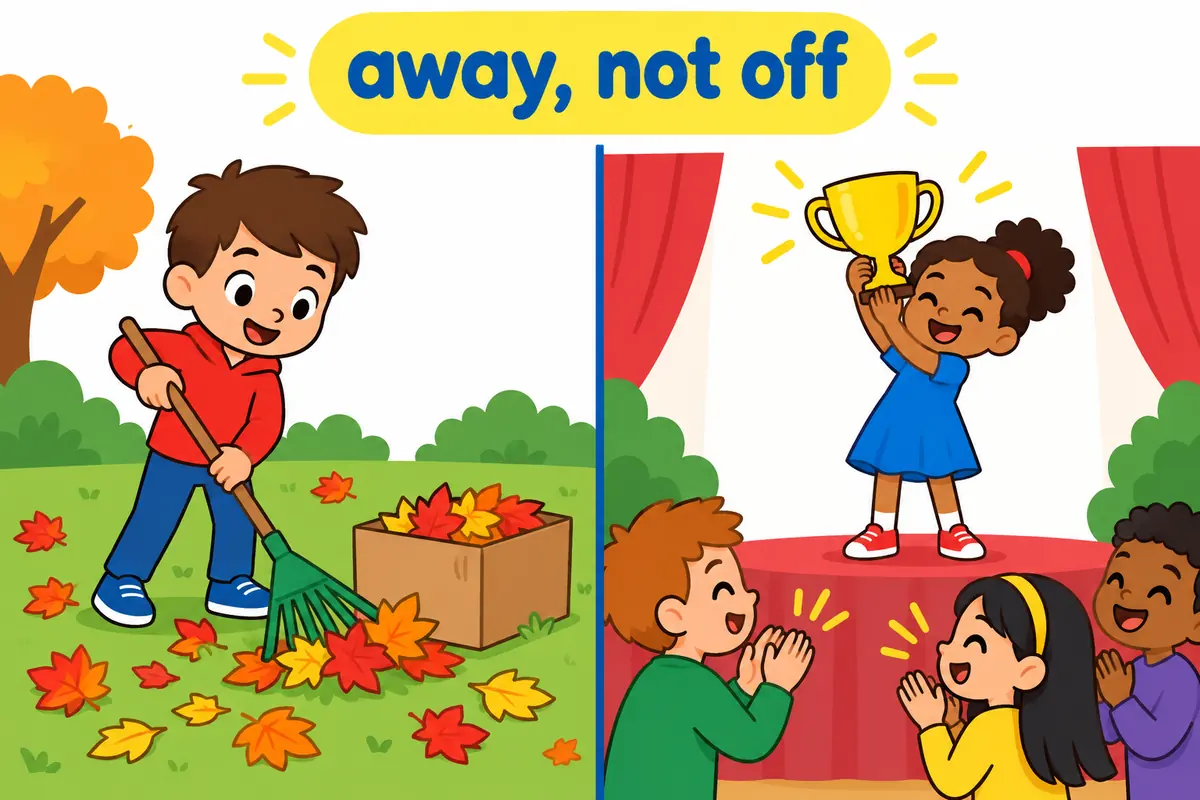
| Win and take | Take a prize or honour from a contest | She carried away three medals from the final. |
How do you use carry away in a sentence?
Decide first whether the object is a thing, a feeling or a prize, because the shape of the sentence changes with it. The literal sense is separable, the emotional idiom is passive and fixed, and the competitive sense behaves like an ordinary transitive verb.
| Pattern | Example | What it signals |
|---|---|---|
| carry + object + away | The current carried the raft away. | the ordinary literal order |
| carry away + object | Workers carried away the fallen branches. | the same sense with the object at the end |
| get or become carried away | She got carried away with the planning. | losing control through enthusiasm |
| be carried away by + feeling | He was carried away by the applause. | being transported by emotion |
| carry away + prize | The team carried away the trophy. | winning and taking an award |
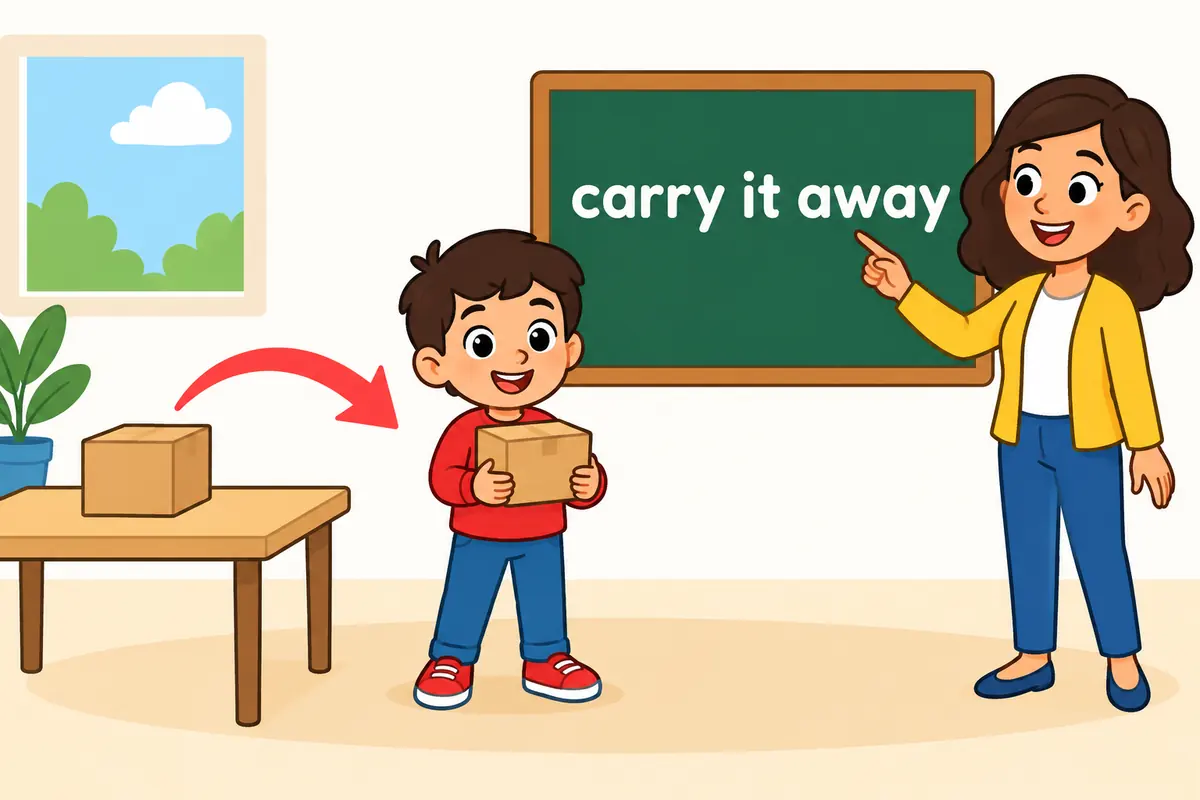
The literal verb is separable, so the object may sit on either side of away: carry the boxes away or carry away the boxes. A pronoun, however, must go in the middle. Write carry it away, and note that haul is the heavier verb for moving something bulky.
Carry away in a sentence: examples across contexts
Carry away moves easily between water, music and sport, and each setting favours one sense. The eleven sentences below keep the phrase while changing the register around it.
| Context | Example sentence | Why this works |
|---|---|---|
| Classroom | The wind carried the paper aeroplanes right away across the field. | Uses a concrete object in the literal sense. |
| Workplace email | Please carry away the recycling before the cleaners arrive. | Turns the phrasal verb into a polite instruction. |
| News report | Flood water carried away the footbridge overnight. | Keeps the literal sense with a dramatic subject. |
| Music review | The final chord carried the hall away and the clapping stopped. | Shows the emotional sense applied to a whole room. |
| Sports report | The sprinter carried away gold in two events. | Uses the competitive sense with a medal. |
| Everyday conversation | I got carried away and bought a second pair of boots. | Uses the idiom for mild self-mockery. |
| Diary entry | She was carried away by the beauty of the valley at sunset. | Shows the passive emotional sense with by. |
| Safety notice | Do not get carried away and lean over the railing. | Uses the idiom as a warning. |
| History essay | Crowds carried away the statue after the announcement. | Keeps the literal sense in a formal frame. |
| Parenting | Children get carried away at parties, so plan a quiet ending. | Offers a general truth with the idiom. |
| Business writing | We should not get carried away by a single good quarter. | Uses the idiom to counsel caution. |
Get carried away: the emotional idiom
Get carried away is the form most learners meet first, and it deserves its own section. It means to become so excited or absorbed that judgement slips, and it works with get, become or be plus the past participle carried. The feeling may be positive, as with thrill, or simply foolish, as with spending too much.
| Pattern | Example | What it signals |
|---|---|---|
| get carried away | We got carried away and stayed up all night. | the everyday idiom, neutral or self-critical |
| become carried away | The crowd became carried away as the band returned. | a slightly more formal version |
| be carried away with + activity | She was carried away with the colour scheme. | absorption in a task, not just excitement |
| be carried away by + feeling | He was carried away by the emotion of the moment. | names the force doing the carrying |
The phrase is passive and fixed, so it cannot be split: you cannot say get carried it away. Note also that the emotional sense usually takes by or with, while the literal sense takes no preposition at all.
Carry away vs carry off
Carry away and carry off share the idea of taking something, and they divide the work by purpose. Carry away removes a thing or transports a feeling; carry off wins a prize or, more tellingly, handles a difficult situation well. The table draws the line.
| Attribute | carry away | carry off |
|---|---|---|
| Core meaning | Remove, or transport with feeling | Win a prize, or handle a difficult moment |
| Typical object | An object, a person, a prize | A prize, a performance, a risky plan |
| Passive idiom | get carried away, meaning lose control | carry it off, meaning succeed at something hard |
| Tone | Neutral; the idiom is informal | Often approving, especially of nerve |
| Wrong pairing | carry away a speech | carry off the rubbish |
Verdict: choose carry away when something leaves a place or when feeling transports a person, and choose carry off when a performer wins applause or a team seizes the prize under pressure. The two verbs are close in the competitive sense, but only carry off means managing a hard thing well.
Word forms and grammar of carry away
Carry away inflects on carry, and the particle away never changes. The same base verb builds several phrases that look alike, so the particle is the part that carries the meaning.
| Form | Part of speech | Example |
|---|---|---|
| carry away | phrasal verb, base form | They carry away the empty crates each evening. |
| carries away | third person singular | The stream carries away the loose soil. |
| carried away | past and past participle | The flood carried away the sign. |
| carrying away | present participle | Carrying away the chairs took two trips. |
| carry on | different particle | Please carry on with your work. |
| carry out | different particle | The lab will carry out the test. |
| carry over | different particle | Unused days carry over to January. |
Keep the particles apart. Carry on means to continue, carry out means to perform or complete, and carry over means to transfer to another time or place.
Common mistakes with carry away
- Incorrect:
The tide carried away it.Correct: The tide carried it away. Rule: A pronoun object sits between the verb and the particle. - Incorrect:
He got carry away by the music.Correct: He got carried away by the music. Rule: The idiom uses the past participle carried. - Incorrect:
Do not carried away at the party.Correct: Do not get carried away at the party. Rule: The idiom needs a verb such as get, become or be. - Incorrect:
She was carried away from the applause.Correct: She was carried away by the applause. Rule: The emotional sense names its force with by. - Incorrect:
He carried away the difficult interview.Correct: He carried off the difficult interview. Rule: Handling a hard situation is carry off, not carry away. - Incorrect:
The team carried away off the cup.Correct: The team carried off the cup. Rule: Use one particle, not two.
Practice using carry away
Work through the seven items, then read the reasons rather than only the answers.
- Fill the gap: The rising river ______ the wooden bridge away.
- Choose the better word: The guests (got carried away / carried off) and ate all the cake.
- Correct the error: The flood carried away it down the street.
- Build a sentence: use get carried away about planning a party.
- Spot the register: which belongs in a formal report — the crowd became unruly, or the crowd got carried away?
- Choose the better word: The young actor (carried away / carried off) the hardest role of the season.
- Rewrite in the passive: Excitement carried the children away. Use get carried away.
Answers
- carried — the past tense matches the flood, and the object follows the particle.
- got carried away — the guests lost control through enthusiasm.
- The flood carried it away down the street — the pronoun goes between carried and away.
- Model answer: We got carried away and invited the whole class.
- The crowd became unruly — a formal report avoids the informal idiom.
- carried off — the actor handled a hard role successfully.
- The children got carried away by the excitement — the passive idiom takes be or get plus carried.
The bottom line
Use carry away in a sentence to say that something is removed from a place, that a person is transported by feeling, or, as get carried away, that somebody loses self-control. Three nuances decide most sentences: a pronoun object must sit between carry and away, the idiom is passive and cannot be split, and the competitive sense overlaps with carry off, which alone means handling a hard moment well. In formal writing, remove is the plainer substitute for the literal sense.
Frequently asked questions about carry away
What does it mean to get carried away?
To get carried away means to become so excited or absorbed that you lose self-control. Someone who gets carried away at a sale buys more than planned. The phrase is informal and usually mild, and it can describe happy enthusiasm or simple foolishness, depending on what was done.
Is carry away separable?
The literal sense is separable, so you may write carry the boxes away or carry away the boxes. A pronoun, however, must go between the verb and the particle, giving carry it away. The passive idiom get carried away is fixed and cannot be split at all.
What does carry away mean in sport?
In sport carry away means to win and take a prize, medal or trophy. A report might say the team carried away the cup after a close final. The same competitive idea appears in carry off, so the two phrases overlap here, though only carry off also means handling a difficult moment well.
What is the difference between carry away and carry off?
Carry away removes something or transports a person with feeling, and its passive form means losing self-control. Carry off means to win a prize or to handle a difficult situation successfully. So a singer carries off a demanding role, while a shopper gets carried away with spending.