Spur on means to encourage someone to keep going or to make something happen faster. To use spur on in a sentence, put the person or thing between spur and on: “The coach spurred the team on.” The verb is transitive and separable, so pronouns must sit in the middle.
Spur on at a glance
- Spur on is a transitive, separable phrasal verb; its forms are spurs on, spurred on and spurring on.
- The object sits between the verb and the particle: spur someone on.
- With a pronoun the split is fixed: spur them on, never spur on them.
- Typical subjects are coaches, teachers, crowds, praise, hardship or a hard challenge.
- It suggests steady pressure toward a goal rather than a single nudge.
- The commonest error is forcing the pronoun after the particle, as in spur on them.
What does spur on mean?
Spur on is a phrasal verb meaning to urge someone to continue, to work harder, or to make an activity grow faster. The Cambridge entry for spur on keeps the two ideas of urging and driving under one heading, and the object decides which is meant.
| Sense | Plain meaning | Example sentence |
|---|---|---|
| Urge a person onward | Encourage someone to keep going | The crowd spurred the runners on. |
| Drive someone to act | Push a person into action they were avoiding | Hunger spurred them on to finish the job. |
| Make something grow faster | Cause an activity or trend to increase | Tax breaks spurred on the building boom. |
| Rally a group | Give a team or crowd fresh energy | A late goal spurred the home side on. |
Spur on is more than plain encouragement. It implies that the person is hesitating, tiring or doubting, and that something gives them the push to continue. Where no resistance exists, encourage a student is the calmer verb, and where the aim is to hold someone back, the opposite is to deter a thief from trying at all.
The force also has a limit. Spur on is firm pressure, not manipulation or panic, so it rarely suits a situation where people are pushed into harm. When the pushing tips into disorder, incite a crowd is the wilder cousin, and a good writer keeps the two apart.
How do you use spur on in a sentence?
Spur on is transitive, so it takes an object, and separable, so the object may sit between the two words or, with a full noun, after on. A pronoun always takes the middle. The pattern is subject + spur + object + on, or subject + spur on + full noun.
| Pattern | Example | What it signals |
|---|---|---|
| spur + object + on | The coach spurred the team on. | the standard split word order |
| spur + pronoun + on | Their cheers spurred us on. | the required order for pronouns |
| spur on + full noun | Praise can spur on a shy pupil. | a heavier noun kept after the particle |
| be + spurred on + by + cause | The reforms were spurred on by public anger. | a formal passive naming the cause |
| spur + object + on + to + action | Ambition spurred her on to retrain. | the goal added as an infinitive |
Because the verb is separable, the object has a home between the words, and a pronoun has nowhere else to go: you say spur them on, never spur on them. When the caller merely wants a substitute to play, a different out family verb, bring on a substitute, keeps its own fixed grammar.
In the passive, the split disappears and the phrase appears whole: the team was spurred on by the noise. That structure is common in reports because it names the cause in a tidy by-phrase, as when a crowd is urged to stay calm rather than pushed.
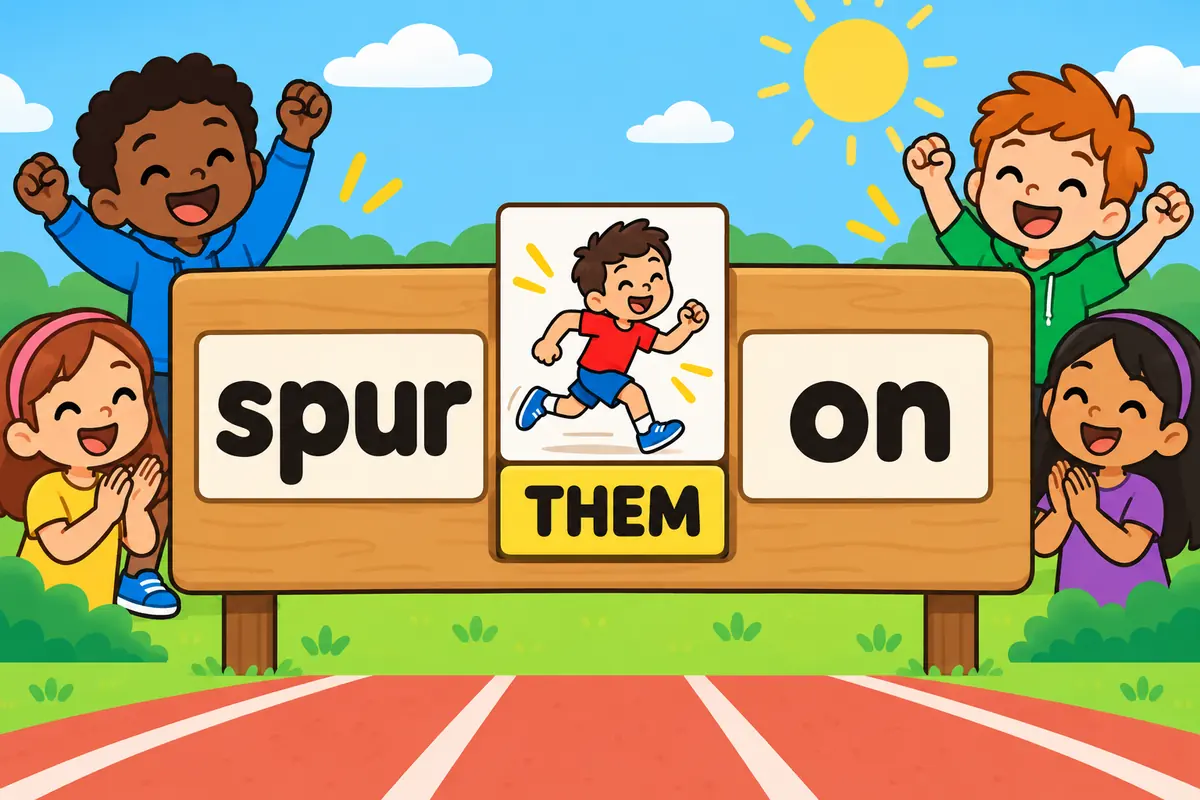
Spur on in a sentence: examples across contexts
| Context | Example sentence | Why this works |
|---|---|---|
| Sports report | A roar from the home crowd spurred the players on. | the split order with a full noun object |
| Classroom | Kind praise can spur on a pupil who is ready to give up. | the full noun stays after the particle |
| News report | The inquiry was spurred on by a series of complaints. | the passive names the cause in a by-phrase |
| Business writing | Rival launches spurred the firm on to speed up its plans. | the goal appears as a to-infinitive |
| Everyday conversation | My friends spurred me on when I wanted to quit. | the pronoun takes the required middle slot |
| History essay | Hardship spurred the settlers on to plant a second crop. | an abstract cause acting on people |
| Motivational speech | We will spur one another on to finish the race. | a collective object with a clear goal |
| Diary entry | A single good review spurred me on to keep writing. | a personal cause with a continued effort |
| Charity appeal | Early donations spurred on the whole fundraising drive. | the object is the effort itself |
| Coaching notes | Short, loud praise spurred them on between sets. | timing is placed in a phrase after on |
| Academic writing | Rising costs spurred on the search for cheaper methods. | the verb drives an impersonal process |
| Film review | The steady soundtrack spurs the hero on through the final act. | an inanimate subject with steady pressure |
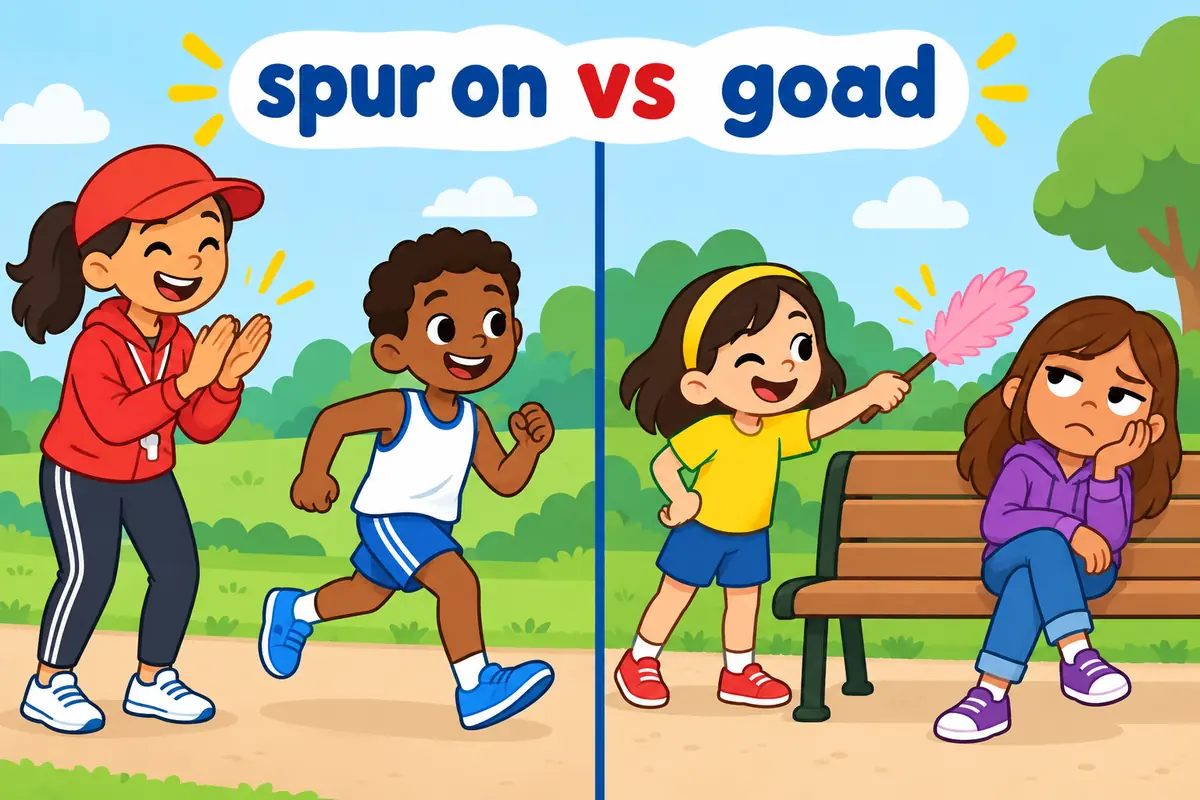
Spur on vs goad
Both verbs push someone toward action, but they differ in warmth and method. Spur on supports a person who is struggling, while goad provokes by irritation, and the difference shows in how the recipient feels afterwards.
| Attribute | spur on | goad |
|---|---|---|
| Core meaning | encourage toward a goal | provoke with repeated needling |
| Typical object | a team, a pupil, a crowd | a stubborn person, an animal |
| Tone | warm, supportive pressure | sharp, often hostile |
| Method | praise, example, a shared goal | teasing, nagging, a pointed remark |
| What it implies | the person wants to succeed | the person is being drawn into a fight |
| Example | The coach spurred her on. | They goaded him into a reply. |
Use spur on to lift someone toward a goal, and goad a rival when the aim is to needle them into action.
Word forms and grammar of spur on
| Form | Part of speech | Example |
|---|---|---|
| spur on | base phrasal verb | Good news spurs the team on. |
| spurs on | third person singular | Praise spurs her on to try again. |
| spurred on | simple past and participle | The crowd spurred them on. |
| spurring on | present participle | Fans were spurring the runners on. |
| spur (noun) | noun, same root | The prize was a spur to work harder, and a rival may stimulate a fresh effort just as well. |
Common mistakes with spur on
Incorrect: The crowd spurred on them.
Correct: The crowd spurred them on.
The rule: a pronoun object must sit between spur and on.
Incorrect: Her words spurred on to keep going.
Correct: Her words spurred her on to keep going.
The rule: the verb is transitive, so an object is required.
Incorrect: The team was spurred on from the noise.
Correct: The team was spurred on by the noise.
The rule: the passive names the cause with by, not from.
Incorrect: He spured the horse on.
Correct: He spurred the horse on.
The rule: the past tense doubles the r, spurring and spurred.
Incorrect: The coach spurred on the team to victory loudly.
Correct: The coach spurred the team on to victory.
The rule: keep the object close to spur and put the goal after on.
Spur on across registers
The phrase changes shape with the formality of the text, and matching that shape to the register is what makes a sentence sound native.
| Register | Typical form | Effect |
|---|---|---|
| Conversation | spur me on | warm and personal, with the pronoun in the middle |
| Sports commentary | spurred them on | fast and energetic, object split from the particle |
| News report | was spurred on by | formal passive that names the cause |
| Speech | spur one another on | collective and rallying, aimed at a group |
The passive is the report writer’s favourite because it keeps the attention on the cause, while speech prefers the active split because it sounds like direct encouragement.
Practice using spur on
- Fill the blank: The crowd ______ the runners on in the final lap.
- Fill the blank: Her letter spurred me ______ to apply again.
- Choose the better word: The coach (spurred / goaded) the nervous beginner gently through the routine.
- Correct the error: The fans spurred on them all match.
- Rewrite as a passive: Public anger spurred the reforms on.
- Build a sentence: use spur on with a pronoun object and a goal after to.
- Spot the register: which sentence fits a news report? (a) Everyone cheering really pushed them. (b) The effort was spurred on by public anger.
- Correct the error: He spured his horse on with a shout.
Answers
- spurred — the past tense matches the completed final lap.
- on — the pronoun me sits between spur and the particle on.
- spurred — the tone is warm and supportive, so goad is too sharp.
- The fans spurred them on all match. — a pronoun object must precede the particle.
- The reforms were spurred on by public anger. — the passive names the cause with by.
- A kind teacher spurred him on to finish the course. — the pronoun splits the verb and to introduces the goal.
- (b) — the formal passive suits a published report.
- He spurred his horse on with a shout. — the past tense doubles the r.
The bottom line
To use spur on in a sentence, keep the object between spur and on, and move it after on only when it is a full noun. The verb is transitive and separable, it doubles the r in spurred, and it carries a warmth that separates it from goad. Reach for it when someone is tiring and needs steady pressure toward a goal.
Frequently asked questions about spur on
Is spur on one word or two?
As a verb it is always two words: spur on, as in spur the team on. The single word spur is a noun for the thing that urges, and the past form is written as two words too. Only the noun stands alone as one word.
Can you separate spur on?
Yes. Spur on is separable, so the object may sit between the two words, as in spur the team on, or follow the particle with a full noun, as in spur on the team. A pronoun, however, must always sit in the middle: spur them on.
What is the difference between spur on and encourage?
Encourage is the neutral everyday verb and works whether or not anyone is hesitating. Spur on adds a push toward a goal, and it suits a person who is tiring, doubting or about to give up. The extra force is what makes spur on the stronger choice.
What is the past tense of spur on?
The simple past is spurred on, doubling the final r, as in the crowd spurred the runners on. It doubles as the past participle with have or had and in passives, as in the effort was spurred on by anger. The present participle is spurring on.