Encourage means to give someone confidence, hope or support so that they are more likely to act or keep going. To use encourage in a sentence, name the person and what they are urged to do: “The coach encouraged her to enter the race.” The verb takes an object and usually a to-infinitive.
Encourage at a glance
- Encourage is a transitive verb; its forms are encourages, encouraged and encouraging.
- Its two senses are giving a person confidence and helping something grow.
- The dominant pattern is encourage + person + to-infinitive.
- Usual collocations are encourage growth, encourage investment and encourage a habit.
- The commonest error is confusing encourage with its opposite, discourage.
What does encourage mean?
Encourage is a transitive verb meaning to give a person confidence or hope, or to help something develop and increase. The Cambridge entry for encourage gives both senses, and the two work differently. The first needs a person; the second needs a thing such as growth or spending.
| Sense | Plain meaning | Example sentence |
|---|---|---|
| Give confidence (main) | Support a person so they try or continue | Her teacher encouraged her to read the poem aloud. |
| Help something grow | Make an activity or feeling more likely | Low rents encouraged new businesses to open. |
| Hearten | Give fresh hope in a hard moment | The letters from home encouraged the whole crew. |
One limitation is worth stating. Encourage means to support, not to force, and it never promises success. Where a person is pushed against their will, push or pressure describes the act more honestly, and where a rule makes something likely, the better verb is foster an attitude of cooperation.
How do you use encourage in a sentence?
Put the person or thing directly after the verb, then add the action as a to-infinitive. Four patterns cover almost every real sentence, and the third is the one learners most often build wrongly.
| Pattern | Example | What it signals |
|---|---|---|
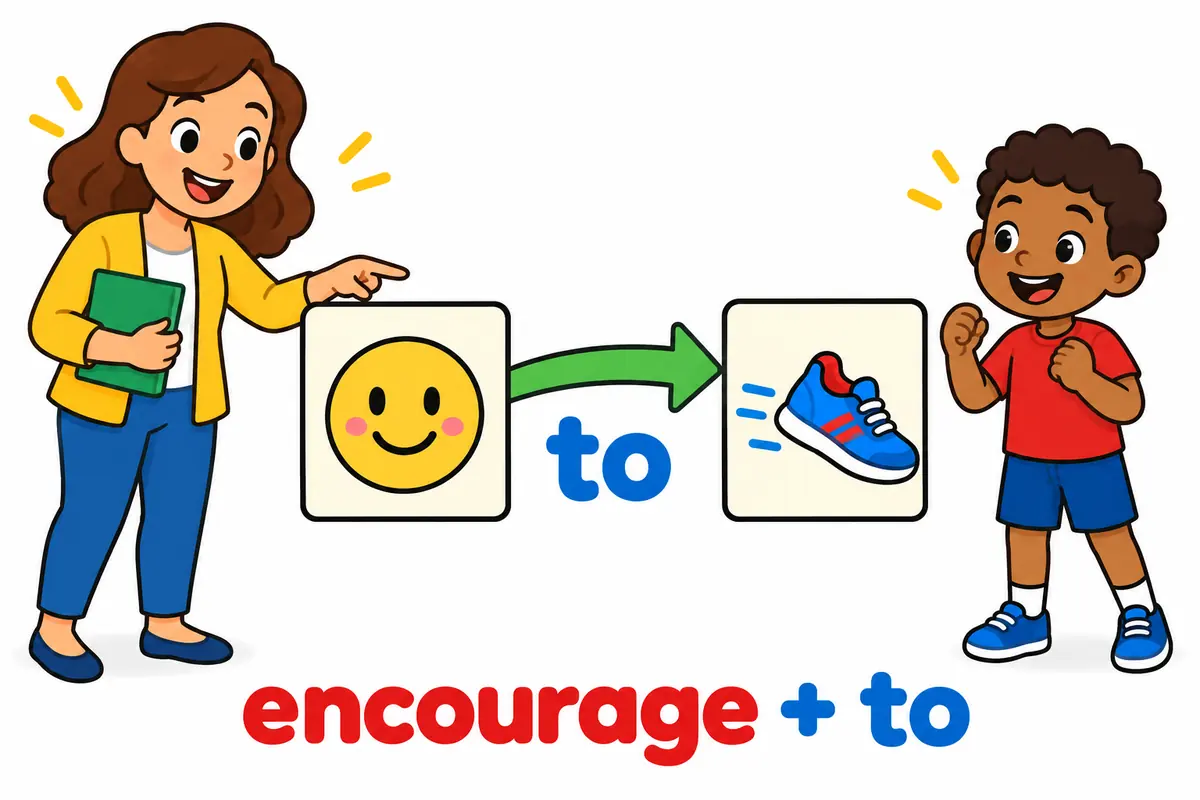
| encourage + person + to-infinitive | The manager encouraged us to take the course. | The standard support pattern, with a clear action. |
| encourage + thing | The tax break encouraged investment. | The growth sense, with no person involved. |
| encourage + person + in + noun | They encouraged him in his music. | Ongoing support without a single action. |
| be encouraged by | We were encouraged by the early results. | Passive, common in reports and reviews. |
Where the goal is a strong desire to act rather than steady support, urge someone to act pushes harder than encourage, and inspire a team works on feeling rather than effort.
Encourage in a sentence: examples across contexts
Encourage moves comfortably from a pep talk to a policy paper. The nine sentences below keep the same verb while changing the object and the register.
| Context | Example sentence | Why this works |
|---|---|---|
| Classroom | The teacher encouraged the quiet boy to answer. | A person and an action, the plain support pattern. |
| Workplace | Managers encourage staff to report small problems early. | A habit is the goal, which suits a policy sentence. |
| Parenting | We encourage our daughter to cook with us. | The first person makes it warm and specific. |
| News report | The grant encouraged firms to hire apprentices. | An impersonal subject keeps it factual. |
| Health writing | Regular walks encourage better sleep. | The object is a state, the growth sense at work. |
| Sports | The crowd encouraged the runner over the final hill. | Support in a moment of difficulty. |
| Policy | Lower fees would encourage more people to save. | Conditional form for a proposed effect. |
| Letters | Her calm words encouraged me at exactly the right time. | The hearten sense, personal and past tense. |
| Academic prose | The findings encourage caution in reading the earlier data. | A measured, hedged use in scholarly writing. |
The policy and academic rows show the growth sense, while the classroom and letters rows show support for a person. Both are the same verb.
Encourage vs discourage
Encourage and discourage are direct opposites, so they take the same grammar while pointing in opposite directions. Choosing between them is the first decision in any sentence about effort.
| Attribute | encourage | discourage |
|---|---|---|
| Core meaning | Give confidence to act | Take confidence away from acting |
| Typical object | A person or a growth noun | A person or a behaviour |
| Following pattern | to do something | from doing something |
| Register | Warm, neutral to formal | Cool, neutral to formal |
| Emotional effect | Hope and momentum | Doubt and restraint |
| Common error | Encourage + -ing is wrong | Discourage + to is rare |
Verdict: choose encourage when you want someone to act, and discourage a bad habit when you want the opposite, remembering that discourage takes from before a gerund.
Word forms and grammar of encourage
Encourage inflects regularly, and its noun and adjective are extremely common, so learners meet the family before they meet the verb. The table also lists the spelling trap waiting one letter away.
| Form | Part of speech | Example |
|---|---|---|
| encourage | verb, base form | Good leaders encourage questions. |
| encourages | verb, third person singular | The scheme encourages saving. |
| encouraged | verb, past and past participle | Her remark encouraged the whole class. |
| encouraging | verb participle and adjective | The early results were encouraging. |
| encouragement | noun | A word of encouragement can change a day. |
| entourage | noun, different meaning | A film star arrived with an entourage. |
The form encouraged doubles as a past verb and an adjective, and entourage is a spelling neighbour with no link in meaning at all.
Common mistakes with encourage
- Incorrect:
She encouraged him entering the contest.Correct: She encouraged him to enter the contest. Rule: Encourage takes a to-infinitive, not an -ing form. - Incorrect:
They encouraged him doing better.Correct: They encouraged him to do better. Rule: The person comes first, then to plus the base verb. - Incorrect:
He was an entourage to the new players.Correct: He was an encouragement to the new players. Rule: Entourage means a group of attendants, not support. - Incorrect:
The coach encouraged that we practise.Correct: The coach encouraged us to practise. Rule: Encourage takes a person, not a that-clause. - Incorrect:
We were encouraging the results.Correct: We were encouraged by the results. Rule: Use encouraged by when results give the confidence.
Practice using encourage
Work through the six items, then check the reasoning rather than only the answer.
- Fill the gap: Her parents ______ her to study music.
- Choose the better word: The new rules (encouraged / discouraged) people from parking on the pavement.
- Correct the error: The tutor encouraged her writing more.
- Build a sentence: use encourage with the to-infinitive about a friend joining a team.
- Spot the register: which suits a school report – the programme encourages reading, or the programme kinda makes kids read?
- Rewrite with the noun: The teacher supported him a lot. Use encouragement.
Answers
- encouraged – the object is her, followed by the to-infinitive to study.
- discouraged – the rules stop a behaviour, and discourage takes from.
- The tutor encouraged her to write more – use to plus the base verb, not -ing.
- Model answer: We encouraged Sam to join the five-a-side team.
- The programme encourages reading – it is formal and impersonal, while the second is too casual.
- The teacher gave him a lot of encouragement – the noun needs an article and a verb.
The bottom line
Use encourage in a sentence when you support a person or help something grow, and remember that it takes an object and usually a to-infinitive. The two decision points are these: the person goes directly after the verb, and the action that follows uses to rather than an -ing form. For the opposite effect, discourage reverses the meaning and takes from before a gerund.
Frequently asked questions about encourage
Is encourage followed by to or -ing?
Encourage takes a to-infinitive, so we say she encouraged him to try. The -ing form is a common mistake: she encouraged him trying is not standard. The pattern is always encourage plus a person plus to plus the base verb, and the same rule holds for the passive form he was encouraged to apply.
What is the difference between encourage and inspire?
Encourage gives support and confidence so someone acts, while inspire stirs a feeling or idea that may lead them to act later. A coach encourages a nervous player before a match; a story inspires a reader to change direction. Encourage is about steady effort, and inspire is about a spark.
Can encourage take a thing as its object?
Yes. Besides supporting a person, encourage can help something grow or become more likely, so we say the policy encouraged investment or warm weather encouraged growth. In this sense there is no person and no to-infinitive. The two senses share a spelling but not a grammar, so check which one you mean.
What is the noun form of encourage?
The noun is encouragement, as in a few words of encouragement. It is uncountable in most uses, so we say some encouragement, not an encouragement, though a specific act can be called an encouragement. The adjective encouraging describes news or results, and the past participle encouraged becomes an adjective too.
Looking to understand how to effectively use the word “encourage” in a sentence? Encouragement is the act of inspiring others with support and positivity, motivating them to take action or pursue their goals. Using “encourage” in a sentence can boost morale and empower those you speak to.
When constructing a sentence with “encourage,” consider the context and tone to convey the desired message effectively. Whether offering words of encouragement to a friend facing a challenge or motivating a team to strive for success, utilizing this word can make a significant impact. By choosing the right words, you can truly inspire and uplift those around you.
7 Examples Of Encourage Used In a Sentence For Kids
- Encourage your friends to play and have fun together.
- Let’s encourage each other to learn new things every day.
- Teachers always encourage students to do their best in school.
- Parents encourage their children to be kind and helpful.
- We should encourage others to be brave and try new activities.
- Encourage your siblings to share their toys with you.
- Remember to encourage your classmates when they do something good.

14 Sentences with Encourage Examples
- Encourage your classmates to join study groups for better understanding of difficult subjects.
- Attend seminars and workshops that encourage networking with professionals in your field of study.
- Encourage your friends to participate in extracurricular activities to enhance their skills and personal development.
- Make use of campus resources that encourage academic success, such as tutoring centers and libraries.
- Encourage your peers to take breaks and practice self-care during stressful exam periods.
- Join student clubs and organizations that encourage leadership and teamwork skills.
- Encourage your roommates to maintain a healthy lifestyle by eating nutritious meals and exercising regularly.
- Seek out mentorship programs that encourage guidance and support from experienced students or faculty.
- Encourage group study sessions to facilitate collaborative learning and exchange of ideas.
- Utilize online platforms and forums that encourage academic discussions and knowledge sharing.
- Encourage your classmates to attend career fairs and job placements events to explore future opportunities.
- Utilize digital tools and apps that encourage productivity and time management for better academic performance.
- Encourage your friends to explore different areas of interests and hobbies outside of their academic studies.
- Participate in volunteering activities that encourage social responsibility and community engagement.

How To Use Encourage in Sentences?
Encourage is a powerful verb that can help you express support, motivation, or inspiration towards someone or a specific action. When using Encourage in a sentence, it is important to keep in mind its meaning and context.
Here is a simple guide on how to use Encourage in a sentence:
- Subject: Begin your sentence with the person or group you want to Encourage. For example, “I” or “She”.
- Verb: Use “Encourage” as the main action in your sentence to convey support or motivation. For example, “I Encourage you to keep going.”
- Object: If applicable, include the specific action or behavior that you are encouraging. For example, “I Encourage you to pursue your dreams.”
- Tone: Ensure that the tone of your sentence matches the intention of your encouragement, whether it’s uplifting, motivational, or supportive.
- Context: Consider the context of the situation when using Encourage in a sentence to ensure that your words have the desired impact.
By following these guidelines, you can effectively use Encourage in a sentence to inspire, support, or motivate others. So go ahead and use this powerful word to uplift and empower those around you!

Conclusion
In conclusion, the power of using sentences that encourage positivity and motivation cannot be understated. Whether it is inspiring someone to chase their dreams, supporting them during difficult times, or simply boosting their self-esteem, encouraging words hold incredible influence. When we choose our words carefully and use sentences that uplift others, we create a ripple effect of positivity that can spread far and wide.
By incorporating sentences that encourage into our daily interactions, we not only brighten someone else’s day but also contribute to a more optimistic and supportive community. From simple affirmations to heartfelt compliments, these words have the ability to instill confidence, inspire action, and foster a sense of belonging. Let us continue to use the power of encouraging sentences to uplift those around us and make a positive impact on the world.


