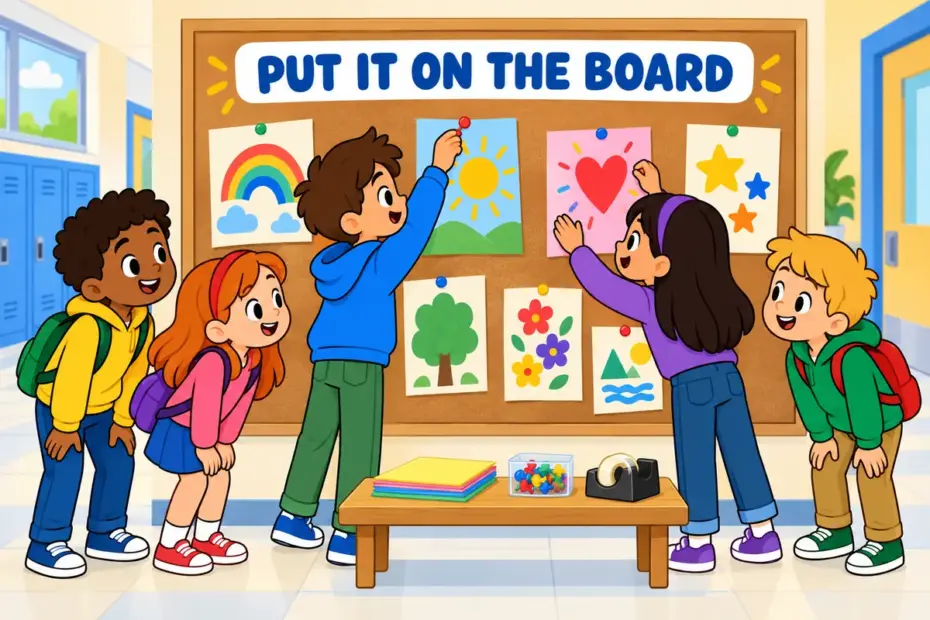
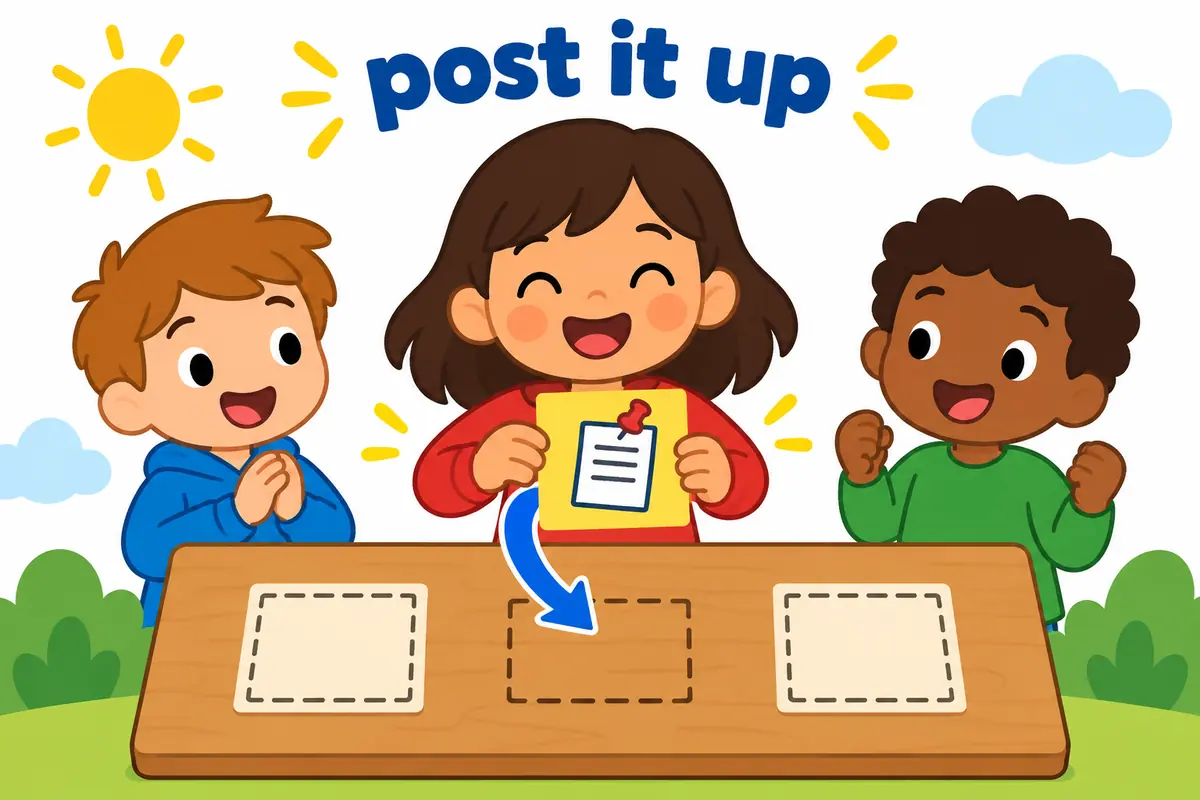
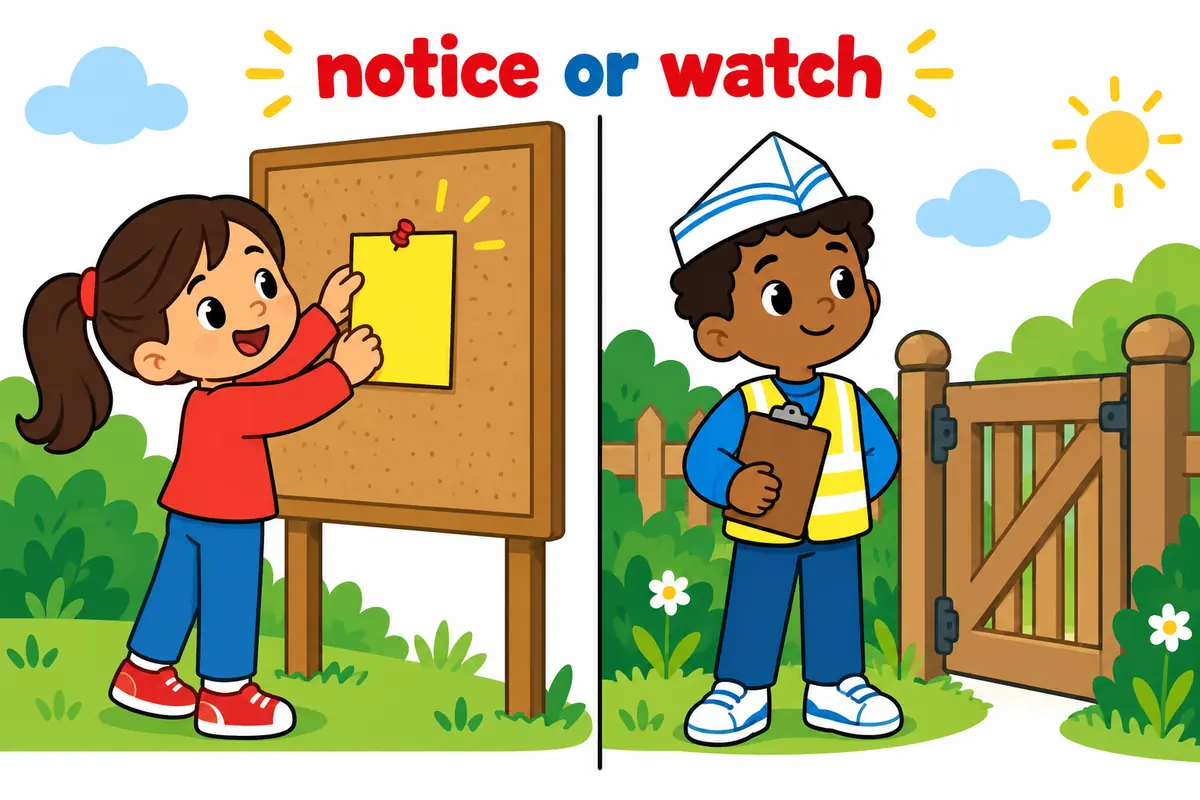
Post up means to display something publicly on a board or wall, or to station yourself in one place. To use post up in a sentence, choose the sense: you post up a notice so people can read it, or you post up at the door. In the notice sense a pronoun goes in the middle: post it up.
Post up at a glance
- Post up is a transitive phrasal verb in its notice sense; its forms are posts up, posted up and posting up.
- The display sense is separable, so the object may follow the verb or sit between post and up.
- The stationing sense usually appears with at or outside: posted up at the gate.
- The object in the display sense is a notice, poster, sign, list or score.
- Basketball uses post up for taking a position near the basket with your back to it.
- The commonest error is confusing post up with post alone, which can mean to send by mail.
What does post up mean?
Post up is a phrasal verb with two everyday senses and one specialist sense. The first is to display something in public, so that it can be read: a notice, a poster, a schedule or a set of results. The second is to station a person, or to take up a position yourself, as a guard might do at a doorway. The third belongs to basketball, where a player posts up near the basket. The Cambridge entry for post up records the display sense as the core one.
| Sense | Plain meaning | Example sentence |
|---|---|---|
| Display publicly | Put a notice or poster where people can read it | They posted up the timetable beside the lift. |
| Station a person | Place someone at a point to watch or wait | Two stewards were posted up at the side gate. |
| Take a position | Stand in one spot and settle there | He posted up by the window and waited. |
| Basketball | Take position near the basket with your back to it | The centre posted up and drew two defenders. |
One limitation is worth stating plainly. Post up is not the same as post on its own: plain post can mean to send a letter or to publish something online, so a sentence about mailing a parcel needs post, not post up. It also says nothing about how long the display or the position lasts.
How do you use post up in a sentence?
In the display sense post up is transitive and separable, so the object can follow the verb or sit between post and up, and a pronoun must go in the middle. In the stationing sense the verb usually pairs with at, outside or by and a place. The table keeps the two patterns apart.
| Pattern | Example | What it signals |
|---|---|---|
| post up + notice | She posted up the rota. | The object follows the full verb. |
| post + notice + up | She posted the rota up. | The separable form, equally correct. |
| post + pronoun + up | She posted it up. | A pronoun must sit between the verb and the particle. |
| be posted up + at | The marshals were posted up at every corner. | Passive form for placing people at a point. |
| post up + at/by + place | We posted up by the entrance. | The intransitive position sense, common in speech. |
Where the emphasis falls on settling into a spot, single verbs compete. Writers may choose position a team for a neutral, formal tone, or stand when the person is simply upright, while post up adds the idea of a watchful or deliberate station.
Post up in a sentence: examples across contexts
Post up shifts between display and station without changing its spelling. The ten sentences below each make the sense clear from context, and one shows the shared particle in another verb.
| Context | Example sentence | Why this works |
|---|---|---|
| School noticeboard | The class posted up the new library rules on Monday. | A concrete notice shows the display sense. |
| Workplace email | Please post up the safety sheet before the site opens. | An instruction keeps the object specific. |
| Community hall | Volunteers posted up posters for the summer fair. | The plural object suits a small campaign. |
| News report | Results were posted up outside the town hall by noon. | The passive form suits formal reporting. |
| Event security | Stewards were posted up at each turnstile. | Uses the stationing sense with a clear location. |
| Sports report | The centre posted up and scored over two defenders. | The basketball sense, kept recognisable by context. |
| Conversation | I posted up by the fountain and waited for you. | The intransitive form is natural in speech. |
| Fiction | He posted up in the shadow of the archway. | The position sense builds quiet tension. |
| Military history | Sentries were posted up along the ridge at dusk. | Formal, dated register suits the setting. |
| Shared particle | It took the clerk an hour to add up the takings. | Same particle, but add up means to total figures. |
The last row is the useful warning: up appears in hundreds of phrasal verbs, and each one carries its own meaning. Post up is about putting something in view or putting someone in place.
Post up vs put up and station
Post up overlaps with two expressions and matches neither exactly. Put up is the closest for the display sense and works for almost any object, while station is the formal verb for the placing sense. Post up keeps the idea of an official or public act.
| Attribute | post up | put up | station |
|---|---|---|---|
| Core job | Display publicly, or place on watch | Fix something in place | Assign someone to a post |
| Object | A notice, or a guard | Any object | A person or unit |
| Tone | Public and official | Neutral and casual | Formal and orderly |
| Separable | Yes, in the notice sense | Yes: put it up | No fixed pattern |
| Common frame | post it up on the board | put it up on the wall | stationed at the border |
| Typically used for | Notices, rules, results, guards | Signs, shelves, decorations | Troops, staff, officers |
Verdict: use post up for a public notice or a deliberate watch, put up for fixing anything in place, and station when you need a formal verb for placing people on duty.
Word forms and grammar of post up
Post up follows the regular pattern of post, and the table also marks the bare verb, which means something different on its own.
| Form | Part of speech | Example |
|---|---|---|
| post up | phrasal verb, base form | We will post up the timetable tonight. |
| posts up | third person singular | The office posts up notices each Friday. |
| posted up | past and past participle | The guard posted up at the gate at six. |
| posting up | present participle | They are posting up the exam results now. |
| posted-up | adjective, hyphenated | A posted-up schedule hung by the door. |
| post | verb, different meaning | I will post the parcel tomorrow. |
Keep the near synonym place a sign in mind for a plain statement, and occupy a position when the focus is on holding ground rather than watching.
Common mistakes with post up
- Incorrect:
She posted up the letter to her aunt.Correct: She posted the letter to her aunt. Rule: Post alone means to send by mail; post up means to display. - Incorrect:
They posted up it on the board.Correct: They posted it up on the board. Rule: A pronoun object sits between post and up. - Incorrect:
The guard posted up the gate.Correct: The guard was posted up at the gate. Rule: The stationing sense needs at or by before the place. - Incorrect:
The marshals posted up.Correct: The marshals posted up at the corner. Rule: The position sense needs a location to be complete. - Incorrect:
He posted up that the meeting had moved.Correct: He posted up a notice about the new meeting room. Rule: The verb takes a noun phrase, never a that-clause.
Practice using post up
Work through the six items, then compare your wording with the reasoning in the answers.
- Fill the gap: The teacher ______ the new seating plan by the door.
- Choose the better word: The police (posted up / posted) outside the hall all evening.
- Correct the error: She posted up it before the meeting.
- Build a sentence: use post up with at about a lifeguard on a beach.
- Spot the register: which belongs in a formal notice — staff will be stationed at each exit, or staff will post up at each exit?
- Rewrite with the display sense: The results went on the board. Use post up.
Answers
- posted up — the plan is displayed for everyone to read.
- posted up — the stationing sense fits officers placed at a point.
- She posted it up before the meeting — the pronoun belongs between post and up.
- Model answer: The lifeguard posted up at the north end of the beach.
- Staff will be stationed at each exit — a formal notice prefers station.
- The results were posted up on the board — the passive keeps the notice in focus.
The bottom line
Use post up in a sentence to put a notice in public view or to place a person on watch at a point. Two nuances decide most sentences: the display sense is separable, so a pronoun must sit between post and up, and the stationing sense needs at or by before the place. When you simply fix something to a wall, leave it there or put it up, and keep post alone for sending mail.
Frequently asked questions about post up
Is post up a separable phrasal verb?
Yes, in its display sense. Post up is separable there, so the object may follow the whole verb or sit between post and up: she posted up the rota, or she posted the rota up. A pronoun must go in the middle, giving posted it up rather than posted up it.
What is the difference between post up and put up?
Post up is used for official or public material such as notices, rules and results, and it can also mean to station a person on watch. Put up is broader and more casual, covering shelves, decorations and signs. Both are separable, and both take an object between the verb and the particle.
Does post up only describe notices?
No. Post up has three lives. It can mean to display a notice, to place a guard or to take up a watchful position yourself, and it also names a move in basketball. Context decides which sense a reader takes, which is why naming the notice, the person or the place matters.
Can post up be used about people?
Yes, in the stationing sense. A guard, a steward or a marshal can be posted up at a gate or corner, and in speech a person can post up somewhere to wait. When people are formally assigned to a duty, the plain verb station often reads better in official writing.