Stake out means either to mark and claim an area or position, or to keep a secret watch on a place or person. To use stake out in a sentence, put the object after the particle or between the two parts: “Detectives staked out the depot” and “Detectives staked the depot out” are both correct.
Stake out at a glance
- Stake out is a separable phrasal verb with a claim sense and a surveillance sense.
- Its forms are stake out, stakes out, staked out and staking out.
- The noun is stakeout, written as one word, and it names a period of watching.
- A pronoun object goes between the parts, so stake it out is correct and stake out it is not.
- The commonest error is writing the noun as two words or the verb as one.
What does stake out mean?
Stake out is a separable phrasal verb meaning to mark and claim an area or position, or to watch a place or person secretly over a period. The Cambridge entry for stake out records both the surveillance sense and the sense of clearly establishing a claim. The first meaning is about boundaries and entitlement: a group claims ground by planting markers, and a writer stakes out a position. The second meaning is about covert observation, where police or reporters watch a location without being seen. Where the boundary is only a matter of drawing a clear line on a map, demarcate is the more technical verb.
Note also that the noun changes the grammar: a stakeout is a thing with a length, while stake out is an action with an object. A sentence such as the stakeout on the flat lasted two nights keeps the noun and its preposition, and a sentence such as they staked out the flat keeps the verb and its object.
Stake out is the wrong choice for a public, openly announced observation; in that case watch or patrol describes the act without the secretive overtone. It also does not mean to stop watching, so a sentence about ending a vigil needs finish or call off instead.
| Sense | Plain meaning | Example sentence |
|---|---|---|
| Mark and claim | Establish rights over an area or position | The crew staked out the building plot. |
| Claim a stance | State a clear position firmly | The paper staked out its view on the reform. |
| Watch secretly | Observe a place or person covertly | Police staked out the warehouse for three nights. |
| Reserve a spot | Hold a place in advance | We staked out seats near the front. |
How do you use stake out in a sentence?
Stake out is transitive and separable, so it needs an object, and the particle out can move past that object. The patterns below show where each part sits and which sense the order tends to carry.
| Pattern | Example | What it signals |
|---|---|---|
| stake out + object | Detectives staked out the flat. | Neutral order, most common in writing. |
| stake + object + out | Detectives staked the flat out. | Keeps the object in focus, common in speech. |
| stake + pronoun + out | They staked it out all night. | Pronouns must sit between the two parts. |
| stake out + a claim or position | The team staked out a bold position. | Points to the claim sense. |
| be staked out (passive) | The building was staked out overnight. | Keeps attention on the watched place. |
Register matters too. Stake out sits comfortably in police reports, journalism and business writing, where it sounds brisk and neutral. In a formal legal document the writer usually prefers observe or surveil, and in casual speech people may simply say they kept an eye on the place.
Stake out in a sentence: examples across contexts
The ten sentences below move between the claim sense and the surveillance sense, keeping each context honest about who is watching or marking what.
| Context | Example sentence | Why this works |
|---|---|---|
| Police report | Detectives staked out the warehouse for three nights. | Shows the covert watching sense clearly. |
| News report | Officers staked out the car park before the raid. | Adds the purpose that justifies the watch. |
| Business | The team staked out a corner of the trade fair. | Uses the claim sense for claiming space. |
| Legal writing | The family staked out its claim to the water rights. | Points to establishing an entitlement. |
| Academic writing | Researchers staked out the boundaries of the field. | Figurative claim of intellectual ground. |
| Conversation | We staked out seats near the front. | Everyday sense of reserving a spot. |
| Journalism | Reporters staked out the minister’s street for a quote. | Press stakeout, slightly informal tone. |
| Startup work | The firm staked out a niche before rivals arrived. | Claim sense applied to markets. |
| Neighbourhood | Neighbours staked out the street to watch for the lost dog. | Friendly, non-police surveillance. |
| Editorial | The paper staked out a firm position on the reform. | Shows a stance being declared. |
When the watching is done quietly by two people, the pair often backs out once the target leaves, but the stakeout itself continues until the shift ends. The object of the verb is always what is marked or watched, so a careful writer checks that the sentence says plainly which sense is meant.
Stake out vs stakeout
| Attribute | Stake out | Stakeout |
|---|---|---|
| Part of speech | phrasal verb | noun |
| Spelling | two words | one word |
| Stress when spoken | stake OUT | STAKE-out |
| Meaning | to watch secretly or mark a claim | a period of secret watching |
| Use in a sentence | Detectives staked out the flat. | The stakeout lasted all night. |
| Plural | no plural form | stakeouts |
Write stake out as two words for the verb and stakeout as one word for the noun, and the sentence keeps its grammar straight. Where the watching is continuous and official, monitor or surveil can stand in, though neither carries the secrecy that stake out implies. The part of speech decides the spelling, and the spelling is what tells a reader whether the sentence describes an action or a thing.
Word forms and grammar of stake out
The verb follows the regular pattern of a separable phrasal verb, and the one-word noun sits beside it.
| Form | Part of speech | Example |
|---|---|---|
| stake out | base phrasal verb | They stake out the depot each night. |
| stakes out | third-person singular | She stakes out her claims early. |
| staked out | past tense | Police staked out the house. |
| staked out | past participle | The site was staked out by noon. |
| staking out | present participle | Staking out the claim took two days. |
| stakeout | noun | The stakeout ended at dawn. |
| staked-out | adjective | They watched the staked-out perimeter. |
Common mistakes with stake out
The five slips below cover spelling, word order and the passive.
The police ran a stake out on the flat.Correct: The police ran a stakeout on the flat. Rule: the noun is one word, stakeout.Detectives staked out it for hours.Correct: Detectives staked it out for hours. Rule: a pronoun object must sit between the verb and its particle.They stake out the house last night.Correct: They staked out the house last night. Rule: a past-time adverbial needs the past form staked.The area staked out quickly by the crew.Correct: The area was staked out quickly by the crew. Rule: the passive needs was before the past participle.We did a stakeout the flat.Correct: We staked out the flat. Rule: use the verb with an object, or the noun with a preposition such as on.
Practice using stake out
Try the seven items, then check the answers and the reason for each.
- Fill in the blank: Detectives decided to ___ ___ the empty shop.
- Choose the better word: The operation was a (stake out / stakeout) that lasted two nights.
- Correct the error: Officers staked out it before dawn.
- Build a sentence: describe a group claiming a patch of land, using stake out plus claim.
- Spot the register: which fits a police report, “Officers staked out the yard” or “The cops hung around the yard”?
- Fill in the blank with the past form: The company ___ out a share of the market years ago.
- Correct the error: The stakeout the building all night.
- Build a sentence: describe reporters waiting outside a court, using stake out plus a place.
Answers
- stake out – the shop is the object that detectives watch.
- stakeout – after the article a, the noun is needed and it is one word.
- Officers staked it out before dawn – the pronoun moves between stake and out.
- Sample: The settlers staked out a claim to the valley – the claim sense follows stake out.
- “Officers staked out the yard” fits a police report; the second version is too casual.
- staked – a past-time clause needs the past form staked.
- The crew staked out the building all night – the verb needs a subject and the noun cannot take an object.
- Sample: Reporters staked out the court for a statement – the verb takes the place as its object.
The bottom line
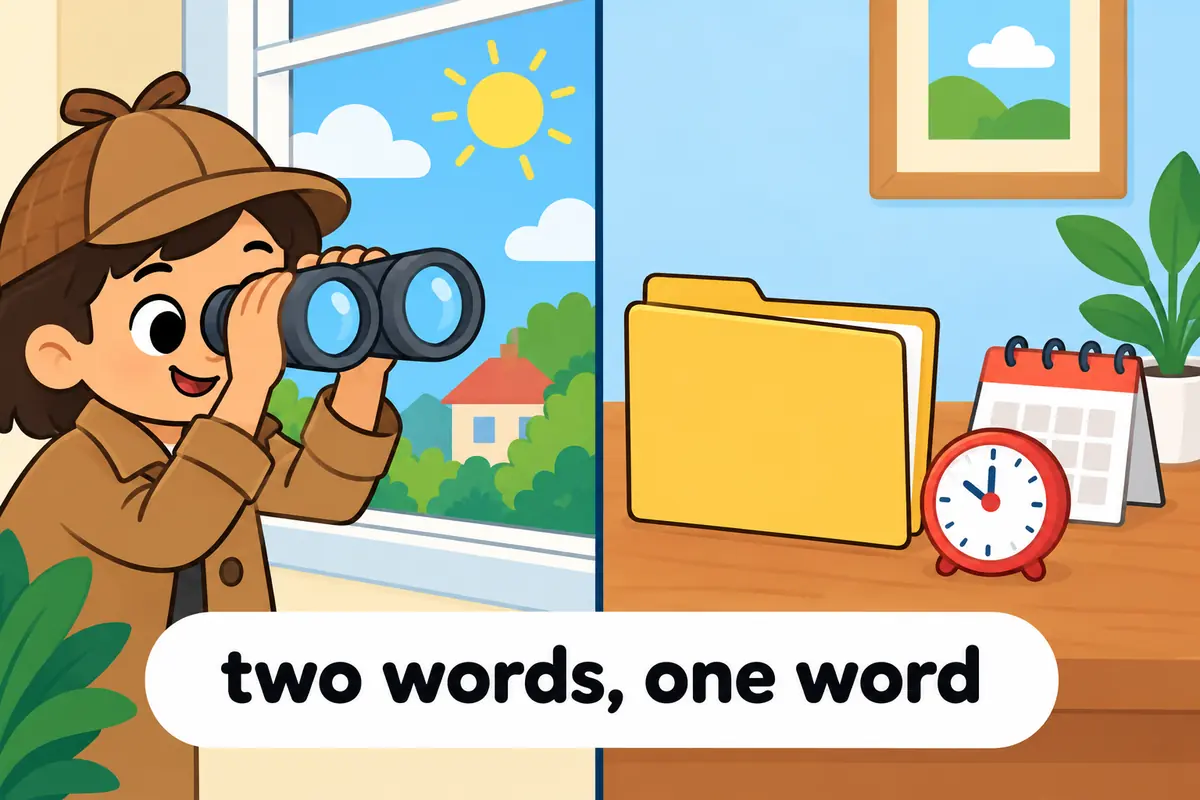
Stake out is a separable phrasal verb with a claim sense and a surveillance sense, so use stake out in a sentence when a group marks ground or watches a place secretly. Keep the noun stakeout as one word, put pronoun objects between stake and out, and choose monitor or surveil when the watching is open rather than covert. The verb suits police reports, journalism and business writing, where claiming and watching are everyday concerns. One test sorts the senses instantly: if the object is ground, a claim or a seat, the verb is marking, and if the object is a building or a person, it is watching.
Frequently asked questions about stake out
Is stake out one word or two?
The verb is two words, as in detectives stake out the flat, while the noun is one word, as in a long stakeout. The same pattern appears in many phrasal verbs, so the spelling tracks the part of speech rather than the sound, which is identical either way.
Can you say stake out it?
No. A pronoun object must sit between the verb and the particle, giving stake it out. Writing stake out it breaks the expected order and sounds wrong to native speakers, even though the intended meaning would still be clear from the context of the sentence.
What does stake out a claim mean?
To stake out a claim is to mark and assert a right to something, whether a patch of land, a share of a market or a position in an argument. The image comes from driving stakes into the ground to show a boundary that others are expected to respect.
Is stake out informal?
Stake out is neutral to slightly informal. Police reports, journalism and business writing use it freely, but a formal document may prefer observe, monitor or surveil. The verb also carries a hint of secrecy, so it fits a night operation better than an open patrol.