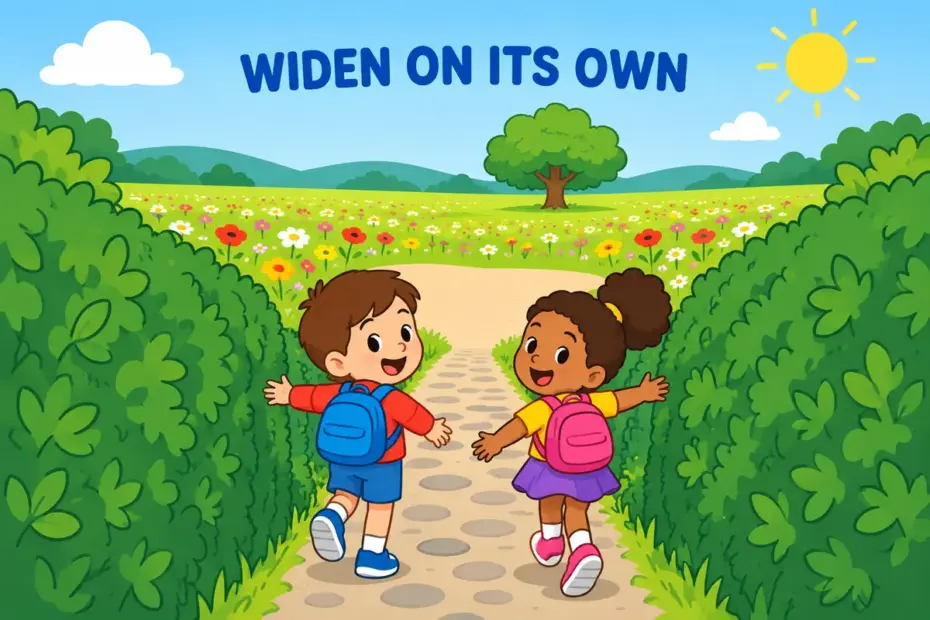
Open out means to unfold, spread wide or become more spacious, and in British use it also means to grow less reserved with someone. To use open out in a sentence, make the thing that widens the subject and say what it becomes: the narrow path opens out onto a meadow. The verb is intransitive, so it takes no object.
Open out at a glance
- Open out is an intransitive phrasal verb; its forms are open out, opens out, opened out and opening out.
- The core sense is to unfold, spread or become wider or more spacious.
- A second sense, common in British English, is to become less shy and talk more freely.
- The particle out cannot be separated because there is no object to place between the words.
- The commonest error is adding an object, as in she opened out the map, when unfold is needed.
What does open out mean?
Open out is an intransitive phrasal verb meaning to unfold, spread wider or become more spacious, and by extension to become more open in manner. The Cambridge entry for open out records both the widening sense and the British sense of becoming less reserved. Where something is folded deliberately and then revealed, unfold a paper map on the table keeps the transitive, hands-on meaning that open out cannot carry.
| Sense | Plain meaning | Example sentence |
|---|---|---|
| Widen or spread | To become wider, roomier or more open | The lane opens out into a market square. |
| Unfold or expand | To spread from a folded or closed state | The paper flower opened out in the water. |
| Become outgoing | To grow less reserved and talk freely | She began to open out after a few weeks. |
One limitation is worth stating plainly. Open out describes a thing that changes by itself, so it never takes a direct object that a person manipulates. You open out a room by knocking down a wall only in casual speech; the precise verb is widen or extend. For a shy person who finally talks, open out is warm and gentle rather than clinical.
How do you use open out in a sentence?
Open out is intransitive, which sets it apart from most phrasal verbs. The subject is the thing that widens, the particle out stays fixed to the verb, and nothing may sit between the two words. A useful contrast is the far commoner open up a long-sealed room, which can take an object and often implies unlocking or beginning to speak.
| Pattern | Example | What it signals |
|---|---|---|
| open out + into + noun | The tunnel opens out into a wide cavern. | Movement from tight space to open space. |
| open out onto + noun | The gate opens out onto the playing field. | Reveals what lies beyond a boundary. |
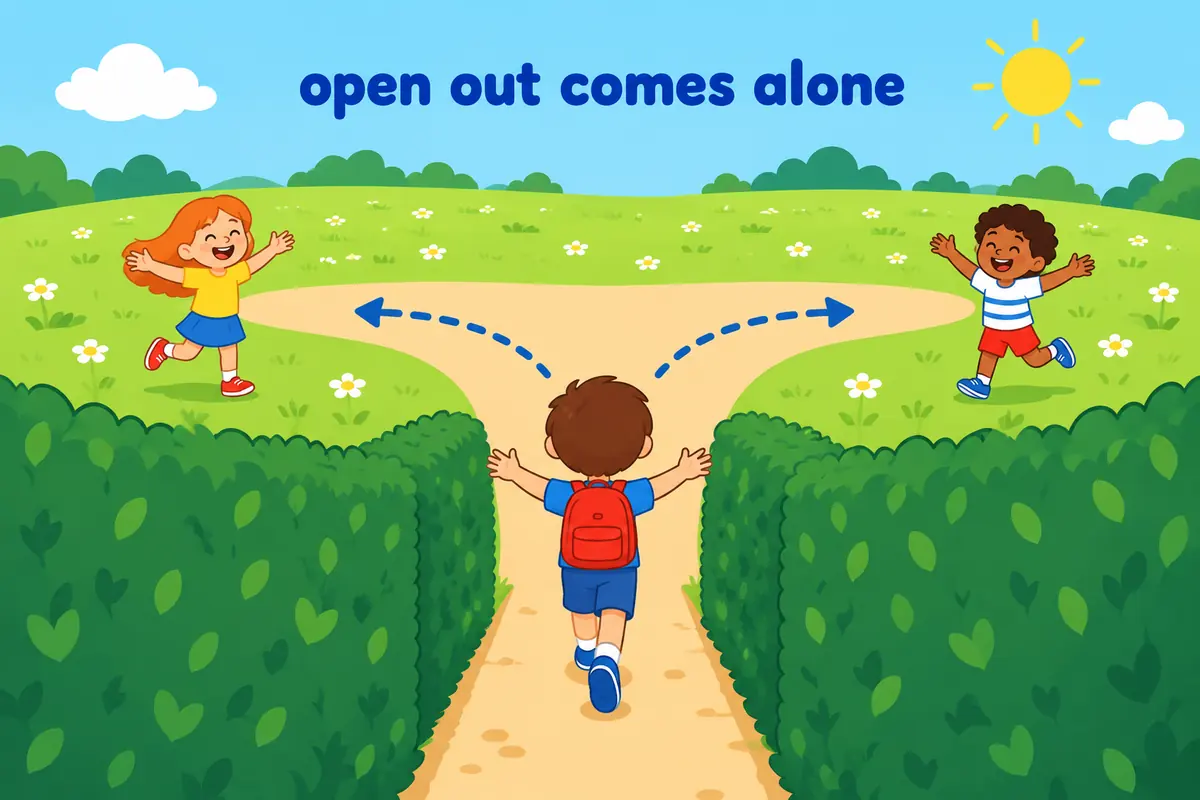
| something opens out | As we climbed, the view opened out. | The view itself becomes expansive. |
| open out + to + person | He slowly opened out to his new friends. | The British sense of growing less reserved. |
| open out + over + time | The discussion opened out over the evening. | A topic or mood becoming freer. |
The same particle out appears in many other phrasal verbs, and it almost always signals something becoming visible or emptying, as when a tired argument finally runs out of steam and emotions blow out in a sudden burst. The particle is shared, the meaning is not.
Open out in a sentence: examples across contexts
Open out keeps the same shape whether the subject is a path, a flower, a view or a person. The ten sentences below move through registers and underline that the verb never takes an object. A close cousin for a widening that people do deliberately is widen a narrow country track.
| Context | Example sentence | Why this works |
|---|---|---|
| Travel writing | Beyond the pine wood the river opens out into a broad lake. | A natural widening with no agent. |
| Gardening | The first buds opened out under the warm glass. | Self-unfolding without hands. |
| Personal writing | She opened out about her worries over dinner. | The British sense of growing frank. |
| News report | The quiet street opens out onto a lively promenade. | A change of space at a boundary. |
| Architecture | The hall opens out into a courtyard with a fountain. | Interior giving way to open air. |
| Classroom | The class opened out once the shy pupils felt safe. | A group becoming more talkative. |
| Nature diary | By dawn the valley had opened out below us. | A view growing wide with height. |
| Business note | The meeting opened out into a real debate. | A discussion becoming freer. |
| Fiction | Her clenched fist opened out as she relaxed. | A closed shape spreading open. |
| Sport writing | The game opened out in the second half. | Play becoming expansive. |
The literal rows take places and objects as subjects, while the human rows take people or groups. In every case the sentence would break if an object were slipped in after open, which is the surest test that the verb is intransitive.
Open out vs open up
Open out and open up look similar and behave differently. Open out is intransitive and usually physical or, in British use, about becoming less reserved. Open up can take an object, so you can open up a box, a debate or a country, and it also covers starting to speak after silence. A third near-synonym, broaden a young person’s horizons, stresses growth rather than physical space.
| Attribute | open out | open up |
|---|---|---|
| Transitivity | Intransitive only | Can be transitive or intransitive |
| Core meaning | Widen, unfold or become roomy | Unlock, expose or begin to speak |
| Typical subject | A path, view, flower or shy person | A room, market, opportunity or a person |
| Physical action | Happens by itself | Often done by someone to something |
| Register | Descriptive, slightly British | Widely used in every register |
| Example | The path opens out onto the field. | They opened up the old warehouse. |
Verdict: choose open out for something that widens or unfolds by itself, and open up when a person unlocks, exposes or finally talks.
Word forms and grammar of open out
Open out keeps the regular forms of the base verb open and adds the fixed particle. There is no passive, because there is no object to become the subject, and that single fact explains most of the grammar.
| Form | Part of speech | Example |
|---|---|---|
| open out | phrasal verb, base | The path opens out beyond the hedge. |
| opens out | third person singular | The valley opens out below the pass. |
| opened out | past and past participle | The road opened out into a square. |
| opening out | present participle | The bud was slowly opening out. |
| open out to + person | intransitive + preposition | He opened out to his tutor. |
| opened-out | attributive participle | An opened-out landscape greeted them. |
The attributive form opened-out uses a hyphen, and it stays rare. Because the verb is intransitive, you cannot write it was opened out by the gardener; that sentence needs a transitive verb such as widened.
Common mistakes with open out
- Incorrect:
She opened out the map on the table.Correct: She unfolded the map on the table. Rule: Open out takes no object, so a person handling a folded thing needs unfold. - Incorrect:
The path was opened out by the workers.Correct: The workers widened the path. Rule: An intransitive verb has no passive, because it has no object. - Incorrect:
The valley opens out a lake.Correct: The valley opens out into a lake. Rule: The widening leads into a place, so the preposition into is required. - Incorrect:
He opened out about his plans after a long silence.Correct: He opened up about his plans after a long silence. Rule: Sharing feelings usually takes open up, which is more common in this sense. - Incorrect:
The room opens out the garden.Correct: The room opens out onto the garden. Rule: A space that reveals another is linked with onto, not a bare noun.
Practice using open out
Work through the six items, then read the reason beside each answer.
- Fill the gap: Beyond the narrow gate the garden ______ out before us.
- Choose the better word: They (opened out / opened up) the sealed attic at last.
- Correct the error: The shy boy slowly opened out the story of his week.
- Build a sentence: use opens out into about a corridor and a hall.
- Spot the register: which fits a travel guide — the track opens out onto the beach, or the track opens out a beach?
- Rewrite transitively: The fold-out chart opened out. Add a person who does it and use unfold.
Answers
- opened out — the garden widens by itself, and the past form is regular.
- opened up — the attic is unlocked by people, so the transitive verb is needed.
- The shy boy slowly opened up about his week — sharing feelings takes open up, not open out with an object.
- Model answer: The corridor opens out into a bright entrance hall.
- The track opens out onto the beach — the widening leads onto a place with the preposition onto.
- She unfolded the fold-out chart — a person handling a folded thing needs the transitive verb unfold.
The bottom line
Use open out for something that widens, unfolds or becomes more spacious by itself, and in British use for a person who grows less reserved. The verb is intransitive, so the particle never separates and the sentence takes no object, which is where most learners slip. When a person unlocks or exposes something, open up is the wider and more common verb, and when a folded thing is handled by hand, unfold is the precise word.
Frequently asked questions about open out
Is open out a phrasal verb?
Yes. Open out is a phrasal verb made of the base verb open and the particle out, and the two words act as a single intransitive unit. Unlike many phrasal verbs it never splits, because there is no object to place between the verb and its particle.
Can open out take an object?
No. Open out is intransitive, so the thing that widens must be the subject, as in the path opens out. If a person handles and unfolds something, the correct verb is unfold, and if something is unlocked or exposed, the correct verb is open up.
What is the difference between open out and open up?
Open up can take an object, so you can open up a box, a market or a conversation, and it also covers starting to speak after silence. Open out takes no object and describes something widening or unfolding on its own, or a person gradually becoming less reserved.
Is open out used in American English?
The physical sense of widening or unfolding is understood on both sides of the Atlantic, but the sense of a person becoming less reserved is far more common in British use. American writers more often choose open up for that meaning, which keeps it natural on both sides.