
Head off is a phrasal verb with two useful senses: to intercept someone or something and turn it aside, and to prevent trouble before it starts. It also means to leave, as in we headed off early. The verb is separable when it takes an object, and intransitive in the departure sense.
Head off at a glance
- Head off is a separable phrasal verb; its forms are heads off, headed off and heading off.
- The primary sense is to intercept and turn something aside before it arrives.
- The second sense is to prevent a problem: head off a crisis, a strike or an argument.
- The intransitive sense means to depart: she headed off at noon.
- The commonest error is confusing head off with head for, which means travel toward.
What does head off mean?
Head off is a transitive phrasal verb meaning to move in front of someone or something and turn it aside, or to act early so that a problem never happens. The Cambridge entry for head off records both the intercepting and the preventing senses, and intercept a signal is the closest single-word verb for the first of them.
| Sense | Plain meaning | Example sentence |
|---|---|---|
| Intercept and divert | Get in front of someone and turn them aside | Police headed off the crowd at the bridge. |
| Prevent in advance | Act early so trouble never starts | A quick call headed off a formal complaint. |
| Depart | Leave a place, with no object | We headed off before the storm. |
One limitation is worth stating plainly. Head off does not mean stop by force, because it implies reaching a point first so that the other party changes direction. When physical force is actually meant, block or stop is the honest verb, and head off would overstate how little effort was involved.
How do you use head off in a sentence?
Head off separates whenever a noun object follows, and a pronoun must sit in the middle. The intransitive departure sense takes no object at all, which is the sense that puzzles learners who meet it first in British fiction.
| Pattern | Example | What it signals |
|---|---|---|
| head off + object | The guard headed off the reporters. | Intercepts the people before they reach their goal. |
| head + object + off | The guard headed the reporters off. | Separable; both orders are correct with a full noun. |
| head + pronoun + off | The guard headed them off. | A pronoun must sit between the verb and off. |
| head off + problem | Good planning headed off the shortage. | Prevents a bad outcome rather than intercepting a person. |
| head off (no object) | They headed off at dawn. | Intransitive departure sense, with no object at all. |
The particle can strand after a full noun but never after a pronoun, so headed off them is wrong. The verb also refuses a that-clause: write the manager headed off the strike, never headed off that the strike happened.

Head off in a sentence: examples across contexts
The verb shifts from intercepting people to preventing events, and the object tells the reader which job it is doing. The ten sentences below move from a school corridor to a government briefing, and each one keeps the sense visible.
| Context | Example sentence | Why this works |
|---|---|---|
| Classroom | The teacher headed off the argument before it reached the corridor. | A small, concrete interception is easy for a young reader to picture. |
| Workplace email | A short update headed off a stream of anxious messages. | Frames prevention as the result of a simple, sensible action. |
| News report | Officers headed off the march before it reached the square. | Names the crowd as object and the place as the point of interception. |
| Sports report | The winger headed off the danger at the near post. | Uses the intercepting sense in a fast, physical setting. |
| Business writing | Early talks headed off a costly dispute. | Shows prevention with an abstract, high-stakes object. |
| Customer service | A refund headed off a written complaint. | Connects one small remedy to a larger problem avoided. |
| Medical writing | Rapid treatment headed off a serious infection. | Keeps the tone clinical and the action pre-emptive. |
| Diplomacy | Talks headed off a trade war for another year. | States prevention of a large consequence in neutral language. |
| Travel writing | We headed off at first light for the coast. | Uses the intransitive departure sense with a time phrase. |
| Conversation | My sister headed them off while I found the keys. | The pronoun between verb and particle is the spoken pattern. |
Notice that eight of these sentences use an object, and the object is a person only twice. The preventing sense, with an event or problem as the object, is the one that dominates formal writing. The departure sense, by contrast, is almost always intransitive, which is why we headed off needs no object while we headed off the crowd does. Readers who meet the verb first in British fiction often know only the departure meaning, so a sentence about preventing trouble can seem ungrammatical until the second sense becomes familiar.
Head off vs head for
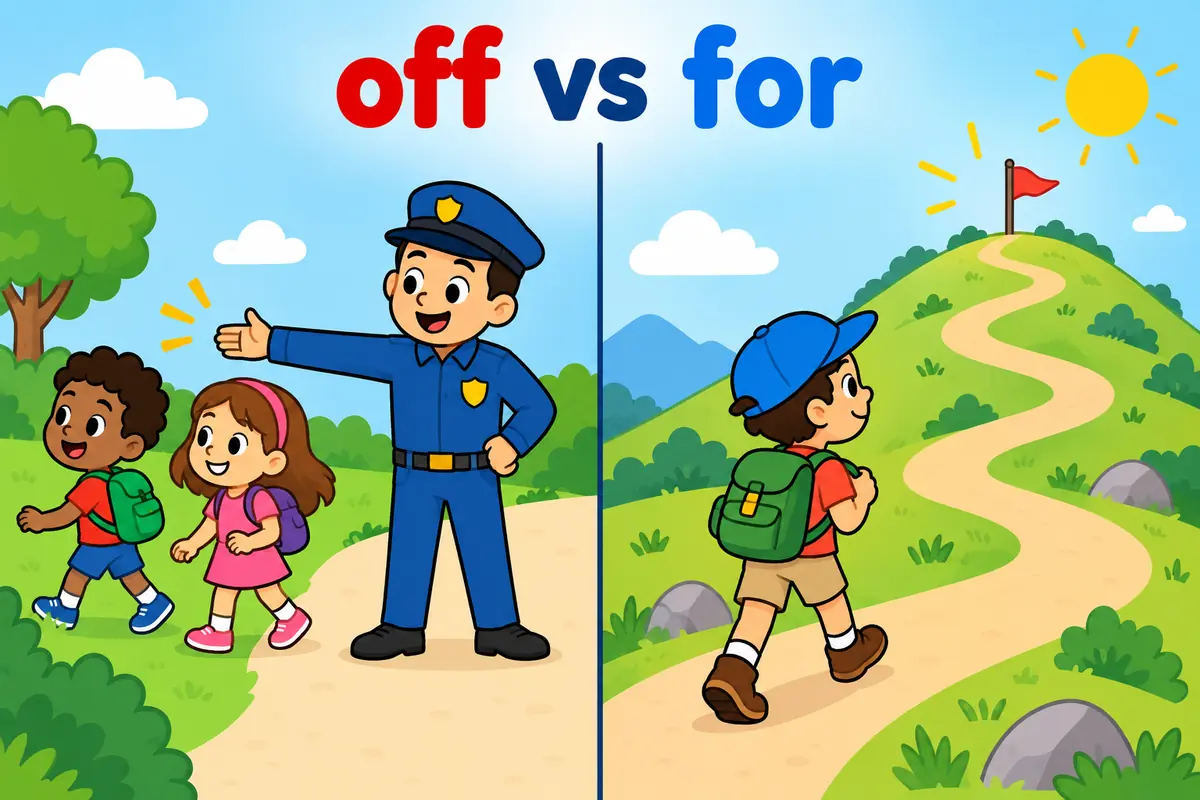
Head off is most often confused with head for, because both describe movement in relation to a point ahead. The first turns aside; the second simply travels toward.
| Attribute | head off | head for |
|---|---|---|
| Core meaning | Intercept or prevent | Travel toward a destination |
| Direction | Toward a point in front of something else | Toward a place or target |
| Typical object | A person, crowd, problem or crisis | A place or a goal |
| Separable | Yes, with a noun object | No; the particle stays put |
| Intransitive use | Depart, as in they headed off | Depart, as in she headed for home |
| Example | Police headed off the marchers. | Police headed for the stadium. |
Two formal verbs sit near the preventing sense. To prevent is the plain choice, and to forestall adds the idea of acting before someone else can, which is close to the diplomatic use of head off. To avert is the specialist verb for heading off a disaster.
Verdict: use head off to intercept a person or prevent an event, and head for only when the sentence is about travelling toward a place, because only head off can carry the sense of stopping something before it happens.
Word forms and grammar of head off
Head off inflects regularly, and the base verb appears in several other phrasal verbs that are easy to mix up. The table below lists the forms, then separates the nearest neighbour.
| Form | Part of speech | Example |
|---|---|---|
| head off | base phrasal verb | We can head off the problem today. |
| heads off | third person singular | She heads off trouble before it grows. |
| headed off | past and past participle | They headed off the delay early. |
| heading off | present participle | He is heading off the challenge well. |
| head off | intransitive verb | We headed off after breakfast. |
| head-off | attributive, rare | A head-off manoeuvre kept the crowd back. |
| head off them | non-standard word order | Write head them off instead. |
Keep head up in a different box: it means to lead a team or project, so she headed up the committee has nothing to do with intercepting anyone.
Common mistakes with head off
- Incorrect:
They headed off them at the gate.Correct: They headed them off at the gate. Rule: a pronoun object must sit between the verb and the particle. - Incorrect:
The manager headed off that the strike happened.Correct: The manager headed off the strike. Rule: head off takes a noun phrase, never a that-clause. - Incorrect:
The government headed off against the crisis.Correct: The government headed off the crisis. Rule: head off takes the problem as its direct object, with no against. - Incorrect:
He headed off the direction of the airport.Correct: He headed for the airport. Rule: head for means travel toward; head off does not take a destination. - Incorrect:
She headed off the committee for three years.Correct: She headed up the committee for three years. Rule: head up means to lead, while head off means to intercept or prevent.
Practice using head off
Work through the six items, then check the reasoning rather than only the answer.
- Fill the gap: A calm reply ______ ______ a long argument.
- Choose the better word: The hikers (headed off / headed for) the ridge before sunrise, meaning they travelled toward it.
- Correct the error: The steward headed off them at the gate.
- Build a sentence: use head off + noun about a disagreement at work.
- Spot the register: which belongs in a formal report — the talks headed off a strike, or the talks stopped the strike, phew.
- Rewrite with a pronoun: The usher intercepted the latecomers. Use head off and a pronoun.
Answers
- headed … off — the reply prevents the argument, so the problem is the object.
- headed for — when the sentence means travelling toward a place, head for is required.
- The steward headed them off at the gate — the pronoun goes in the middle.
- Model answer: A quick email headed off a misunderstanding between the two teams.
- The talks headed off a strike — a formal report avoids the exclamation.
- The usher headed them off — the pronoun must sit between verb and particle.
The bottom line
Use head off in a sentence to intercept someone and turn them aside, or to prevent a problem before it starts; use it intransitively only when you mean that somebody left. Two details decide most sentences: the verb is separable, so a pronoun belongs in the middle, and it is not the same as head for, which describes travelling toward a place rather than stopping something.
Frequently asked questions about head off
Is head off one word or two?
Head off is always two words as a verb. The base is head and the particle is off, and they stay separate in writing even when a pronoun sits between them, as in head them off. A rare attributive form, head-off, appears only in technical or sporting descriptions.
What does head off mean in British English?
In British English, head off often means to depart: we headed off after lunch. The same sense exists in American English, but it is more common in Britain. Context decides, because the departure use has no object while the intercepting use always does.
Is head off separable?
Yes, when it takes a noun object. You can say head off the reporters or head the reporters off, and the meaning does not change. A pronoun must go in the middle, so head them off is correct and head off them is not. The departure sense is not separable because it has no object.
Can head off take a that-clause?
No. Head off takes a noun phrase such as a strike, a crisis or a complaint. To report what was prevented, use a noun instead: the manager headed off the strike, not headed off that the strike happened. Verbs like prevent can take a different pattern, but head off cannot follow it.