
Dust Off in a Sentence: Meaning, Examples & Practice
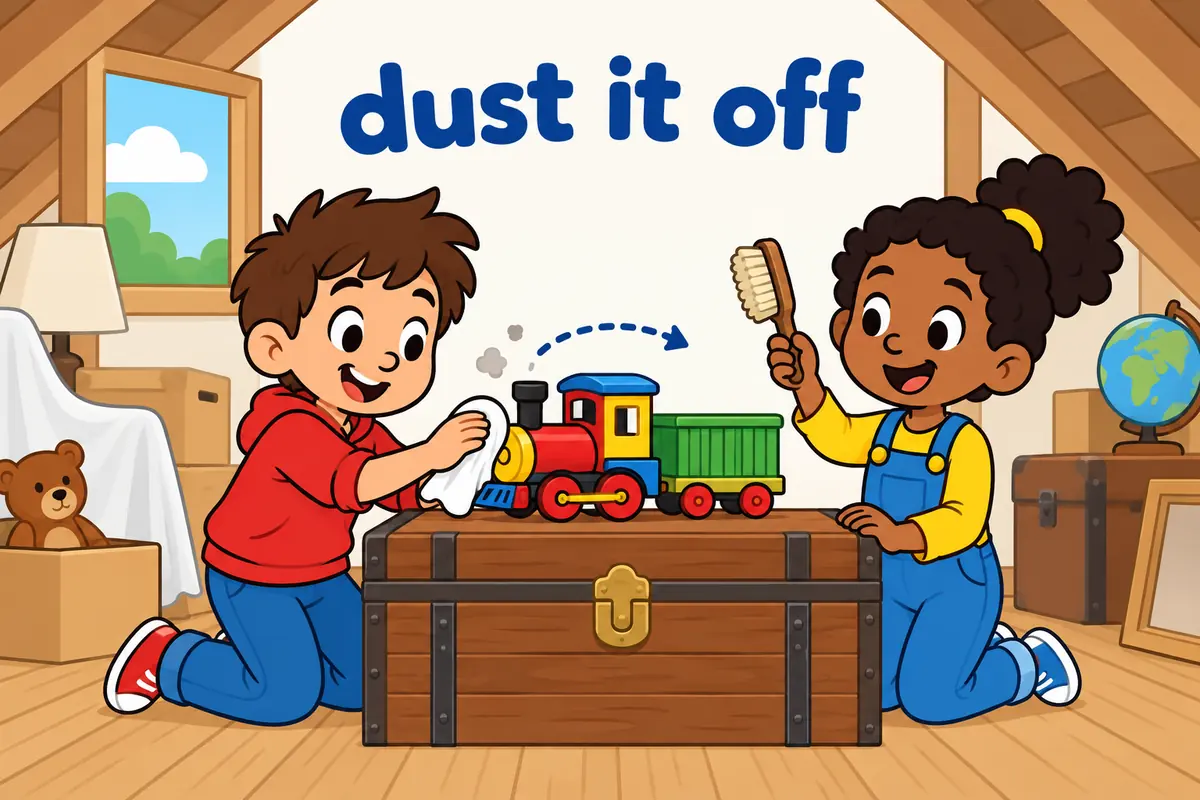
Dust off in a sentence means to remove dust from something or to bring an old skill, plan or object back into use. To use it, name the thing being revived: “He dusted off his guitar.” The verb is transitive and separable, so the object may sit after dust off or between dust and off.
Dust off at a glance
- Dust off is a transitive phrasal verb; its forms are dusts off, dusted off and dusting off.
- The literal sense is clearing dust from a surface; the common figurative sense is bringing something back into use.
- The verb is separable: dust off the bike or dust the bike off.
- A reflexive form, dust yourself off, means to recover after a setback or a fall.
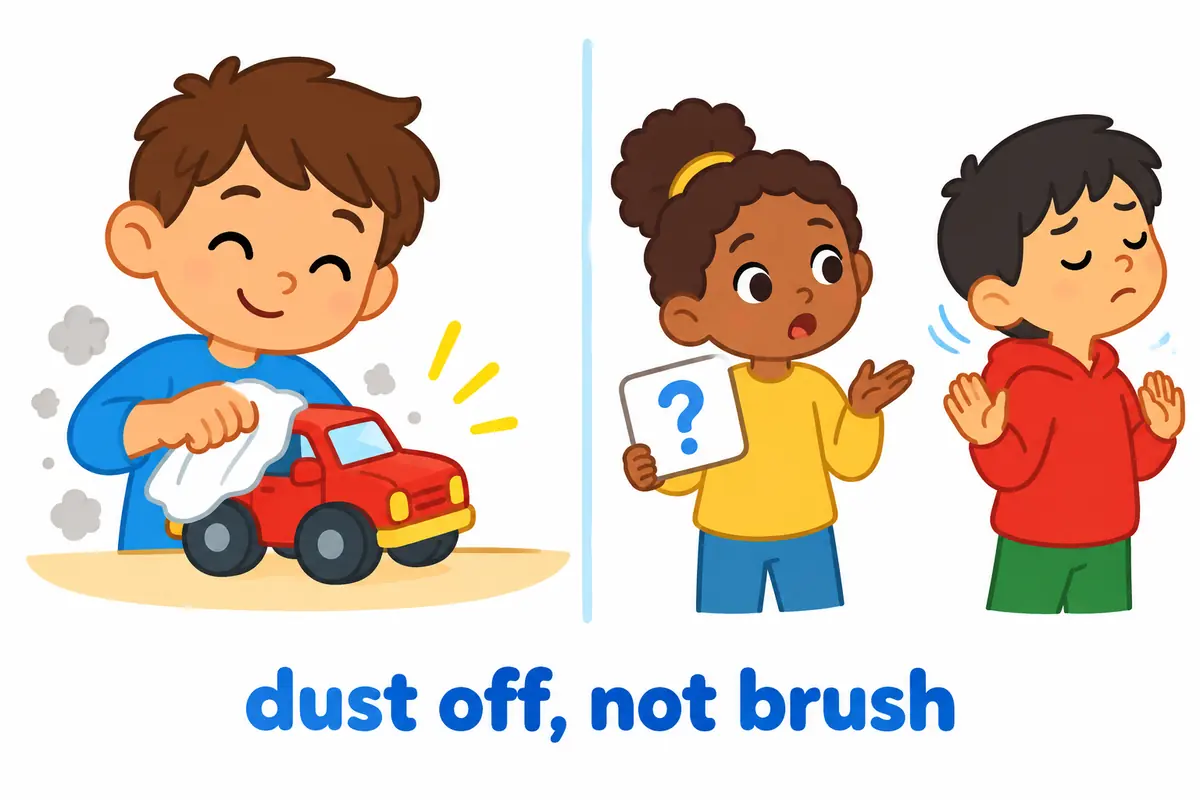
- The commonest error is confusing dust off with brush off, which means to dismiss someone or something.
What does dust off mean?
Dust off is a transitive phrasal verb meaning to remove dust from a surface or, more often, to bring something long unused back into service. The Cambridge entry for dust off records the cleaning sense, and the figurative sense follows it closely: you clear the dust away before you use the thing again. Writers revive a plan when they dust it off, though dust off suggests the revival is quick rather than deep.
| Sense | Plain meaning | Example sentence |
|---|---|---|
| Clean a surface | Remove dust from something | She dusted off the old bookcase before moving it. |
| Bring back into use | Start using something again after a pause | He dusted off his French before the trip. |
| Recover after a setback | Reflexive: get back up and continue | She dusted herself off and tried the climb again. |
Dust off is lighter than restore. A restored chair is repaired in full, while a dusted-off chair is simply wiped and used again. The phrase also does not mean to discard: when something is dusted off it returns to service, and the dust is what leaves, not the object. A quick refresh of an old skill is exactly what dust off describes, while a full repair calls for restore. The base verb dust is broad, because it can also mean to sprinkle a surface with a powder, so the particle off is what pins down the meaning of removing dust rather than adding it.
How do you use dust off in a sentence?
The separable order is the main decision, and the reflexive pattern covers a separate idea. The table sets out the shapes worth copying.
| Pattern | Example | What it signals |
|---|---|---|
| dust off + object | She dusted off the trophy. | The thing cleaned or revived. |
| dust + object + off | She dusted the trophy off. | Separable order, object first. |
| dust off + object (figurative) | They dusted off an old plan. | A skill or idea reused. |
| dust yourself off | He dusted himself off after the fall. | Reflexive recovery. |
| be dusted off (passive) | The scheme was dusted off last spring. | Revival with the doer unnamed. |
The object rule is the same as for other separable verbs: a pronoun must sit between verb and particle. Speakers say dust it off, never dust off it. A full noun phrase may take either position, so dusted off the medal and dusted the medal off are both correct. The same rule explains why the reflexive form keeps the pronoun inside the verb: the person doing the dusting and the person being dusted are one and the same.
Dust off in a sentence: examples across contexts
The phrase moves easily between literal cleaning and figurative revival, and the setting decides which sense a reader hears. Each row gives a context and a reason.
| Context | Example sentence | Why this works |
|---|---|---|
| Home | She dusted off the shelf before setting out the photographs. | Literal cleaning in a domestic scene. |
| Music | He dusted off his trumpet for the school concert. | Figurative revival of a skill. |
| Sports | The coach dusted off a tactic from last season. | A plan reused after a pause. |
| Library | The librarian dusted off a set of forgotten maps. | Literal cleaning with a hint of rediscovery. |
| Business | Managers dusted off the old training manual. | Revival in a workplace register. |
| Playground | She dusted herself off and ran back to the game. | Reflexive recovery after a tumble. |
| News report | Fans dusted off their winter coats for the match. | Everyday items reused for a new purpose. |
| Technology | The team dusted off a backup server after the outage. | Equipment returned to service. |
| Cooking | He dusted off the old recipe book and baked again. | Literal and figurative senses overlap neatly. |
| Volunteering | They dusted off a fundraising idea that had once worked. | An idea revived, with the past made clear. |
| Gardening | She dusted off the greenhouse before planting in spring. | A literal wipe in a seasonal routine. |
| Winter sport | Skiers dusted off their boots for the first snow. | Equipment returned to service after months. |
| Study | He dusted off his notes the night before the exam. | A skill or knowledge refreshed quickly. |
| DIY | They dusted off the tools and repaired the fence. | Idle objects pressed back into use. |
A workshop may restore a machine over weeks, but it only dusts it off before that work begins. In the same way, you can retrieve a file from storage, yet dust off the habit of reading it, because the verb suits a return that is light and quick.
Dust off vs brush off
Brush off looks similar and even shares the particle, but it sends the opposite message in most sentences, so the two are worth separating.
| Attribute | dust off | brush off |
|---|---|---|
| Core meaning | Clean or bring back into use | Dismiss or refuse to take seriously |
| What it affects | An object, skill or plan | A person, comment or concern |
| Outcome | Something returns | Something is pushed away |
| Tone | Practical, sometimes nostalgic | Rude or careless |
| Typical object | guitar, plan, trophy | criticism, question, offer |
Dust off brings something back, while brush off pushes something away, so a sentence about clearing a surface must not borrow the dismissing verb.
Word forms and grammar of dust off
Every form keeps the particle off, and the reflexive needs a matching pronoun.
| Form | Part of speech | Example |
|---|---|---|
| dust off | base phrasal verb | We dust off the bikes each spring. |
| dusts off | third-person singular | He dusts off his boots at the door. |
| dusted off | past tense and past participle | She dusted off the old camera. |
| dusting off | present participle | They are dusting off the plan again. |
| dust yourself off | reflexive idiom | Dust yourself off and keep going. |
Common mistakes with dust off
Five slips account for most errors, and each repair is a matter of position or particle.
She dusted off it before the party.Correct: She dusted it off before the party. Rule: a pronoun object must sit between verb and particle.He dusted the guitar.Correct: He dusted the guitar off. Rule: dust alone means to sprinkle or clean, not to revive.They dusted off up the old plan.Correct: They dusted off the old plan. Rule: use one particle, never off and up together.He brushed off his old guitar.Correct: He dusted off his old guitar. Rule: brush off dismisses; dust off revives.Dust off yourself and try again.Correct: Dust yourself off and try again. Rule: the reflexive pronoun goes between the verb and off.
Practice using dust off
Seven tasks cover the separable order, the reflexive form and the contrast with brush off. Write each answer before checking below.
- Fill in the blank: Every summer we _____ the camping gear.
- Choose the better word: She _____ the rude comment and kept talking. (dusted off / brushed off)
- Correct the error: He dusted off it last week.
- Build a sentence: use dust off in the reflexive form about a fall.
- Spot the register: which fits a business report — “The firm dusted off an old proposal.” or “The firm found an old proposal.”?
- Fill in the blank: The scheme _____ off after years on the shelf. (passive)
- Correct the error: They dusted the plan.
- Fill in the blank: She _____ her boots off before stepping inside.
Answers
- Every summer we dust off the camping gear. The object follows the whole verb.
- Brushed off fits, because the comment is dismissed rather than revived.
- He dusted it off last week. The pronoun goes between dust and off.
- She dusted herself off and continued. The reflexive pronoun marks recovery.
- The first sentence fits a report; finding is flatter and loses the sense of revival.
- The scheme was dusted off after years on the shelf. The passive keeps the scheme in focus.
- They dusted the plan off. The particle off is required for the meaning.
- She dusted her boots off before stepping inside. The object sits between dust and off.
The bottom line
Dust off in a sentence covers both a wipe with a cloth and the revival of something long unused. Keep the object close to the verb, place a pronoun in the middle, and let the context decide whether the dust is literal. When the work is a full repair, use restore; when a surface only needs a wipe, clean is the plainer word; and when the meaning is to dismiss, brush off is the verb you want. A pronoun belongs in the middle, and the reflexive form turns the phrase into encouragement after a setback.
Frequently asked questions about dust off
Is dust off separable?
Yes, dust off is a separable phrasal verb. A full noun phrase may follow the verb or split it, so dust off the trophy and dust the trophy off are both correct. A pronoun, however, must sit in the middle, which is why native speakers say dust it off.
What does it mean to dust yourself off?
To dust yourself off is to recover after a fall, a failure or an embarrassment and continue. The image comes from brushing dirt off your clothes after a tumble. It is usually encouraging, and it appears in sport, study and everyday advice about resilience rather than cleaning.
What is the difference between dust off and brush off?
Dust off clean or revives something, while brush off dismisses a person, comment or concern. The shared particle makes them easy to mix, but the outcome is opposite: one brings something back into use, and the other pushes something away without attention.
Can dust off be used figuratively?
It very often is. People dust off skills, plans, arguments and old songs, meaning they return to them after a break. The figurative use still keeps the literal picture of clearing dust, so it suggests a light, quick return rather than a full restoration or rebuild.