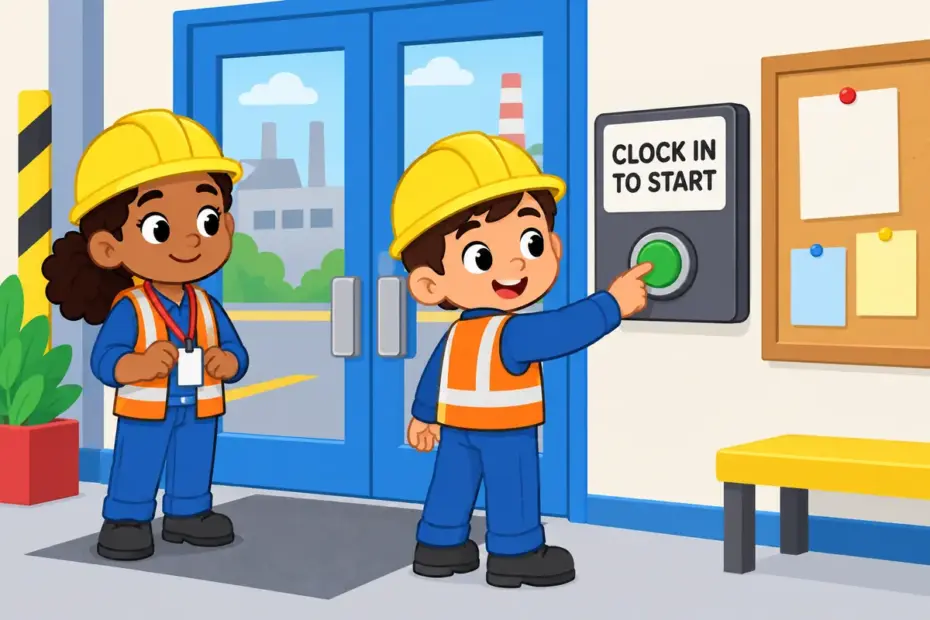
Clock In in a Sentence: Meaning, Examples & Practice
Clock in in a sentence marks the start of paid work, when an employee records the time of arrival. To use it, name the worker and the moment: “She clocked in at seven.” The verb is intransitive, so it takes no direct object, and the particle stays fixed after clock.
Clock in at a glance
- Clock in is an intransitive phrasal verb; its forms are clocks in, clocked in and clocking in.
- The main sense is recording the time you begin work; the opposite is clock out.
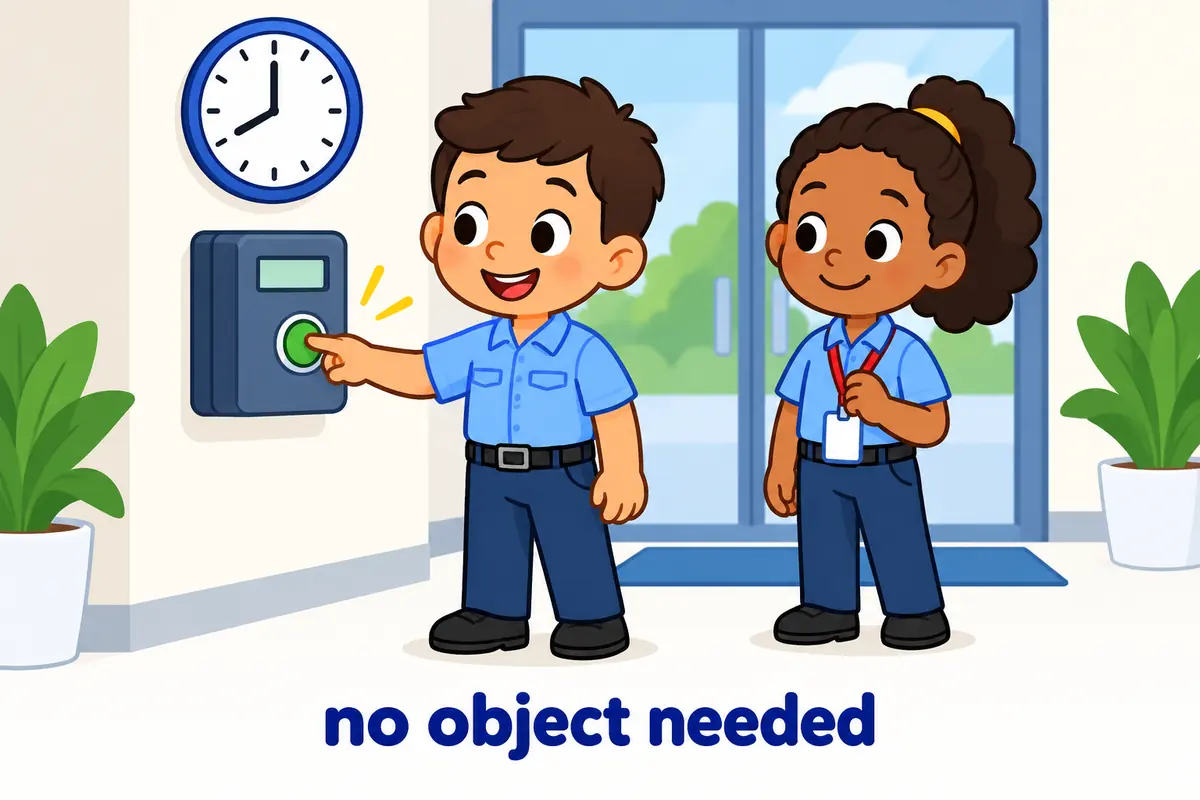
- The verb takes no object, but clock in at adds a time or a measurement.
- The particle is fixed, so the verb is not separable and clock yourself in is not standard.
- The commonest error is confusing clock in with check in or log in, which are not about a shift.
What does clock in mean?
Clock in is an intransitive phrasal verb meaning to record the time you start work, usually on a machine or an app. The Cambridge entry for clock in records this sense, and a second sense uses clock in at for a measured figure. Most workers arrive and clock in within the same minute, and the system records the time so pay can be worked out later.
| Sense | Plain meaning | Example sentence |
|---|---|---|
| Start of a shift | Record the time you begin work | She clocked in at seven and started the delivery round. |
| Measured figure | Register a time, speed or amount | The marathon clocked in at just under four hours. |
| Machine reading | Show a value on an instrument | The old meter clocked in a little high. |
Keep clock in apart from clock up, which means to accumulate a total rather than to start a shift. A driver clocks in at eight, but clocks up thousands of miles over a year. The two share the base verb and nothing else, so a sentence about timekeeping never uses clock up, and a sentence about totals never uses clock in.
Clock in is about the start of paid time, not about arriving somewhere for pleasure, and it is never used with a person as its object. A manager does not clock an employee in; the employee clocks in. Where the meaning is simply to reach a place, arrive is the plainer verb, and where a reading is recorded, register is often clearer.
How do you use clock in in a sentence?
The pattern is short because the verb takes no object. Add at, for or on only when the time, shift or reason needs naming, as the table shows.
| Pattern | Example | What it signals |
|---|---|---|
| clock in | I clock in at nine every morning. | The plain intransitive use. |
| clock in at + time | He clocked in at half past six. | The exact moment of starting. |
| clock in for + shift | She clocks in for the night shift. | The shift being started. |
| clock in early / late | They clocked in early to help. | Adverbs of time sit after the verb. |
| clock in at + measurement | The flight clocked in at eleven hours. | The figurative measured-figure sense. |
Because the particle is fixed, the object test fails cleanly: there is no object to move, so clock in never splits. A sentence such as the manager clocked the staff in belongs to a rare transitive use and sounds unlike everyday speech, which keeps the plain intransitive form.
Clock in in a sentence: examples across contexts
The phrase appears wherever work is timed, and the setting quietly shapes the sentence. Each row gives a different context and the reason it reads naturally.
| Context | Example sentence | Why this works |
|---|---|---|
| Factory floor | Every operator clocks in before the line starts. | Habitual present for a daily routine. |
| Hospital ward | The night nurse clocked in at ten and took the handover. | Precise time fixes the shift. |
| Office email | I clocked in from home and joined the call. | Remote work still uses the same verb. |
| Retail rota | Staff must clock in for the morning shift. | The for phrase names the shift. |
| News report | Drivers clocked in early to clear the snow. | Adverb early adds useful detail. |
| Sports writing | The winning run clocked in at a record pace. | Measured-figure sense, not a shift. |
| Conversation | She clocked in late and missed the briefing. | Casual past tense, clear cause and effect. |
| Timekeeping policy | Workers who clock in late lose a quarter hour of pay. | Formal rule, present simple. |
| Warehouse | New starters clock in at the gate and collect a scanner. | Two present-simple actions in sequence. |
| Remote team | Please clock in on the app before you open any tickets. | Polite instruction with the plain form. |
| Cafe rota | The barista clocked in for the early shift and started the grinder. | The for phrase plus a following action reads smoothly. |
| Seasonal work | Pickers clock in at dawn while the field is cool. | Habitual present and a clear time phrase. |
A worker who cannot come to the office may call in sick instead, and some firms register attendance by fingerprint rather than a punched card, though the verb clock in survives in both systems.
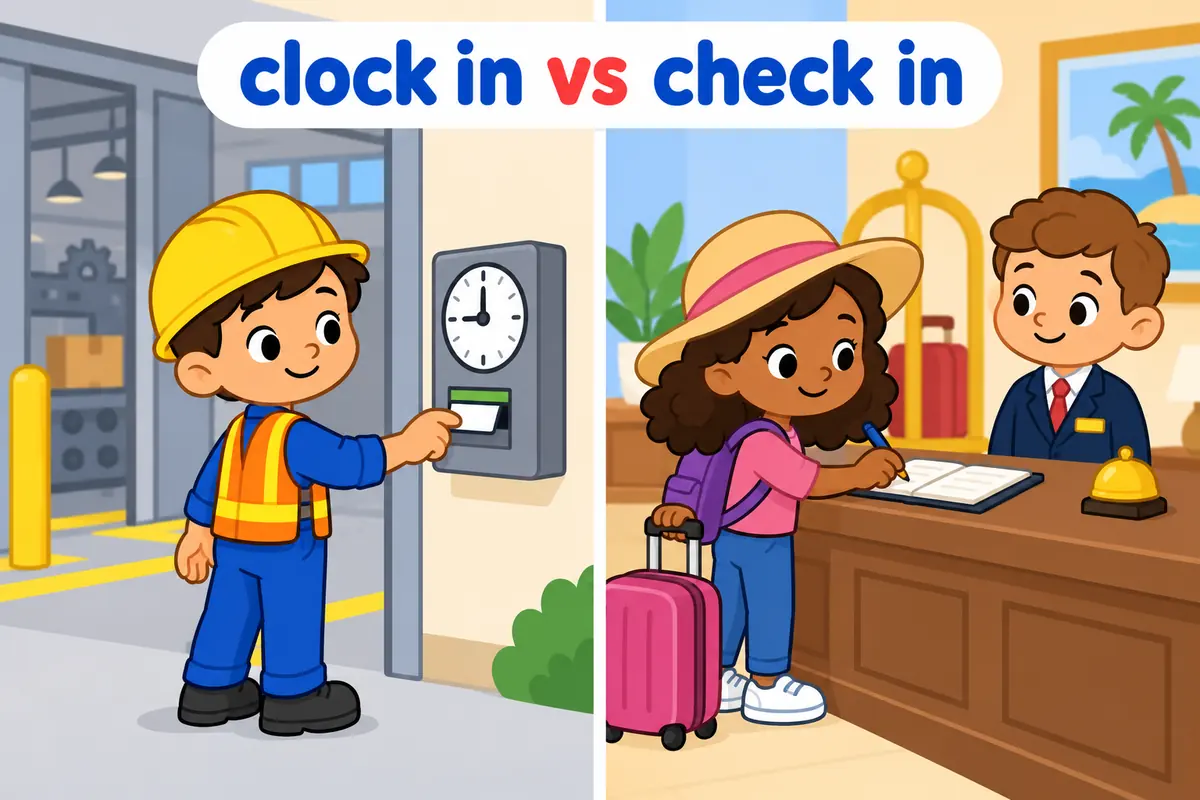
Clock in vs check in
Check in and log in are the verbs learners substitute for clock in, but only clock in is tied to paid time, and each one opens a different kind of record.
| Attribute | clock in | check in |
|---|---|---|
| Core meaning | Record the start of a shift | Announce your arrival or register on arrival |
| Typical setting | Workplace, factory, ward | Hotel, airport, clinic |
| What it opens | A paid time record | A room, a seat or a booking |
| Opposite | clock out | check out |
| Register | Workplace and informal | Neutral and travel-facing |
Check in is the hotel-desk cousin that confirms a booking, while Log in opens a computer account with a password, so neither belongs on a time sheet unless the job pays you to be online.
Word forms and grammar of clock in
Every form keeps the particle after clock, and the third-person -s attaches to clock alone.
| Form | Part of speech | Example |
|---|---|---|
| clock in | base phrasal verb | I clock in before the bell. |
| clocks in | third-person singular | She clocks in at nine. |
| clocked in | past tense and past participle | They clocked in early. |
| clocking in | present participle | He is clocking in now. |
| clock-in | attributive noun, hyphenated | The clock-in machine is by the door. |
In the workplace the noun is often just clock, as in punch the clock, and the time-tracking record is a timesheet or a time log. The verb clock in stays two unhyphenated words in every tense, and only the compound modifier before a noun carries the hyphen, which is a common point of confusion in formal writing.
Common mistakes with clock in
These five errors are the ones that most often mark a learner, and each has a simple fix.
The manager clocked in the new staff.Correct: The new staff clocked in. Rule: clock in is intransitive and takes no object.She clocked in it at nine.Correct: She clocked in at nine. Rule: a time follows clock in at, not a pronoun object.He clocked in check at the hotel.Correct: He checked in at the hotel. Rule: hotels take check in, not clock in.They clocked in in the morning shift.Correct: They clocked in for the morning shift. Rule: use for before a shift, not a repeated in.I will clock in the app.Correct: I will clock in on the app. Rule: the tool takes on, because it is a location, not an object.
Practice using clock in
Seven tasks cover the intransitive pattern, the at phrase and the contrast with check in. Write each answer before checking below.
- Fill in the blank: All staff _____ before the doors open.
- Choose the better word: We _____ at the hotel reception. (clock in / check in)
- Correct the error: The supervisor clocked in the whole team.
- Build a sentence: use clock in for about a night shift.
- Spot the register: which belongs in a timekeeping policy — “Workers clock in at the gate.” or “Workers clock in at the gate, no worries.”?
- Fill in the blank: The race _____ at just over three hours.
- Correct the error: She clocked in it on the app.
- Fill in the blank: The whole crew _____ early to load the van.
Answers
- All staff clock in before the doors open. The verb needs no object.
- Check in fits, because a hotel records a booking rather than a shift.
- The whole team clocked in. The staff, not the supervisor, complete the action.
- She clocks in for the night shift. The for phrase names the shift.
- The first sentence fits a policy; the second is too casual for a written rule.
- The race clocked in at just over three hours. The at phrase carries the measured figure.
- She clocked in on the app. The tool takes on, and no pronoun object is allowed.
- The whole crew clocked in early to load the van. The past tense plus adverb early keeps the verb objectless.
The bottom line
Clock in in a sentence records the start of work, and it never takes a direct object. Add at for a time or a measured figure, add for before a shift, and keep check in for hotels and airports. When the meaning is simply reaching a place, arrive carries the sentence better, and when a figure is recorded, register is often the sharper verb. Keep the two words separate, and the sentence will read as a native timekeeping statement rather than a login instruction.
Frequently asked questions about clock in
Is clock in one word or two?
As a verb it is always two words: clock in. The hyphenated form clock-in appears only as a compound modifier before a noun, as in a clock-in machine. Never write clockin, and remember that the third-person form is clocks in, not clocks-in.
What is the opposite of clock in?
Clock out is the opposite, and it records the moment you finish a shift. The two verbs frame the paid part of the day, so a sentence often pairs them: she clocked in at eight and clocked out at four. Time-tracking apps usually offer both buttons side by side.
Can clock in mean to arrive?
It implies arrival, but the verb itself is about the time record, not the journey. You can arrive early and clock in later, or clock in from home without travelling at all. When arrival is the point, use arrive; when the time sheet is the point, use clock in.
Is clock in used in American and British English?
Both varieties use clock in, and both also use punch in, especially in American workplaces with a physical time clock. The meaning is identical. Pick clock in for a general audience, because it is understood on both sides of the Atlantic and works for app-based systems too.