Tap out means to signal that you have had enough, either by tapping the ground to concede a fight or by running out of strength. To use tap out in a sentence, choose the sense first: “He tapped out in the second round.” The phrase is a combat term and an informal way to say exhausted.
Tap out at a glance
- Tap out is a phrasal verb with two main senses: conceding a fight and stopping from exhaustion.
- In the combat sense it is intransitive, so it never takes an object: he tapped out.
- In the typing or drumming sense it is transitive and separable: tap out a tune.
- The adjective tapped out means exhausted or completely out of money.
- The commonest error is treating the combat sense as transitive and writing tapped out him.
What does tap out mean?
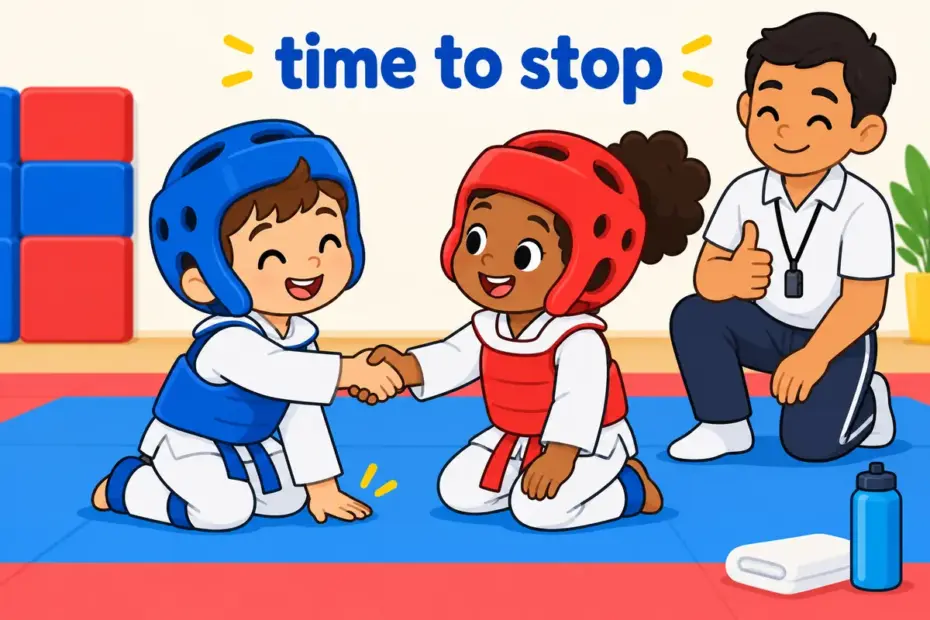
Tap out is a phrasal verb meaning to show that you have had enough, most often by tapping the mat to surrender a fight. The Cambridge entry for tap out records the combat sense, and the same phrase extends to quitting from exhaustion in sport and everyday life.
A second family of senses is physical: to produce something by light repeated taps, as when you tap out a message or a rhythm on a surface, or to fit and remove a part by pressing it, as a tray taps out of its slot. The sense you choose decides the grammar, because the combat sense stands alone while the typing sense needs an object.
| Sense | Plain meaning | Example sentence |
|---|---|---|
| Concede a fight | Tap the mat to surrender | The champion tapped out after the arm lock. |
| Stop from exhaustion | Quit because your strength is gone | Two runners tapped out near the final hill. |
| Produce by tapping | Type or drum something out | She tapped out a quick reply on her phone. |
| Remove by pressing | Free a part from its fitting | The pin taps out from the other side. |
| Exhausted, as an adjective | Spent, or out of money | We were tapped out by the last mile. |
One limitation is worth stating plainly. Tap out does not mean to collapse or pass out; it is a deliberate signal that a person gives. It is also informal outside combat sports, so a formal report would say the fighter submitted or the runner withdrew. Where the reason is simply losing heart, give up is the plainer phrase.
How do you use tap out in a sentence?
The grammar changes with the sense. The combat and exhaustion uses are intransitive, so nothing follows the particle, while the typing and pressing uses are transitive and separable, which lets the object sit between the verb and out.
| Pattern | Example | What it signals |
|---|---|---|
| tap out (intransitive) | He tapped out in the first round. | No object is possible; the phrase stands alone. |
| tap out of + noun | She tapped out of the tournament. | Withdraw from an event rather than a single bout. |
| tap out + object | He tapped out a rhythm on the desk. | The transitive typing or drumming sense. |
| tap + object + out | He tapped the rhythm out on the desk. | The separable order, with the object in the middle. |
| tap + pronoun + out | She tapped it out in a minute. | A pronoun must split the phrase; tap out it is wrong. |
| be tapped out | We were tapped out by the last mile. | The adjective sense of complete exhaustion. |
The particle can strand at the end of a passive clause in the typing sense, as in the code was tapped out by hand. Two other phrasal verbs with the same particle, back out and blow out, behave differently again, so learners should test separability phrase by phrase.
Tap out in a sentence: examples across contexts
The phrase keeps its shape while the setting changes, and each sentence below names the part of the sense doing the work.
| Context | Example sentence | Why this works |
|---|---|---|
| Combat sports | The challenger tapped out with two seconds left. | The core sense, intransitive and precise. |
| Fitness class | Half the group tapped out during the final set. | Extends the submission idea to giving up from fatigue. |
| Workplace email | We tapped out a short summary before the call. | The typing sense, transitive and businesslike. |
| Music lesson | The pupil tapped out the beat on a wooden block. | The drumming sense, with a clear object. |
| News report | The veteran tapped out of the season after one bout. | The of pattern, marking withdrawal from an event. |
| Conversation | I am totally tapped out after that shift. | The adjective sense that dominates everyday speech. |
| Repair manual | The retaining pin taps out towards the rear. | The technical sense of freeing a part by pressing. |
| Finance page | Small investors were tapped out long before spring. | The adjective carried into a money sense. |
| Sports commentary | He tapped out rather than risk a serious injury. | Shows the signal as a sensible choice, not weakness. |
| Game design | Players tapped out a sequence to open the gate. | Uses the input sense with a clear result. |
Tap out vs give up, concede and quit
Tap out overlaps with three plainer verbs and is interchangeable with none of them. concede is the formal word for admitting defeat, quit means leaving a task or job, and give up covers all of them at a general level.
| Attribute | tap out | give up | concede | quit |
|---|---|---|---|---|
| Core job | Signal that you have had enough | Stop trying | Admit defeat formally | Leave a task, job or habit |
| Who uses it | Fighters, athletes, informal speech | Everyone, every register | Officials, commentators, formal prose | Workers, players, speakers |
| Implies a signal | Yes, a physical tap or gesture | No | No, though a statement is normal | No |
| Implies exhaustion | Sometimes, by itself | Not necessarily | No, it is a judgement | No, it is a decision |
| Register | Informal to sporting | Neutral | Formal | Neutral to informal |
Verdict: choose tap out for a deliberate signal that the struggle is over, give up for stopping the effort, concede when defeat is admitted formally, and quit when someone leaves a position or a habit.
Word forms and grammar of tap out
The verb inflects regularly, and the past participle doubles as an adjective. The compound spelling matters, because the noun tapout is written as one word while the verb stays open.
| Form | Part of speech | Example |
|---|---|---|
| tap out | phrasal verb, base form | Do not tap out before the bell. |
| taps out | verb, third person singular | He taps out whenever the hold is tight. |
| tapped out | verb past; adjective | She tapped out early; by nine we were tapped out. |
| tapping out | present participle | He is tapping out a message now. |
| tapout | noun, one word | It was his first tapout in three years. |
| tap-out | attributive adjective | She won by a tap-out finish. |
The spelling split is the same pattern that governs other compounds: write the verb as two words, the noun as one, and keep the hyphen only when the phrase stands as an adjective before a noun. A related idiom, blow out, shows how the same particle changes meaning from verb to verb.
Common mistakes with tap out
- Incorrect:
She tapped out it in a minute.Correct: She tapped it out in a minute. Rule: a pronoun object must split the phrase, so the particle cannot follow it. - Incorrect:
After the shift I was totally tap out.Correct: After the shift I was totally tapped out. Rule: the adjective keeps the past-participle ending. - Incorrect:
The hold tapped out him.Correct: The hold made him tap out. Rule: the combat sense is intransitive, so nobody is tapped out by another in the active voice. - Incorrect:
He tapped out of tired.Correct: He tapped out because he was tired. Rule: of introduces an event or contest, not a cause. - Incorrect:
The team tapped out the report overnight.Correct: The team tapped out a report overnight. Rule: the typing sense is transitive and needs an object.
Practice using tap out
Work through the seven items, then check the reasoning rather than only the answer.
- Fill the gap: The apprentice ______ the code ______ on an old keyboard.
- Choose the better word: The captain (tapped out / gave up) the match when the referee stopped it.
- Correct the error: The wrestler tapped out him in the final second.
- Build a sentence: use tapped out as an adjective about being out of money.
- Spot the register: which fits a formal report — the fighter tapped out, or the fighter submitted?
- Rewrite with an object pronoun: He tapped out the message. Use it instead of the message.
- Explain the split: why is tapped it out correct but tapped out it wrong?
Answers
- tapped, out — a noun object may follow out, and the second gap closes the phrase.
- tapped out — the fighter used a recognised signal, which the phrasal verb names precisely.
- The wrestler made him tap out — the combat sense takes no object, so use make.
- Model answer: By December we were tapped out and cancelled the subscription.
- The fighter submitted — it keeps the formal, neutral register of a report.
- He tapped it out — a pronoun object must sit between the verb and the particle.
- Because a pronoun has little weight of its own, it must go between verb and particle; only a full noun phrase may follow out.
The bottom line
Use tap out in a sentence when someone signals that they have had enough, whether on a mat or at the end of a long day. The two decisions that settle most sentences are the sense and the grammar: the combat sense stands alone, while the typing sense is separable, so a pronoun must split tap and out. Keep give up for plain stopping, and write the adjective as tapped out, with the whole phrase spelled as two words.
Frequently asked questions about tap out
Is tap out one word or two?
The verb is always two words, as in the fighter tapped out in round two. The noun is one word, as in his first tapout, and the hyphenated form tap-out works only as an adjective before a noun, as in a tap-out finish. The spelling depends on the job the phrase is doing.
Where does tap out come from in fighting?
The name comes from the physical signal a fighter gives, usually a rapid tap of the hand on the mat or on the opponent to show that the bout is over. It is a safety convention rather than a sign of weakness, and it lets a competitor concede before serious injury. The phrase spread from there to everyday exhaustion.
Can tap out be used outside sport?
Yes, in two ways. The adjective tapped out is common in ordinary speech for being exhausted or completely out of money, as in we are tapped out until payday. The verb also describes typing on a phone or drumming a rhythm, so it travels well beyond the ring, though it stays informal.
Is tapped out the same as exhausted?
They are close, but tapped out is more informal and often carries the extra sense of having nothing left, whether energy or money. Exhausted is neutral and works in formal writing, while tapped out suits conversation. The verb phrase tap out also names a deliberate signal, which exhausted never suggests.