
Hop off is a phrasal verb meaning to get off a vehicle, ledge or platform quickly and lightly. To use hop off in a sentence, keep the particle attached and name what is left: “She hopped off the bus.” The verb carries a bounce that plainer get off does not, so it suits travel writing and conversation.
Hop Off at a glance
- Hop off is a phrasal verb; its forms are hops off, hopped off and hopping off.
- The core meaning is to leave a vehicle, seat or raised surface with a small jump.
- The particle off never separates: hopped off the bus is right, hopped the bus off is not.
- The usual objects are buses, trains, bikes, walls, benches and steps.
- Hop off is informal and lively, so formal notices prefer get off or alight.
- The commonest error is dropping off and treating hop as a plain transitive verb.
What does hop off mean?
Hop off is a phrasal verb meaning to get down from a vehicle or raised surface with a quick, light movement. The Cambridge entry for hop off treats it as the informal partner of get off, and to alight from the train is the formal announcement version of the same movement. The image inside the verb is a single small jump, which is why it rarely describes a slow or difficult exit.
| Sense | Plain meaning | Example sentence |
|---|---|---|
| Leave a vehicle | Get off a bus, train or tram | We hopped off at the next stop. |
| Dismount | Get down from a bike or horse | He hopped off his bike at the gate. |
| Step down from a ledge | Jump down from something low | The cat hopped off the wall. |
One limitation is worth stating. Hop off suggests an easy, short drop, so it is the wrong verb for a long climb down, a stretcher or an emergency. A passenger who needs help does not hop off; they are helped off. The word also stays informal, which keeps it out of airport signs and safety notices.
How do you use hop off in a sentence?
Hop off keeps its particle welded to the verb, and what follows is the thing being left. To disembark at the terminal is the official word used by ports and airlines, while hop off belongs to ordinary speech. Five patterns cover almost every real sentence.
| Pattern | Example | What it signals |
|---|---|---|
| hop off + the + vehicle | She hopped off the tram. | The vehicle is the thing left. |
| hop off + at + place | We hopped off at the market. | The exit point is named. |
| hop off + possessive + bike or horse | He hopped off his bike. | A ridden thing is left. |
| hop off + a ledge or surface | The puppy hopped off the sofa. | A low height is descended. |
| hop off (imperative) | Hop off, we are here. | A brisk instruction with no object. |
To dismount from the bike is the precise verb for leaving a thing you straddle, and to get off the bus says the same thing with no hint of speed or bounce.
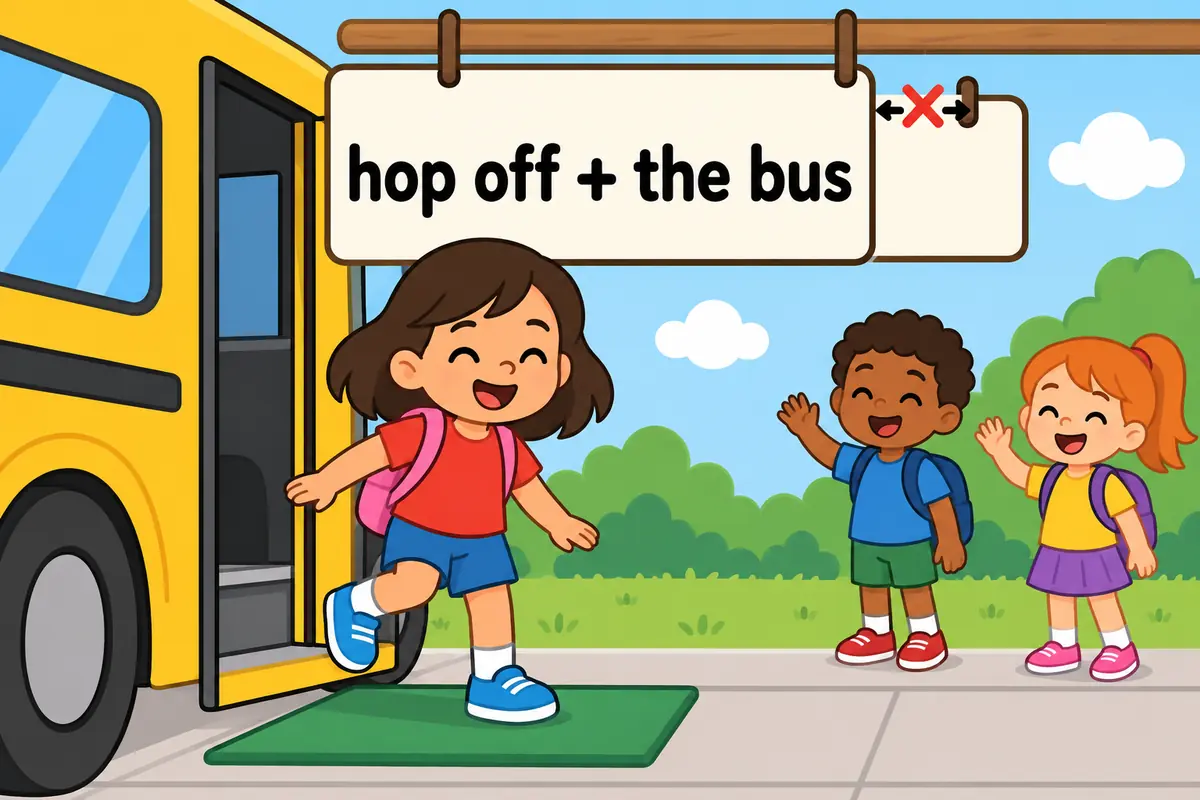
Hop off in a sentence: examples across contexts
Hop off keeps its bounce while the setting changes from a holiday bus to a video game. The twelve sentences below each name what is being left and, where it matters, the speed the verb implies.
| Context | Example sentence | Why this works |
|---|---|---|
| Travel diary | We hopped off the ferry and walked straight to the old town. | A holiday register suits the light verb. |
| City directions | Hop off at the third stop and turn left. | An imperative gives brisk, friendly advice. |
| Conversation | I hopped off the bus two stops early. | Spoken use names a small decision. |
| Children’s story | The rabbit hopped off the log and vanished into the ferns. | Of an animal, the verb is literal and vivid. |
| Cycling blog | He hopped off his bike to check the tyre. | A quick dismount explains the pause. |
| Commuting note | She hopped off the train and ran for the bus. | Speed between connections is the point. |
| Sports report | The winger hopped off the turf after a heavy tackle. | Injury use stays light and non-graphic. |
| School notice | Children will hop off the coach in the school car park. | The object names the vehicle and the place. |
| Video game | Players hop off the moving platform before it tilts. | Gaming uses the verb for a timed jump. |
| Song lyric | Hop off the midnight train and meet me downtown. | The verb gives the line a spring. |
| Safety leaflet | Passengers should hop off only when the bus has fully stopped. | The word is softened by a firm condition. |
| Restaurant review | Hop off the tram right outside the door. | Practical directions keep it casual. |
Hop off vs get off
Hop off and step off the kerb both describe leaving a surface, yet only hop off insists on a bounce. To jump off the wall carries more force and height than a simple hop, so the three verbs sit on a scale of energy.
| Attribute | hop off | get off |
|---|---|---|
| Core job | Leave quickly and lightly | Leave, at any speed or mood |
| Register | Informal and lively | Neutral, usable anywhere |
| Implied speed | Fast and bouncy | Unstated |
| Works in notices | Rarely | Yes |
| Typical object | A bus, train, bike or ledge | Anything you were on |
| Feel | Cheerful and small | Plain and functional |
Verdict: choose get off for notices, instructions and formal writing, and hop off when the sentence should sound quick, easy and a little cheerful.
Word forms and grammar of hop off
Hop off inflects like the base verb hop, and the particle stays fixed throughout. The table also lists the double preposition that appears in careless speech, because off of repeats the idea.
| Form | Part of speech | Example |
|---|---|---|
| hop off | phrasal verb, base form | We can hop off here. |
| hops off | third person singular | He hops off the wall easily. |
| hopped off | past and past participle | They hopped off the bus together. |
| hopping off | present participle | She is hopping off before the terminus. |
| hop off it | non-standard variant | Incorrect: Please hop off it now. |
| off of | non-standard double preposition | Incorrect: He hopped off of the bus. |
To leave the platform names the departure without saying how the feet moved, and to exit the coach is the neutral sign-and-notice word for the same action.
Common mistakes with hop off
- Incorrect:
She hopped the bus off at the corner.Correct: She hopped off the bus at the corner. Rule: The particle stays after hop, so the vehicle follows the whole phrase. - Incorrect:
He hopped off of the train.Correct: He hopped off the train. Rule: Off already carries the sense, so off of doubles the preposition. - Incorrect:
We hop off down from the wall.Correct: We hopped off the wall. Rule: Off and down are not used together; off already means downward here. - Incorrect:
The pilot hopped off the plane in an emergency.Correct: The pilot left the plane in an emergency. Rule: Hop off implies an easy jump, so it is wrong for a serious exit. - Incorrect:
Passengers may hop off at the rear door when the bus has stopped.Correct: Passengers may leave by the rear door when the bus has stopped. Rule: Formal safety notices avoid the informal verb.
Practice using hop off
Work through the eight items, then read the reasoning rather than only the answer.
- Fill the gap: We ______ the tram one stop before the museum.
- Choose the better word: The official notice says passengers should (hop off / get off) at the rear door.
- Correct the error: He hopped off of his bike at the gate.
- Build a sentence: use hop off about a child leaving an open-top bus tour.
- Spot the register: which suits a holiday blog — we hopped off at the harbour, or we alighted from the vessel at the harbour?
- Choose the better word: The kitten (hopped off / jumped off) the low stool.
- Correct the error: She hopped the train off in a hurry.
- Rewrite more formally: Hop off at the next stop. Use alight instead.
Answers
- hopped off — the particle follows hop and the vehicle comes after the whole phrase.
- get off — a safety notice needs the neutral verb, not the informal one.
- He hopped off his bike at the gate — off of doubles the preposition.
- Model answer: The children hopped off the tour bus and ran to the beach.
- We hopped off at the harbour — a lively travel blog prefers the informal verb.
- hopped off — a low, quick jump suits hop, while jumped off suggests more height.
- She hopped off the train in a hurry — the particle must stay with hop.
- Alight at the next stop — the formal register matches a railway announcement.
Sounding natural with hop off
Hop off earns its place when the sentence is already relaxed. In travel diaries, group messages and children’s stories it makes the movement vivid without extra words, because the small jump is built into the verb. Readers hear speed and lightness at once, which is hard to achieve with get off and a chain of adverbs.
The same liveliness becomes a problem in formal settings. Timetables, safety leaflets and airport signs use get off, leave or alight, because they must be understood by every reader and cannot sound playful. A writer who needs a neutral tone should avoid hop off entirely, even if the action really was a quick jump, and let the plain verb do the work.
The bottom line
Use hop off in a sentence when someone leaves a vehicle, bike or low ledge with a quick, light movement, and keep the particle fixed after hop. The two nuances that settle most sentences are these: the verb implies an easy jump, which rules out serious or assisted exits, and it stays informal, so notices prefer get off. Where the movement is slow or deliberate, step off the kerb is the better phrase.

Frequently asked questions about hop off
Is hop off one word or two?
It is always two words, because hop is a verb and off is its particle. The pair is never written as a single word and takes no hyphen, since the phrase does not work as a compound adjective. Only the verb hop changes form, as in hops off, hopped off and hopping off, while off stays put.
What is the difference between hop off and get off?
Both mean to leave a vehicle or surface, but hop off adds a quick, light bounce. Get off is neutral and fits every speed and every setting, including formal notices. Hop off is informal and slightly cheerful, so it suits conversation and travel writing rather than announcements or safety instructions.
Can you hop off a bike?
Yes, hop off a bike is standard and natural, and it usually means a quick dismount to pause or check something. The phrase treats the bike as the thing left, so the pattern is hop off the bike or hop off your bike. More formal writing may prefer dismount instead, especially in technical or safety contexts.
Does hop off need an object?
Not always. The verb can stand alone in a short instruction such as hop off, which means get off here. When an object is present it names what the person leaves, as in hop off the bus or hop off the wall. The particle always comes before that object, so it never splits across the phrase.