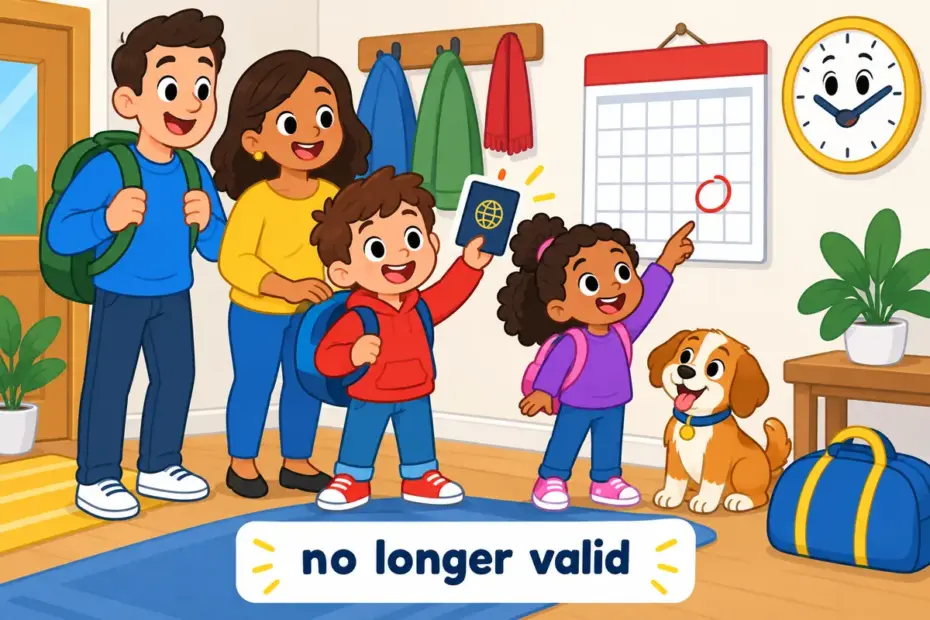
Expire means to reach the end of a valid period, so a passport, contract or password expires when it stops working. To use expire in a sentence, make the document or period the subject: “My library card expires next month.” The verb is intransitive, so it takes no object, and in formal writing it also means to die.
Expire at a glance
- Expire is an intransitive verb meaning to lose validity or come to an end.
- Its forms are expire, expires, expiring and expired, with the nouns expiry and expiration.
- The dominant pattern is a document, licence or period plus expire, usually with a date.
- It also means to die, but only in very formal, legal or literary writing.
- In technical writing it means to breathe out, the opposite of inhale.
- The commonest error is making it transitive, as in expire the contract.
What does expire mean?
Expire is a verb meaning to come to the end of a period of validity, or more broadly to come to an end. The Cambridge Dictionary entry for expire lists the validity sense first and adds the formal sense of dying and the technical sense of breathing out. The first sense is the one almost every everyday sentence needs.
| Sense | Plain meaning | Example sentence |
|---|---|---|
| Lose validity | Stop being legally or officially usable | My passport expires at the end of June. |
| Come to an end | Reach the end of a fixed period | The lease expires at midnight on Friday. |
| Die (formal) | Pass away, in legal or literary use | The patient expired peacefully at dawn. |
| Breathe out (technical) | Exhale air from the lungs | Breathe in slowly, then expire through the mouth. |
One honest limitation is worth stating. In everyday English the verb almost always belongs to documents, cards, offers, subscriptions and time limits, not to people. The sense to die is correct but sounds cold and legal, so a newspaper would say died or passed away. Keep the dying sense for wills, medical notes and historical prose, and let a card or a contract do the expiring everywhere else.
How do you use expire in a sentence?
Expire is intransitive, so the thing that runs out is the subject and nothing follows the verb. The five patterns below move from the plain present to the adjective-like expired and the completed have expired.
| Pattern | Example | What it signals |
|---|---|---|
| document + expire (+ date) | Her visa expires in September. | The plain pattern, with a concrete deadline. |
| expire + at / on | The discount expires on Friday. | Pins the end point to a day or hour. |
| period + expire | The trial period expires after thirty days. | An abstract span runs out. |
| be expired | The milk is expired, so pour it away. | Uses expired like an adjective in everyday speech. |
| have / has expired | My subscription has expired. | Shows the ending is already complete. |
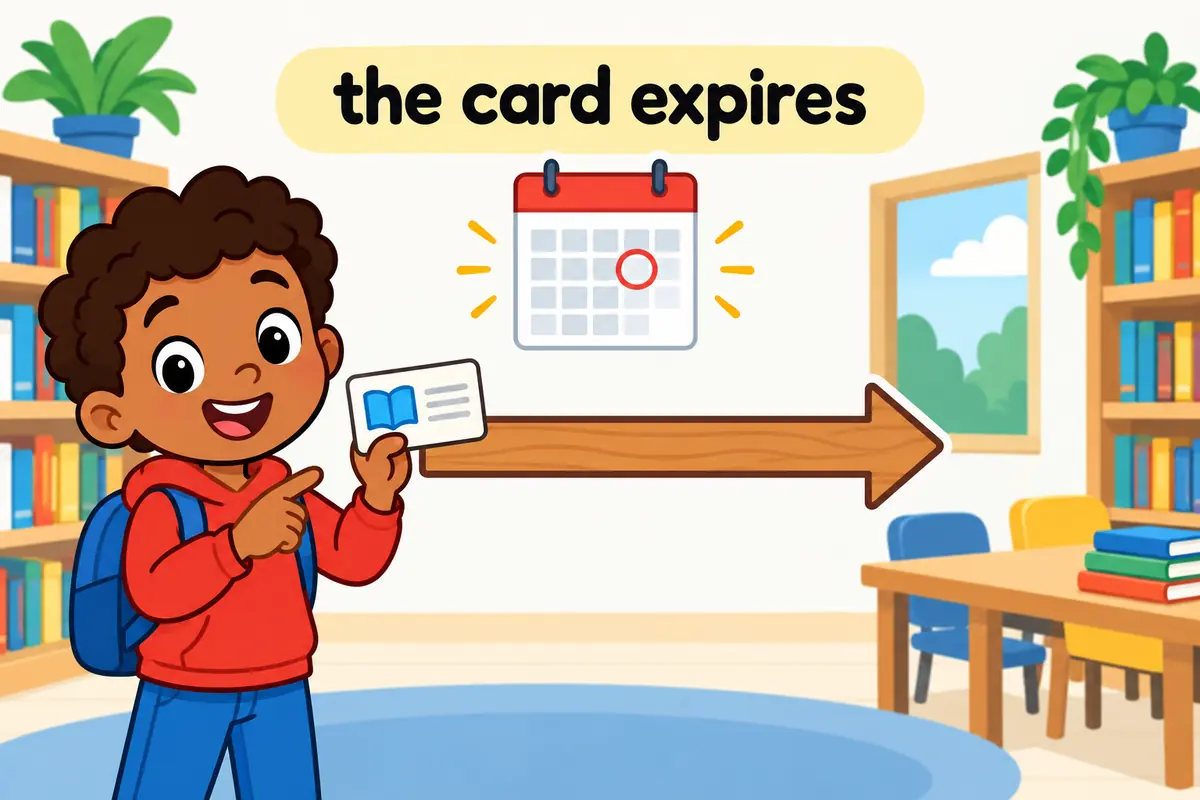
Expire in a sentence: examples across contexts
Expire keeps its meaning of running out, but the subject changes with the setting, from a passport counter to a hospital note. Each row names the context and why the sentence works.
| Context | Example sentence | Why this works |
|---|---|---|
| Classroom | The reading challenge ends when the term expires. | Uses a period, not a person, as the subject. |
| Workplace email | Your building pass expires on 31 March, so please renew it. | Names the deadline and the action needed. |
| News report | The ceasefire expires tonight unless both sides agree to extend it. | Applies the verb to an agreement with high stakes. |
| Everyday conversation | My gym membership expired months ago. | Natural spoken past tense with no object. |
| Travel writing | Check that your passport does not expire within six months. | States a real rule of entry in a plain command. |
| IT support page | Your password expires every ninety days. | Sets a recurring limit for a system. |
| Legal writing | The option expires if it is not exercised in writing. | Formal register with a condition attached. |
| Medical note | The patient expired at 4 a.m. despite treatment. | The formal sense of dying in its proper register. |
| Science textbook | Mammals inspire air and then expire it. | The technical sense of breathing out. |
| Food label | Use the cheese before the printed date expires. | Ties the verb to a visible deadline. |
| Subscription page | Your free trial has expired, but you can subscribe now. | Completed action with a clear consequence. |
| Contract summary | The warranty expires two years after purchase. | Fixes a period from a starting event. |
| Banking app | The one-time code expires after sixty seconds. | Shows a very short validity window. |
| Insurance policy | Cover expires unless the premium is paid on time. | Attaches a condition to the ending. |
Expire vs aspire, exile and lapse
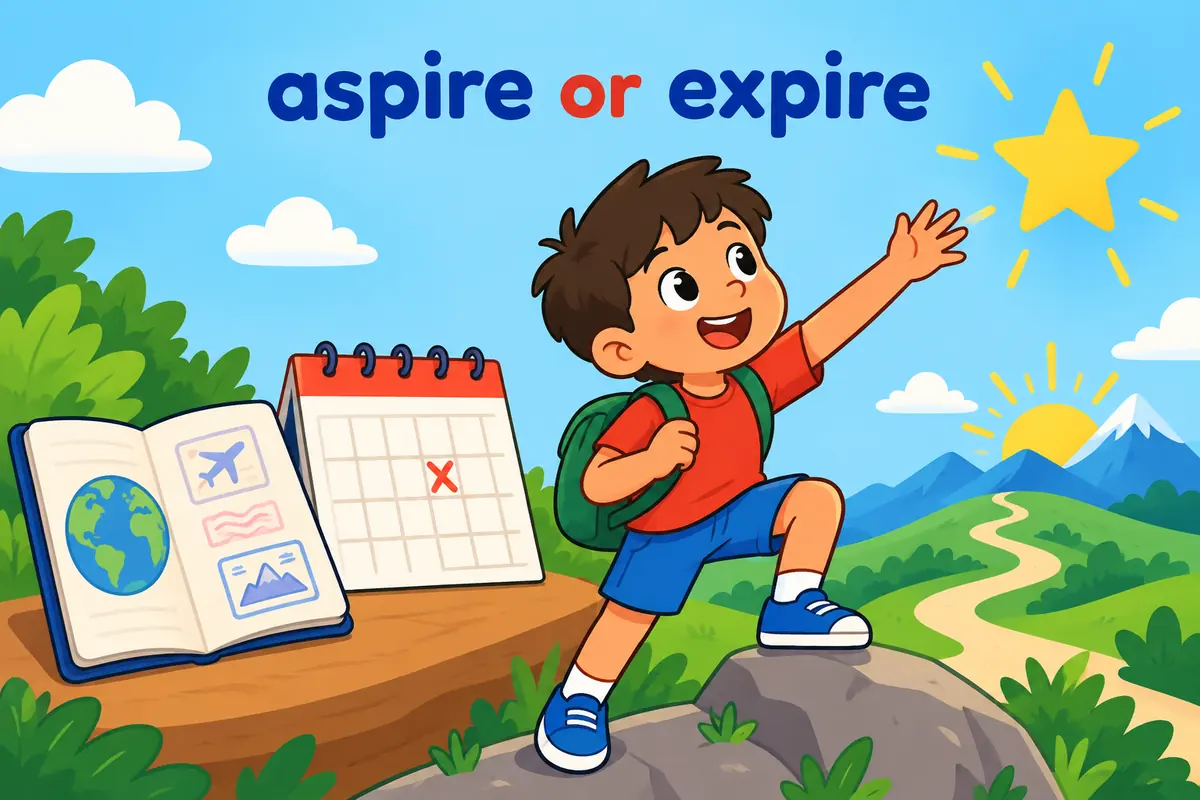
Expire is confused with two words that look similar and one verb with a comparable meaning. Aspire means to hope for something, exile means to force someone out of a country, and lapse means to end quietly because a renewal was missed.
| Attribute | expire | aspire | exile |
|---|---|---|---|
| Core meaning | Reach the end of validity | Hope or aim for something | Force someone out of a place |
| Part of speech | intransitive verb | intransitive verb | verb or noun |
| Typical subject | A card, contract or period | A person and an ambition | A ruler, government or authority |
| Common frame | expires on a date | aspire to do something | be exiled from a country |
| Register | Everyday to formal | Formal | Formal and political |
The verdict is easy once the meanings are clear: expire for a deadline, aspire for ambition, and exile for banishment. Where the ending is quiet and caused by neglect rather than a fixed date, the better word is lapse, as in a membership that lapsed when the renewal was forgotten.
Word forms and grammar of expire
The verb is regular, and its two nouns differ by region and register. The table also records the form learners try to build and should avoid.
| Form | Part of speech | Example |
|---|---|---|
| expire | verb, base form | Cards expire at the end of the month. |
| expires | verb, third person singular | The offer expires tomorrow. |
| expiring | verb, present participle | He renewed the expiring licence. |
| expired | verb, past and past participle | The ticket expired last night. |
| expiration / expiry | noun | Check the expiration date on the label. |
| expire (transitive) | non-standard use, avoid | Say let the contract expire or end the contract. |
British English favours expiry and American English favours expiration, though both are understood everywhere. A useful test is to ask who ends the thing: if a date ends it, the document expires; if a person ends it on purpose, a transitive verb such as cancel or terminate is needed. The verb also sits in a family of endings: things cease, elapse or terminate, each with a slightly different subject.
Common mistakes with expire
- Incorrect:
The company expired my contract.Correct: The company let my contract expire. Rule: Expire is intransitive, so it cannot take an object. - Incorrect:
My passport will be expire in June.Correct: My passport will expire in June. Rule: Do not add be before the base verb; use the simple future or the participle. - Incorrect:
I need to expire my membership.Correct: I need to cancel my membership. Rule: A person cancels; a membership expires by itself. - Incorrect:
My grandfather expired last year.Correct: My grandfather passed away last year. Rule: In everyday writing the dying sense sounds cold; keep it for legal prose. - Incorrect:
The deadline has been expired for a week.Correct: The deadline expired a week ago. Rule: The verb describes an event, so the passive be expired is wrong here. - Incorrect:
I will expire my old password.Correct: My old password will expire, or I will change it. Rule: The password is the subject, not the object of expire.
Practice using expire
- Fill in the blank: My travel card ______ at the end of the year.
- Choose the better word: The young dancer (aspired / expired) to join the company.
- Correct the error: The council expired the parking permit.
- Build a sentence: use has expired about a subscription.
- Spot the register: which suits a serious medical note – the patient expired at dawn, or my grandad expired at dawn?
- Fix the form: The warranty will be expired in March.
- Choose the word: Her gym membership quietly (lapsed / expired) when she forgot to renew it.
Answers
- expires — the card is the subject and the deadline is present.
- aspired — to hope for a place is aspire, not expire.
- The parking permit expired — expire cannot take the council as its subject and the permit as object.
- Model answer: My streaming subscription has expired, so the shows will not play.
- The patient expired at dawn — the dying sense belongs to formal medical writing.
- The warranty will expire in March — drop be and use the simple future.
- lapsed — neglect, not a fixed date, ended it, which is the quiet ending lapse describes.
The bottom line
Use expire in a sentence when a document, card, subscription or period reaches the end of its validity, and make that thing the subject because the verb is intransitive. The two facts that decide most sentences are that expire never takes an object, so you let a contract expire rather than expire it, and that the sense to die belongs only to formal and legal writing. Where the ending comes from neglect rather than a set date, lapse is the more precise verb.
Frequently asked questions about expire
Does expire mean die?
It can, but only in formal, legal or literary writing. The everyday meaning of expire is to lose validity, as a passport or a contract does. The dying sense sounds cold in ordinary conversation, so most writers use died or passed away outside wills, medical notes and historical prose.
Is expire a transitive verb?
No. Expire is intransitive, so it never takes an object. A contract expires, a card expires, and a period expires. If you want a transitive verb, use cancel, end or terminate: a company ends a contract, but the contract is what expires. This is the error that marks learners most clearly.
What is another word for expire?
Run out, lapse, end and terminate are the nearest alternatives, and cease works for formal writing. Lapse suggests an ending caused by neglect, run out is the everyday spoken choice, and terminate is the most formal and often transitive. Each changes the subject and the tone slightly, so match the word to the sentence.
What is the difference between expire and aspire?
Expire means to reach the end of a valid period, while aspire means to hope or aim for something. They look alike but share no meaning: a visa expires, and a student aspires to a place at university. The pair trips up spellers because both end in -pire and appear in similar positions in a sentence.