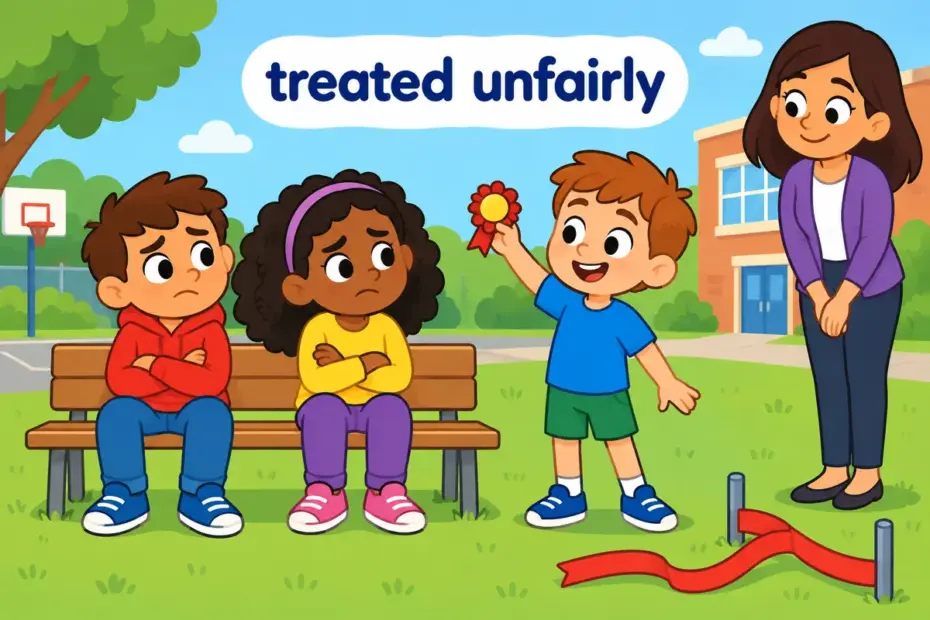
Aggrieved describes someone who feels wronged or unfairly treated and quietly resents it. To use aggrieved in a sentence, name the person and the treatment that caused the hurt: “The aggrieved tenants demanded a refund.” The adjective usually follows be or a noun, and it signals a grievance rather than simple sadness.
Aggrieved at a glance
- Aggrieved is an adjective meaning resentful because of unfair treatment.
- It describes both a feeling and, in law, a person whose rights have been harmed.
- The usual patterns are be aggrieved by something and be aggrieved at something.
- Its commonest partners are party, employee, tenant, customer and voter.
- The commonest error is treating it as a synonym for sad; aggrieved always implies a complaint.
What does aggrieved mean?
Aggrieved is an adjective meaning resentful because you believe you have been treated unfairly. The Cambridge entry for aggrieved leans on the feeling of having been wronged, and the Merriam-Webster entry adds the settled legal sense of a person whose rights are adversely affected. The two senses sit side by side because both turn on an injury that somebody refuses to accept.
| Sense | Plain meaning | Example sentence |
|---|---|---|
| Resentful feeling | Hurt and annoyed at unfair treatment | She felt aggrieved at being passed over twice. |
| Formal grievance | Having a complaint one intends to pursue | The aggrieved employee filed a formal complaint. |
| Legal status | A person whose legal rights have been harmed | The court heard the aggrieved party first. |
One limitation is worth stating plainly. Aggrieved is not a neutral word for sadness or disappointment, because it always assigns blame. A runner can be disappointed without being aggrieved; a runner is aggrieved only when the result feels unfair. Where no unfairness is claimed, unhappy or disappointed is the honest choice.
How do you use aggrieved in a sentence?
Put the person first and the unfair treatment after a preposition. Four patterns cover almost every real sentence, and the pattern with by is the one that appears most often in formal and legal writing.
| Pattern | Example | What it signals |
|---|---|---|
| be aggrieved by + noun | Residents were aggrieved by the sudden closure. | The standard formal pattern; the cause follows by. |
| be aggrieved at + noun or -ing | He was aggrieved at being ignored. | Slightly more personal and common in speech. |
| aggrieved + noun | The aggrieved customer asked for a manager. | Attributive use before a person or group. |
| feel aggrieved | She felt aggrieved for weeks afterwards. | Reports the emotion without naming a legal claim. |
A precise writer chooses aggrieved when the sense of injustice is the point. If the sentence only needs displeasure, a plainer adjective such as annoyed or unhappy avoids implying that a wrong has been done. That distinction is the whole reason the word exists.
Aggrieved in a sentence: examples across contexts
The word moves easily from a playground to a tribunal because the feeling and the formal claim share a shape. The ten sentences below shift register while keeping the sense of unfair treatment.
| Context | Example sentence | Why this works |
|---|---|---|
| Classroom | The aggrieved pupil complained that the group never chose her. | Uses a child as the wronged person without overstating it. |
| Workplace email | Two aggrieved staff members asked for the rota to be reviewed. | Names a formal grievance inside a calm request. |
| News report | Aggrieved commuters demanded refunds after the timetable failed. | Compresses a group complaint into a single adjective. |
| Customer service | The aggrieved caller wanted an apology, not a voucher. | Shows the hurt behind the demand. |
| Legal writing | The aggrieved party must file within twenty-eight days. | Uses the settled legal noun phrase. |
| Academic prose | Aggrieved workers were more likely to join the union. | Treats the group as a subject for observation. |
| Sports commentary | The aggrieved striker felt the referee had cost his team the match. | Links the feeling to a specific decision. |
| Conversation | He looked aggrieved when nobody thanked him. | The feel pattern survives easily in speech. |
| Letter of complaint | I remain aggrieved by the delay in answering my letters. | Formal, first person, names the cause with by. |
| Diplomatic report | The aggrieved government recalled its ambassador. | Raises a grievance to the level of state business. |
Only the letter and the conversation use the first person, which is the clearest signal of where the adjective lives. In the middle registers, the writer keeps the aggrieved person at a measured distance and lets the cause carry the emotion.
Aggrieved vs disgruntled
Aggrieved and disgruntled both describe unhappiness, but only aggrieved claims that a wrong was done. A disgruntled worker is generally dissatisfied; an aggrieved worker believes the treatment was unfair and expects it to be corrected.
| Attribute | aggrieved | disgruntled |
|---|---|---|
| Core meaning | Wronged and resentful | Dissatisfied and in a bad mood |
| What it implies | A specific unfair act | General unhappiness |
| Typical trigger | Being passed over, ignored or overcharged | Poor service, long shifts, low pay |
| Register | Formal to legal | Neutral, common in journalism |
| Typical subject | A person, party, tenant or employee | A worker, customer or voter |
| What it invites | A complaint or remedy | A grumble or a change of habit |
Verdict: choose aggrieved when someone has been wronged and wants redress, and disgruntled when a group is simply fed up; the first names an injury, the second a mood. Where the anger is hot and moral, indignant is often sharper still.
How is aggrieved used in law?
In legal English, aggrieved is a term of art rather than a feeling. A person aggrieved, or an aggrieved party, is someone whose legal rights or interests have been harmed, which gives that person the standing to appeal or sue.
| Legal phrase | What it means | Example sentence |
|---|---|---|
| the aggrieved party | The side that suffered the harm | The aggrieved party sought damages. |
| a person aggrieved | A fixed phrase granting standing to appeal | Only a person aggrieved may bring the appeal. |
| the aggrieved | A collective noun for those harmed | The fund was set up to compensate the aggrieved. |
The legal phrase is fixed, so writers keep the word order and never say an aggrieved of the ruling. Getting the phrase right matters because standing decides who may be heard.
Word forms and grammar of aggrieved
Aggrieved is the past participle of the verb aggrieve, used as an adjective. The verb itself is formal and rare in modern speech, which is why learners meet the adjective first.
| Form | Part of speech | Example |
|---|---|---|
| aggrieve | verb, formal | The ruling aggrieved thousands of small savers. |
| aggrieved | adjective, past participle | The aggrieved neighbour wrote to the council. |
| aggrievedly | adverb, rare | She answered aggrievedly that the fault was not hers. |
| grievance | noun, related | The team filed a grievance about the rota. |
| aggrievedness | noun, non-standard | Writers prefer a sense of grievance to this heavy noun. |
The related noun most learners need is not a form of aggrieved at all but aggrieve, the formal verb behind the adjective; the complaint itself is a grievance. Keeping those two apart solves most of the confusion around this family.
Common mistakes with aggrieved
- Incorrect:
The aggrieved flower wilted in the heat.Correct: The unhappy flower wilted in the heat. Rule: Aggrieved needs a person or group that can feel a wrong, not a plant. - Incorrect:
She was aggrieved about the weather.Correct: She was annoyed about the weather. Rule: Aggrieved claims unfair treatment; weather is nobody’s fault. - Incorrect:
The workers were aggrieved with the new manager.Correct: The workers were aggrieved by the new manager’s decision. Rule: Name the unfair act, and let by introduce it. - Incorrect:
He felt aggrieved of being left out.Correct: He felt aggrieved at being left out. Rule: The adjective takes at or by, never of. - Incorrect:
The aggrieved was asked to leave.Correct: The aggrieved party was asked to leave. Rule: Use the full legal phrase, or a noun such as person or customer.
Practice using aggrieved
Work through the seven items, then check the reasoning as well as the answer.
- Fill the gap: The ______ taxpayer argued that the fine was unfair.
- Choose the better word: After the mix-up she felt (aggrieved / unhappy) because the fault was clearly the hotel’s.
- Correct the error: The team was aggrieved of the selection process.
- Build a sentence: use be aggrieved by about a neighbour whose tree was cut down without warning.
- Spot the register: which belongs in a tribunal filing — the aggrieved party seeks a review, or they’re pretty upset about it?
- Rewrite in the legal phrase: The council’s error harmed several residents. Use the aggrieved.
- Choose the preposition: The customer was aggrieved (at / of) being charged twice.
Answers
- aggrieved — the taxpayer believes the fine is unfair, which is a grievance.
- aggrieved — the hotel was at fault, so a wrong is being claimed.
- The team was aggrieved by the selection process — the adjective takes by, not of.
- Model answer: The neighbour was aggrieved by the removal of the tree without any notice.
- The aggrieved party seeks a review — a filing keeps formal wording and the fixed phrase.
- The fund was set up to compensate the aggrieved — the phrase names those harmed as a group.
- at — aggrieved takes at before an -ing or event, and by before the person or act.
The bottom line
Use aggrieved in a sentence when someone has been treated unfairly and resents it, and name the unfair act after by or at. The two nuances that decide most sentences are these: the word always implies a wrong, so it cannot stand in for ordinary sadness, and in legal writing it becomes a fixed phrase that gives the aggrieved party standing to act. Where the anger is hot and moral rather than quietly resentful, resentful or indignant carries the tone better.
Frequently asked questions about aggrieved
Is aggrieved a formal word?
Aggrieved works in formal, journalistic and legal writing, and it also appears in ordinary speech when the sense of injustice matters. In casual conversation people often say annoyed or hard done by instead. A text message that reads I am aggrieved can sound stiff, while a complaint letter uses it naturally.
What is the difference between aggrieved and indignant?
Aggrieved describes a lasting sense of having been wronged, while indignant describes a flash of anger at something unfair or mean. A person can be aggrieved for months about a lost promotion, yet indignant for a moment at a rude remark. The two overlap, but indignant is hotter and usually shorter.
Can aggrieved describe a whole group?
A whole group can be aggrieved, and the plural noun phrase the aggrieved names those who were harmed. In legal writing the fixed phrase the aggrieved party usually refers to one side in a dispute. In news reports, phrases such as aggrieved residents summarise a collective complaint in two words.
What is the noun form of aggrieved?
Aggrieved is an adjective, so the related noun is grievance for the complaint and aggrievedness only in rare, non-standard use. Speakers who want to name the people simply say the aggrieved or the aggrieved party. When the sense is the feeling itself, a sense of grievance is the natural choice.