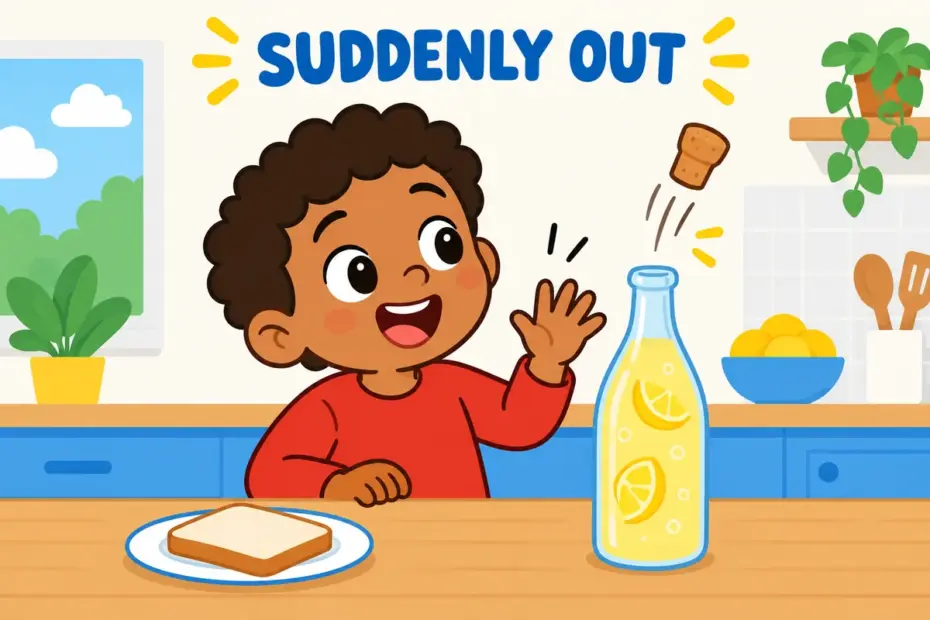
Pop out means to come out suddenly, to leave a place briefly, or to stand out clearly against a background. To use pop out in a sentence, make the subject the thing that emerges and keep the particle attached: “The cork popped out with a bang.” The verb is intransitive in this sense, so nothing is popped by anyone.
Pop out at a glance
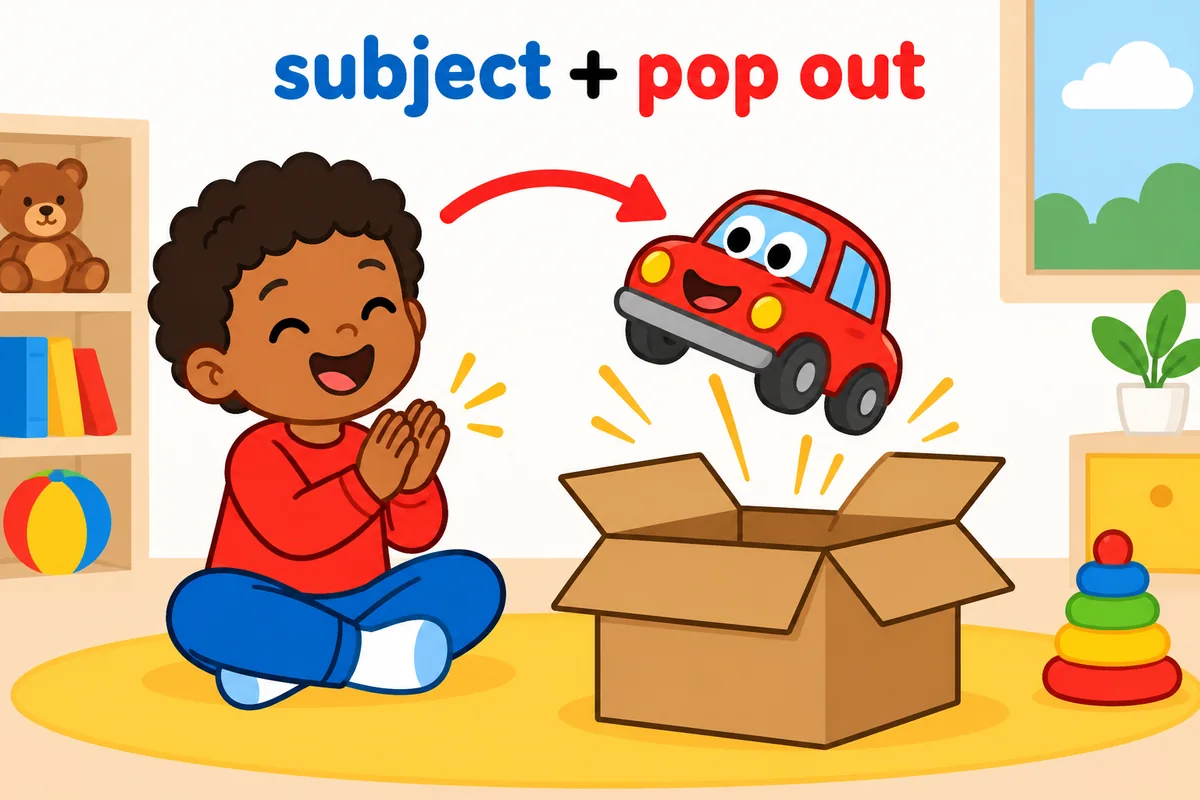
- Pop out is an intransitive phrasal verb: the thing that emerges is the subject.
- Its three senses are a sudden emergence, a short absence, and standing out visually.
- The verb inflects as pops out, popped out and popping out.
- Usual subjects are corks, buttons, notifications and brightly coloured shapes.
- The commonest learner error is confusing pop out with pop off.
What does pop out mean?
Pop out is a phrasal verb meaning to emerge suddenly, to leave briefly, or to be immediately noticeable. The Cambridge entry for pop out records the physical sense of coming out with a short, sudden movement. A sentence built on pop out names the thing that moves, and a form of appear fits when the movement is calm: a notification can appear slowly, but it pops out only when it arrives at once. The motion is brief by default, so a thing that stays out of its container for hours has protruded rather than popped out.
| Sense | Plain meaning | Example sentence |
|---|---|---|
| Emerge suddenly | Come out with a quick, short movement | The cork popped out of the bottle. |
| Leave briefly | Go out for a short time | I am popping out to the shop. |
| Stand out | Be immediately noticeable | The yellow sign pops out against the grey wall. |
How do you use pop out in a sentence?
The particle out stays next to pop in the intransitive sense, so the subject carries the action. The transitive pattern pops something out also exists for removing a part quickly, and there the object may sit between the verb and the particle. The verb emerge is the formal single-word alternative when the tone must stay neutral.
| Pattern | Example | What it signals |
|---|---|---|
| pop out + of + place | The flash drive popped out of the port. | movement out of something |
| pop out (no object) | A message popped out on her screen. | a sudden appearance |
| pop out + for + purpose | He popped out for milk. | a short errand |
| pop out + against + background | The logo pops out against navy. | visual contrast |
| pop out + at + person | The error pops out at any proofreader. | immediate noticeability |
Pop out in a sentence: examples across contexts
| Context | Example sentence | Why this works |
|---|---|---|
| Kitchen accident | The cork popped out of the bottle and hit the ceiling. | A sudden release of pressure is the core physical sense. |
| Phone notification | A message popped out at the top of her screen. | Digital items appear abruptly, so the phrasal verb fits. |
| Home chat | I am just popping out for bread and will be back in ten minutes. | The short-absence sense marks a quick errand. |
| News report | The hatch popped out as the rescue pod surfaced. | A report uses it for a brief mechanical emergence. |
| Design review | The red icon pops out against the pale background. | Visual contrast is the third sense. |
| Children’s story | A tiny rabbit popped out of the burrow and blinked. | A concrete subject makes the verb easy for young readers. |
| Tech support | The disc tray will not pop out when you press the button. | Everyday faults are described with the intransitive form. |
| Classroom | The answer popped out before she had time to check it. | Speech pops out when it is sudden and unplanned. |
| Travel | We popped out of the hotel to watch the parade. | A short trip out of a place uses of. |
| Sports report | The ball popped out of the goalkeeper’s gloves. | Losing possession suddenly reads as an emergence. |
| Cooking show | The golden yolk popped out of the shell without a break. | A skilled action reads as a clean, quick emergence. |
| Police report | A witness popped out of the doorway and signaled the driver. | A person appearing briefly suits the informal sense. |
Across all ten contexts the verb keeps two habits. First, the thing that moves is the subject, so the sentence never needs an object in the emergence sense. Second, the event is short, which is why a routine that lasts all afternoon sounds wrong with pop out. A news report can use the verb for a hatch that opens in a second, but a door that stays open for hours has simply opened.
Pop out vs pop off
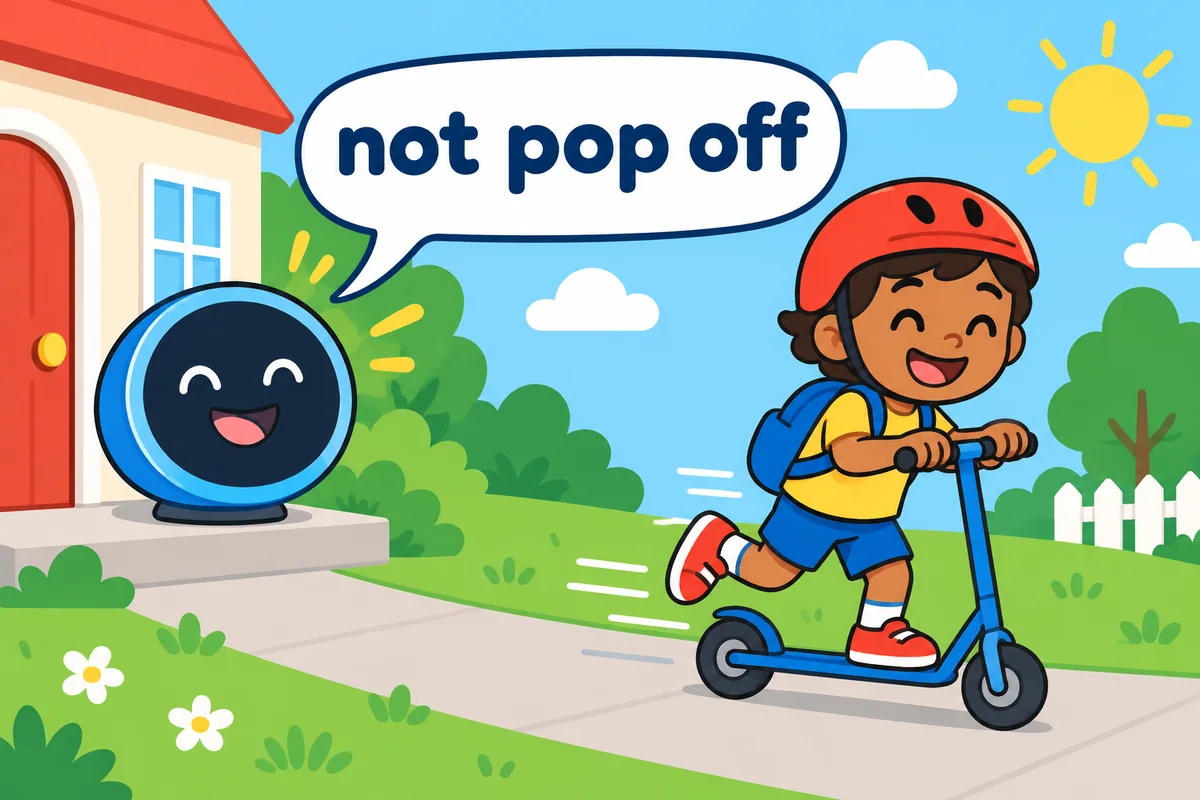
The shared base verb makes these two easy to mix, but the particle changes the meaning. Pop out centres on something emerging or on a short trip, while pop off centres on leaving quickly or on a sharp noise. The phrasal verb pop off never describes a cork leaving a bottle, and pop out never describes a shot. When a thing remains outside its container, the steady verb protrude is more exact than either.
| Attribute | Pop out | Pop off |
|---|---|---|
| Core meaning | Emerge suddenly or leave briefly | Leave quickly or make a sharp noise |
| Typical subject | Corks, messages, colours | People, engines, fireworks |
| Direction | Out of a container or toward the eye | Away from a place, often without notice |
| Register | Neutral to informal | Informal |
| What it implies | A short duration | A sudden exit or a bang |
Choose pop out for something emerging or for a brief errand, pop off for a quick departure or a bang, and protrude for a part that stays out of place.
Word forms and grammar of pop out
Only the base, the third person singular, the past and the participle are standard. A hyphenated pop-out is a compound adjective, not a verb, and a form such as pop outed does not exist in edited English. Other verbs that share the out particle, such as ask out, keep the same fixed position after the verb.
| Form | Part of speech | Example |
|---|---|---|
| pop out | phrasal verb, base | The chick will pop out of the shell. |
| pops out | phrasal verb, third person singular | The cork pops out with a small bang. |
| popped out | phrasal verb, past | A notification popped out during the meeting. |
| popping out | phrasal verb, present participle | The toast is popping out of the toaster now. |
| pop-out | compound adjective | A pop-out menu appeared beside the icon. |
| pop outed | non-standard past | Do not write this; use popped out. |
Common mistakes with pop out
Separating the particle in the intransitive sense. Incorrect: The cork popped the out. Correct: The cork popped out. Rule: an intransitive phrasal verb keeps its particle beside the verb, because there is no object to place between them.
Dropping the preposition of. Incorrect: The coin popped out the pocket. Correct: The coin popped out of the pocket. Rule: of marks the container that the moving thing leaves.
Confusing it with pop off. Incorrect: The bird popped off its cage. Correct: The bird popped out of its cage. Rule: pop off means to leave or to fire, not to emerge from a place.
Using it in formal writing. Incorrect: The findings popped out of the analysis. Correct: The findings emerged from the analysis. Rule: match the phrasal verb to the register; emerged belongs in a report.
Forgetting the third person ending. Incorrect: The cork pop out. Correct: The cork pops out. Rule: add -s for a singular subject in the present.
Using it for something that stays out. Incorrect: The bolt popped out of the wall all afternoon. Correct: The bolt protruded from the wall all afternoon. Rule: pop out marks a brief movement, and protruded describes a lasting position.
Practice using pop out
- The drawer will not ____ because the latch is stuck.
- When the magician left the stage, a dove ____ from her sleeve. (popped out / popped off)
- Correct the error: The coin popped out the pocket.
- Write a sentence about a reminder on a phone, using pop out.
- Which belongs in a formal report: The results popped out, or The results emerged?
- He popped out ____ a coffee during the break. Add the missing preposition.
- Correct the error: A pin popped out of the board for a whole week.
- Write a sentence with pop out about a rabbit leaving a burrow.
Answers
- pop out — the base form follows the modal will.
- popped out — the dove emerged from the sleeve; pop off means to leave or fire.
- Popped out of the pocket — of marks the container the coin left.
- A reminder popped out on my phone just before the meeting — the message is the subject and no object is needed.
- The results emerged — formal writing avoids the informal phrasal verb.
- for — a short errand states its purpose with for.
- A pin protruded from the board for a whole week — a lasting position takes protruded, not popped out.
- A rabbit popped out of its burrow and looked around — the rabbit is the subject and of marks the burrow.
The bottom line
Pop out in a sentence works best when the thing that emerges is the subject and the particle stays attached. Choose it for a sudden appearance, a brief errand or a bright shape that catches the eye, and keep the formal verb emerge for reports. Its opposite, vanish, covers the moment when something disappears as quickly as it arrived. The one test that settles most doubts is meaning: if nothing is emerging or drawing the eye, pop off or left is the better choice.
Frequently asked questions about pop out
Is pop out one word or two?
As a verb, pop out is written as two words. The one-word form pop-out is a compound adjective or noun, as in a pop-out window or a pop-out menu on a screen. Keep the verb open and hyphenate the compound.
Can pop out take an object?
In its central sense pop out is intransitive, so the emerging thing is the subject and no object follows. A transitive pop something out exists for removing a part quickly, as in pop the card out, where the object may sit between the verb and the particle.
What is the past tense of pop out?
The past tense is popped out, formed by doubling the final consonant before -ed. The third person singular is pops out and the present participle is popping out. Non-standard forms such as pop outed never appear in edited writing, so use popped out for every past context.
Why does pop out describe bright colours?
Pop out describes anything that catches the eye at once, so designers apply it to colours, shapes and words that contrast sharply with their surroundings. A yellow button pops out against a dark screen because the contrast makes the eye land there first.