The phrase dive in in a sentence means begin an activity eagerly or become deeply involved; literally, enter water headfirst. Its grammar depends on the intended sense: dive in. For example, “The volunteers dived in as soon as the boxes arrived.” shows dive in in a natural, complete sentence with enough context to understand the expression.
Dive In at a glance
- Part of speech: phrasal verb phrase with the base form dive in.
- Core meaning: Begin an activity eagerly or become deeply involved; literally, enter water headfirst.
- Grammar: dive in is a common construction.
- Useful contrast: begin overlaps in meaning but does not fit every sentence.
- Common learner issue: selecting the right preposition or object for the intended sense.
What does dive in mean?
Dive In is a phrasal verb meaning begin an activity eagerly or become deeply involved; literally, enter water headfirst. The choice between “dive in” and “dive into” is partly about what the sentence names. “Let’s dive in” works when the shared task is already known. “Let’s dive into the figures” names a specific object and sounds more complete when the sentence stands alone. In water contexts, “dive in” is literal.
| Sense | Plain meaning | Example |
|---|---|---|
| Begin eagerly | Start doing something with energy and little delay. | The volunteers dived in as soon as the boxes arrived. |
| Become involved | Engage deeply in a subject or activity. | She dived in to the research. |
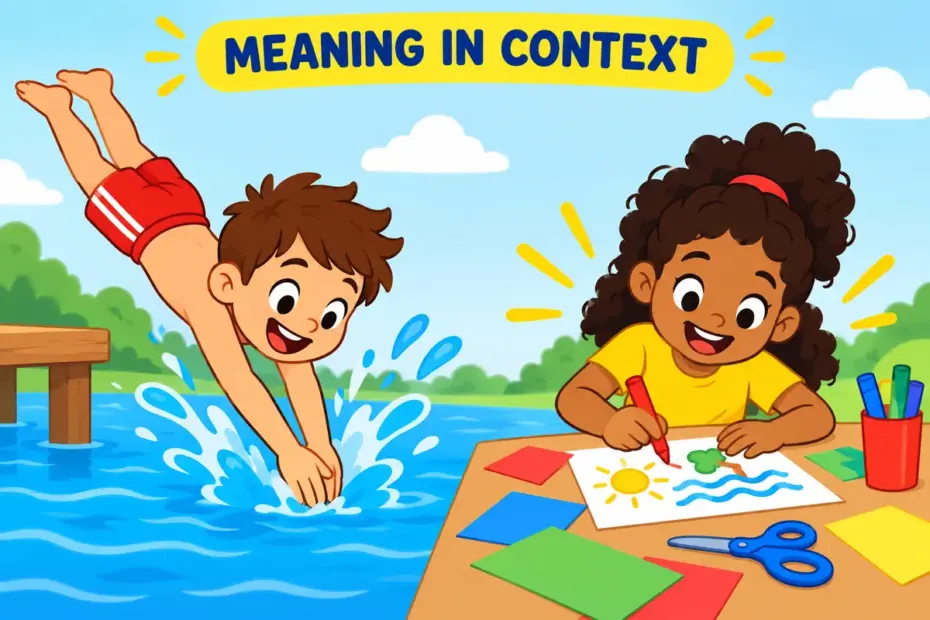
| Enter water | Jump headfirst into water. | The swimmer dived in at the signal. |
The Cambridge Dictionary: dive in supports these core meanings and patterns. Nearby vocabulary includes attack, begin, and commence; each can express a related idea, but none automatically substitutes for every sense of dive in.
How do you use dive in in a sentence?
Dive In takes different complements according to its meaning. These patterns show the particle or preposition’s job and whether a direct object is required. The choice between “dive in” and “dive into” is partly about what the sentence names. “Let’s dive in” works when the shared task is already known. “Let’s dive into the figures” names a specific object and sounds more complete when the sentence stands alone. In water contexts, “dive in” is literal.
| Pattern | Example | What it signals |
|---|---|---|
| dive in | We can dive in after the safety briefing. | In can stand alone; the task is understood from context. |
| dive in to + activity | He dived in to help with the move. | To introduces the action or purpose. |
| dive into + noun | She dived into the report. | Into takes a direct object and stresses immersion. |
| dive in + water context | The children dived in at the pool. | In refers to entering water when the setting supports it. |
It is not separable: keep the particle after the verb. It is intransitive in its usual form; say “dive into the report” when a noun names the subject matter.

Dive In in a sentence: examples across contexts
Each example gives enough surrounding detail to identify the sense. The subject, complement and preposition are part of the meaning, rather than decoration.
| Context | Example sentence | Why this works |
|---|---|---|
| Classroom | The class dived into the poem and marked unfamiliar images. | Into has the subject matter as its object. |
| Volunteer work | The volunteers dived in as soon as the boxes arrived. | The task is clear from the preceding context. |
| Meeting | After introductions, the group dived into the budget review. | The phrase signals a prompt start to substantive work. |
| Research | Mina dived into the archive to trace the family name. | Into introduces an area explored in depth. |
| Swimming | The lifeguard checked the pool before the children dived in. | The pool setting makes the literal water sense clear. |
| Cooking | We dived in and chopped vegetables while the oven warmed. | The shared task supplies the omitted complement. |
| Reading | He dived into the manual before touching the machine. | The object after into names the material studied. |
| Contrast | She began the form slowly, then dived in once the instructions made sense. | The phrase marks a change from caution to active involvement. |
Dive In vs begin
Begin is a useful comparison because it overlaps with one sense of dive in, but its grammar or emphasis differs. Choose by asking what the sentence needs to communicate.
| Feature | dive in | begin |
|---|---|---|
| Core meaning | begin an activity eagerly or become deeply involved; literally, enter water headfirst | broader or adjacent meaning |
| Typical subject/object | dive in | depends on the verb’s own pattern |
| Emphasis | the specific action or sense shown above | the related idea without the same nuance |
| Useful context | Classroom | general situations where the simpler word is enough |
| When to choose it | when the particle/preposition and context fit | when its plain meaning is the intended one |
Verdict: choose dive in when the sentence needs its specific pattern; choose begin when its broader or simpler meaning is intended.
Word forms and grammar of dive in
Use the form that matches the subject and time reference. Do not transfer the pattern of a related word automatically: the example in each row shows the form in a complete clause.
| Form | Use | Example |
|---|---|---|
| dive in | base form | We dive in after the lesson. |
| dives in | third-person present | He dives in when the task is ready. |
| dived in | past form | The volunteers dived in immediately. |
| dove in | past form variant | The children dove in at noon. |
| diving in | present participle | They are diving in to help. |
Common mistakes with dive in
These errors arise when a learner treats the particle as a separate preposition or gives the verb an object pattern it does not take.
- Incorrect:
We dived the assignment.Correct: We dived into the assignment. Rule: The subject matter needs into as its preposition. - Incorrect:
She dived in the project.Correct: She dived into the project. Rule: Use into before a noun naming the activity; in alone is possible when the activity is already understood. - Incorrect:
He dive in yesterday.Correct: He dived in yesterday. Rule: Use the past form after a completed-time expression. - Incorrect:
The team dived in the report.Correct: The team dived into the report. Rule: A report is the object of into, not a location introduced by in.
Practice using dive in
Complete each task by checking both meaning and grammar. The final two items ask for interpretation and revision, so more than one well-formed answer may be possible.
- Fill the gap: The class dived into the poem and marked unfamiliar images.
- Choose the better word, dive in or begin: “The volunteers dived in as soon as the boxes arrived.”
- Correct the error: “We dived the assignment.”
- Build a sentence that uses dive in to + activity.
- Explain the meaning in this example: “After introductions, the group dived into the budget review.”
- Rewrite this sentence more precisely: “It happened.”
Answers
- The class dived into the poem and marked unfamiliar images. — the context supplies the intended sense.
- dive in — the sentence follows the target phrase’s pattern.
- We dived into the assignment. — The subject matter needs into as its preposition.
- Model: He dived in to help with the move. — this uses the specified construction.
- The phrase signals a prompt start to substantive work. — the subject and complement signal the sense.
- Model: The volunteers dived in as soon as the boxes arrived. — the revised sentence names the subject and action.
How context changes dive in
Dive In is easiest to interpret when the sentence gives a concrete subject and complement. Compare these cases: the same phrase can look different when the actor changes, when a preposition is added, or when the sentence shifts from literal to figurative use.
- Classroom: The class dived into the poem and marked unfamiliar images. Into has the subject matter as its object.
- Volunteer work: The volunteers dived in as soon as the boxes arrived. The task is clear from the preceding context.
- Meeting: After introductions, the group dived into the budget review. The phrase signals a prompt start to substantive work.
- Research: Mina dived into the archive to trace the family name. Into introduces an area explored in depth.
- Swimming: The lifeguard checked the pool before the children dived in. The pool setting makes the literal water sense clear.
- Cooking: We dived in and chopped vegetables while the oven warmed. The shared task supplies the omitted complement.
- Reading: He dived into the manual before touching the machine. The object after into names the material studied.
- Contrast: She began the form slowly, then dived in once the instructions made sense. The phrase marks a change from caution to active involvement.
A reader should not have to guess which sense is intended. Add the object, place, time, or result that distinguishes it. For example, “The class dived into the poem and marked unfamiliar images.” names the situation; “The volunteers dived in as soon as the boxes arrived.” adds a different clue. The two sentences share vocabulary but communicate distinct details.
For a related vocabulary step, compare attack, begin, or commence only after deciding which sense of dive in is active. A synonym may fit one context and fail in another because prepositions and objects belong to particular constructions. Replacing a phrase without checking the whole clause can create a grammatical error even when the dictionary meanings overlap.
The bottom line
Use dive in in a sentence when the subject and surrounding words support the intended meaning. The most useful distinction is the choice between “dive in” and “dive into” is partly about what the sentence names. If a simpler word communicates the point more clearly, prefer it.

Frequently asked questions about dive in
Is “dive in” literal or figurative?
It can be either. In a pool setting, “dive in” may mean enter the water headfirst. In a work or study setting, it usually means begin energetically or become involved. The surrounding subject and objects distinguish the physical action from the figurative one.
Should I write “dive in” or “dive into”?
Use “dive in” when the activity is understood or when describing entry into water. Use “dive into” before a noun naming the subject or task: “dive into the book.” The two forms overlap in figurative use, but into makes the object relationship explicit.
Is “dive in” separable?
No. The phrase does not take a direct object between dive and in. Say “dive in,” or name a subject with into: “dive into the proposal.” A phrase such as “dive the proposal in” does not express the intended meaning.
What is the past tense of “dive in”?
Both dived and dove are used as past forms of dive in English. “The children dived in” and “the children dove in” are both understandable; keep the same chosen form consistently in a piece of writing. The particle in does not change.