young vs inexperienced in a sentence requires attention to its grammatical role and tone. Young describes age or a youthful stage; inexperienced describes a lack of practice or knowledge, regardless of age. The clearest example is “Young belongs in this context.” A writer can choose a plainer alternative when precision, a professional register, or a different shade of meaning matters.
Young Vs Inexperienced at a glance
- Young describes age or a youthful stage; inexperienced describes a lack of practice or knowledge, regardless of age.
- Young and Inexperienced have different grammatical jobs and are not interchangeable.
- The surrounding noun, verb pattern and context usually identify the intended sense.
- Use a more precise plain alternative when the phrase could be read in two ways.
- A common learner error is applying the phrase to a context where its grammar does not fit.
What does young vs inexperienced mean?
Young describes age or a youthful stage; inexperienced describes a lack of practice or knowledge, regardless of age. The dictionary entries Cambridge Dictionary: young and Merriam-Webster Dictionary: young document the standard senses and forms. When this expression is not the right choice, a plain term such as novice or a direct description may be clearer; it does not automatically carry every implication of its near-synonym.
| Sense | Plain meaning | Example |
|---|---|---|
| Young describes age or a youthful stage; inexperienced describes a lack of practice or knowledge, regardless of age | Young describes age or a youthful stage; inexperienced describes a lack of practice or knowledge, regardless of age. | Young Vs Inexperienced appears in a sentence that supplies its context. |
| Contextual or extended use | Meaning shaped by the surrounding subject and register | The writer chose a precise alternative when novice was clearer. |
The related page on inexperienced gives readers another useful point of comparison.The related page on young gives readers another useful point of comparison.The related page on callow gives readers another useful point of comparison.
How do you use young vs inexperienced in a sentence?
Young describes age or a youthful stage; inexperienced describes a lack of practice or knowledge, regardless of age. The grammatical frame helps a reader recognize the intended meaning; the particle or nearby noun can be decisive.
| Pattern | Example | What it signals |
|---|---|---|
| young + subject/object | The example shows young in context. | Use only with a fitting grammatical frame. |
| inexperienced in contrast | The writer chose inexperienced for a different meaning. | A neighboring alternative may change the meaning. |
| past or inflected form | The expression appeared in a past-tense sentence. | Inflect the main verb according to the subject and tense. |
| plain-language substitute | The report used a direct synonym for clarity. | A neutral alternative can suit formal writing. |
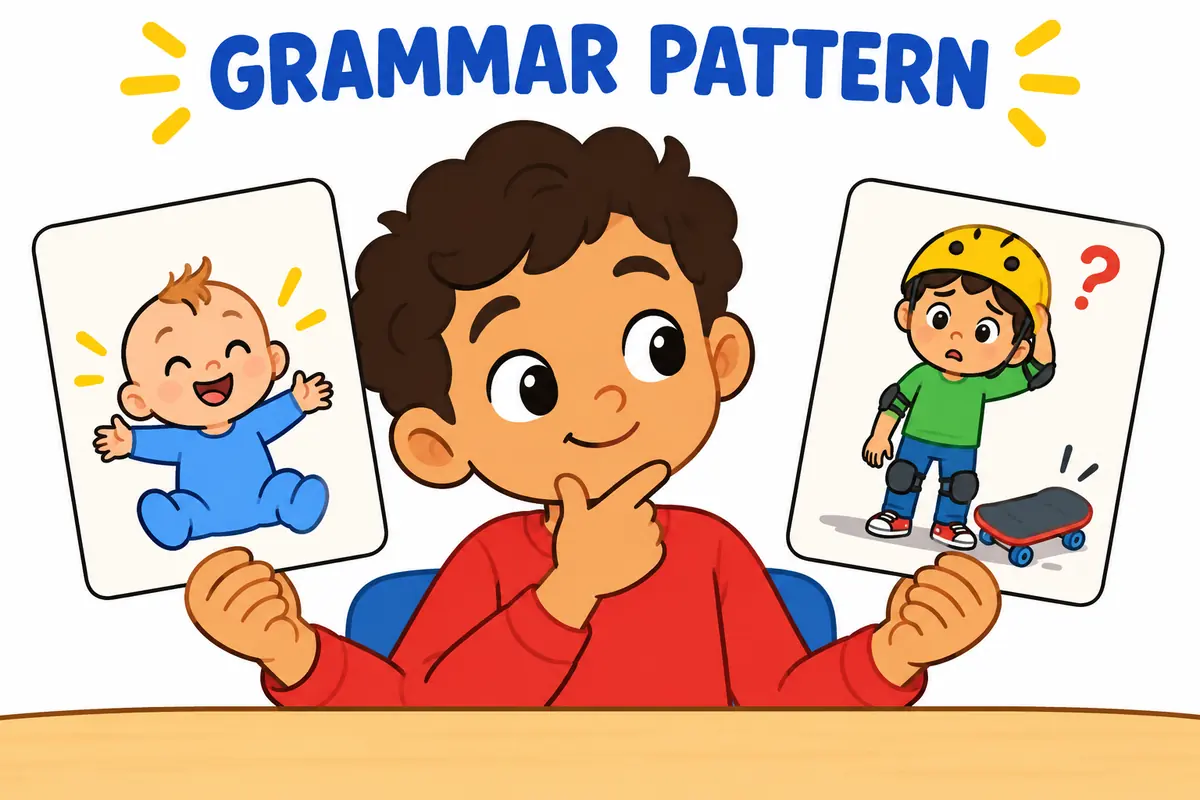
Young Vs Inexperienced in a sentence: examples across contexts
These examples vary the setting so the same expression is not mistaken for a universal fit. Register and grammatical role both affect whether a sentence sounds natural.
| Context | Example sentence | Why this works |
|---|---|---|
| Classroom | The teacher used young in a short example on the board. | The context makes the target expression’s role visible. |
| Workplace email | Please consider whether young is the precise wording for this update. | A professional reader benefits from a direct, unambiguous choice. |
| News report | The report described how young affected the people involved. | The sentence identifies a concrete situation rather than making a vague claim. |
| Technical writing | The guide explains when young applies to the process. | A technical context calls for a literal, well-defined use. |
| Conversation | “I heard someone use young yesterday,” said Noor. | Quoted speech can carry an informal tone. |
| Academic writing | The paper distinguishes young from its nearest alternative. | The comparison is explicit and supports a careful definition. |
| Home | At home, the family discussed whether young described the event. | A familiar setting makes the expression easy to interpret. |
| Editing | The editor replaced young where a more exact term was needed. | Editing considers both denotation and register. |
Young Vs Inexperienced vs novice
Young describes age or a youthful stage; inexperienced describes a lack of practice or knowledge, regardless of age. Use the comparison table to check meaning, grammar and register before substituting one word for another.
| Criterion | young vs inexperienced | novice |
|---|---|---|
| Grammar | young: adjective | inexperienced: adjective |
| Core meaning | Young describes age or a youthful stage; inexperienced describes a lack of practice or knowledge, regardless of age. | A neighboring but distinct meaning |
| Typical subject | A person, place, action or situation | A person, state or event depending on the word |
| Register | Neutral or context-marked | Neutral or context-marked |
| Can it be measured? | Depends on the specific sentence | Depends on the specific sentence |
| Best choice | When its stated meaning and grammar fit | When its distinct meaning and grammar fit |
Verdict: choose the target when its specific meaning and grammar fit, and choose novice only when that word expresses the intended idea more precisely.
Which should you use?
Choose young when age or an early stage of life is relevant. Choose inexperienced when the relevant fact is limited practice or knowledge in a particular activity. A person can be young and experienced, older and inexperienced, or any combination; the words describe separate attributes.
| Situation | Recommended wording | Reason |
|---|---|---|
| A biography gives a person’s age context | “The young composer wrote her first opera at sixteen.” | Young refers to age, not skill. |
| A new employee has not used a specific system | “He is inexperienced with this database.” | The limitation is task-specific and can change with practice. |
| A mature worker is new to a role | “The experienced engineer was inexperienced in court testimony.” | Skill in one domain does not guarantee experience in another. |
| A child performs a well-practised activity | “The young swimmer has trained for three seasons.” | Age does not imply lack of practice. |
Use the narrowest description that helps the reader understand the decision. In a hiring note, “inexperienced with the scheduling software” identifies a support need; “young” may be irrelevant and can distract from job-related evidence. In a profile of a youth orchestra, however, age may be central, while each musician’s experience is described separately.
Inexperienced is often most useful with a field or task: inexperienced at negotiating, inexperienced in laboratory work, or inexperienced with a particular tool. Without that context, it can sound like a broad judgment about a person’s competence. Specify the missing experience and avoid turning one unfamiliar task into a general label.
Young is relative to a comparison group or life stage. A young tree, a young adult and a young company refer to different timelines, so the surrounding noun matters. If an exact age affects the reader’s understanding, provide the number instead of asking “young” to do more work than it can. If the contrast is maturity rather than age, immature may be intended, but it carries a negative judgment and should not be used as a casual synonym.
Neither adjective automatically explains performance. A young player may be exceptionally skilled, while an inexperienced player may learn quickly. To describe an outcome, state observable evidence: years in the role, training completed, tasks handled or the result achieved. This keeps a description fair and makes the reason for the comparison clear.
Word forms and grammar of young vs inexperienced
| Form | Part of speech | Example |
|---|---|---|
| young | target form | The example uses young naturally. |
| inexperienced | related word | The nearby word inexperienced serves a different role. |
| inflected form | past or participle | The team used the appropriate past form. |
| neutral alternative | plain-language form | A plain alternative can clarify a formal sentence. |
Common mistakes with young vs inexperienced
- Incorrect:
Young was used as though it meant inexperienced.Correct: Young was used with its own meaning. Rule: Young and inexperienced have distinct meanings and grammatical roles. - Incorrect:
The phrase was put in a sentence without a clear subject.Correct: The sentence names the person or thing involved. Rule: Give the expression enough grammatical context to identify its subject or object. - Incorrect:
The formal report used young without checking tone.Correct: The formal report chose a precise neutral alternative. Rule: An informal or marked expression may not suit a formal document. - Incorrect:
The writer changed the verb form incorrectly.Correct: The writer matched the verb form to its subject and tense. Rule: Phrasal verbs inflect their main verb, while the particle remains unchanged.
Practice using young vs inexperienced
Try each task before checking the answer; the explanation identifies the grammatical or meaning clue.
- Fill in the blank: Choose young vs inexperienced or novice for a sentence about the intended meaning.
- Choose the better word: Complete a sentence where only young vs inexperienced fits the context.
- Correct the error: Rewrite one of the incorrect patterns above.
- Build a sentence: Use young vs inexperienced in a short workplace message.
- Spot the register: Identify which example above fits a formal report, and explain why.
- Rewrite: Replace young vs inexperienced with a clear plain-language alternative without changing the main idea.
Answers
- Use young vs inexperienced where the definition and syntax fit; the context determines the intended reading.
- Choose young vs inexperienced only if its exact meaning fits; novice expresses a different idea.
- Use the corrected construction shown in the common-mistakes section; its rule explains the repair.
- Model: The editor checked whether young vs inexperienced conveyed the intended meaning; the subject and setting make the phrase interpretable.
- The technical or academic example is most suitable because it states the point precisely and avoids casual tone.
- Choose a direct synonym that preserves the sentence’s intended action or state; do not swap words mechanically.
The bottom line
Use young vs inexperienced when its meaning and grammatical pattern fit the sentence. The strongest clue is the surrounding context, while register determines whether the expression sounds natural to the intended reader. A direct alternative is clearer when the phrase could be misunderstood.
Frequently asked questions about young vs inexperienced
What does young vs inexperienced mean?
Young describes age or a youthful stage; inexperienced describes a lack of practice or knowledge, regardless of age. Check the full sentence before choosing a substitute, because a related word may share only part of the meaning. The subject, object and setting can narrow the sense and show whether the expression sounds natural there.
Is young vs inexperienced formal or informal?
The best register depends on the expression and context. If the phrase sounds conversational, use it in dialogue or informal writing and consider a precise alternative in a report, application or technical instruction. A sentence should match the audience and the consequence of ambiguity.
What is a common mistake with young vs inexperienced?
A common mistake is treating a related word as an exact synonym or using the expression with the wrong grammatical pattern. Test the sentence by naming the subject and object, then check whether the intended meaning still holds after replacing it with a plain definition.
Can young vs inexperienced have more than one meaning?
Context can give this expression more than one reading. Read the words around it, especially its subject, object and any time or place phrase. If two readings remain possible, replace the expression with a direct verb or noun that states the intended event.