100 examples of irregular adjectives show why good becomes better rather than gooder, and why bad becomes worse rather than badder. These adjectives form the comparative and superlative with a new word instead of -er and -est. The list below pairs each form with a full example sentence.
100 examples of irregular adjectives at a glance
- Irregular adjectives build the comparative and superlative with a new word, not with -er or -est.
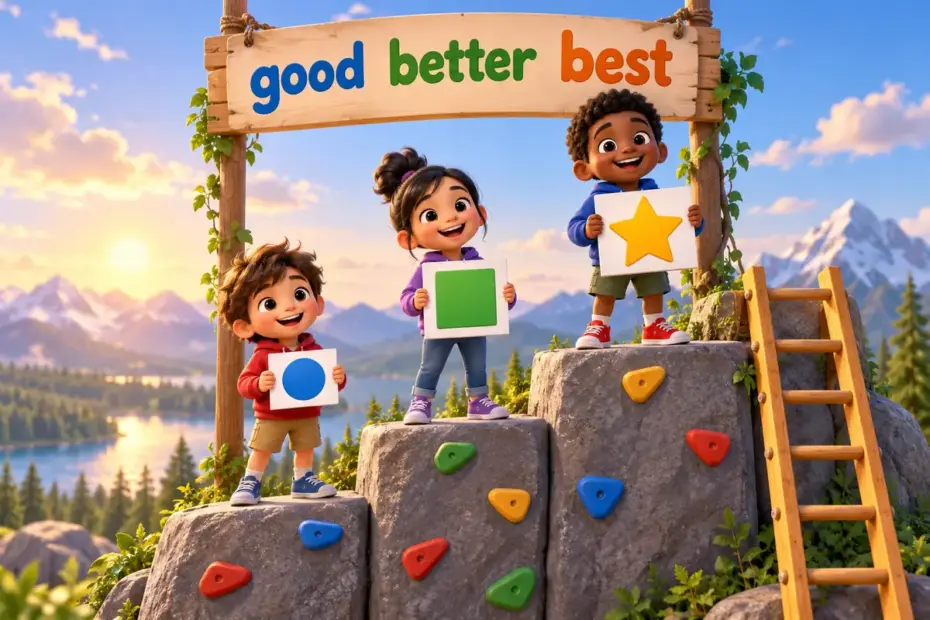
- Good becomes better and best; bad becomes worse and worst.
- Far takes either further and furthest or farther and farthest.
- Little becomes less and least, and many or much become more and most.
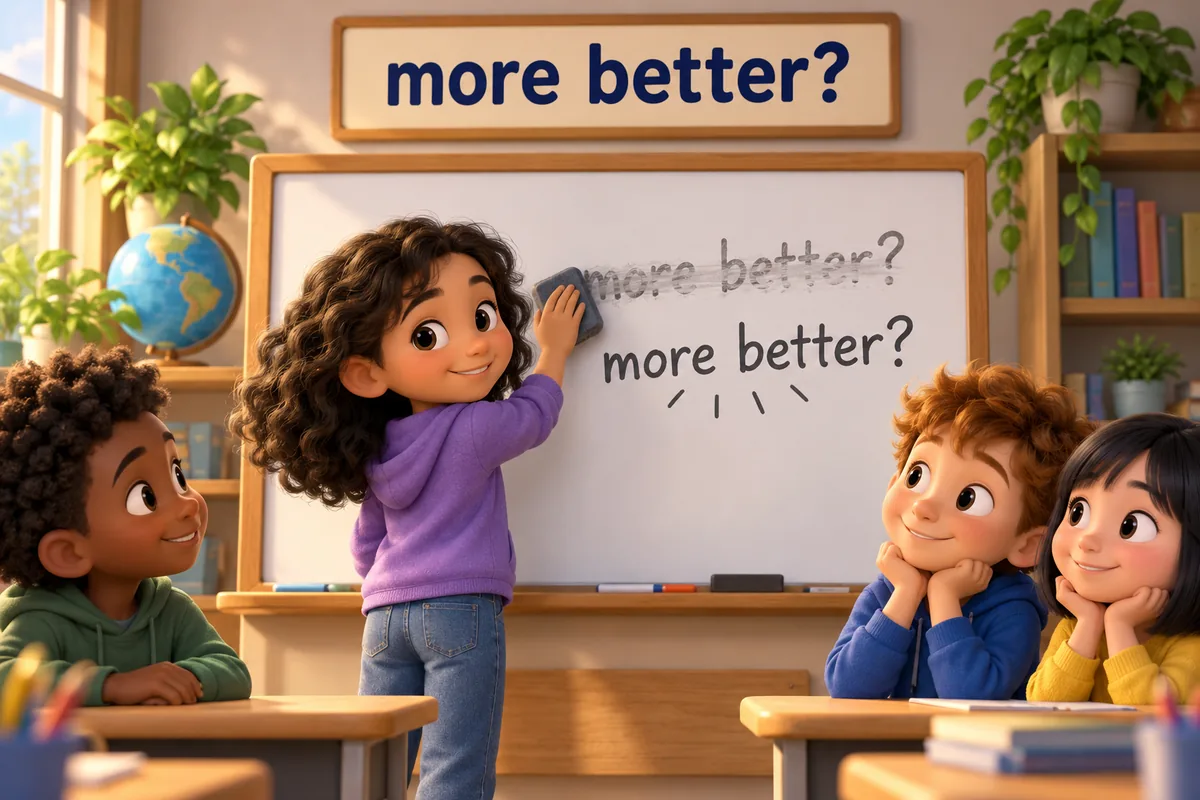
- A double comparative such as more better is always an error.
What are irregular adjectives?
An irregular adjective is an adjective whose comparative and superlative forms are different words rather than the base word with -er and -est added. Big follows the regular pattern as bigger and biggest, but good breaks it entirely, giving better and best.
English keeps this small, high-frequency set because the words are used so often that the old forms survived. Most adjectives follow the rule, so a learner meets irregulars early and reuses them constantly.
| Adjective | Comparative | Superlative | Example sentence |
|---|---|---|---|
| good | better | best | Her first idea was good, her second was better, and her third was best. |
| good | better | best | This year’s harvest is the best the village has seen. |
| bad | worse | worst | The traffic was bad, the detour worse, and the delay worst of all. |
| bad | worse | worst | That was the worst storm in a decade. |
| far | further | furthest | The far shore looked close, but the further island vanished in mist. |
| far | farther | farthest | Of the three peaks, this one stands farthest from the road. |
| little | less | least | He had little time, less patience, and the least interest in waiting. |
| little | less | least | Use the least sugar you can and taste again. |
| many | more | most | Many hands applied, more arrived later, and most stayed to the end. |
| many | more | most | She read the most books in the class. |
| much | more | most | There is not much rain here, more in spring, and most in July. |
| much | more | most | He showed the most courage of anyone that day. |
| old | older | oldest | My older cousin is the oldest of the four children. |
| old | elder | eldest | The eldest sister carried the elder brother home. |
| late | later | latest | We caught a later train but missed the latest one. |
| late | later | latest | This is the latest version of the plan. |
| well | better | best | After a week of rest she felt better and soon her best. |
| ill | worse | worst | He grew worse before he turned, and the worst day came on Friday. |
| fore | former | foremost | The foremost runner led the former champion home. |
| good | better | best | The best seats went to the earliest arrivals. |
| bad | worse | worst | A worse plan would be hard to find. |
| far | further | furthest | The furthest village has no road at all. |
| little | less | least | The least effort often brings the least reward. |
| many | more | most | Most pupils chose the more familiar story. |
| much | more | most | The most help came from the quietest helper. |
| old | older | oldest | The oldest building still stands beside the newest one. |
| late | later | latest | A later train caught the latest crowd. |
| good | better | best | A better mood made the best of a dull day. |
| bad | worse | worst | The worst choice was to wait another hour. |
| far | further | furthest | A further delay pushed the trip to its furthest point. |
The table above shows the core irregulars and repeats them across many sentences, which is how the forms stick. Learn the three columns as one triangular unit, since better almost never appears without good behind it and best behind that.
Some words sit outside the pattern entirely, and adjectives that take no comparison explains why unique has no comparative at all. Rankings rely on articles, so using the before a superlative shows why we say the best, not a best.
How do you use irregular adjectives in a sentence?
The irregular forms behave exactly like regular comparatives grammatically, so the sentence frame does not change even when the word does.
| Pattern | Example | What it signals |
|---|---|---|
| comparative + than | Her plan was better than mine. | A comparison between two things. |
| the + superlative | That was the worst answer. | One item ranked against a whole group. |
| comparative + and + comparative | The nights grew colder and darker. | A change that keeps increasing. |
| much + comparative | This route is much further. | A large difference between two options. |
| the + superlative + of | She is the eldest of the three. | A ranking inside a named group. |

Irregular adjectives in a sentence: examples across contexts
The irregular forms appear everywhere from playgrounds to reports, and the context shows how naturally they fit.
| Context | Example sentence | Why this works |
|---|---|---|
| classroom | Your second answer was better than the first. | A teacher compares two attempts directly. |
| sports report | This is the best time of the season. | A superlative ranks one result against all others. |
| weather note | The storm was worse than forecast. | A comparison measures one event against a prediction. |
| story opening | It was the worst winter the village remembered. | A superlative sets the scene for the plot. |
| shopping list | We need less sugar and more flour. | Two irregular comparatives adjust a quantity. |
| journey plan | The further road was quieter. | A comparative chooses between two routes. |
| family news | Our eldest cousin arrived first. | An irregular superlative describes a family position. |
| book review | The latest chapter is the best yet. | A superlative praises one part against the rest. |
| sick note | He felt worse in the evening. | A comparative tracks a change in condition. |
How do you choose between farther and further?
Both words are correct, and the choice depends on whether you mean physical distance or an amount of something.
| You mean | Choose | Reason |
|---|---|---|
| A physical distance | farther or farthest | The word echoes far for measured space. |
| An extra amount or degree | further or furthest | The word suits abstraction and quantity. |
| A British report or letter | further or furthest | British usage prefers further even for distance. |
| A casual American text | farther or farthest | American usage leans to farther for space. |
| A fixed phrase such as further education | further | The established phrase uses further only. |
Different forms of the same root sit together in the -ed and -ing adjective pairs, where a verb supplies two describing words.
Word forms and grammar of irregular adjectives
Irregular adjectives keep the same grammar as regular ones, and only the word changes.
| Form | Rule it breaks | Example |
|---|---|---|
| good / better / best | takes no -er or -est | A better idea is the best one. |
| bad / worse / worst | takes no -er or -est | The worst day passed. |
| far / further / furthest | has two accepted sets | The furthest town is small. |
| little / less / least | takes no -er or -est | Use less salt. |
| many / more / most | serves countable nouns | Most seats were taken. |
| old / elder / eldest | elder sits only before a noun | My elder sister called. |
Common mistakes with irregular adjectives
Nearly every error here comes from mixing a regular ending onto an irregular word.
Incorrect: This one is more better. Correct: This one is better. Rule: Irregular comparatives already carry the comparison, so more is redundant.
Incorrect: She did gooder than last time. Correct: She did better than last time. Rule: Good is irregular and never takes -er.
Incorrect: That is the baddest film. Correct: That is the worst film. Rule: Bad forms its superlative as worst, not baddest.
Incorrect: It was more worse after lunch. Correct: It was worse after lunch. Rule: The irregular comparative worse cannot take more as well.
Incorrect: My older brother is my elder by two years. Correct: My elder brother is two years older than me. Rule: Elder sits before a family noun to mark rank, not after a verb.
Practice using irregular adjectives
Answer each item, then check the reason to confirm the form.
- Fill in the blank: Of the two routes, the coast road is ________. (good)
- Fill in the blank: That was the ________ meal I have ever eaten. (bad)
- Choose the better form: The valley lies ________ from here. (farther / more far)
- Correct the error: Her singing was more better than mine.
- Build a sentence: compare two attempts at a task using better and worst.
- Spot the register: which fits a school report, She is the eldest pupil, or She is the most old pupil?
Answers
- better. Good is irregular, so the comparative is better rather than gooder.
- worst. The superlative of bad is worst, formed without -est.
- farther. Physical distance uses farther, and more far is never correct.
- Her singing was better than mine. Better already carries the comparison, so more is redundant.
- Sample: Her first try was good, her second was better, but the third was the worst of all. The three irregular forms rank the attempts.
- She is the eldest pupil. Eldest is the standard superlative for age rank in a group.
The bottom line
100 examples of irregular adjectives come down to a short, high-frequency set: good, bad, far, little, many, much, old and their relatives. Learn each set as better and best rather than by rule, drop the double comparative, and the forms will fit any sentence. Regular adjectives then handle almost everything else.
Frequently asked questions about irregular adjectives
Why are irregular adjectives irregular?
They survive from older forms of English that built comparison with different stems rather than endings. Because good and bad are used constantly, their old comparatives better and worse never faded, while rarer adjectives settled into the regular -er and -est pattern.
Is more fun or funner correct?
Most careful writers accept more fun, since fun behaves as a noun in older usage and resists -er. Funner appears in casual speech but still draws objections in formal writing. When in doubt, choose more fun, or rewrite with an adjective such as enjoyable.
Can furthest and farthest be used interchangeably?
They can in everyday speech, but the older guidance splits them: farther and farthest for physical distance, further and furthest for degree or amount. British writing often uses further for both, so both forms are safe when space is meant.
Do irregular adjectives take the and not a?
A superlative takes the before it in most sentences, so you write the best answer and the worst day. A comparative uses the only when the sentence names the comparison, as in the better of the two. The definite article marks the ranking, not the adjective.