20 examples of irregular adjectives make the strangest corner of English comparison easy to see, because each example shows a word that ignores -er and -est. Good becomes better, bad becomes worse, and far becomes further. The twenty sentences below show every form in real use.
20 examples of irregular adjectives at a glance
- Twenty examples cover the whole core set of irregular adjectives in English.
- Good, bad, far, little, many, much and old account for most of them.
- Each adjective has a comparative and a superlative built from a different word.
- Far and old each accept two correct sets, such as further and farther.
- The one rule: never add -er, -est or more to an irregular form.
What makes an adjective irregular?
An adjective is irregular when its comparative and superlative come from a different word rather than from -er and -est. Tall is regular because it gives taller and tallest, but good is irregular because it gives better and best, leaving no trace of the base inside the new form.
The set is tiny because every member is used thousands of times a day. That constant use kept the older forms alive while rarer adjectives drifted into the regular pattern, so twenty examples really do cover almost everything you need.
| Adjective | Comparative | Superlative | Example sentence |
|---|---|---|---|
| good | better | best | This is the best bread in town. |
| bad | worse | worst | The weather grew worse by noon. |
| far | further | furthest | The furthest farm has no postbox. |
| far | farther | farthest | Their house stands farther up the lane. |
| little | less | least | Add less water and even less salt. |
| many | more | most | Most guests arrived before six. |
| much | more | most | He has more patience than most. |
| old | older | oldest | My older cousin moved away last spring. |
| old | elder | eldest | My elder sister taught me to swim. |
| late | later | latest | The latest news arrived at noon. |
| well | better | best | She felt better after a short nap. |
| ill | worse | worst | He was worse on Sunday than on Saturday. |
| fore | former | foremost | She is the foremost expert in the room. |
| good | better | best | A better plan saved the whole day. |
| bad | worse | worst | That was the worst film of the year. |
| little | less | least | The least noise woke the baby. |
| many | more | most | More helpers joined the team at dawn. |
| far | further | furthest | A further step will finish the job. |
| old | older | oldest | This is the oldest tree in the park. |
| much | more | most | Much depends on the most careful reading. |
Read the table down the first column to see the base words, then across to watch each one turn into a new word. Because the twenty examples repeat a small set of roots, the forms become familiar faster than a long rule ever would.
A second family of describing words is covered in adjectives built from verbs with -ed and -ing, where one verb yields two forms. At the other extreme sit words that allow no comparative at all, since they name a complete state.
How do you use an irregular adjective in a sentence?
The grammar around an irregular adjective is identical to the grammar around a regular one, so only the word itself needs care.
| Pattern | Example | What it signals |
|---|---|---|
| comparative + than | This path is shorter than that one. | A direct comparison of two things. |
| the + superlative | She gave the best answer. | One item ranked above a group. |
| comparative + than + ever | The river is wider than ever. | A record or peak reached now. |
| much + comparative | The second test was much harder. | A large gap between two items. |
| the + superlative + in | He is the oldest in the class. | A ranking inside a named group. |
Irregular adjectives in a sentence: examples across contexts
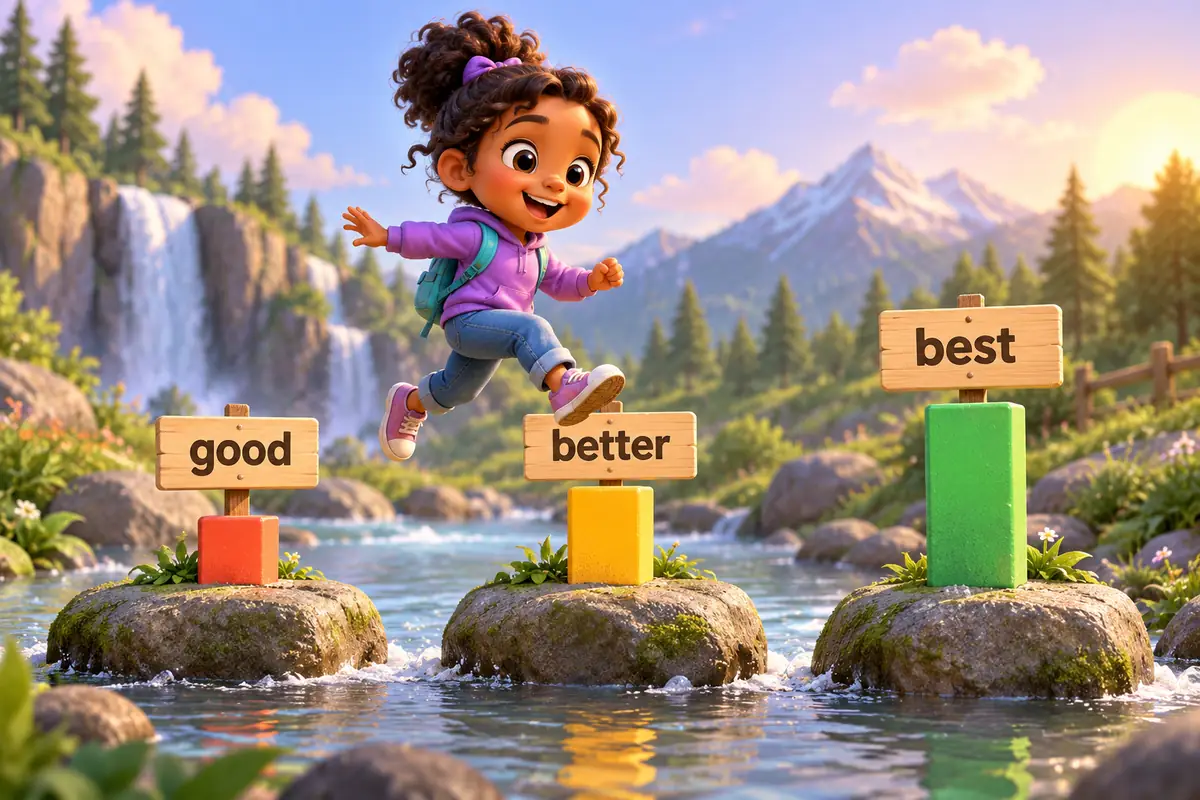
The same small set of words carries clear comparisons in shops, classes, clinics and stories, and each context shows a slightly different job for the form.
| Context | Example sentence | Why this works |
|---|---|---|
| Bakery counter | This loaf is better than the last one. | A shopper compares two loaves directly. |
| Weather bulletin | Tomorrow will be worse than today. | A forecast ranks two days. |
| Class mark | She has the best handwriting in the class. | A superlative ranks one pupil among many. |
| Farm note | The furthest field needs the most rain. | Two forms compare distance and need. |
| Clinic chat | You will feel better by Friday. | A comparative tracks recovery over time. |
| Story ending | It was the worst night of the year. | A superlative frames a dramatic scene. |
| Recipe card | Use less butter and more flour. | Two irregular comparatives adjust a recipe. |
| Family album | Our eldest cousin took the photo. | An irregular superlative names a family rank. |
| Travel plan | The farther route avoids the traffic. | A comparative chooses between two roads. |
Which form should you pick?
When two forms are both correct, the sense of the sentence decides, and the table below maps the common choices.
| You are comparing | Choose | Reason |
|---|---|---|
| Two things | the comparative | Two items need better, worse or further, not the superlative. |
| One thing against all others | the superlative | A ranking within a group needs best, worst or furthest. |
| Distance in space | farther or farther | American usage prefers farther for measured space. |
| Degree of an idea | further | Abstract amounts take further, as in further study. |
| Family rank before a noun | elder or eldest | These forms sit only before a family noun, as in her elder brother. |
The small word that sits before best or worst is explained in the article that precedes a superlative.
Word forms and grammar of irregular adjectives
Each irregular adjective keeps its own small table, and the forms never borrow a regular ending.
| Form | What changes | Example |
|---|---|---|
| good / better / best | the whole stem | Her better idea was the best one. |
| bad / worse / worst | the whole stem | The worst storm passed quickly. |
| far / further / furthest | the vowel and ending | The furthest hill is bare. |
| little / less / least | the whole stem | There is less wind today. |
| old / elder / eldest | rank versus age | My eldest cousin called. |
| well / better / best | health sense | He feels better this morning. |
Common mistakes with irregular adjectives
The same handful of slips appears in schoolwork again and again, and each fix is a subtraction rather than an addition.
Incorrect: This cake is more better. Correct: This cake is better. Rule: The comparative better already carries the comparison, so more is redundant.
Incorrect: He is the goodest player. Correct: He is the best player. Rule: Good is irregular and never takes -est.
Incorrect: She ran further than anyone. Correct: She ran farther than anyone. Rule: Physical distance takes farther in American usage.
Incorrect: This is the most worst storm. Correct: This is the worst storm. Rule: Worst is already a superlative, so most cannot precede it.
Incorrect: My brother is elder than me. Correct: My brother is older than me. Rule: Elder sits before a family noun, not after the verb be.
Practice using irregular adjectives
Complete each item, then read the reason to confirm the form.
- Fill in the blank: My new boots are ________ than my old ones. (good)
- Fill in the blank: That was the ________ goal of the match. (bad)
- Choose the better form: The shop lies ________ along this road. (farther / further)
- Correct the error: This puzzle is more easier than the last.
- Build a sentence: compare three maths tests using worse and best.
- Spot the register: which fits a school report, He is my elder brother, or He is elder than my brother?
Answers
- better. Good is irregular, so the comparative is better, not gooder.
- worst. The superlative of bad is worst, formed without -est.
- farther. A measured distance along a road takes farther.
- This puzzle is easier than the last. Easy follows the regular pattern, and more duplicates the comparison.
- Sample: The first test was bad, the second was worse, and the third was the best of all. Three irregular forms rank the results.
- He is my elder brother. Elder sits before a family noun and does not follow the verb be.

The bottom line
20 examples of irregular adjectives cover nearly the entire English set, so the task is small: learn good, bad, far, little, many, much and old with their two extra forms, and never double the comparison. The twenty sentences show the forms working in ordinary places. Everything else follows the regular pattern.
Frequently asked questions about irregular adjectives
How many irregular adjectives does English have?
The core set is under twenty words once repeated roots are counted, and a short list covers nearly all of them. Good, bad, far, little, many, much and old sit at the centre. Every other English adjective follows the regular -er and -est pattern.
Is funner a real word?
Funner appears in informal speech but is not accepted in careful writing, and most editors prefer more fun. The word fun began as a noun, which is why it resists the -er ending. When you need a safe choice, use more fun or an adjective such as enjoyable.
What is the difference between older and elder?
Older is the everyday comparative and works anywhere, as in my older brother or she is older than me. Elder marks rank inside a family and sits only before a noun, as in my elder sister. After the verb be, always use older.
Do irregular adjectives ever take more or most?
No. Words such as better, worse, best and worst already carry the comparison, so adding more or most duplicates it. The only exception is a fixed phrase such as the more the merrier, where more belongs to a different structure. Otherwise keep the irregular form alone.