Adverbs definition types and examples explain the words that tell us how, when, where and how often an action happens. An adverb usually modifies a verb, an adjective or another adverb, as in she sings loudly or he arrived late.
Adverbs at a glance
- An adverb describes how, when, where or how often something happens.
- Adverbs modify verbs, adjectives or other adverbs.
- Many adverbs end in -ly, as in quickly, softly and rarely.
- Others have no -ly, as in fast, soon and here.
- Adverbs of frequency sit before the main verb but after be.
- A well-placed adverb sharpens meaning; a scattered one muddles it.
What is an adverb?
An adverb is a word that describes a verb, an adjective or another adverb, adding detail about manner, time, place, frequency or degree. It answers questions such as how, when, where and how often, and it can often move around the sentence without changing the meaning.
| Type | Question it answers | Example |
|---|---|---|
| Manner | How? | She spoke quietly. |
| Time | When? | We left early. |
| Place | Where? | They waited outside. |
| Frequency | How often? | He always arrives first. |
| Degree | How much? | The soup is very hot. |
For more words of this class, browse adverbs that start with a.
Where do adverbs go in a sentence?
Position depends on the type. Manner adverbs usually follow the verb, frequency adverbs sit before the main verb but after be, and time adverbs can open or close the sentence. Moving an adverb changes the emphasis even when the meaning holds.
| Position | Example | What it signals |
|---|---|---|
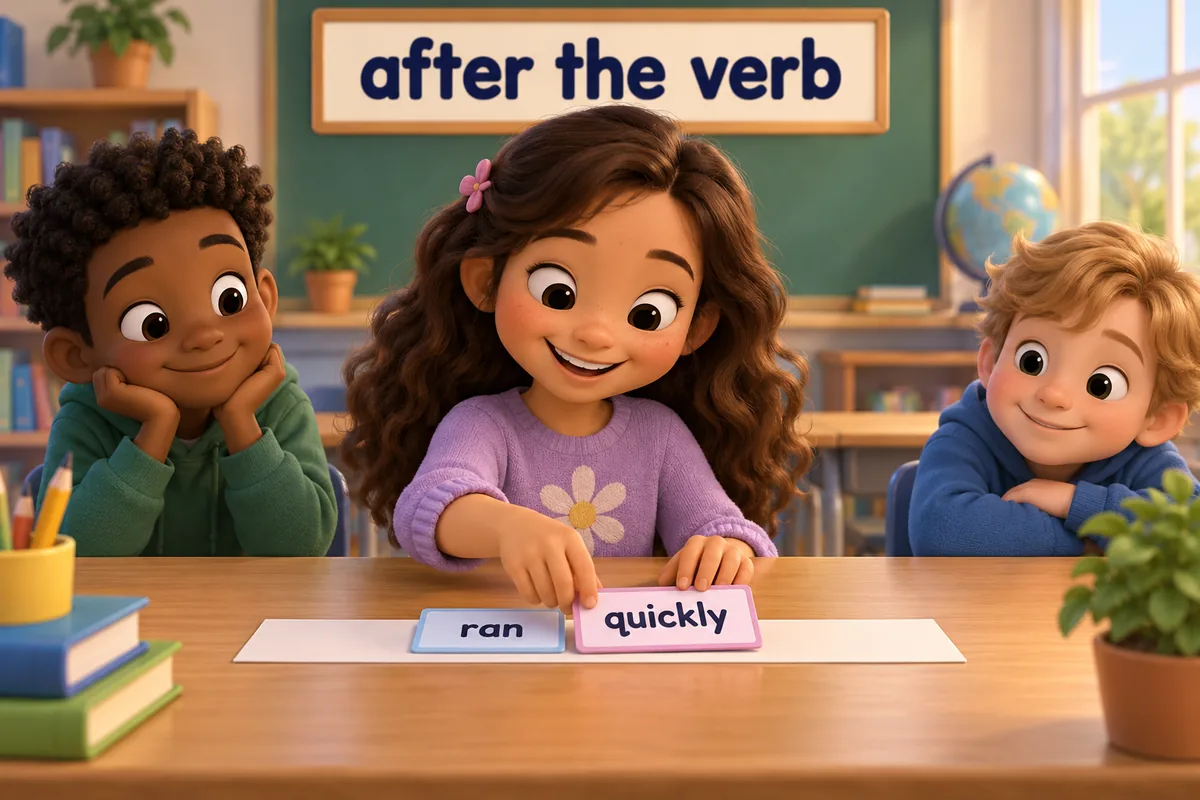
| after the verb | He ran quickly. | Manner adverbs usually follow the verb. |
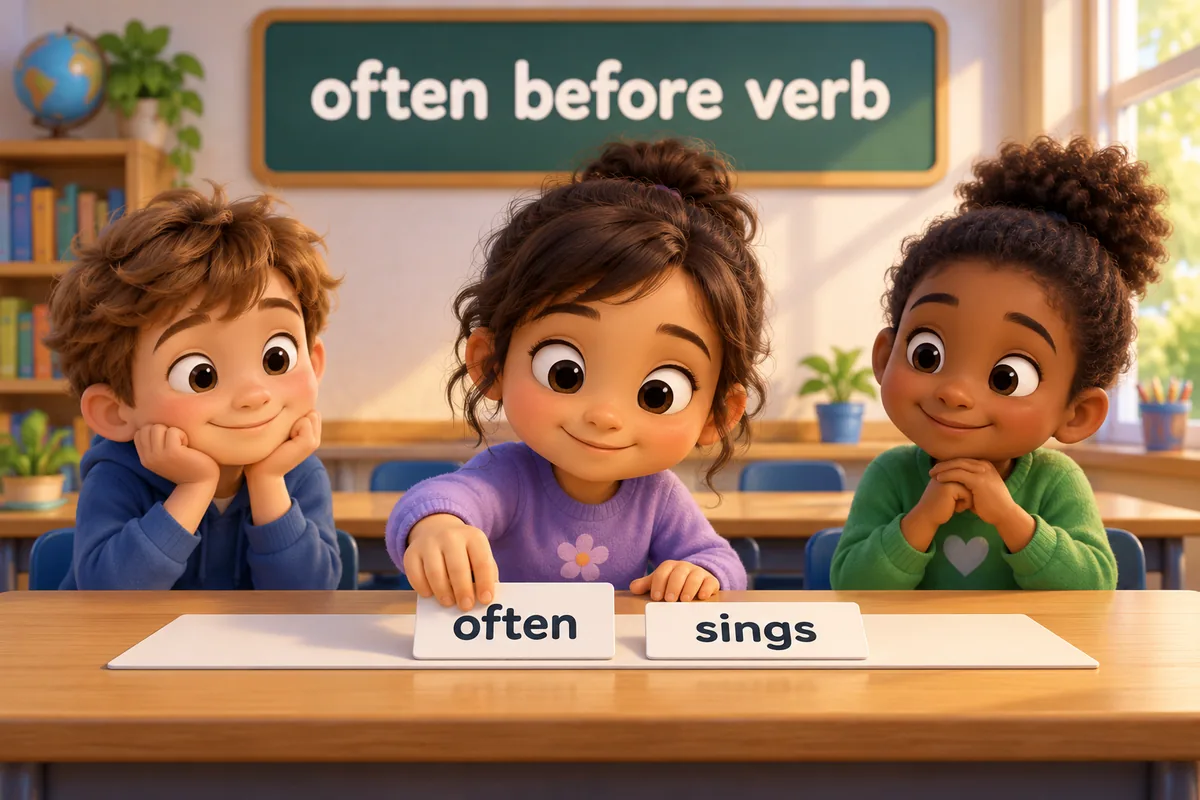
| before the main verb | She often sings. | Frequency adverbs sit before the main verb. |
| after be | They are always late. | Frequency adverbs follow the verb be. |
| at the start | Yesterday we travelled. | A time adverb can open the sentence. |
| between auxiliary and verb | He has never tried. | The adverb splits the auxiliary from the main verb. |
A second set appears in adverbs that start with b.
Adverbs in sentences across contexts
The table moves from a classroom to a lab report and shows what each adverb adds. The final column names the type, so the same word can be recognised in future sentences. For more words of this class, browse adverbs that start with a.
| Context | Example sentence | Why this works |
|---|---|---|
| Classroom | The pupils listened carefully. | carefully tells how they listened. |
| Work email | Please reply soon. | soon tells when to reply. |
| News report | The rescue team worked tirelessly. | tirelessly tells how they worked. |
| Story | The stream flowed gently past the mill. | gently tells how it flowed. |
| Conversation | I hardly slept last night. | hardly is a degree adverb with a negative sense. |
| Academic writing | The results were clearly significant. | clearly tells how significant. |
| Instructions | Slowly lower the lid. | Slowly tells how to do the step. |
| Travel diary | We hiked daily in the hills. | daily tells how often. |
| Technical writing | The sample cools rapidly. | rapidly tells how the change happens. |
| Recipe | Stir the sauce constantly. | constantly tells how often to stir. |
| Sports report | She trains twice weekly. | weekly tells how often she trains. |
Manner words gather in adverbs that start with c.
Adverbs vs adjectives
The two classes are often confused because they share a root. An adverb describes a verb, an adjective or another adverb, while an adjective describes a noun, and the same word can rarely do both jobs without a change of form.
| Feature | Adverb | Adjective |
|---|---|---|
| What it describes | A verb, adjective or adverb | A noun |
| Example | She sings beautifully. | She has a beautiful voice. |
| Common ending | Often -ly | Often no -ly |
| Test | It answers how, when or where | It answers what kind |
| Watch out | good and well | good describes a noun |
| Position | Flexible around the verb | Before the noun or after be |
Word forms and grammar of adverbs
Most adverbs form from an adjective with -ly, but several common ones do not follow the rule at all. The table lists the regular pattern alongside the irregulars that trip learners, so the exceptions can be learned together.
| Form | Part of speech | Example |
|---|---|---|
| quickly | adverb from adjective quick | He finished quickly. |
| well | adverb, irregular from good | She sings well. |
| fast | adverb, same as adjective | The car moved fast. |
| hardly | adverb, not from hard | We hardly spoke. |
| friendly | adjective, not an adverb | She gave a friendly wave. |
| early | adverb, same as adjective | We arrived early. |
A useful set of time and degree words sits in adverbs that start with d.
Position is the part of adverb use that marks a fluent writer, because the wrong place sounds foreign even when the meaning is clear. A frequency adverb belongs before the main verb but after be, so she often sings is right and she sings often shifts the emphasis. A manner adverb usually follows the verb, while a time adverb can open or close the sentence for emphasis. Beware the words that look like adverbs but are adjectives, because friendly, lovely and lonely take no -ly adverb form, and the sentence must be rebuilt around them. The irregulars also need attention: well rather than good for a verb, fast rather than fastly, and hardly, which means barely rather than with effort. Reading a line aloud exposes an awkward adverb quickly. A second habit is to check the word the adverb is describing, because an adverb modifies a verb while an adjective modifies a noun, and mixing the two produces a sentence such as she sings good. When in doubt, place the adverb next to the word it describes and see whether the meaning still holds, since an adverb that drifts to the wrong side of the verb can change the emphasis without changing the words. These small checks turn a rule list into a habit.
Common mistakes with adverbs
- Incorrect:
She sings good.Correct: She sings well. Rule: use the adverb well to describe a verb. - Incorrect:
He drives very quick.Correct: He drives very quickly. Rule: manner adverbs usually take -ly. - Incorrect:
I did it very hardly.Correct: I did it with great effort. Rule: hardly means barely, not with effort. - Incorrect:
She is friendly speaking.Correct: She speaks in a friendly way. Rule: friendly is an adjective and forms no -ly adverb. - Incorrect:
We reached lately.Correct: We reached late. Rule: late is the adverb of time; lately means recently. - Incorrect:
They played the music loud.Correct: They played the music loudly. Rule: the adverb of manner takes -ly after a verb.
Practice using adverbs
- Fill the gap with the adverb: The turtle moved ______. (slow)
- Fill the gap with a frequency adverb: She ______ brings a snack. (always)
- Choose the adverb: He plays the piano (good / well).
- Correct the error: They arrived lately for the show.
- Build a sentence with often placed before the main verb.
- Spot the register: which fits a formal report, (a) The trend rose steadily, or (b) The trend went up a lot?
Answers
- slowly, because the adjective slow forms the adverb with -ly.
- always, because an adverb of frequency sits before the main verb.
- well, because the adverb well describes how he plays.
- They arrived late for the show, because late means after the expected time.
- She often walks to work, because often sits before the main verb walks.
- (a) The trend rose steadily, because steadily is a precise manner adverb suited to a report.
The bottom line
Adverbs definition types and examples come down to a simple question: what does the word add? Manner, time, place, frequency and degree each answer a different question, and position follows the type. Learn the irregular forms such as well and fast, and keep good and friendly where they belong as adjectives.
Frequently asked questions about adverbs
Do all adverbs end in -ly?
No, and assuming they do causes errors. Fast, soon, here and hard are adverbs without -ly, while friendly and lovely are adjectives that only look like adverbs. The ending is a useful clue rather than a reliable rule, so always check the word it describes.
What is the difference between adverbs and adjectives?
An adjective describes a noun, as in a quick runner, while an adverb describes a verb, an adjective or another adverb, as in he runs quickly. The test is what the word is describing, not how the word is spelled.
Where does an adverb of frequency go?
A frequency adverb such as always, often or never sits before the main verb, as in she often sings, but after the verb be, as in she is often late. When an auxiliary is present it goes between the two, as in he has never tried.
Is it wrong to start a sentence with an adverb?
It is perfectly correct, and a time or linking adverb often reads well at the start, as in yesterday we travelled. Style guides only warn against overusing the pattern, because too many sentences that open the same way feel repetitive.