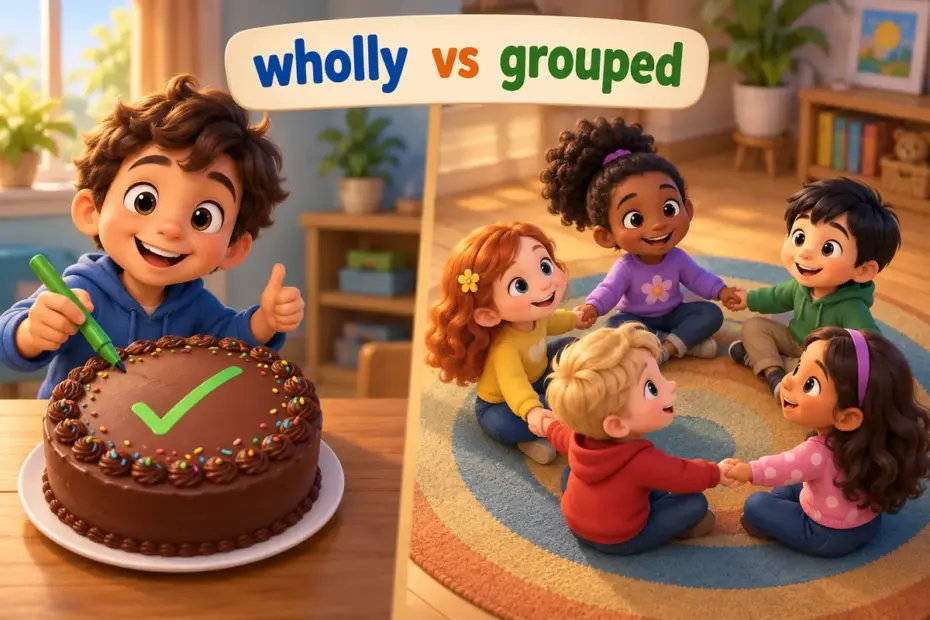
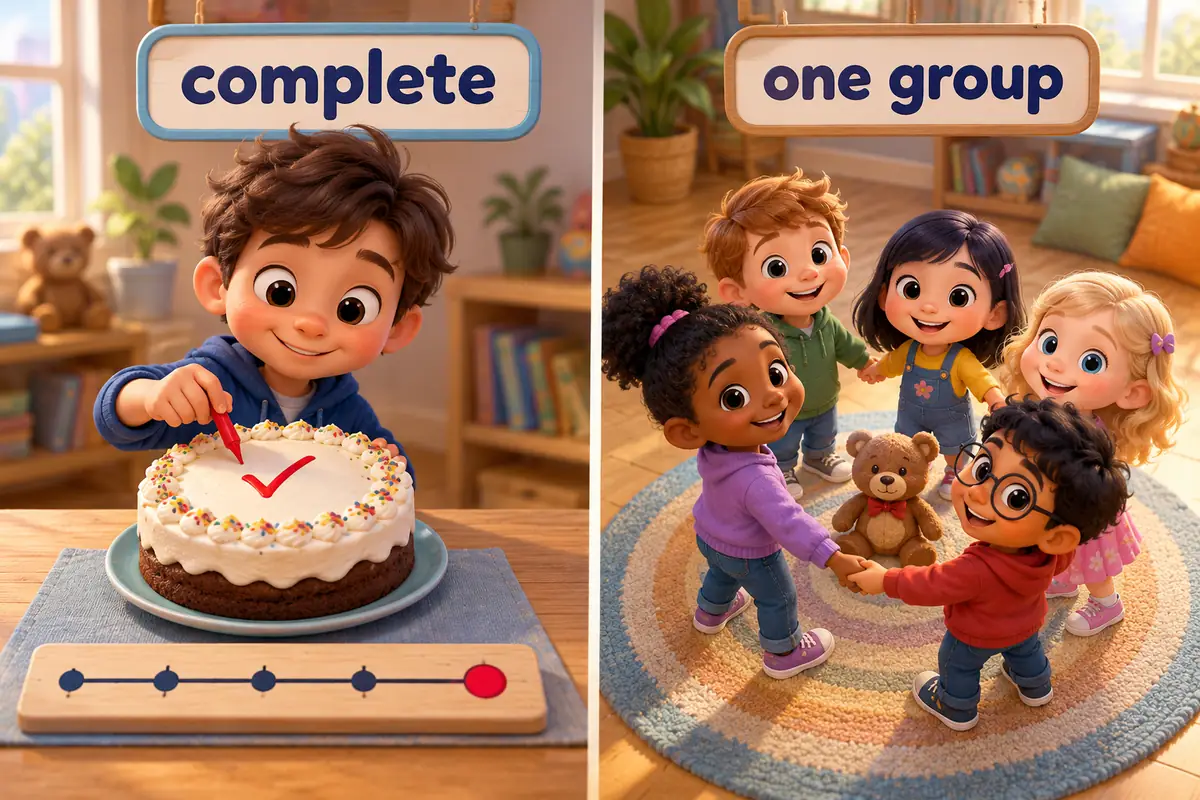
Altogether vs all together look the same in speech but split by meaning: altogether is an adverb meaning completely or in total, while all together means everyone or everything in one place. “It was altogether too hot” means completely; “sing all together” means as one group.
Altogether vs All Together at a glance
- Altogether is one word and an adverb of degree or total.
- All together is two words, the quantifier all plus the adverb together.
- Altogether means completely, entirely, or in total.
- All together means in one place or as one group.
- The commonest error is writing all together where the sentence means completely.
What does altogether mean and what does all together mean?
Altogether is an adverb meaning completely, entirely, or when everything is counted; all together is the phrase formed by all and together, meaning that a group is in one place or acts as one. The Cambridge entry for altogether and the Cambridge entry for all mark this split, and one line shows it: “the effort was altogether wasted” means wholly, while “the team stood all together” means in one group.
| Sense | Word | Plain meaning | Example |
|---|---|---|---|
| Completely | altogether | Wholly, entirely | The plan was altogether wrong. |
| In total | altogether | Counting everything | Altogether we raised fifty pounds. |
| On the whole | altogether | All things considered | Altogether it was a good day. |
| In one group | all together | Everyone in one place | The choir sang all together. |
| At the same time | all together | Simultaneously | They spoke all together. |
What is the difference between altogether and all together?
The difference is number of words and meaning: altogether is a single adverb of degree or total, while all together is a quantifier and an adverb describing a group in one place. A familiar look-alike pair such as abel vs able is decided the same way, by asking what the sentence is actually saying.
| Test | Altogether | All together |
|---|---|---|
| Number of words | one | two |
| Part of speech | adverb | quantifier plus adverb |
| Core meaning | completely, in total | a group in one place |
| Can replace with | entirely | all in one place |
| Typical frame | altogether different | sing all together |
| Quick test | if it means wholly, use altogether | if it means as a group, use all together |
Choose altogether when you could replace the word with entirely, and all together when you could replace it with as a group.
How do you use altogether and all together in a sentence?
Each form fits fixed frames, and the frame is a faster test than the sound; to watch the adverb of degree work, read sentences using altogether.
| Pattern | Example | What it signals |
|---|---|---|
| altogether + adjective | The story felt altogether strange. | complete degree |
| not altogether + adjective | I am not altogether sure. | a partial hedge |
| altogether + number | Altogether, ten people came. | a total |
| altogether too + adjective | The price was altogether too high. | emphasis on excess |
| all together, group verb | They walked all together. | moving as one group |
| get something all together | Get your notes all together. | gathering in one place |
Altogether and all together in a sentence: examples across contexts
Reading the pair in different registers makes the choice automatic, and more frames for the grouped sense sit in sentences using all together.
| Context | Example sentence | Why this works |
|---|---|---|
| Classroom | Altogether, the class collected three hundred books. | altogether gives a total |
| Workplace email | The changes are altogether sensible. | altogether means wholly |
| News report | Altogether, the repairs cost four million. | altogether sums up |
| Music lesson | The choir practised the song all together. | all together means as one group |
| Everyday speech | That is altogether too much salt. | altogether too emphasises excess |
| Sports coaching | The squad ran the last lap all together. | all together marks one unit |
| Academic writing | The evidence is not altogether convincing. | not altogether hedges |
| Family life | Put the toys all together in one box. | all together means one place |
| Planning | Altogether, six buses are needed. | a counted total |
| Art class | The children held the ribbon all together. | all together as one line |
Which should you use?
Match the form to the meaning: wholly or in total takes altogether, and a group in one place takes all together.
| Situation | Use | Example |
|---|---|---|
| A complete degree | altogether | The result was altogether better. |
| A group in one place | all together | The family sat all together. |
| Adding everything up | altogether | Altogether, it took two hours. |
| Doing something at once | all together | Count to three and jump all together. |
Register is the second test. Altogether appears in careful writing and in speech, often beside an adjective or a number, while all together needs a plural subject that can gather in one place. Neither replaces the other, so the honest limit is this: a sentence that counts or measures takes altogether, and a sentence that gathers people or things takes two words.
Word forms and grammar of altogether and all together
The adverb has no inflections, while all and together belong to other word classes, and another one-letter and one-space trap, addition vs edition, is caught the same way once the meaning is clear.
| Form | Part of speech | Example |
|---|---|---|
| altogether | adverb, one word | It was altogether dark. |
| all | quantifier | They all clapped. |
| together | adverb | We worked together. |
| all together | two words | The group is all together. |
| togetherness | noun | A sense of togetherness grew. |
Common mistakes with altogether and all together
Mistake 1: all together for a total. Incorrect: All together, the trip cost two hundred pounds. Correct: Altogether, the trip cost two hundred pounds. Rule: a sum or total takes the single adverb altogether.
Mistake 2: altogether for a group. Incorrect: The choir sang altogether. Correct: The choir sang all together. Rule: a group acting as one takes the two words.
Mistake 3: all together for a degree. Incorrect: The film was all together too long. Correct: The film was altogether too long. Rule: a complete degree takes altogether.
Mistake 4: splitting the adverb. Incorrect: The plan was all altogether together wrong. Correct: The plan was altogether wrong. Rule: altogether is a single adverb and stays whole.
Mistake 5: a singular subject with all together. Incorrect: The sand all together filled the hole. Correct: The sand filled the hole completely. Rule: all together needs a plural group that can be gathered.
Practice using altogether and all together
- Fill in the blank: ___, the tickets cost eighty pounds.
- Choose the better word: The choir sang (altogether / all together) at the concert.
- Correct the error: The meal was all together too spicy for me.
- Build a sentence: use all together to say that a family sat in one group.
- Spot the register: which line suits a news report, (a) The costs were totally huge, or (b) Altogether, the costs reached four million?
- Fill in the blank: The puppies slept ___ in one basket.
Answers
- Altogether, because it introduces a total.
- all together, because it describes the group singing as one.
- The meal was altogether too spicy for me; a degree takes the single adverb.
- The family sat all together on the bench.
- (b), because altogether suits a formal total.
- all together, because the puppies are gathered in one place.

The bottom line
The altogether vs all together choice comes down to meaning and number of words: altogether means completely or in total, and all together means a group in one place. Use the replacement test, since entirely points to altogether and as a group points to the two words. The forms sound identical, so a check of the number of words catches most errors on the page.
Frequently asked questions about altogether and all together
Is altogether one word or two?
Altogether, meaning completely or in total, is always one word. All together, meaning everyone in one place or acting as one, is always two words. The spelling follows the meaning, so the number of words is itself the clue to which sense a sentence needs.
How do I choose between altogether and all together?
Replace the phrase with a synonym. If entirely or in total fits, the answer is the one-word adverb altogether. If as a group or all in one place fits, the answer is the two words all together. Because the two meanings never overlap, the test is reliable.
What does not altogether mean?
Not altogether means not completely, and it softens a statement. In I am not altogether sure, the speaker means partly unsure rather than certain. The phrase always needs the single adverb, because it describes a degree rather than a group of people or things.
Can all together mean at the same time?
Yes. All together can describe people acting at once, as in count to three and jump all together, as well as people gathered in one place. Both uses need a plural subject and the two-word spelling, never the single adverb altogether.