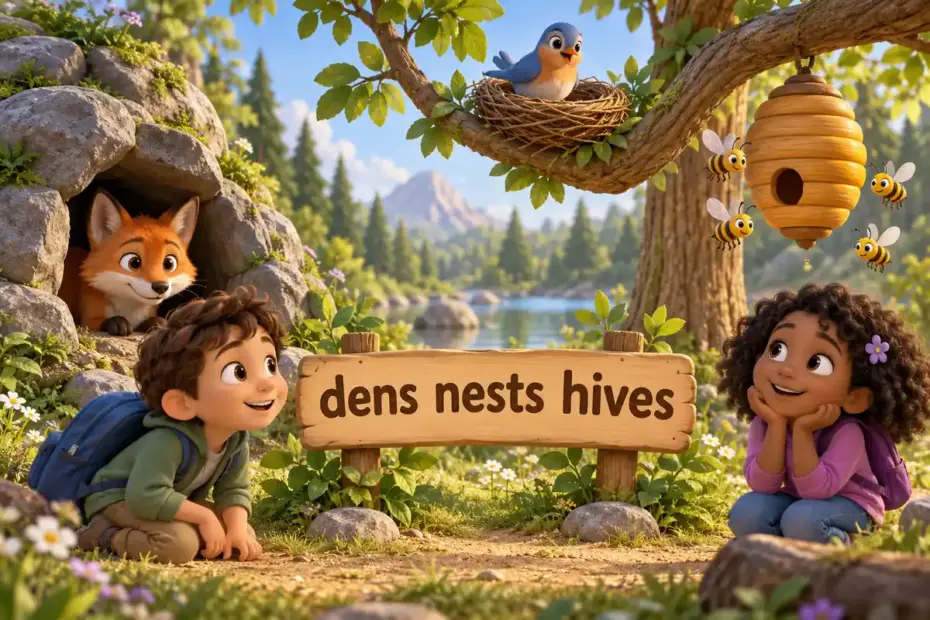
Animal homes and shelters name the places where creatures rest, hide and raise their young, and English has a separate word for almost every kind. A bear sleeps in a den, a rabbit in a burrow, a bird in a nest and a bee in a hive, and each word carries the animal with it.
Animal homes and shelters name at a glance
- Every animal home word usually carries its builder with it.
- A den, a burrow and a warren are all underground or hidden homes.
- A nest, a hive, a web and a dam are built by their owners.
- A sty, a coop and a stable are homes people provide.
- The commonest error is using nest for every animal home.
What do we call the places where animals live?
English avoids one general word for animal homes, so each species tends to have its own noun. The nouns divide into homes the animal builds, natural shelters the animal finds, and homes that people make on farms or in gardens. Basic frames for the creatures appear in animal in a sentence, which sets up the home words above.
| Animal home | Built by or for | Usually home to |
|---|---|---|
| den | found or dug by the animal | a bear, a fox, a wolf |
| burrow | dug by the animal | a rabbit, a mole, a badger |
| nest | built by the animal | a bird, a wasp, a turtle |
| hive | built by the colony | bees |
| web | spun by the animal | a spider |
| dam and lodge | built by the animal | a beaver |
| warren and sett | dug in a group | rabbits, badgers |
| sty, coop, stable | provided by people | pigs, chickens, horses |
The home noun often comes from the material or the building method, which is why the words are so specific. A nest can be twigs, mud or grass, a burrow is always dug earth, and a lodge is a dome of sticks and mud. Knowing what the home is made of helps you choose the right noun.
How do animal home words work in a sentence?
These nouns follow the animal they belong to, and the possessive apostrophe is the frame learners use most. Countability also matters, because some homes come in colonies.
| Pattern | Example | What it signals |
|---|---|---|
| animal + possessive + home | the fox’s den | one animal and its home |
| live in a + home | Rabbits live in a burrow. | the animal inside its home |
| build a + home | Birds build a nest each spring. | the act of making it |
| a + home + of + material | a nest of twigs | what it is made from |
| retreat to its + home | The bear retreated to its den. | a shelter to return to |
| a colony of + animal + home | a colony of ant nests | a group of homes |

Animal homes and shelters name in sentences across contexts
The same noun shifts register easily, from a nursery rhyme to a nature report, so the context decides how much detail you add. Animals that carry loads have their own useful frames in pack animal in a sentence.
| Context | Example sentence | Why this works |
|---|---|---|
| Classroom | A spider spins a web to catch its food. | ties the home to its purpose |
| Nature writing | The badger settled in a sett deep under the hedge. | names a specific hidden home |
| Farm sign | The hens are in the coop before dusk. | a home provided by people |
| Story | The bear lumbered back to its den for the winter. | a single animal and its shelter |
| Science report | A beaver dam changes the flow of the stream. | shows the home reshaping habitat |
| Everyday speech | There is a bird nest in the apple tree. | a plain, countable home |
| Gardening blog | A bee hive helps the whole garden. | a colony home |
| Geography lesson | A warren holds many tunnels and exits. | the group structure of the home |
| Zoo sign | This shelter copies a wild den. | a man-made version |
| Poem | In a bright hive the bees keep time. | a musical single image |
| Farmers market | The stable is warm and dry in winter. | a home built for large animals |
| Field guide | Look for a nest of twigs near the branch fork. | names the material too |
The vocabulary suits different readers, so the setting picks the word. A nursery rhyme says a cosy nest, a nature report says a sett, and a farm sign says the coop. Use the plain word for young learners and the precise term when an expert reader expects accuracy.
Which word: den, burrow, or nest?
The three words are close but not identical, and the animal and the building material decide which one fits. Working animals kept in stables appear in draft animal in a sentence, matching the farm shelters here.
| Question | den | burrow | nest |
|---|---|---|---|
| Built or found? | usually found and enlarged | dug by the animal | built by the animal |
| Typical animal | bear, fox, wolf | rabbit, mole, badger | bird, wasp, turtle |
| Position | often a cave or hollow | underground tunnel | up a tree or on the ground |
| Made of | the natural hole | the earth | twigs, grass, mud |
| Group home? | no | sometimes a warren | sometimes a colony |
| Everyday phrase | a fox’s den | a rabbit burrow | a bird nest |
The quickest test is the builder. If the animal built it from twigs or silk, it is a nest or a web; if it dug into the earth, it is a burrow; and if it found a natural hollow, it is a den. Match the builder and the material and the home word follows.
Word forms and grammar of home and shelter
The words home and shelter carry their own grammar, and a few derived forms appear when these nouns are used as verbs. Homes people provide, such as the coop and the sty, relate to domestic animal in a sentence.
| Form | Part of speech | Example |
|---|---|---|
| home | noun | The nest is the bird home. |
| homes | noun, plural | Owls use many homes. |
| shelter | noun | The cave is a shelter. |
| shelters | noun, plural | Rock shelters line the cliff. |
| shelter | verb | The lambs shelter under the wall. |
| burrow | verb | Moles burrow through the soil. |
| nest | verb | The turtles nest on the same beach. |
Most of these nouns also work as verbs, so a mole burrows and a bird nests. The verb keeps the same form as the noun, which makes the pair easy to remember. Use the possessive for one animal, as in the fox den, and the plural for a group, as in the rabbit burrows.
Common mistakes with animal home words
Mistake 1: nest for every animal home. Incorrect: The bear slept in its Correct: The bear slept in its den all winter. Rule: a den belongs to large mammals; a nest is built by birds and insects.nest all winter.
Mistake 2: missing possessive apostrophe. Incorrect: The fox Correct: The fox’s den was under the rock. Rule: a home belonging to a singular animal takes an apostrophe and s.den was under the rock.
Mistake 3: wrong preposition. Incorrect: The bees live Correct: The bees live in a hive. Rule: a colony lives in its home, not on it.on a hive.
Mistake 4: hive as a countable single bee home. Incorrect: Each Correct: Each hive belongs to a colony of bees. Rule: a hive is shared by a whole colony.hive belongs to one bee.
Mistake 5: sett and warren confused. Incorrect: The rabbits dug a Correct: The rabbits dug a warren in the field. Rule: a warren belongs to rabbits; a sett belongs to badgers.sett in the field.
Practice using animal home words
- Fill in the blank: A rabbit lives in a ___ under the ground.
- Choose the better word: A bird builds a (nest / den) in the tree.
- Correct the error: The bees live on a hive.
- Build a sentence: use the pattern the beaver dam to describe a home that changes a river.
- Spot the register: which suits a field guide, (a) The badger hole, or (b) The badger sett?
- Fill in the blank: Hens are shut in the ___ at night.
Answers
- burrow, because a rabbit digs an underground tunnel.
- nest, because birds build nests from twigs and grass.
- The bees live in a hive; a colony lives in its home.
- The beaver dam slowed the stream and created a pond.
- (b), because a field guide uses the precise term sett for a badger home.
- coop, because a coop is the shelter built for hens.

The bottom line
Animal homes and shelters name a hidden vocabulary where each word usually carries its animal with it. Bears and foxes keep dens, rabbits and moles dig burrows, birds and wasps build nests, and people supply sties, coops and stables. Learn the animal with the home and the pair stays fixed in memory.
Frequently asked questions about animal homes
What is the difference between a den and a burrow?
A den is usually a natural hollow, cave or tree base that a large mammal finds and enlarges, while a burrow is a tunnel an animal digs for itself in the ground. Bears and foxes keep dens, and rabbits and moles dig burrows, so the animal often hints at the right word.
Is a spider web a home?
A spider web is mainly a trap for catching food, but it also serves as a shelter and nursery for many species, so it works as a home in the loose sense. The word web names the structure, while the spider may also retreat to a small den or a curled leaf.
What do we call a rabbit home?
The everyday word is burrow, and a whole network of connected burrows is a warren. Rabbits live in groups, so a warren can hold many families with several entrances. Both words are standard English, and burrow is the simpler choice for young learners.
Which word is used for a badger home?
A badger home is called a sett, a term used mainly in Britain and in nature writing. Badgers dig extensive tunnels and chambers, so the sett can be very large. The word is specific to badgers, which is why a field guide would never call it a burrow.