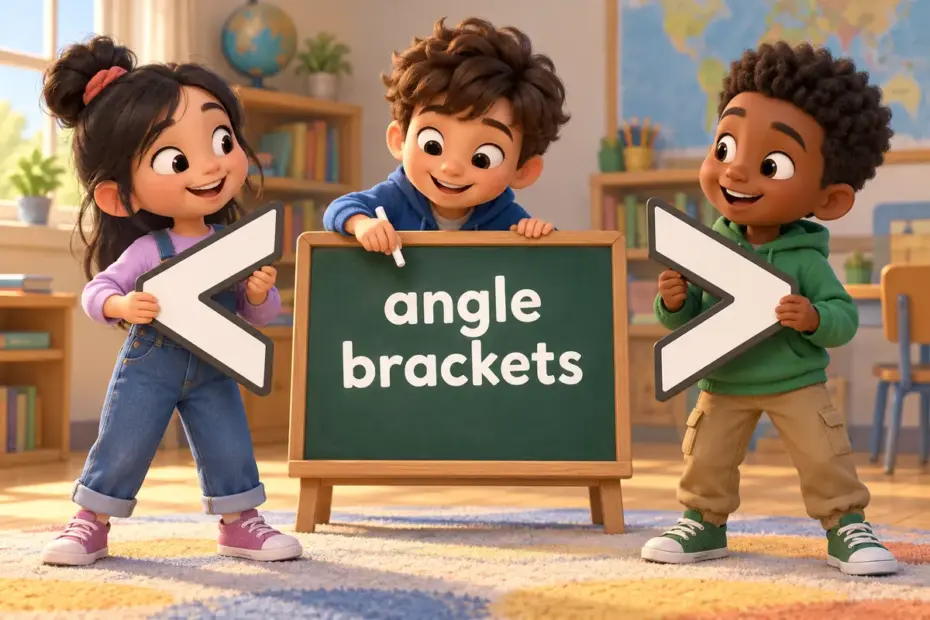
Angle brackets in English meaning and uses cover the pair of wedge signs, < and >, that appear in maths, markup and editorial notes. They look like less-than and greater-than symbols, and each job follows its own small rule. The reading depends on where they are used.
Angle brackets at a glance
- Angle brackets are the pair of wedge signs that look like less-than and greater-than marks.
- They appear in maths as an alternative to round brackets.
- In coding and markup they enclose tags such as the paragraph tag.
- In editing they mark information supplied by the editor.
- The opening sign is < and the closing sign is >.
- Their meaning depends on context, so read the surrounding sentence.
What are angle brackets?
Angle brackets are a matched pair of pointed signs, an opening < and a closing >, used to enclose something. In maths they group values, in markup they wrap a tag, and in editing they flag text the editor has supplied. The same pair carries a different job in each field.
| Use | What it marks | Example |
|---|---|---|
| Maths | A point or a set | The point <3, 4> lies on the line. |
| Markup | A tag in code | The tag <p> opens a paragraph. |
| Editing | Editor-supplied text | The letter was sent <in haste>. |
| Computing | A type parameter | A list of <string> holds text. |
| Correspondence | An email address in older style | Write to <name@example> for help. |
For the plain word behind the shape, see angle in a sentence.
How do you write angle brackets on a keyboard?
On most keyboards the pair shares two keys on the bottom row. Holding Shift and pressing the comma key gives the opening <, and holding Shift and pressing the full-stop key gives the closing >, so the two signs sit side by side on the same pair of keys.
| Pattern | Example | What it signals |
|---|---|---|
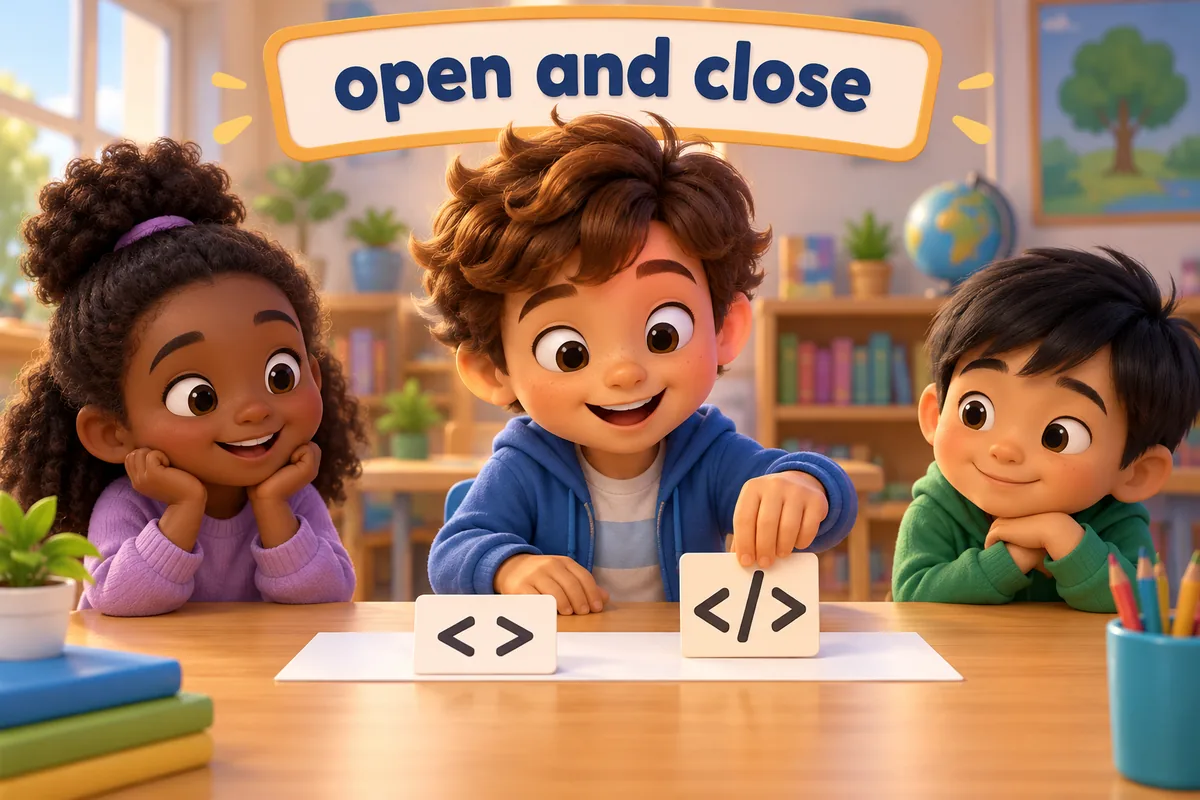
| open and closed pair | The tag <p>text</p> wraps a line. | Markup needs a matching closing tag. |
| single pair in maths | The point <A, B> groups values. | The pair keeps related values together. |
| inside a quotation | She wrote <sic> after the typo. | An editor flags an unusual form. |
| no spaces inside | Write the tag as <name>. | Keep the sign tight against the word. |
| paired on one key row | Shift plus comma, then Shift plus full stop. | The two signs sit together on the keyboard. |
A narrow turn is named in acute angle.
Angle brackets in sentences across contexts
The table shows the same pair of signs at work in a maths class, an editing desk and a coding note. Each row names the job the brackets do. For the plain word behind the shape, see angle in a sentence.
| Context | Example sentence | Why this works |
|---|---|---|
| Maths class | The vector is written <2, 5>. | The pair groups two coordinates. |
| Web writing | The browser reads the tag <div> as markup. | Angle brackets mark markup in code. |
| Editing a letter | The editor added <London> to the dateline. | The signs mark supplied text. |
| Computing notes | Declare the list of <integer>. | The pair names a data type. |
| Proofreading | Keep the error and add <sic>. | The note records the original form. |
| Technical manual | Press the key marked <Enter>. | The sign names a key. |
| Academic writing | The source reads <emphasis added>. | The note shows who added a mark. |
| Email advice | Write the address inside <angle brackets>. | The pair names the sign itself. |
| Blog formatting | Wrap the word inside <code>. | The tag styles the word as code. |
| Data notes | Sort the list by <date>. | The pair names the sort field. |
| Grammar review | The correction reads <thirty> for thirty. | The sign marks a silent change. |
A wider turn appears in obtuse angle.
Angle brackets vs parentheses
Both pairs enclose extra material, but they are not interchangeable. Angle brackets wear points and suit maths, code and editorial notes, while parentheses wear curves and suit asides and clarifications in ordinary prose.
| Feature | Angle brackets | Parentheses |
|---|---|---|
| Shape | Wedge signs, pointed | Rounded signs |
| Maths use | Coordinates and sets | Extra notes and grouping |
| Editing use | Supplied or altered text | Asides and clarifications |
| Keyboard | Shift plus comma and full stop | Shift plus nine and zero |
| Look | < and > | ( and ) |
| Typical reader | Programmers, editors, scientists | General readers |
Forms and grammar of angle brackets
The term has a singular and a plural, and the two halves have their own names. The table also shows the short form brackets, which is common in editing, and the adjective form that describes the shape.
| Form | Part of speech | Example |
|---|---|---|
| angle bracket | noun, singular | An angle bracket opens the tag. |
| angle brackets | noun, plural | Use angle brackets around the tag. |
| left angle bracket | noun phrase | The left angle bracket opens the pair. |
| right angle bracket | noun phrase | The right angle bracket closes the pair. |
| brackets | noun, short form | The brackets must match. |
| bracketed | adjective | The bracketed note was added later. |
The square corner is described in right angle.
The same pointed signs serve three communities, and the reader has to work out which one is speaking from the surrounding text. In maths the pair groups a coordinate or a set, in markup it wraps a tag, and in editing it flags words the editor has supplied, so a single symbol carries three unrelated jobs. Two habits prevent confusion: keep the signs tight against the word with no inner spaces, and match every opening sign with its closing partner, especially in code where a missing slash breaks the tag. When you meet the same shape without a partner, as in the less-than sign, the context tells you it is a comparison rather than a bracket. When in doubt, ask which field the sentence belongs to.
Common mistakes with angle brackets
- Incorrect:
Use a angle bracket.Correct: Use an angle bracket. Rule: a vowel sound takes an before the noun. - Incorrect:
The tag reads <p>text<p>.Correct: The tag reads <p>text</p>. Rule: a closing tag needs the slash. - Incorrect:
Open the tag as < tag >.Correct: Open the tag as <tag>. Rule: no spaces inside the signs. - Incorrect:
The point is (3, 4) in angle brackets.Correct: The point is <3, 4> in angle brackets. Rule: angle brackets use the wedge signs, not round ones. - Incorrect:
Anglebracket are pointed.Correct: Angle brackets are pointed. Rule: the noun is two words, angle brackets. - Incorrect:
Wrap the word in a angle brackets.Correct: Wrap the word in angle brackets. Rule: the plural noun takes no article here.
Practice using angle brackets
- Fill the gap: a closing paragraph tag is written </p>, so an opening tag is written ______.
- Fill the gap: a point in angle brackets is written ______3, 4______.
- Choose: use (parentheses / angle brackets) for a coordinate in maths.
- Correct the error: Use a angle bracket for the tag.
- Build a sentence stating what angle brackets mark in editing.
- Spot the register: which fits a coding note, (a) Wrap the word in angle brackets, or (b) Wrap the word in curved brackets?
Answers
- <p>, because the opening tag matches the closing tag without the slash.
- < and >, because the wedge signs wrap the pair of values.
- angle brackets, because maths uses the pointed signs for coordinates.
- Use an angle bracket for the tag, because a vowel sound takes an.
- In editing, angle brackets mark text that the editor has supplied, because a round bracket would suggest the reader added it.
- (a) Wrap the word in angle brackets, because markup uses the pointed signs.

The bottom line
Angle brackets in English meaning and uses always come back to one pair of pointed signs. In maths they group values, in markup they wrap a tag, and in editing they flag supplied text. Learn the two jobs side by side, keep the signs tight against the word, and the right use follows from the context.
Frequently asked questions about angle brackets
What does a pair of angle brackets look like?
A pair of angle brackets looks like a pointed wedge on each side, an opening sign that leans right and a closing sign that leans left. They resemble the less-than and greater-than symbols, which is why the two are often confused.
Are angle brackets the same as less-than and greater-than signs?
They share the same shapes but carry different jobs. In maths the pointed signs mean less than and greater than, while the same signs used in pairs around a value or a tag are named angle brackets. Context tells the reader which role is meant.
When do editors use angle brackets?
An editor places angle brackets around text that has been supplied or altered, such as a guessed date or a corrected spelling. The marks tell the reader that the words inside did not come from the original writer, which keeps the edit transparent.
How do I type angle brackets?
On most keyboards the pair sits on the bottom letter row. Hold Shift and press the comma key for the opening sign, then hold Shift and press the full-stop key for the closing sign, so the two characters share that pair of keys.