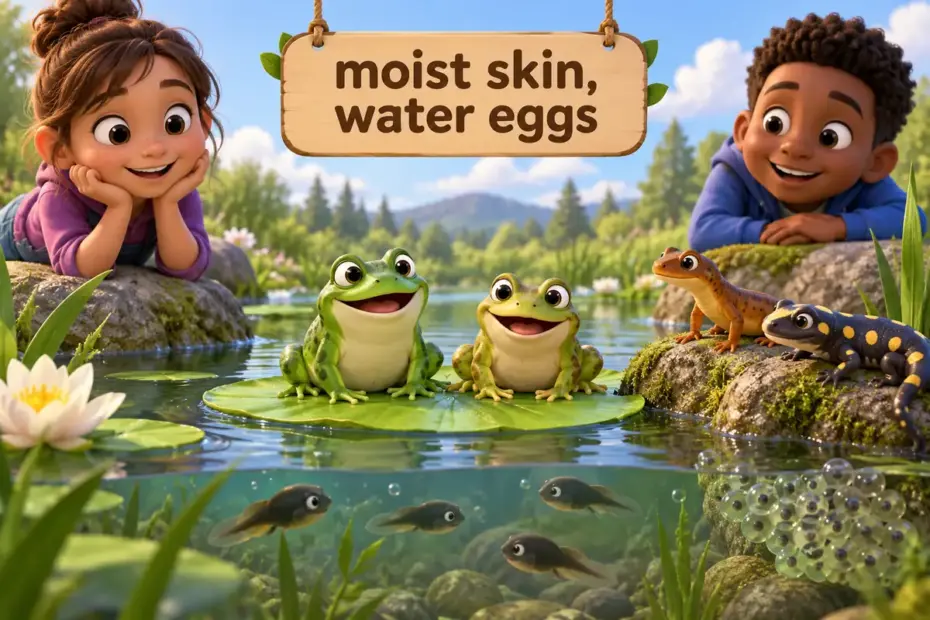
Amphibians names in English cover three main groups: frogs and toads, newts and salamanders, and the burrowing caecilians. Every amphibian has moist skin and lays its eggs in water, and the young usually change shape as they grow from tadpole to adult.
Amphibians names in English at a glance
- Amphibians are cold-blooded animals with moist, bare skin.
- They lay their eggs in water or damp places.
- Most begin life as water-breathing young and change shape.
- The three groups are frogs and toads, salamanders and newts, and caecilians.
- The commonest error is calling every amphibian a frog.
What is an amphibian?
An amphibian is a cold-blooded animal that spends part of its life in water and part on land, and the name comes from Greek words meaning both kinds of life. The group splits into three orders, and each order supplies a set of everyday English names. For a broader browse, the list of animals that start with A to Z places these names beside the rest of the animal kingdom.
| Group | Plain meaning | Common English names |
|---|---|---|
| Frogs and toads | tailless jumpers with strong back legs | frog, toad, tree frog, bullfrog |
| Salamanders and newts | lizardshaped amphibians with a tail | newt, salamander, axolotl, fire salamander |
| Caecilians | limbless, wormlike burrowers | caecilian, ringed caecilian |
| Water breeders | species that lay eggs in ponds | common frog, common toad, green frog |
| Tree dwellers | species that climb with sticky toes | tree frog, red-eyed tree frog |
| Neoteny species | adults that keep young features | axolotl, mudpuppy |
Two features separate amphibians from reptiles: their skin and their eggs. Amphibian skin is moist and bare, while reptile skin is dry and scaly. Amphibian eggs have no shell and must stay in water or damp ground, while reptile eggs have a leathery shell and can be laid on dry land.
How do amphibian names work in English?
Most amphibian names are either a single word or a compound made of a descriptive word plus a base noun, and the base noun tells you the group.
| Pattern | Example | What it signals |
|---|---|---|
| descriptor + base noun | tree frog | the habitat or look of the animal |
| base noun alone | newt | the whole group in one word |
| proper place + base noun | European common frog | a species from a region |
| colour + base noun | red-eyed tree frog | a striking feature |
| a / an + singular | an axolotl | one animal |
| plural with no article | Frogs live near ponds. | the group in general |
Amphibians names in sentences across contexts
The names appear in science lessons, nature writing and ordinary speech, and the register decides how much detail you add. Water creatures that are not amphibians appear in fish names that start with A, which honours the same naming patterns.
| Context | Example sentence | Why this works |
|---|---|---|
| Classroom | A frog begins life as a tadpole in the pond. | ties the name to the life cycle |
| Nature writing | Newts shelter under damp logs through the winter. | names a group with a habitat |
| Science report | The axolotl keeps its gills into adult life. | uses a species as an example |
| Everyday speech | We heard toads calling after the rain. | a plain, countable plural |
| Field guide | The fire salamander has bright yellow markings. | a species with a defining feature |
| Gardening blog | A pond attracts frogs and other amphibians. | amphibians as the general term |
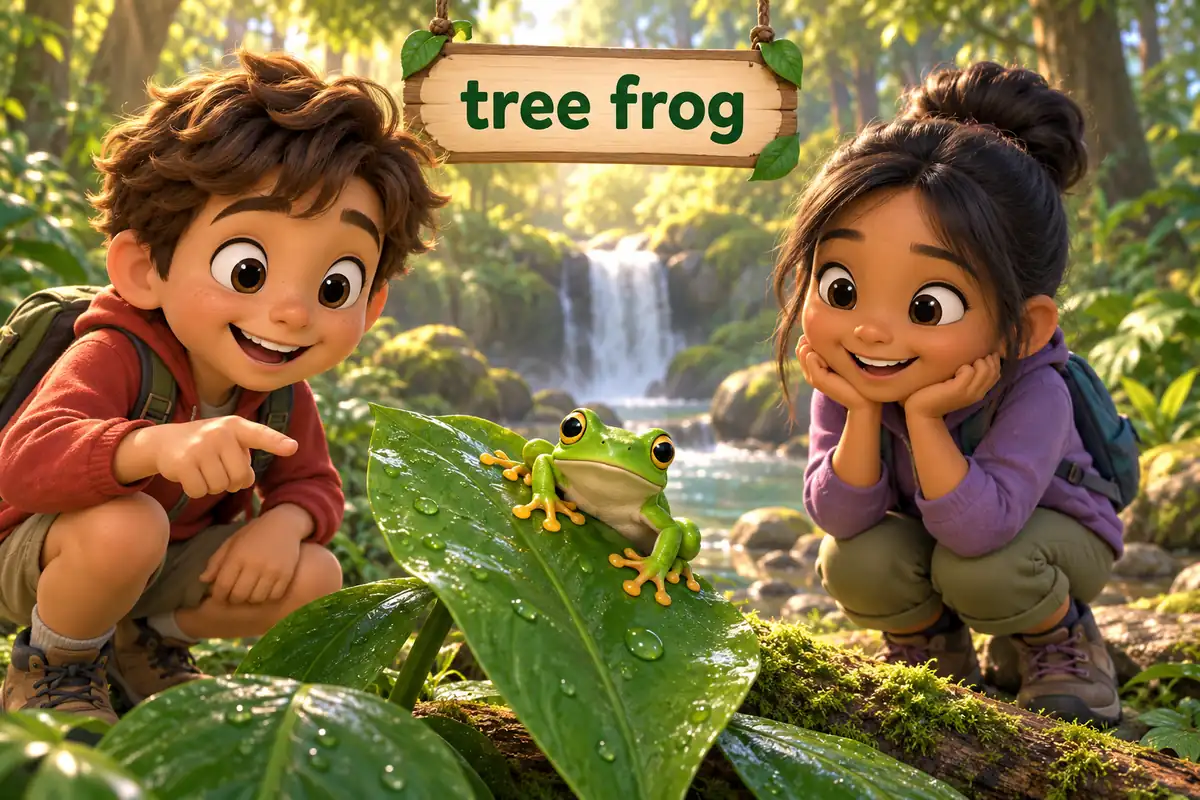
| Story | A green tree frog sat on the wet window. | a vivid single animal |
| Fact sheet | Amphibians absorb water through their skin. | a defining trait |
| Zoo sign | The caecilians are kept in the dark burrow. | a less familiar group named clearly |
| Exam answer | Name one amphibian that lays eggs in water. | asks for a single correct noun |
The register decides whether you name the group or the species. A classroom says amphibians, a field guide says the common frog, and a zoo sign names the axolotl. Use the group word when the exact species is unknown, and the species name when a precise example matters.
Which word: frog, toad, or newt?
The three names are not interchangeable, and the differences show in the skin, the legs and the habitat even when the animals look similar. The animals most often confused with newts and toads are gathered in amphibians in a sentence.
| Feature | frog | toad | newt |
|---|---|---|---|
| Skin | smooth and moist | dry and warty | smooth and moist |
| Body shape | long legs, jumper | shorter legs, hopper | long tail, walker |
| Habitat | near water | drier ground | ponds and damp shade |
| Group | tailless amphibian | tailless amphibian | tailed amphibian |
| Lay eggs in | water, in clumps | water, in strings | water, singly |
| Everyday use | the commonest name | often confused with frog | often confused with lizard |
The leg count and the skin settle most cases. Frogs and toads have no tail as adults, newts and salamanders keep a tail, and caecilians have no limbs at all. When two names seem possible, ask whether the animal keeps a tail, because that single test separates the two largest groups.
Word forms and grammar of amphibian words
A few grammar points matter with these nouns, especially the plural and the article, because the names behave like ordinary count nouns.
| Form | Part of speech | Example |
|---|---|---|
| amphibian | noun | A frog is an amphibian. |
| amphibians | noun, plural | Amphibians need damp skin. |
| amphibious | adjective | Amphibious animals live on land and water. |
| tadpole | noun | The tadpole grew legs in the spring. |
| metamorphosis | noun | The frog undergoes metamorphosis. |
| spawn | noun or verb | Frogs spawn in shallow ponds. |
| cold-blooded | adjective | Amphibians are cold-blooded. |
The plural forms are regular, so one frog becomes two frogs and one newt becomes two newts. The word amphibians itself is the plural of amphibian and names the whole class. Use amphibious only as an adjective, as in amphibious animals or an amphibious vehicle.
Common mistakes with amphibian names
Mistake 1: frog for every amphibian. Incorrect: A salamander is a kind of Correct: A salamander is a kind of amphibian. Rule: frog is one group, not the whole class.frog.
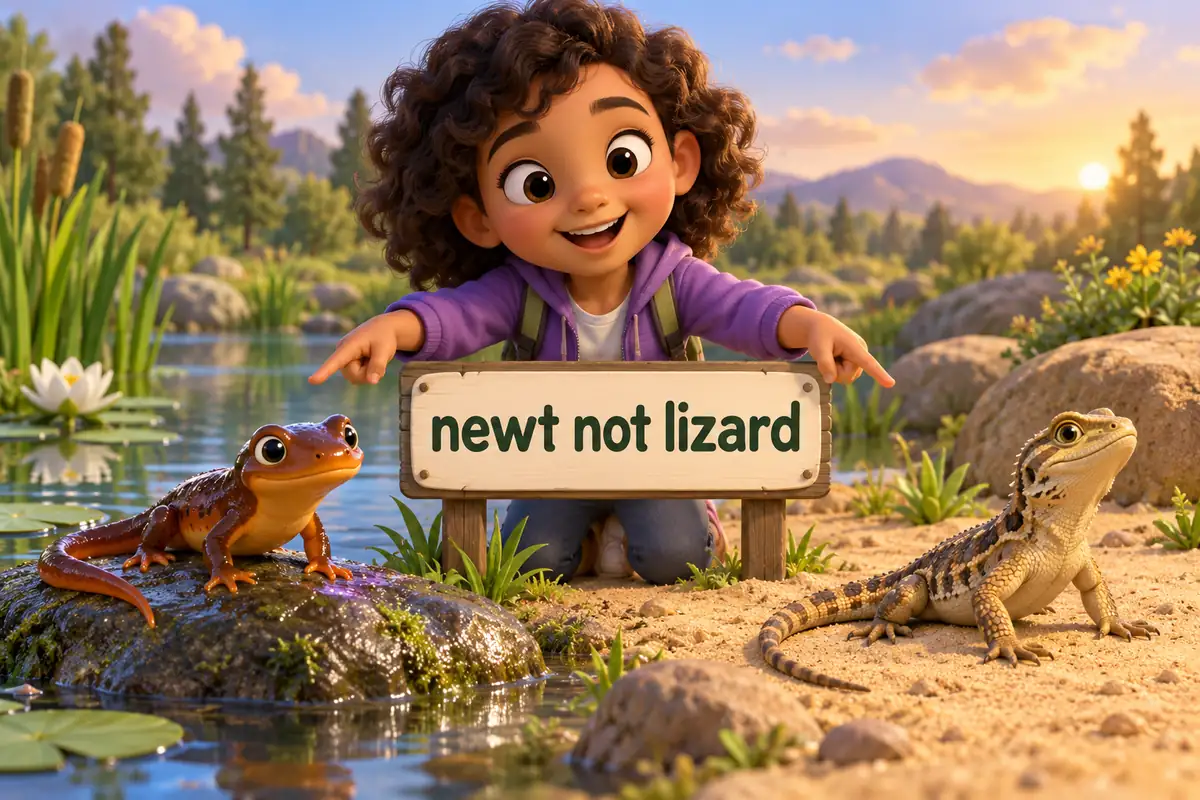
Mistake 2: newt called a lizard. Incorrect: The newt looks like a small Correct: The newt looks like a small salamander. Rule: a newt is a tailed amphibian, not a reptile.snake.
Mistake 3: missing plural on a general statement. Incorrect: All Correct: All amphibians need water to breed. Rule: all takes a plural noun.amphibian need water to breed.
Mistake 4: article before a plural. Incorrect: The Correct: The frog is an amphibian. Rule: a singular noun needs a singular verb.frogs is an amphibian.
Mistake 5: wrong irregular plural. Incorrect: Two Correct: Two axolotls keep changing shape. Rule: axolotl forms its plural in the regular way, so the sentence is fine when the verb agrees.axolotls keep changing shape.
Practice using amphibian names
- Fill in the blank: A ___ begins life as a tadpole in the water.
- Choose the better word: A salamander is an (amphibian / insect).
- Correct the error: All amphibian need damp skin.
- Build a sentence: use tree frog to describe an animal on a wet leaf.
- Spot the register: which suits a field guide, (a) That little green guy, or (b) The common tree frog has sticky toe pads?
- Fill in the blank: The ___ keeps its gills even as an adult.
Answers
- frog, because a frog is the classic amphibian with a tadpole stage.
- amphibian, because a salamander has moist skin and breeds in water.
- All amphibians need damp skin; all takes a plural noun.
- A green tree frog rested on a wet leaf after the rain.
- (b), because a field guide uses a precise, descriptive name.
- axolotl, because the axolotl is known for keeping its gills into adulthood.
The bottom line
Amphibians names in English gather into three clear groups, and the group word is the safest choice when a species is uncertain. Frogs and toads are tailless jumpers, newts and salamanders keep a tail, and caecilians have no limbs at all. Learn the group first, then the species name.
Frequently asked questions about amphibians
Is a newt the same as a lizard?
No. A newt is an amphibian with moist skin that lays eggs in water, while a lizard is a reptile with dry, scaly skin that lays eggs on land. They look alike because both have a long body and a tail, but their skin and their breeding habits clearly separate them.
How many groups of amphibians are there?
Living amphibians fall into three orders: the frogs and toads, the salamanders and newts, and the limbless caecilians. The first two are the groups most learners meet in English, while caecilians are burrowing animals that rarely appear in everyday conversation or school texts.
Why do amphibians need water?
Amphibians have thin, moist skin and lay soft eggs without shells, so both the eggs and the adults dry out without damp surroundings. Most species return to ponds and streams to breed, and many keep close to water or damp shade for their whole lives.
What is the plural of axolotl?
The plural is axolotls, following the ordinary English rule of adding s to a word ending in a consonant. The name was borrowed from the language of central Mexico, and English treats it as a regular count noun, so you can write one axolotl, two axolotls.